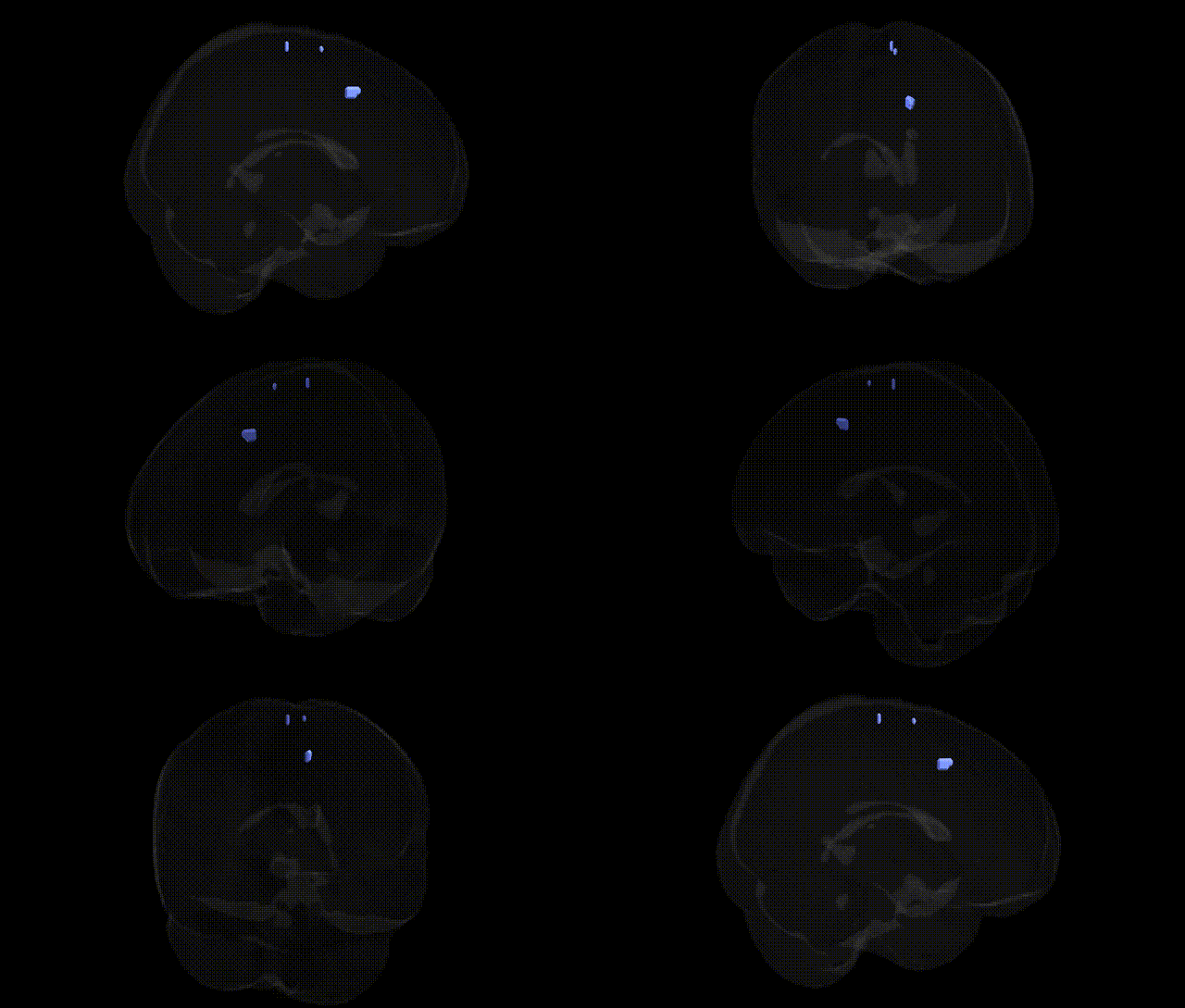
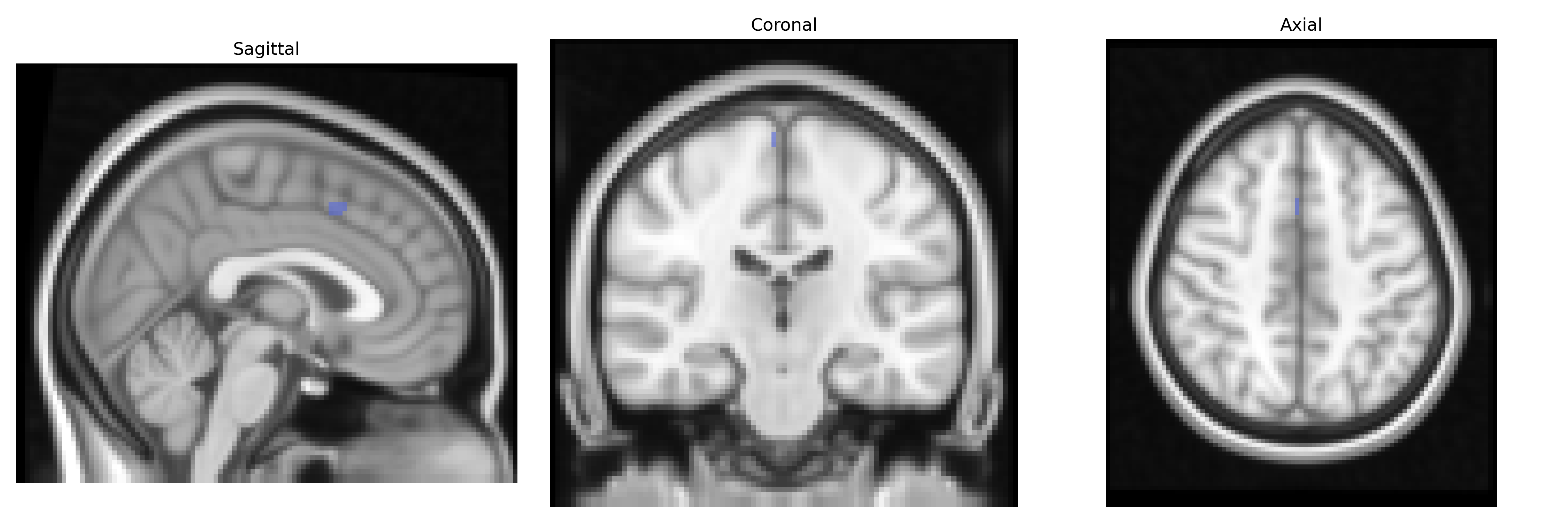
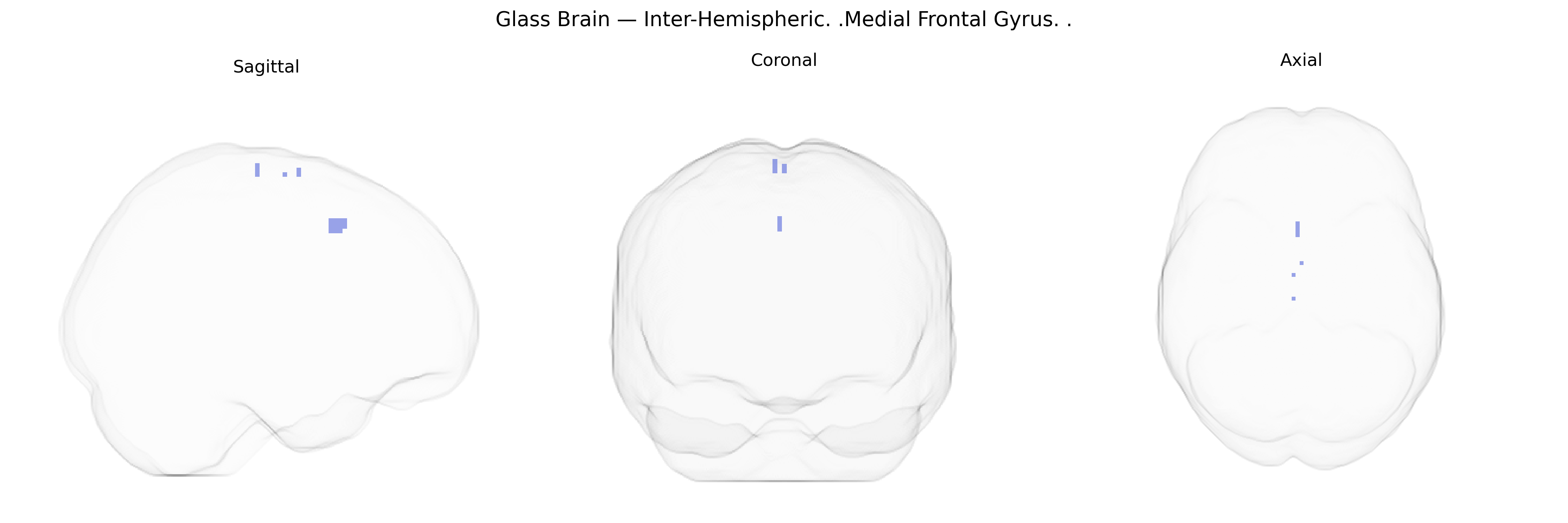
The bilateral inter-hemispheric medial frontal gyrus, as defined in the Talairach 2 mm atlas, corresponds primarily to medial portions of the superior and middle frontal regions along the interhemispheric fissure, including parts of the medial prefrontal cortex and adjacent supplementary motor areas. This region participates in high-order executive and cognitive control processes, decision-making, error monitoring, and aspects of social cognition, as well as contributing to motor planning and initiation. Cytoarchitectonically, it spans territories associated with Brodmann areas commonly classified as medial aspects of BA 8, 9, 10, and 32, depending on the exact rostro-caudal position, and is interconnected with limbic, cingulate, and lateral prefrontal networks that support goal-directed behavior and regulation of action. There is no direct Wikipedia article for the “medial frontal gyrus” as a standalone entry; a related and encompassing structure is the Frontal lobe.
The bilateral inter-hemispheric medial frontal gyrus (encompassing medial prefrontal and anterior cingulate territories in the Talairach 2 mm atlas) emerges repeatedly in imaging genetics and GWAS of brain structure and function, though usually under broader labels such as “medial prefrontal cortex” or “frontal pole.” Large-scale brain MRI GWAS (e.g., ENIGMA and UK Biobank) have shown that cortical thickness and surface area in medial frontal regions are heritable and associated with common variants in genes implicated in neurodevelopment and synaptic function (such as variants near HMGA2, CENPW, and multiple loci in Wnt and cell-adhesion pathways), many of which also influence total intracranial volume and general cognitive abilities. Functional activation and connectivity of the medial frontal gyrus in tasks involving cognitive control, decision-making, and social cognition have been linked to dopaminergic and serotonergic gene variants, including COMT Val158Met, DRD2/ANKK1, and 5-HTTLPR, as well as polygenic scores for schizophrenia, depression, and ADHD, which alter medial prefrontal activity and default-mode network coupling. Structural and functional measures in this region have been associated with risk genotypes for major depressive disorder, bipolar disorder, schizophrenia, and autism spectrum disorder, often reflecting reduced cortical thickness or altered resting-state connectivity; these links are typically mediated by large polygenic burdens rather than single variants. GWAS of behavioral traits—such as neuroticism, educational attainment, and risk-taking—identify loci whose imaging follow-up studies show correlated differences in medial frontal morphology and activation, suggesting that genetic influences on these traits are partly expressed through this region’s development and function, although highly localized, atlas-specific genetic associations for the bilateral inter-hemispheric medial frontal gyrus remain limited and are usually inferred from broader medial prefrontal or frontal cortical GWAS findings.
Overview generated by GPT-4o (2026).
Region ID: 1059
Hemisphere: bilateral
Atlas: Talairach labels 2mm
Full Quality Version: Download MP4
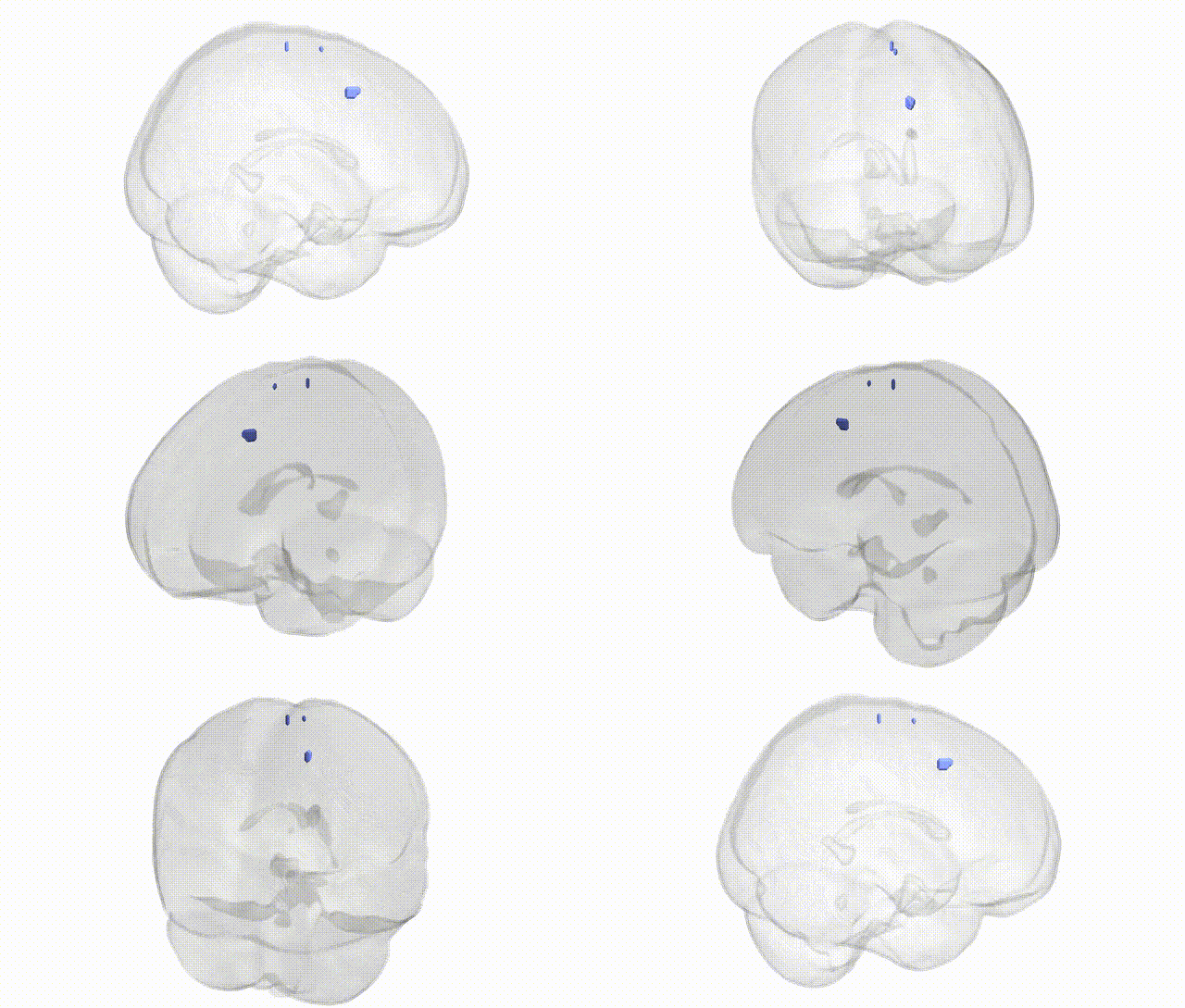
Full Quality Version: Download MP4
Wali Sidiqyar*, Gaurav Rudravaram*, Elyssa M. McMaster, Trent M. Schwartz, Adam M. Saunders, Kurt G. Schilling, Bennett A. Landman "Introducing SPINS: A Shared Public Visualization Library of Neuroanatomical Structures." Medical Imaging with Deep Learning- short paper
This resource is licensed under CC0 1.0 Universal (Public Domain).