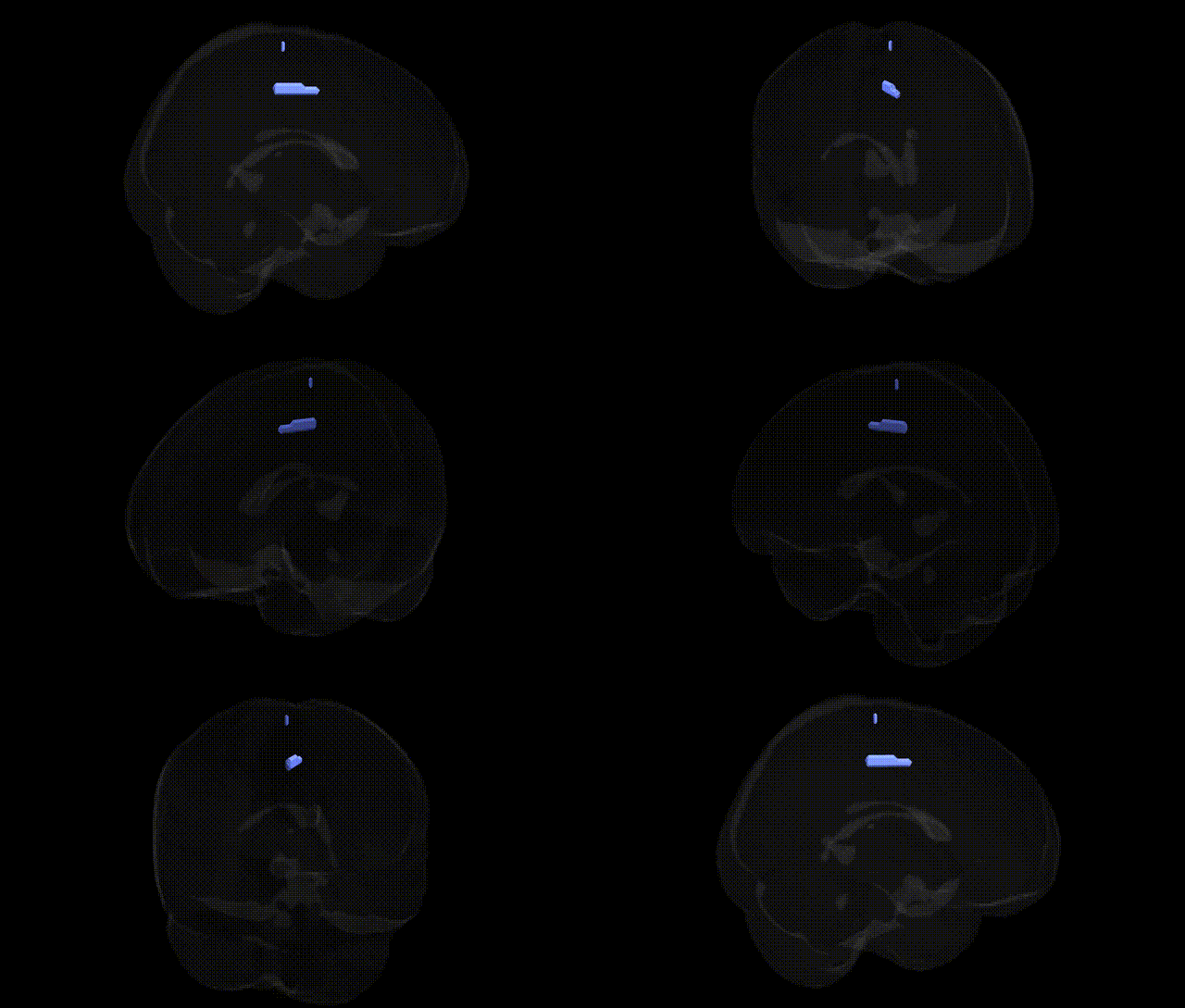
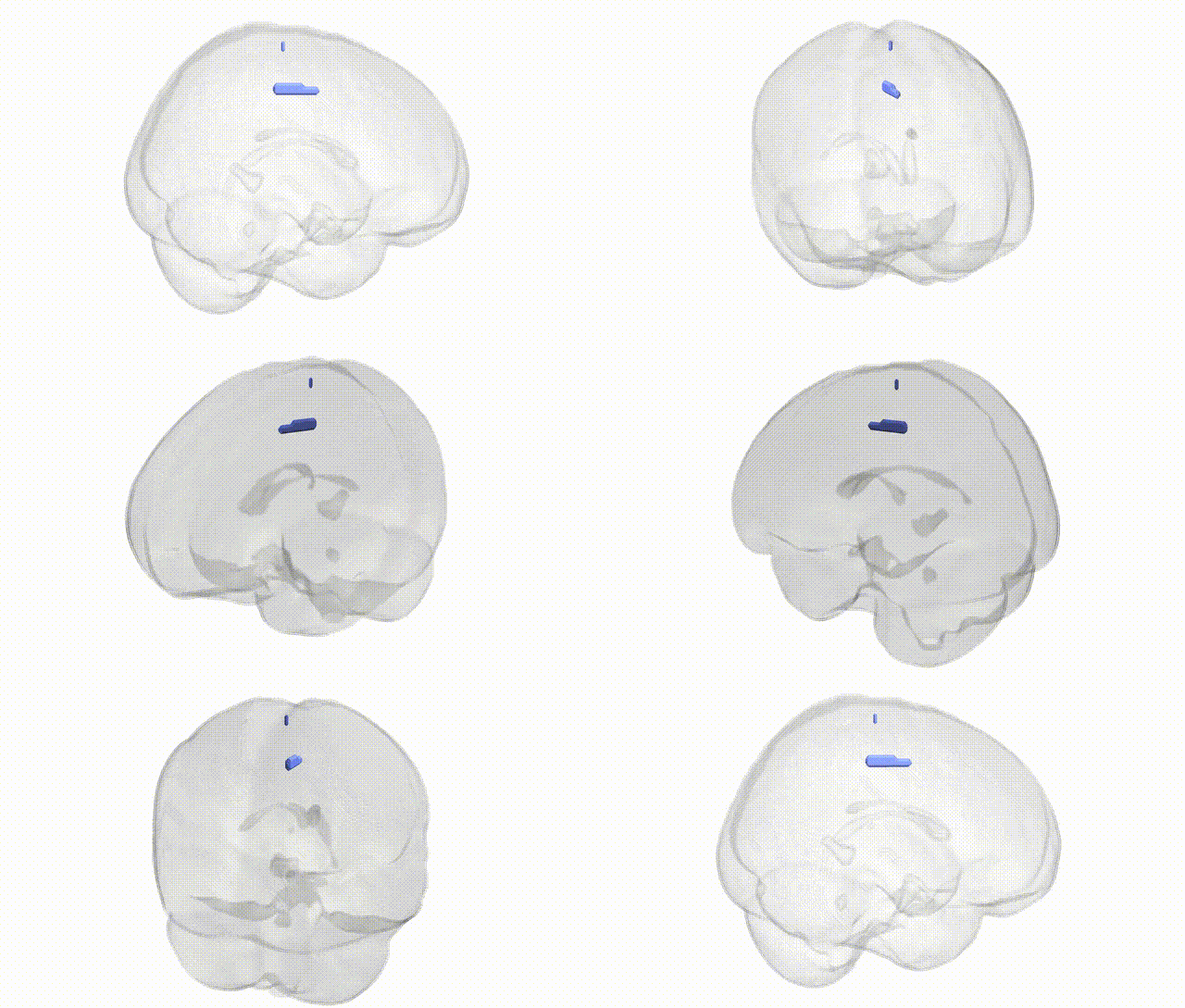
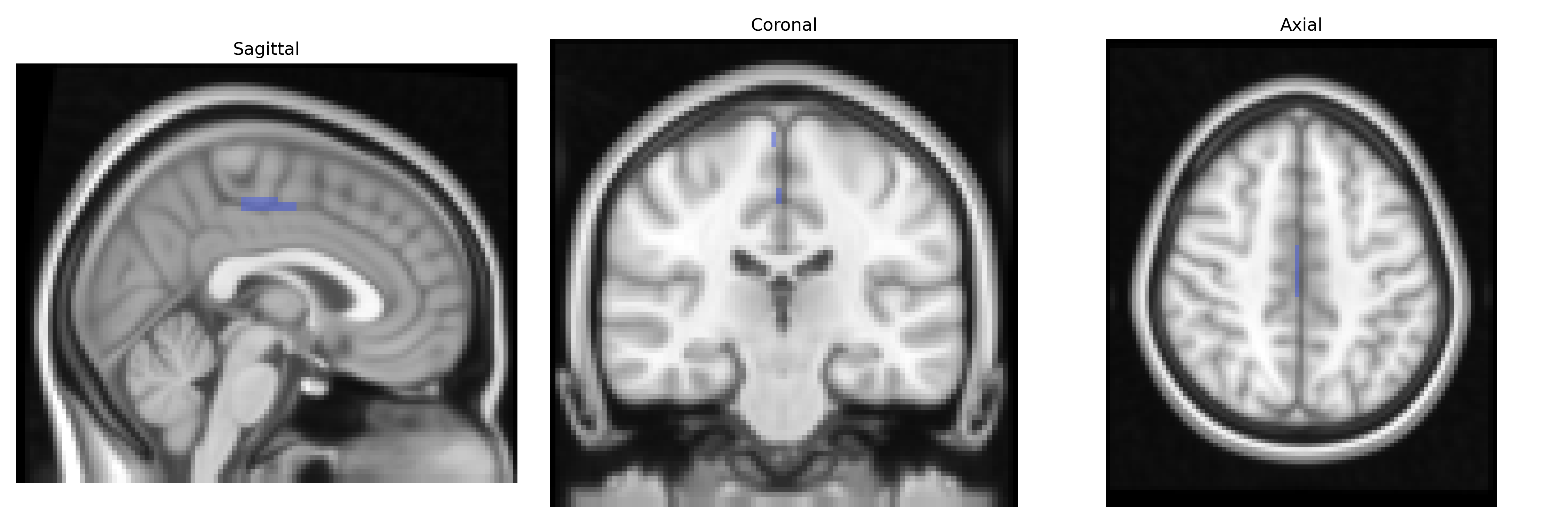
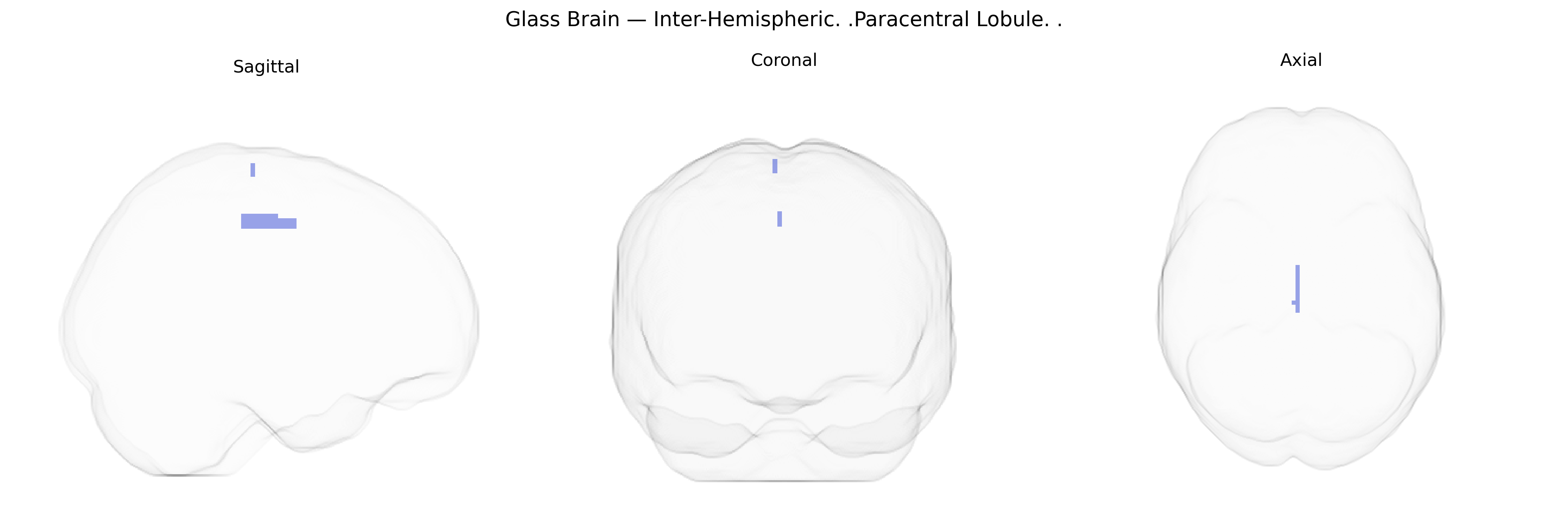
The bilateral Inter-Hemispheric Paracentral Lobule is a medial cortical region located on the superomedial surface of the cerebral hemispheres, spanning portions of the frontal and parietal lobes along the longitudinal fissure. In the Talairach 2 mm Atlas, this area lies adjacent to the midline and encompasses parts of the primary motor and primary somatosensory cortices responsible for sensorimotor representation of the lower extremities, including leg and foot movements and corresponding somatic sensations. Functionally, the paracentral lobule contributes to voluntary motor control, proprioception, and tactile processing of the contralateral lower limb, and is interconnected with supplementary motor and premotor areas as well as subcortical motor circuits. There is no direct link for the Talairach “Inter-Hemispheric Paracentral Lobule” label; a closely related structure is the Paracentral lobule.
The bilateral inter-hemispheric paracentral lobule, encompassing primary motor and somatosensory representations of the lower limbs, has been implicated in genetic studies largely through its involvement in motor, sensory, and pain-related traits and disorders rather than direct region-specific GWAS hits. Variants in genes influencing cortical structure and thickness (e.g., polygenic architectures involving neurodevelopmental genes such as those related to synaptic formation and neuronal migration) have been associated with morphological differences in medial sensorimotor areas that include the paracentral lobule in large neuroimaging GWAS, though these findings typically report broader “sensorimotor cortex” measures rather than Talairach-defined subregions. GWAS of chronic pain, migraine, and neuropathic pain have repeatedly implicated genetic pathways for synaptic plasticity, neuroinflammation, and ion channel function that correspond to altered activation and connectivity in the paracentral lobule seen in imaging studies, linking this region indirectly to pain-related genetic risk. Similarly, disorders with motor system involvement—such as multiple sclerosis, hereditary spastic paraplegia, and amyotrophic lateral sclerosis—show disease-associated variants in immune, myelin, and axonal maintenance genes whose clinical expression includes structural and functional changes in medial motor cortex including the paracentral lobule. In cognition and behavior, polygenic scores for general intelligence, educational attainment, and physical activity have been associated with global sensorimotor and medial frontal cortical measures in imaging-genetics cohorts, with the paracentral lobule often part of the implicated networks, though not singled out with locus-specific genetic effects. Overall, current genetic evidence ties the paracentral lobule to broader sensorimotor and pain networks and neurodegenerative or demyelinating conditions, with region-level associations emerging mainly from imaging-genetics studies of cortical morphology and function rather than from GWAS explicitly targeting the Talairach paracentral lobule label.
Overview generated by GPT-4o (2026).
Region ID: 1047
Hemisphere: bilateral
Atlas: Talairach labels 2mm
Full Quality Version: Download MP4
Full Quality Version: Download MP4
Wali Sidiqyar*, Gaurav Rudravaram*, Elyssa M. McMaster, Trent M. Schwartz, Adam M. Saunders, Kurt G. Schilling, Bennett A. Landman "Introducing SPINS: A Shared Public Visualization Library of Neuroanatomical Structures." Medical Imaging with Deep Learning- short paper
This resource is licensed under CC0 1.0 Universal (Public Domain).