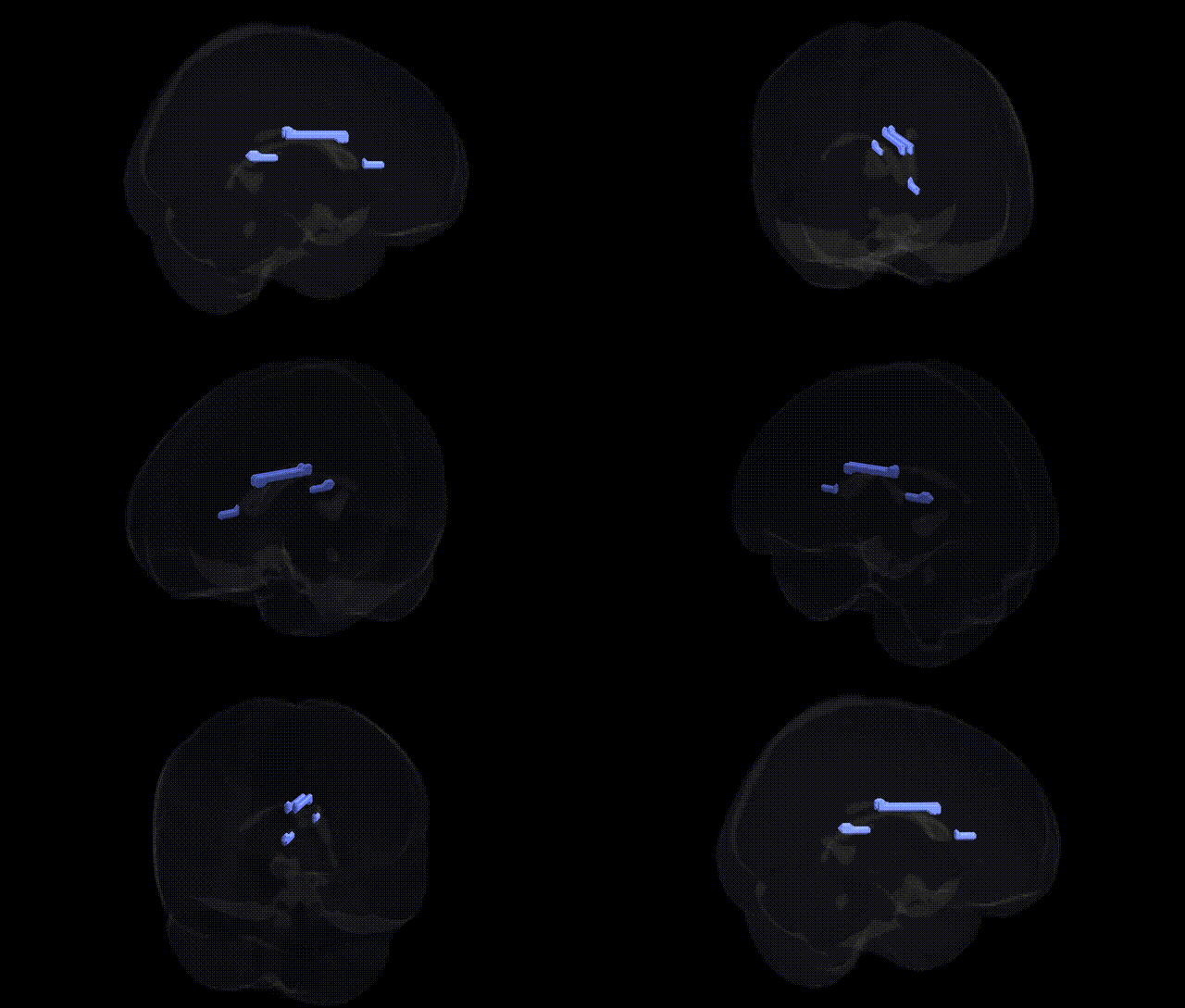
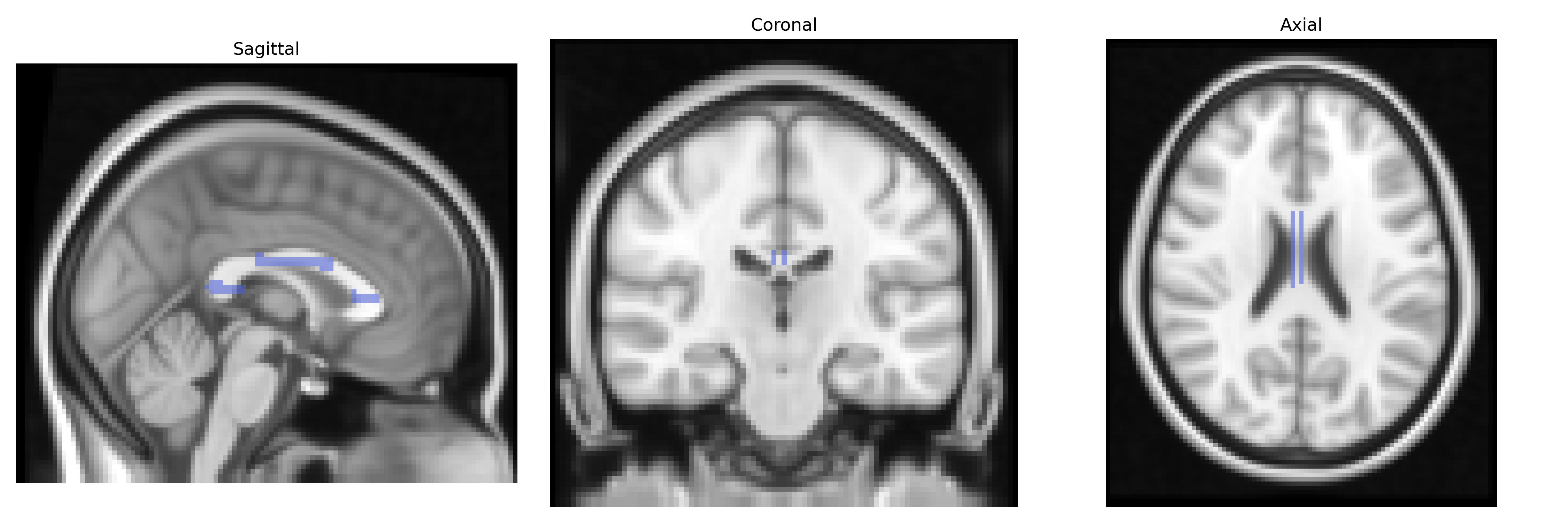
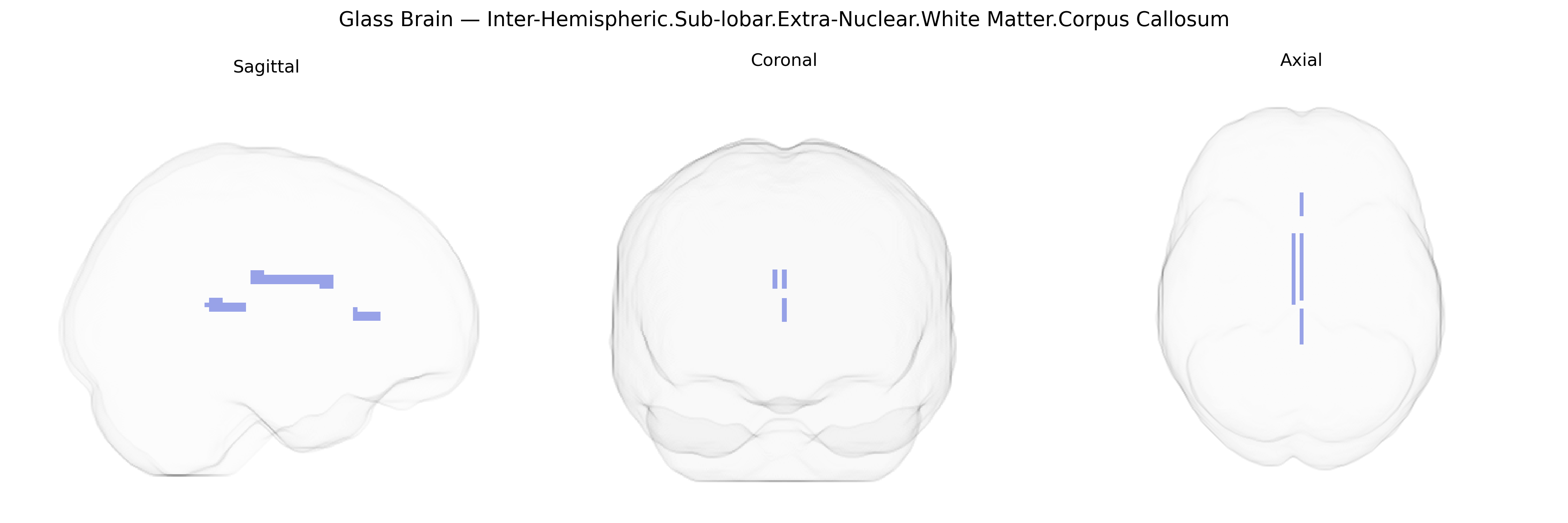
The bilateral Inter-Hemispheric.Sub-lobar.Extra-Nuclear.White Matter.Corpus Callosum, as defined in the Talairach 2 mm Atlas, corresponds to the main interhemispheric commissural white matter tract linking homologous cortical regions of the left and right cerebral hemispheres. Composed predominantly of myelinated axons, the corpus callosum enables rapid transcallosal communication, supporting integration of sensory information, coordination of motor activities, and higher-order cognitive processes such as language, attention, and memory. Sub-lobar and extra-nuclear designations reflect its position deep to the cortex and outside basal nuclear structures, while its classification as white matter emphasizes its role in long-range signal conduction rather than local processing. Damage or developmental abnormalities in this region can lead to disconnection syndromes and a range of neurocognitive and neuropsychiatric manifestations. Corpus callosum
The corpus callosum, the principal interhemispheric white matter tract corresponding to the Talairach “Inter-Hemispheric.Sub-lobar.Extra-Nuclear.White Matter.Corpus Callosum” region, shows robust genetic influences on its volume, microstructure (e.g., fractional anisotropy, mean diffusivity), and shape, with twin and family studies estimating heritability commonly in the 0.7–0.9 range. Large imaging-genetics GWAS (e.g., ENIGMA, UK Biobank) have identified multiple loci associated with corpus callosum measures, including variants near genes involved in axon guidance, myelination, and neuronal development such as CNTNAP2, NTRK1/2, CADM1, and myelin-related genes (e.g., MAG, MBP in broader white-matter analyses), although specific loci and effect sizes vary by study and callosal subregion. Genetic variants linked to neurodevelopmental and psychiatric disorders often show callosal correlates: common and rare variants in genes such as DISC1, NRG1, and CNTNAP2 have been associated with altered callosal structure in schizophrenia and autism spectrum conditions; ADHD and bipolar disorder GWAS polygenic risk scores correlate with callosal microstructural differences; and callosal abnormalities are reported in carriers of copy number variants like 22q11.2 and 1q21.1 deletions. Callosal measures are also genetically correlated with cognitive traits (IQ, processing speed, educational attainment), motor coordination, and, in some studies, risk for depression and anxiety, consistent with the role of this structure in interhemispheric integration. While no single “corpus callosum gene” has emerged, convergent evidence from GWAS, candidate-gene studies, and polygenic risk analyses indicates that complex, polygenic architectures influencing neurodevelopment, axon guidance, and myelination contribute to individual differences and disorder-related changes in this interhemispheric white matter region.
Overview generated by GPT-4o (2026).
Region ID: 651
Hemisphere: bilateral
Atlas: Talairach labels 2mm
Full Quality Version: Download MP4
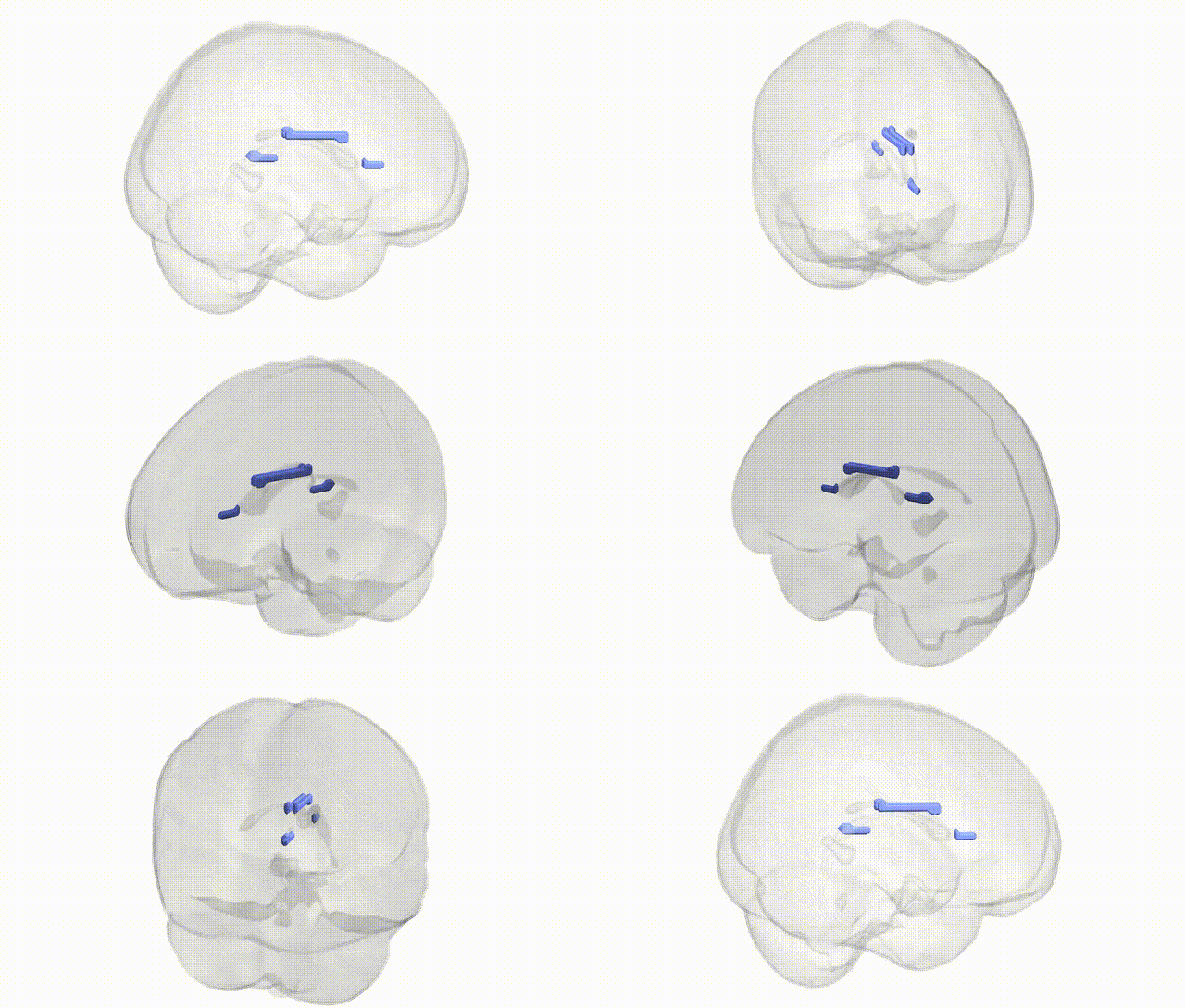
Full Quality Version: Download MP4
Wali Sidiqyar*, Gaurav Rudravaram*, Elyssa M. McMaster, Trent M. Schwartz, Adam M. Saunders, Kurt G. Schilling, Bennett A. Landman "Introducing SPINS: A Shared Public Visualization Library of Neuroanatomical Structures." Medical Imaging with Deep Learning- short paper
This resource is licensed under CC0 1.0 Universal (Public Domain).