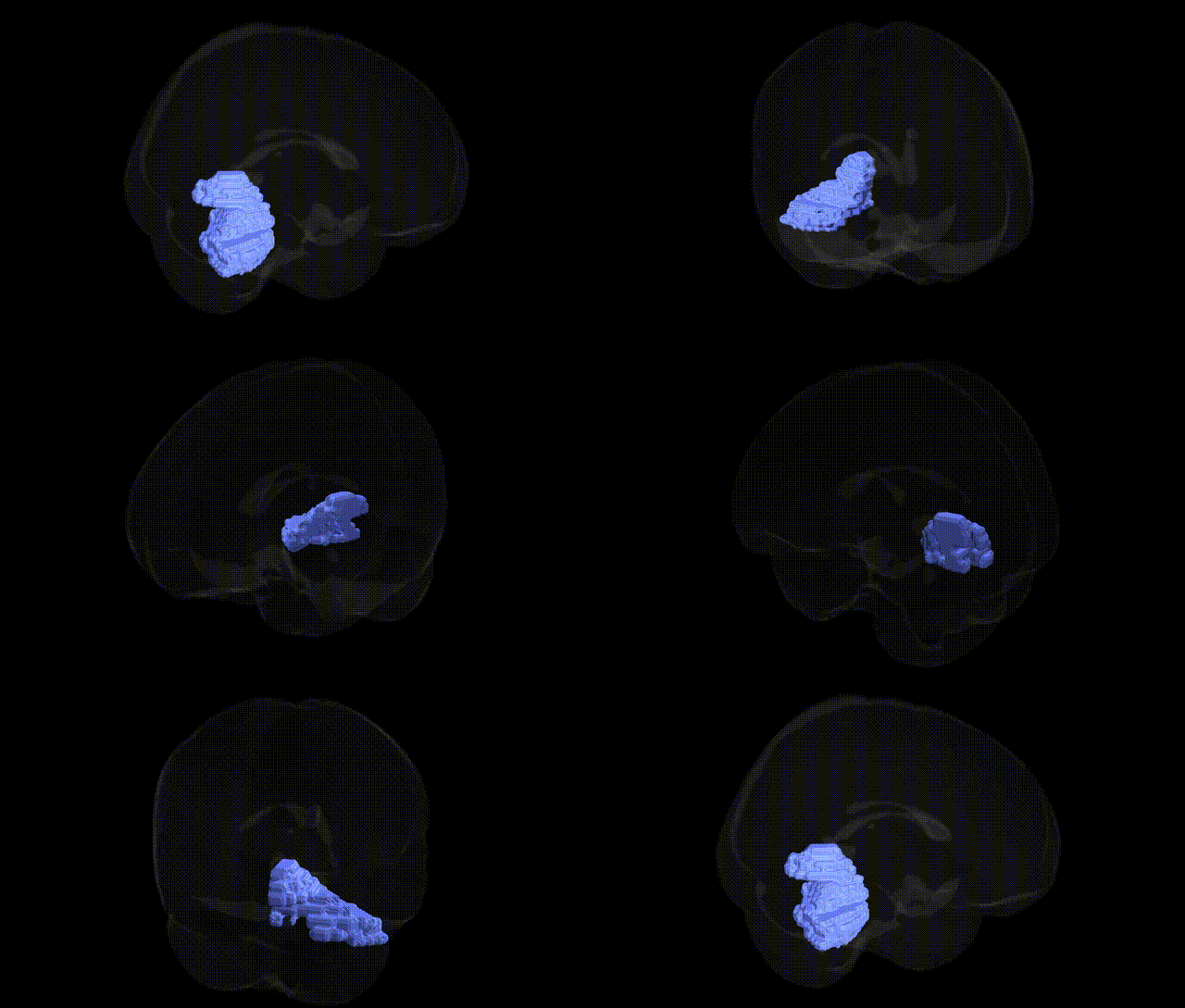
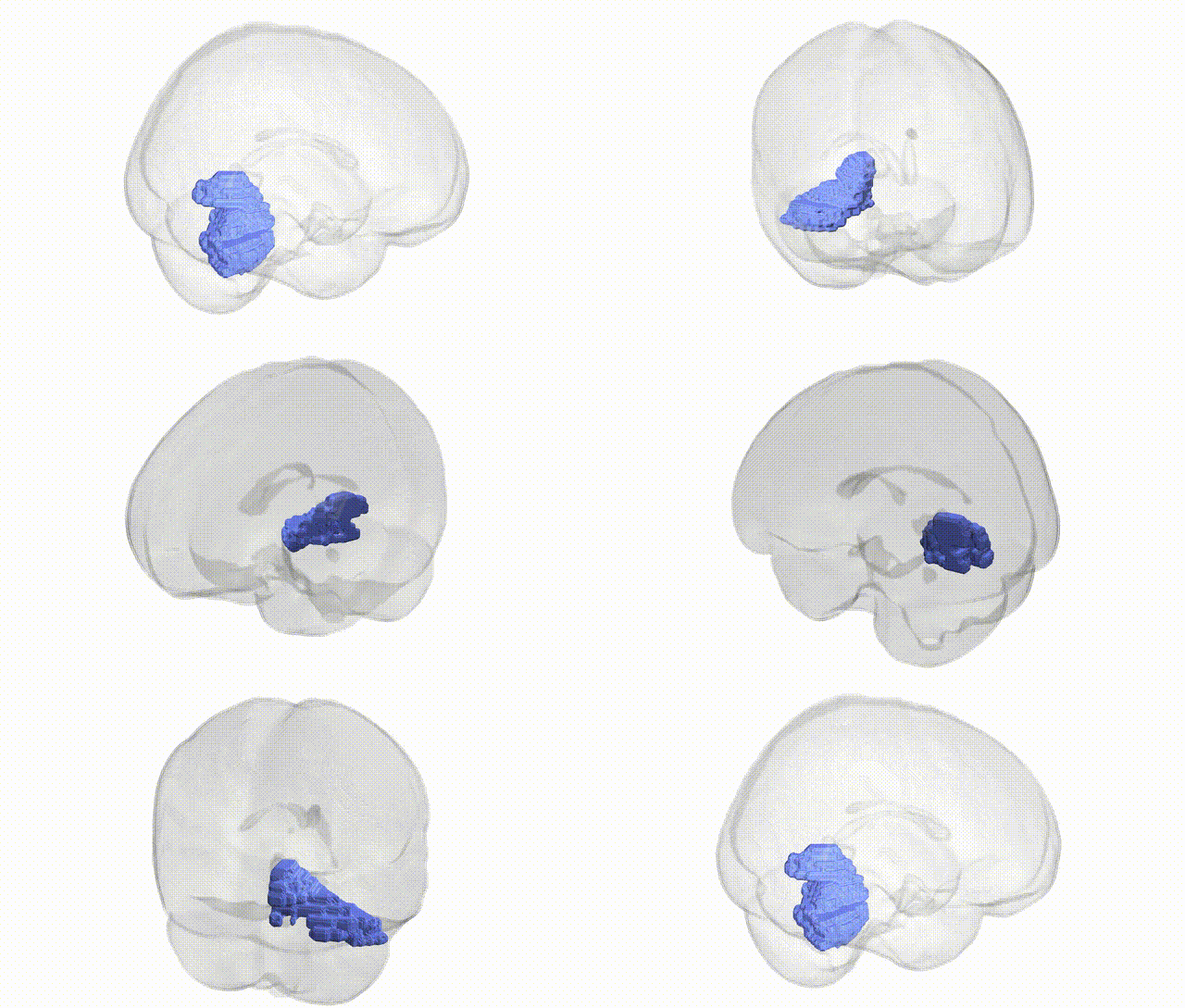
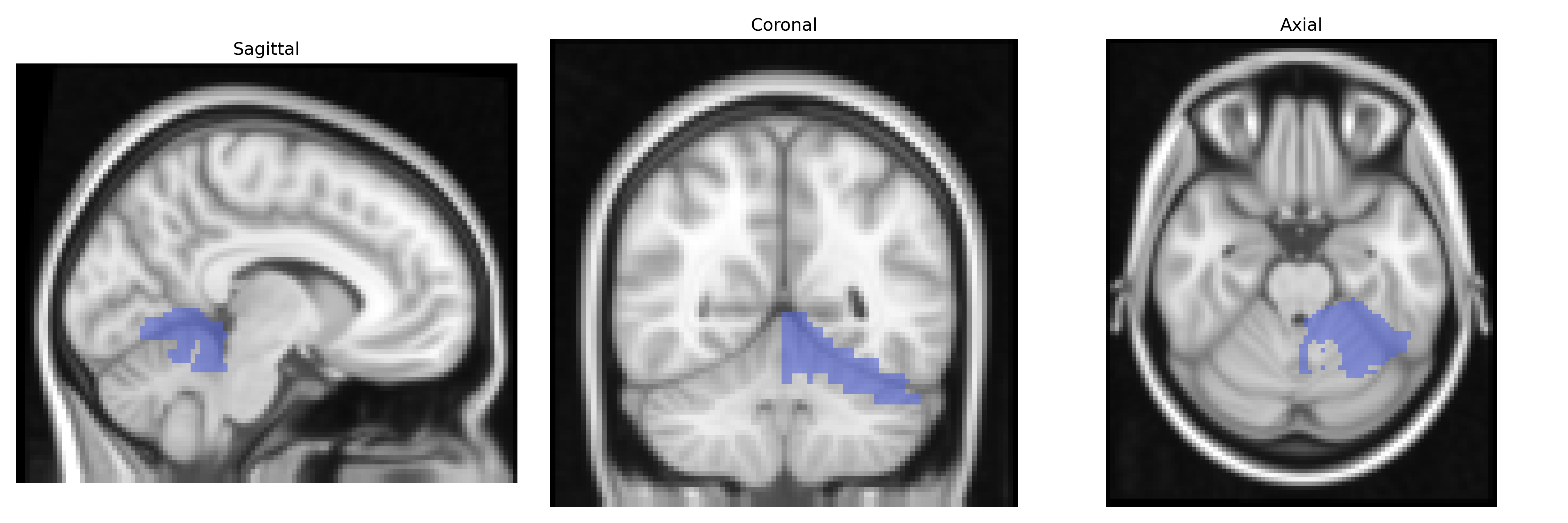
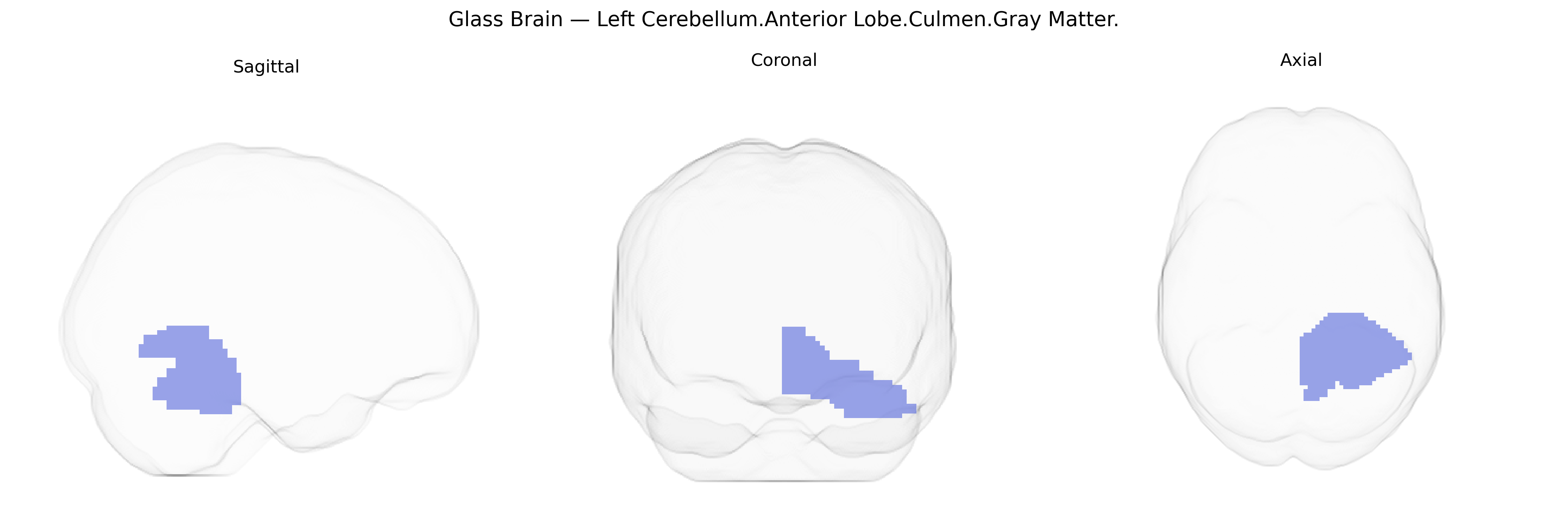
The bilateral Left Cerebellum.Anterior Lobe.Culmen.Gray Matter, as defined in the Talairach 2 mm atlas, refers to gray matter within the culmen, a lobular portion of the anterior lobe of the cerebellum located superiorly on the cerebellar vermis and extending laterally into the hemispheres. This region contributes to the cerebellum’s core roles in motor coordination, postural control, and fine-tuning of ongoing movements, integrating somatosensory and proprioceptive inputs to adjust motor output via cerebellar-cortical and cerebellar-brainstem circuits. Functionally, the anterior lobe (including the culmen) is particularly associated with regulation of limb movements and gait, and damage here can lead to ataxia, dysmetria, and disturbances in stance and walking. There is no direct link for “culmen (cerebellum)” in Wikipedia; a closely related and encompassing structure is the Cerebellum.
The bilateral Left Cerebellum.Anterior Lobe.Culmen.Gray Matter region, as defined in the Talairach labels 2mm atlas, lies within the anterior cerebellar cortex, a territory repeatedly implicated in large-scale imaging genetics and GWAS of brain structure and function. Genome-wide studies of cerebellar volume and cortical thickness have identified polygenic influences from loci near genes involved in neurodevelopment, synaptic plasticity, and axonal guidance (e.g., variants in or near KIAA0319, DLG2, and CADM2 have been linked to cerebellar morphology or related motor–cognitive endophenotypes), though most signals affect global or lobule-level metrics rather than this specific culmen parcel. Imaging genetics consortia such as ENIGMA and UK Biobank have reported associations between common variants and total or regional cerebellar gray matter, with downstream links to neurodevelopmental and psychiatric conditions, including schizophrenia, major depression, autism spectrum disorder, and ADHD, where altered anterior cerebellar structure and connectivity have been observed. GWAS of motor coordination, balance, and cognitive measures (working memory, processing speed) also implicate cerebellar circuitry, suggesting that genetic variation influencing these traits partly acts through anterior lobe and culmen morphology and function. However, no robust, widely replicated variant has yet been tied uniquely and specifically to the Left Cerebellum.Anterior Lobe.Culmen.Gray Matter label; current evidence supports a highly polygenic architecture where many small-effect variants contribute to cerebellar gray matter characteristics and related clinical and behavioral phenotypes.
Overview generated by GPT-4o (2026).
Region ID: 88
Hemisphere: bilateral
Atlas: Talairach labels 2mm
Full Quality Version: Download MP4
Full Quality Version: Download MP4
Wali Sidiqyar*, Gaurav Rudravaram*, Elyssa M. McMaster, Trent M. Schwartz, Adam M. Saunders, Kurt G. Schilling, Bennett A. Landman "Introducing SPINS: A Shared Public Visualization Library of Neuroanatomical Structures." Medical Imaging with Deep Learning- short paper
This resource is licensed under CC0 1.0 Universal (Public Domain).