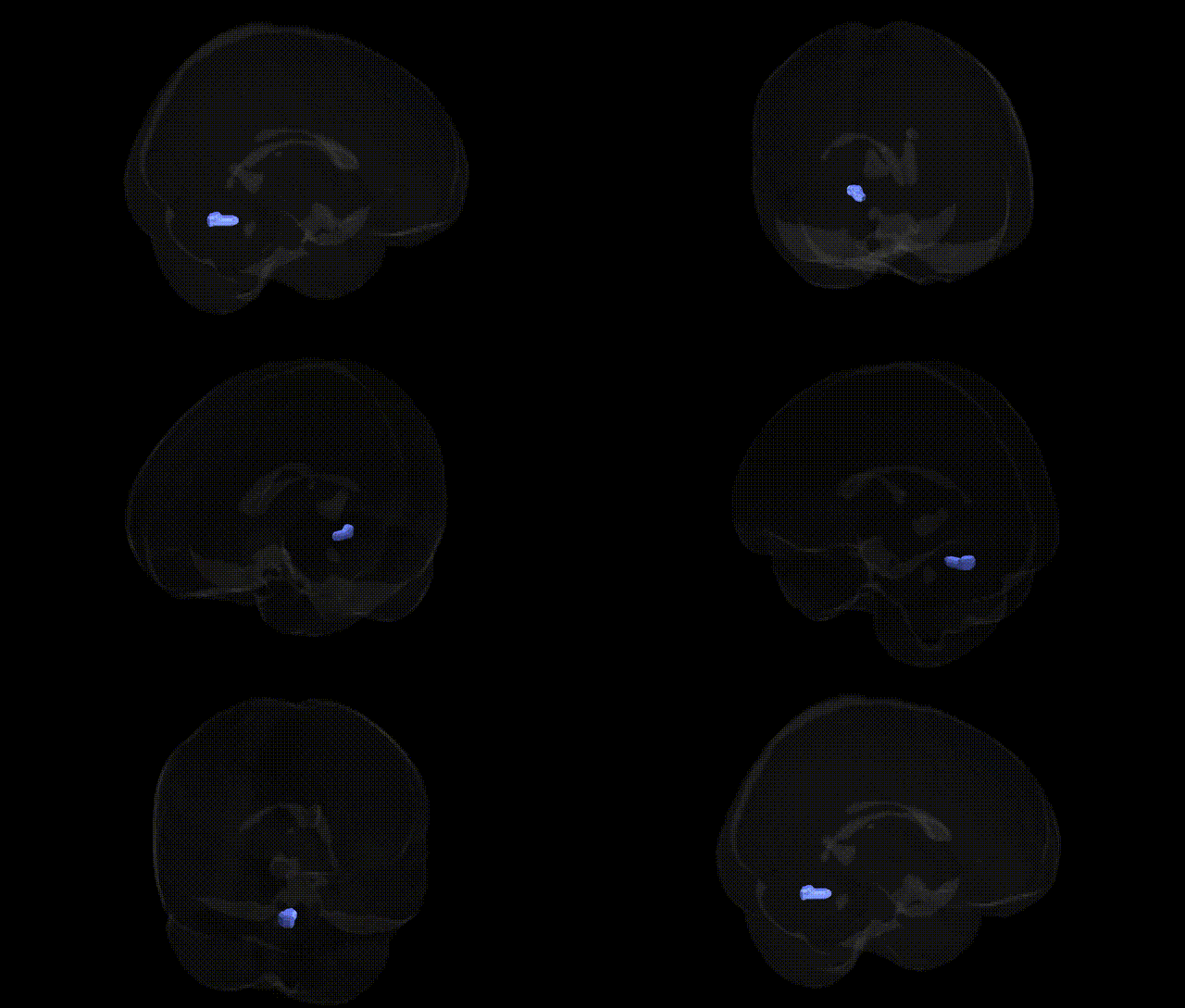
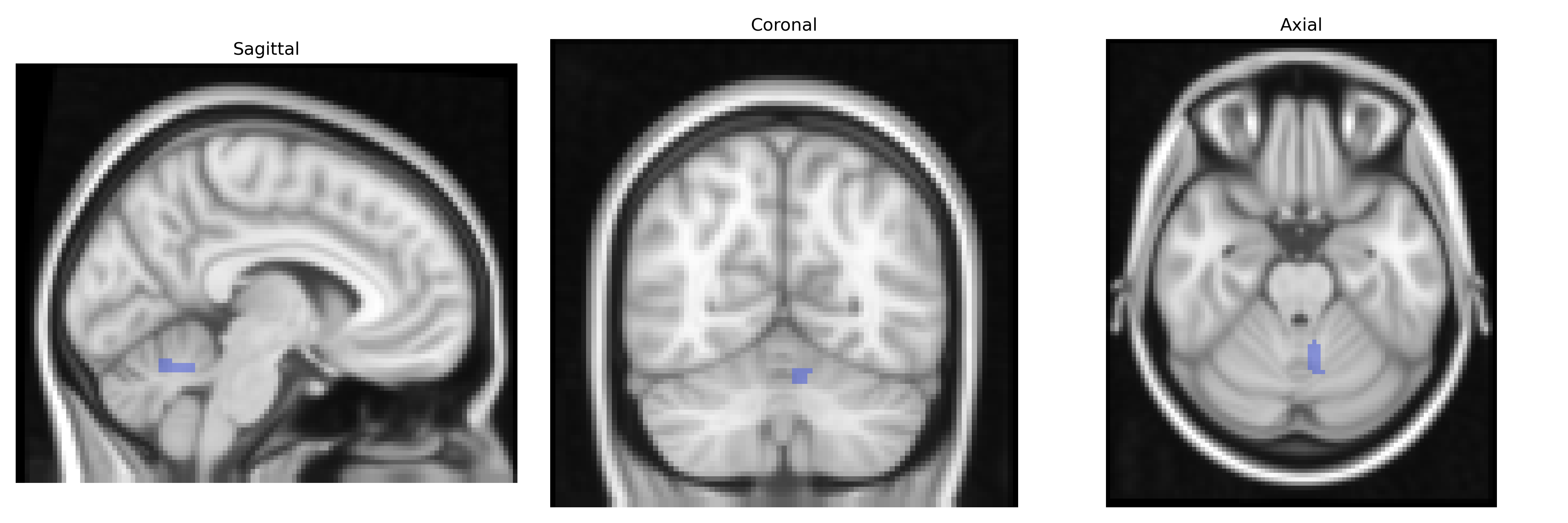
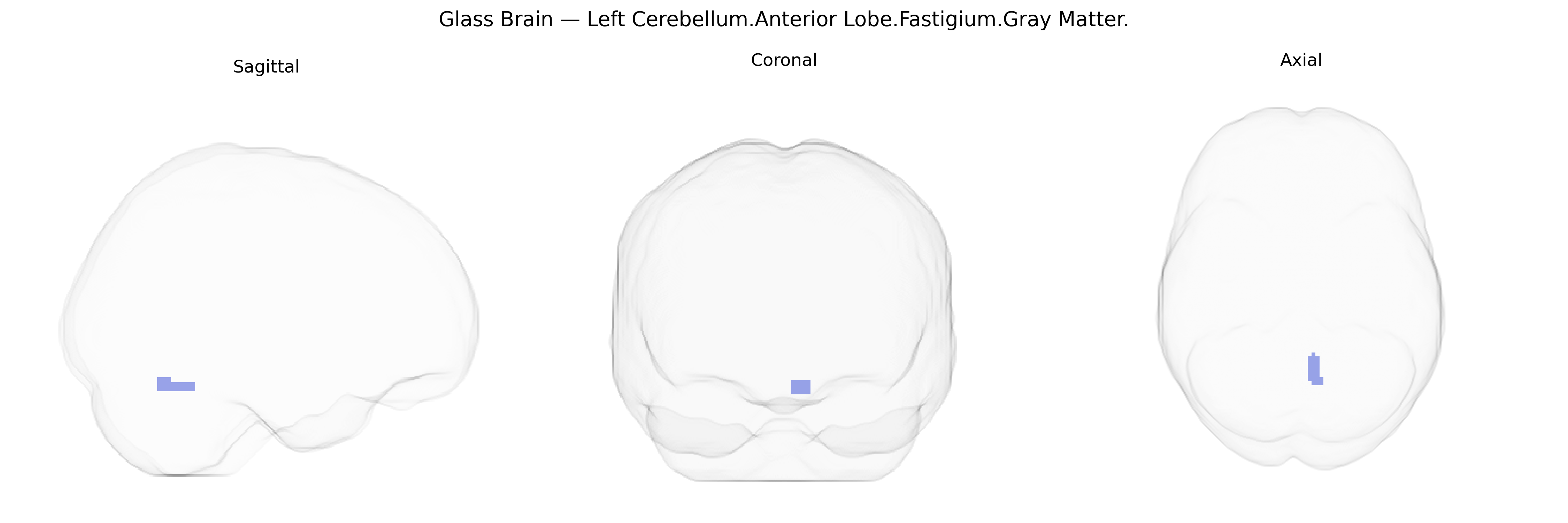
The bilateral Left Cerebellum.Anterior Lobe.Fastigium.Gray Matter corresponds to gray matter within the fastigial region of the anterior lobe of the cerebellum, a midline structure associated with the vermis and part of the vestibulocerebellum circuitry. Functionally, this area is involved in the regulation of posture, balance, and axial (trunk and proximal limb) motor control, integrating vestibular, proprioceptive, and somatosensory inputs to modulate muscle tone and equilibrium. Neurons in this region contribute to coordination of gait and stance by influencing brainstem motor pathways, including vestibular nuclei and reticular formation, and participate in fine-tuning of eye movements and head position. Lesions affecting this fastigial/vermal anterior lobe territory can lead to truncal ataxia, gait instability, and impaired postural reflexes. There is no direct Wikipedia article for the fastigium; a closely related structure is the cerebellar vermis: Cerebellar Vermis.
The bilateral Left Cerebellum.Anterior Lobe.Fastigium.Gray Matter region in the Talairach 2 mm Atlas corresponds to midline anterior cerebellar gray matter around the fastigial nucleus, but current genetic neuroimaging literature rarely targets this subregion explicitly; instead, relevant evidence comes from cerebellar and anterior lobe–level analyses. Large-scale GWAS of brain structure (e.g., ENIGMA and UK Biobank–based studies) have identified common variants associated with cerebellar volume and morphology, including loci near genes involved in neurodevelopment and synaptic function such as KIAA0586 (ciliogenesis and Joubert syndrome), FOXC1 (posterior fossa/cerebellar development), and multiple regulatory regions influencing cerebellar size; however, these findings usually aggregate across lobules and nuclei rather than isolating the fastigial area. Rare, high‑penetrance variants in genes like CACNA1A, ITPR1, ATXN1/2/3/7, and others cause spinocerebellar ataxias and congenital cerebellar malformations, which often involve the anterior lobe and vermis and therefore plausibly affect fastigial gray matter, but the spatial resolution of clinical imaging generally does not permit fastigium‑specific genotype–phenotype mapping. GWAS of psychiatric and cognitive traits—schizophrenia, bipolar disorder, major depression, autism spectrum disorder, and general cognitive ability—have consistently implicated cerebellar structures in imaging-genetics mediation analyses (e.g., polygenic risk scores correlating with cerebellar volume or functional connectivity), yet these studies also treat the cerebellum as lobular or whole‑structure ROIs rather than this precise Talairach-defined region. Overall, existing genetic associations relate to broader cerebellar development, motor coordination, and neuropsychiatric liability, with no robust, replicated GWAS or candidate‑gene findings that selectively implicate the Left Cerebellum.Anterior Lobe.Fastigium.Gray Matter region as an independent locus of genetic risk or trait variation.
Overview generated by GPT-4o (2026).
Region ID: 165
Hemisphere: bilateral
Atlas: Talairach labels 2mm
Full Quality Version: Download MP4
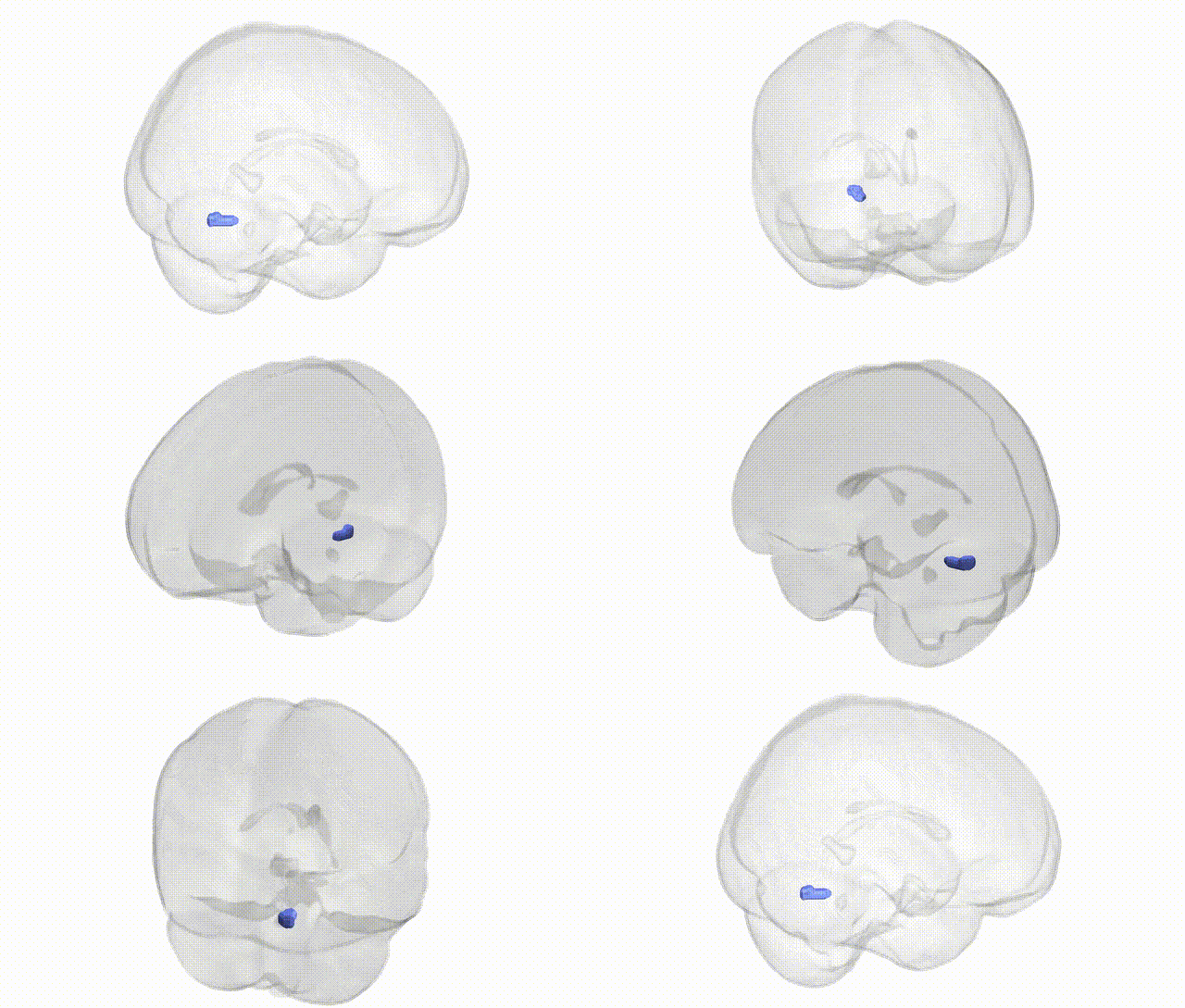
Full Quality Version: Download MP4
Wali Sidiqyar*, Gaurav Rudravaram*, Elyssa M. McMaster, Trent M. Schwartz, Adam M. Saunders, Kurt G. Schilling, Bennett A. Landman "Introducing SPINS: A Shared Public Visualization Library of Neuroanatomical Structures." Medical Imaging with Deep Learning- short paper
This resource is licensed under CC0 1.0 Universal (Public Domain).