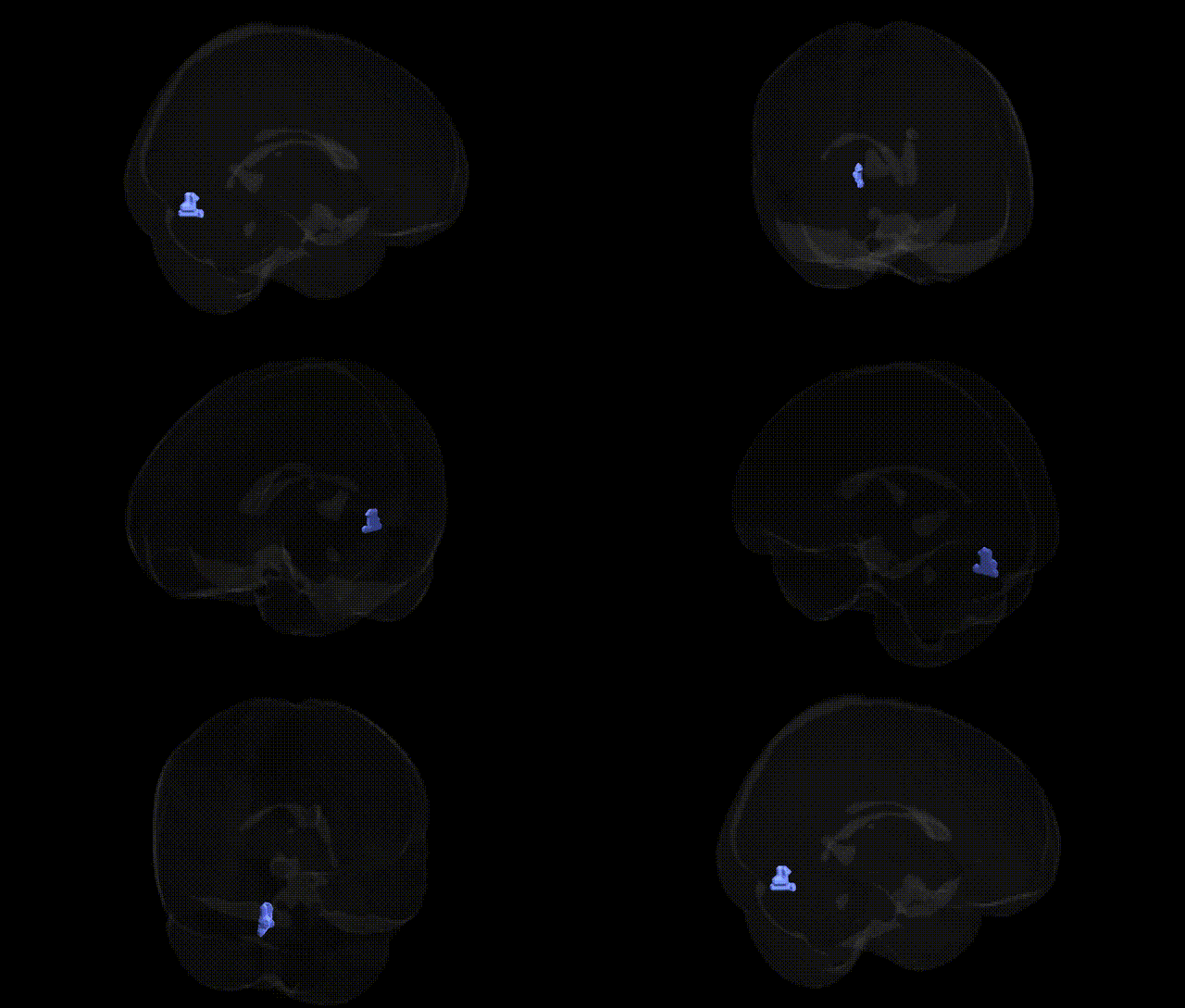
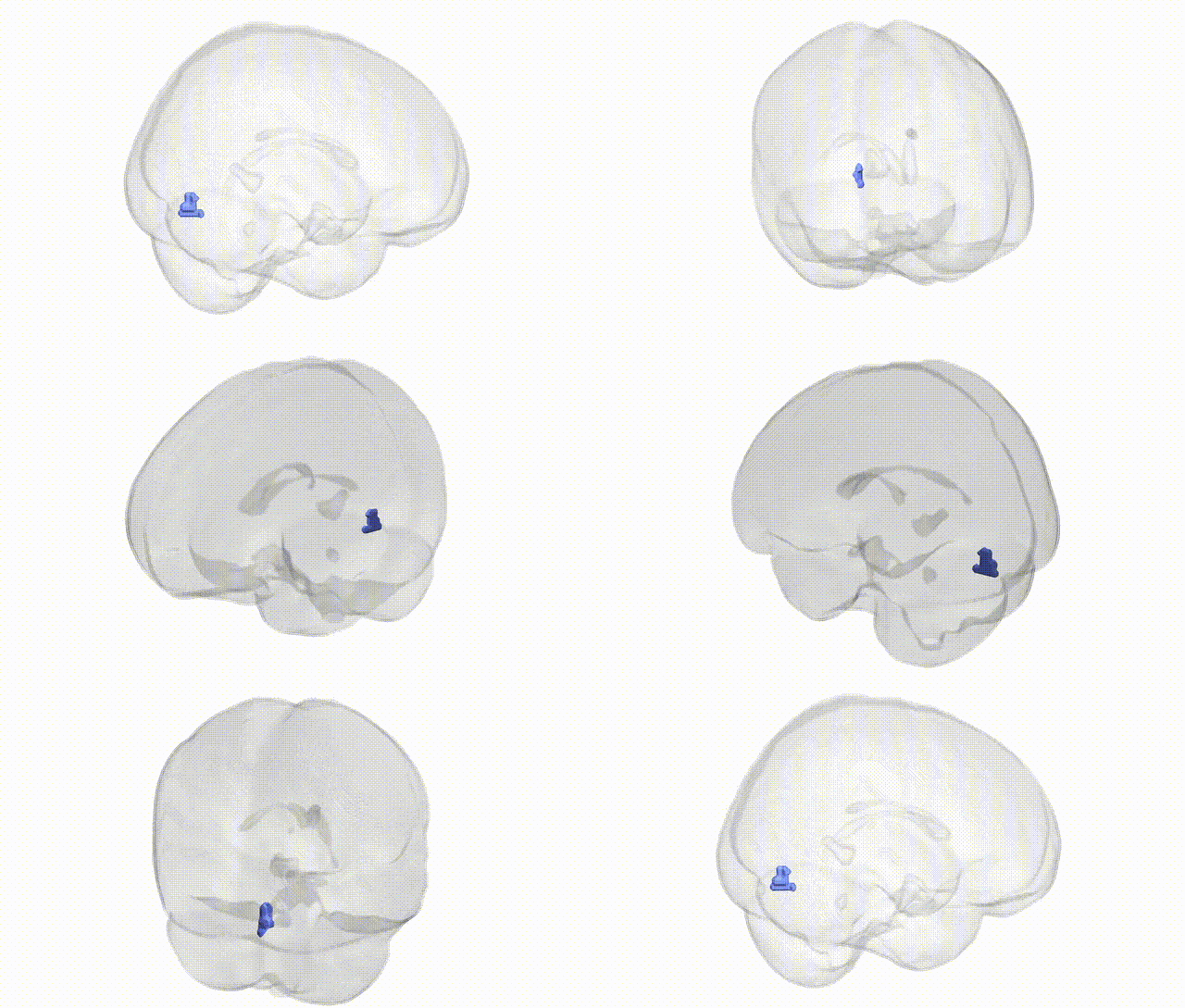
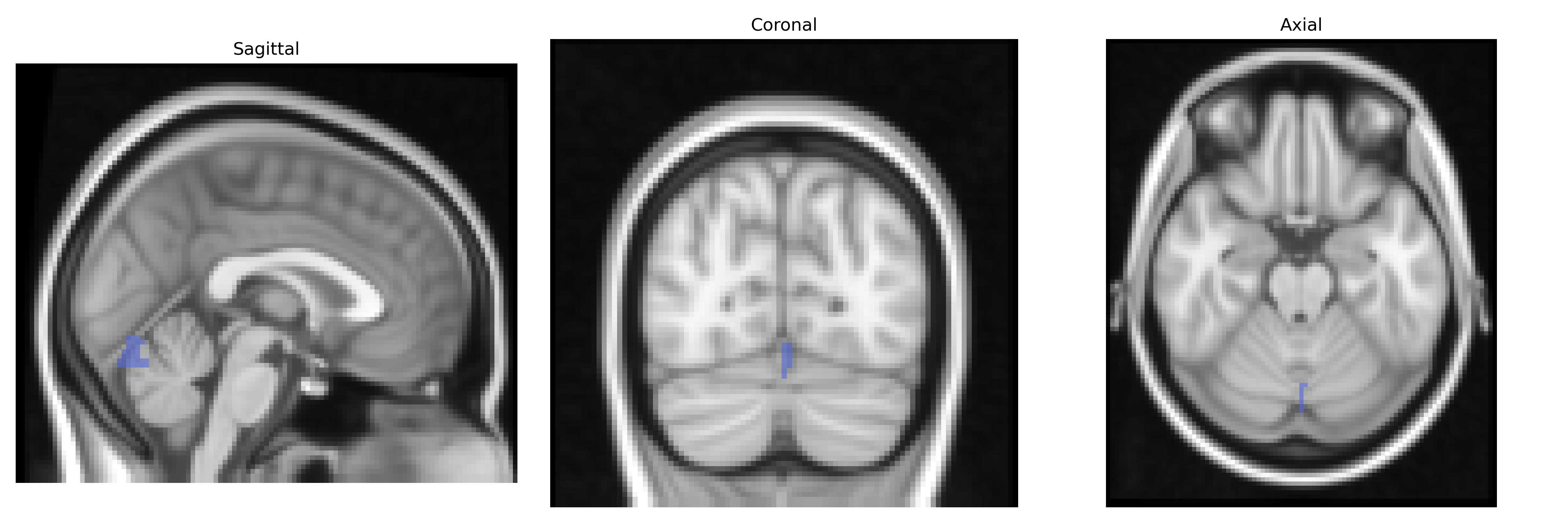
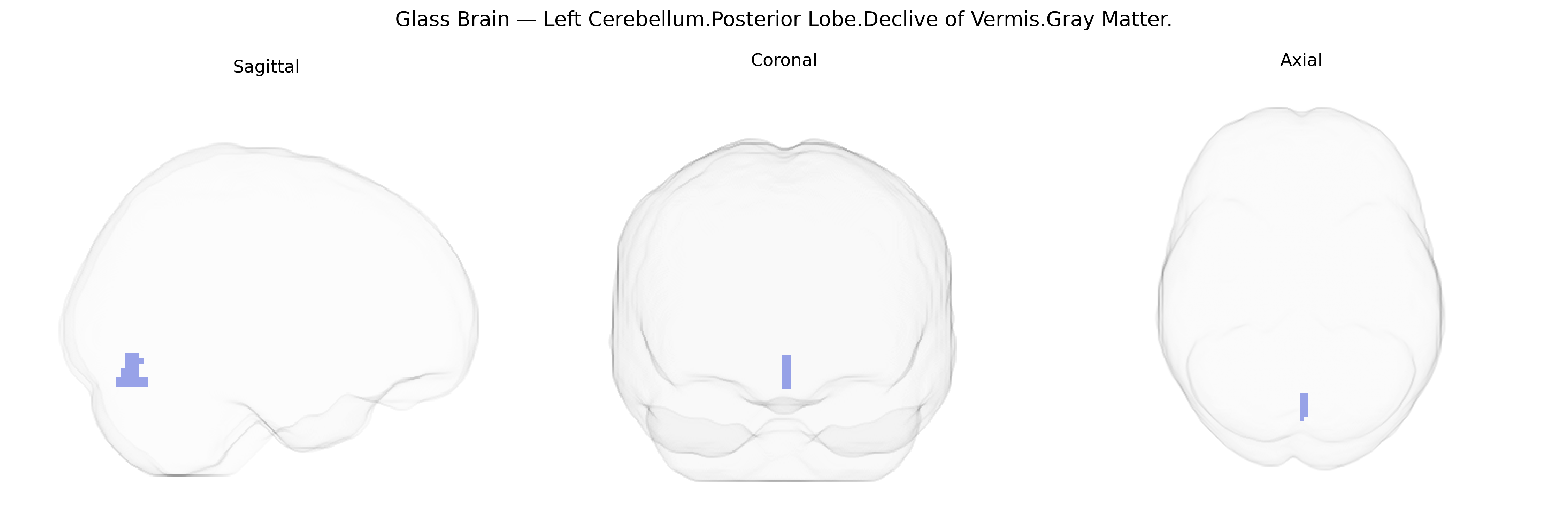
The bilateral Left Cerebellum Posterior Lobe, Declive of Vermis, Gray Matter corresponds to a midline segment of the cerebellar vermis located within the posterior lobe, composed primarily of cortical gray matter involved in coordination and fine-tuning of motor activity. The declive (also called lobule VI of the vermis) participates in the regulation of posture, balance, and smooth execution of voluntary movements, and is increasingly recognized for roles in cognitive and affective processing through its connections with cerebral association areas. As part of the cerebellar cortex, its Purkinje cells integrate diverse sensory and motor signals and project to deep cerebellar nuclei, contributing to error correction and motor learning. There is no direct Wikipedia article for this specific subregion; see the related structure Cerebellar vermis.
The bilateral Left Cerebellum Posterior Lobe (Declive of Vermis, gray matter) has been implicated in genetic studies primarily through its role in motor coordination, cognitive processing, and affect regulation, rather than via region-specific GWAS hits explicitly targeted to the Talairach 2 mm label. Large-scale imaging genetics consortia such as ENIGMA and UK Biobank have identified numerous common variants associated with cerebellar volume and morphology, including loci near KIAA0586, PAPPA2, and genes involved in neurodevelopment, synaptic signaling, and axon guidance, which influence posterior cerebellar structures encompassing the declive. Polygenic risk scores for schizophrenia, bipolar disorder, major depressive disorder, autism spectrum disorder, and ADHD show associations with altered cerebellar gray matter, including vermis regions, suggesting shared genetic architectures affecting cortico-cerebellar circuits. Rare variant and CNV studies in neurodevelopmental and autism-related cohorts have also reported cerebellar vermis abnormalities linked to genes such as FOXP1, DCC, and others involved in neuronal migration and connectivity. Additionally, GWAS of cognitive performance, educational attainment, and neuroticism have shown that genetic factors increasing these traits are associated with structural and functional variation in the posterior cerebellum, consistent with its role in higher-order cognition and emotion, though specific hits are typically reported at the level of overall cerebellar or lobular measures rather than the declive of vermis alone.
Overview generated by GPT-4o (2026).
Region ID: 159
Hemisphere: bilateral
Atlas: Talairach labels 2mm
Full Quality Version: Download MP4
Full Quality Version: Download MP4
Wali Sidiqyar*, Gaurav Rudravaram*, Elyssa M. McMaster, Trent M. Schwartz, Adam M. Saunders, Kurt G. Schilling, Bennett A. Landman "Introducing SPINS: A Shared Public Visualization Library of Neuroanatomical Structures." Medical Imaging with Deep Learning- short paper
This resource is licensed under CC0 1.0 Universal (Public Domain).