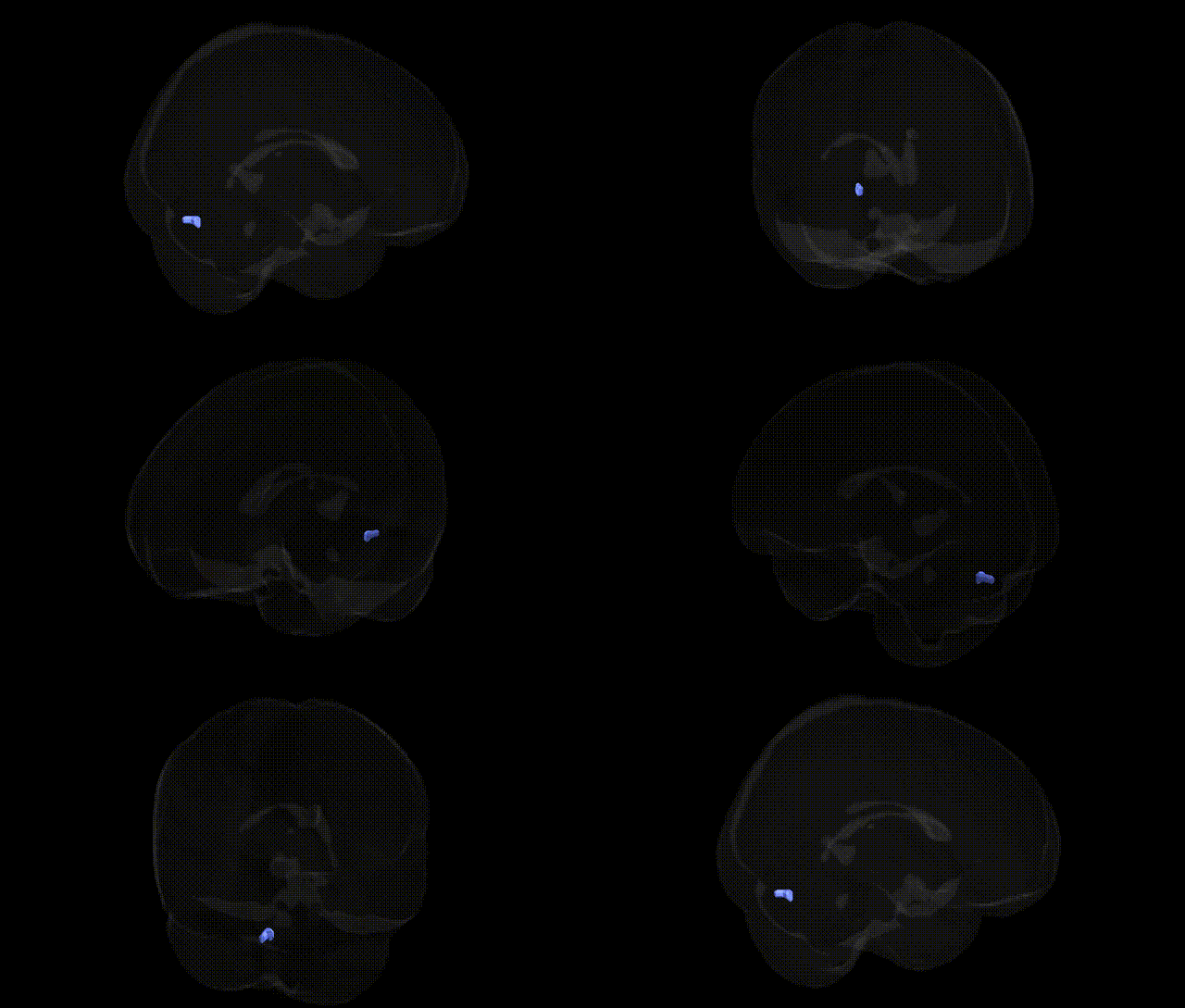
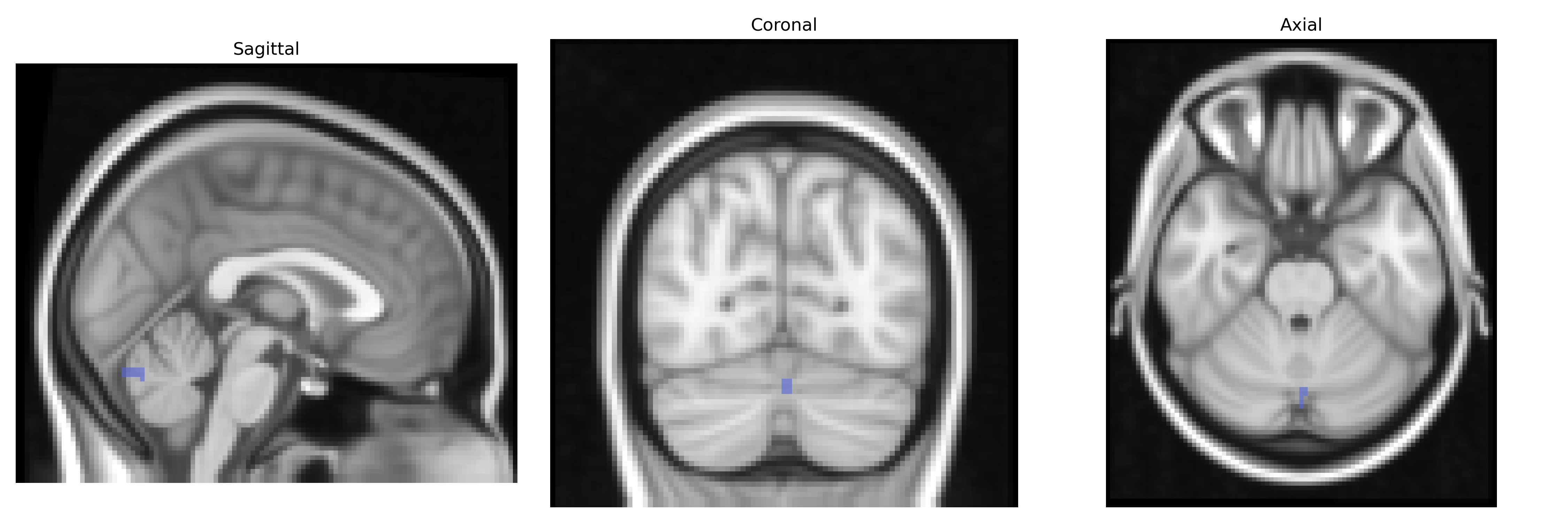
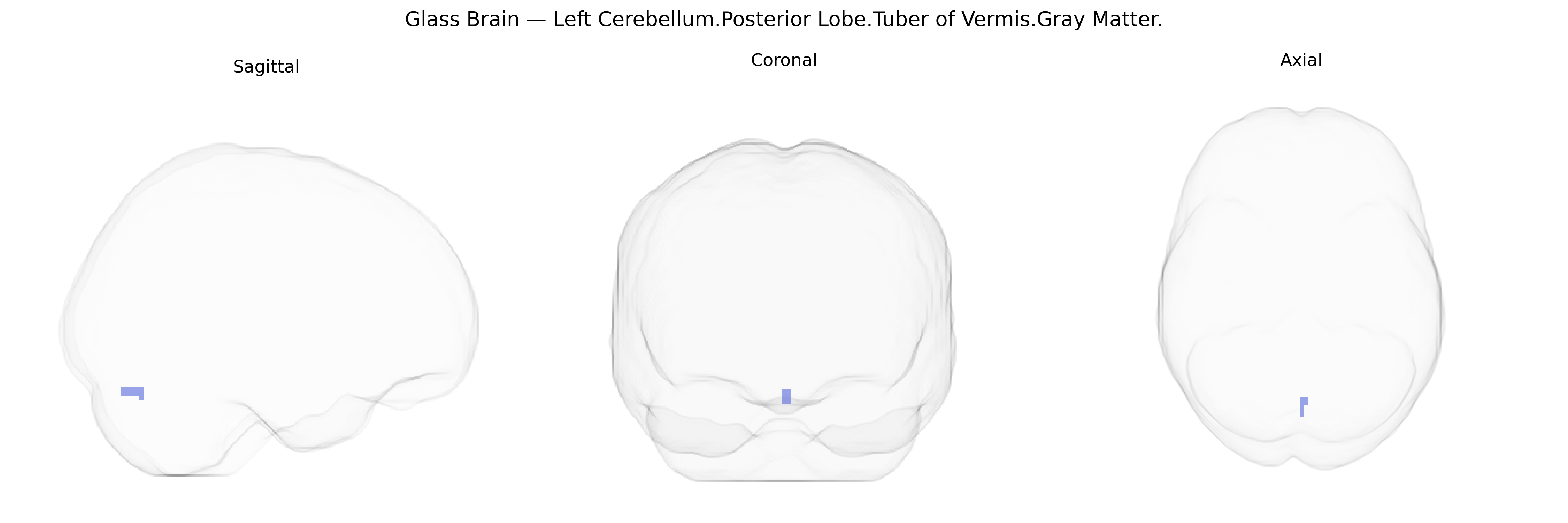
The Left Cerebellum, Posterior Lobe, Tuber of Vermis, Gray Matter refers to gray matter within the midline cerebellar vermis, specifically the tuber region of the posterior lobe, on the left side. This area is part of the cerebellar cortex and contributes to the fine-tuning of motor coordination, balance, and posture, with vermal regions more strongly associated with axial musculature and control of trunk and gait. Functionally, the posterior lobe, including the vermis, is also implicated in higher-order processes such as motor learning and aspects of cognitive and affective regulation through its connections with cerebral cortical and brainstem structures. There is no direct Wikipedia article for this specific subregion; a related article describing its broader structure is Cerebellar vermis.
The bilateral Left Cerebellum Posterior Lobe Tuber of Vermis gray matter, as defined in the Talairach 2 mm atlas, is part of the posterior vermis, a region implicated in motor coordination, affective regulation, and cognitive processing; while few genetic studies target this specific subregion at high anatomical resolution, cerebellar vermis and posterior cerebellar gray matter are recurrently involved in imaging genetics and GWAS of brain structure and neuropsychiatric traits. Large-scale GWAS of regional brain volumes (e.g., ENIGMA and UK Biobank cohorts) have identified associations between cerebellar gray matter volumes and variants in genes affecting neurodevelopment, synaptic function, and axonal guidance, including loci near KIAA0586 (involved in Joubert syndrome and cerebellar malformations), FOXP1/FOXP2 (language and motor planning), and polygenic architectures involving glutamatergic and GABAergic signaling. Variants in neurodevelopmental genes such as RELN, CNTNAP2, and several autism- and schizophrenia-associated loci have been linked to altered cerebellar vermis morphology or functional connectivity, and posterior vermis volume or activity changes appear in disorders including autism spectrum disorder, attention-deficit/hyperactivity disorder, bipolar disorder, major depression, and anxiety, often in the context of polygenic risk scores for these conditions. Cerebellar involvement has also been reported in GWAS-informed studies of cognitive traits (general intelligence, working memory, language) and emotional regulation, with polygenic profiles for these traits correlating with cerebellar gray matter measures. Although resolution limits and variability of atlas-based parcellations mean genetic associations are typically reported for broader cerebellar lobules rather than the Tuber of Vermis alone, convergent data suggest this posterior vermis region participates in genetically influenced networks underlying motor control, social and emotional processing, and higher-order cognition.
Overview generated by GPT-4o (2026).
Region ID: 114
Hemisphere: bilateral
Atlas: Talairach labels 2mm
Full Quality Version: Download MP4
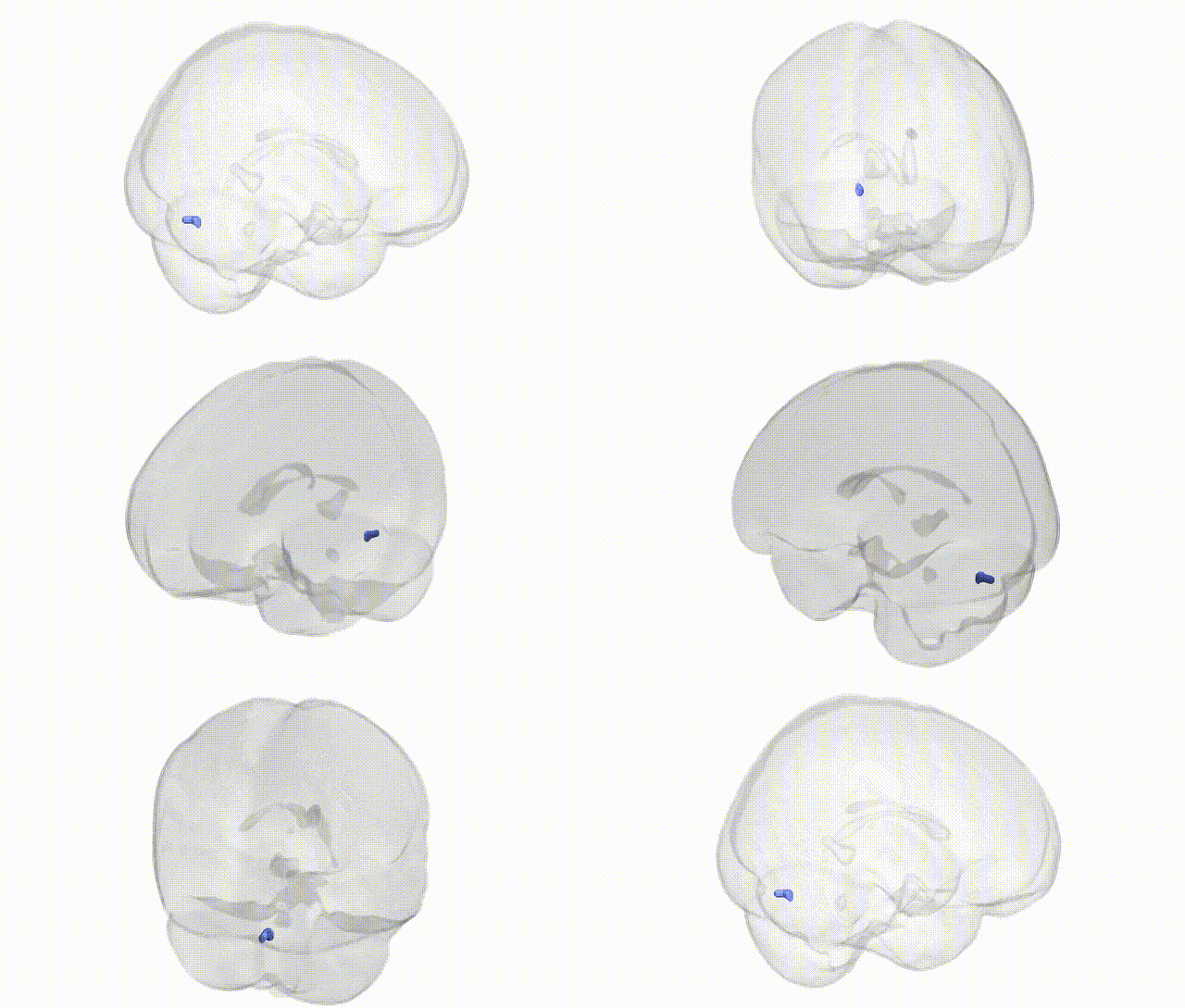
Full Quality Version: Download MP4
Wali Sidiqyar*, Gaurav Rudravaram*, Elyssa M. McMaster, Trent M. Schwartz, Adam M. Saunders, Kurt G. Schilling, Bennett A. Landman "Introducing SPINS: A Shared Public Visualization Library of Neuroanatomical Structures." Medical Imaging with Deep Learning- short paper
This resource is licensed under CC0 1.0 Universal (Public Domain).