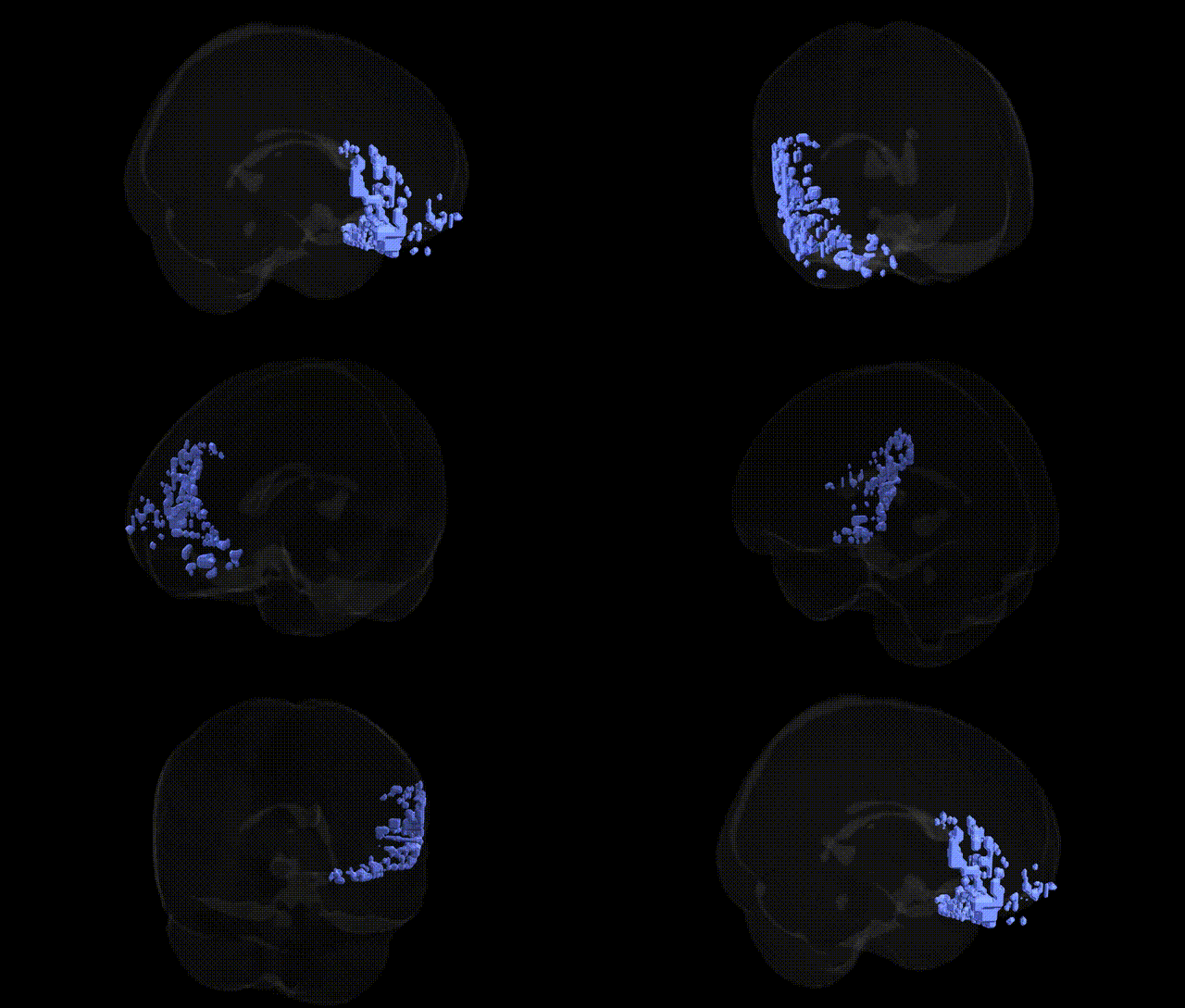
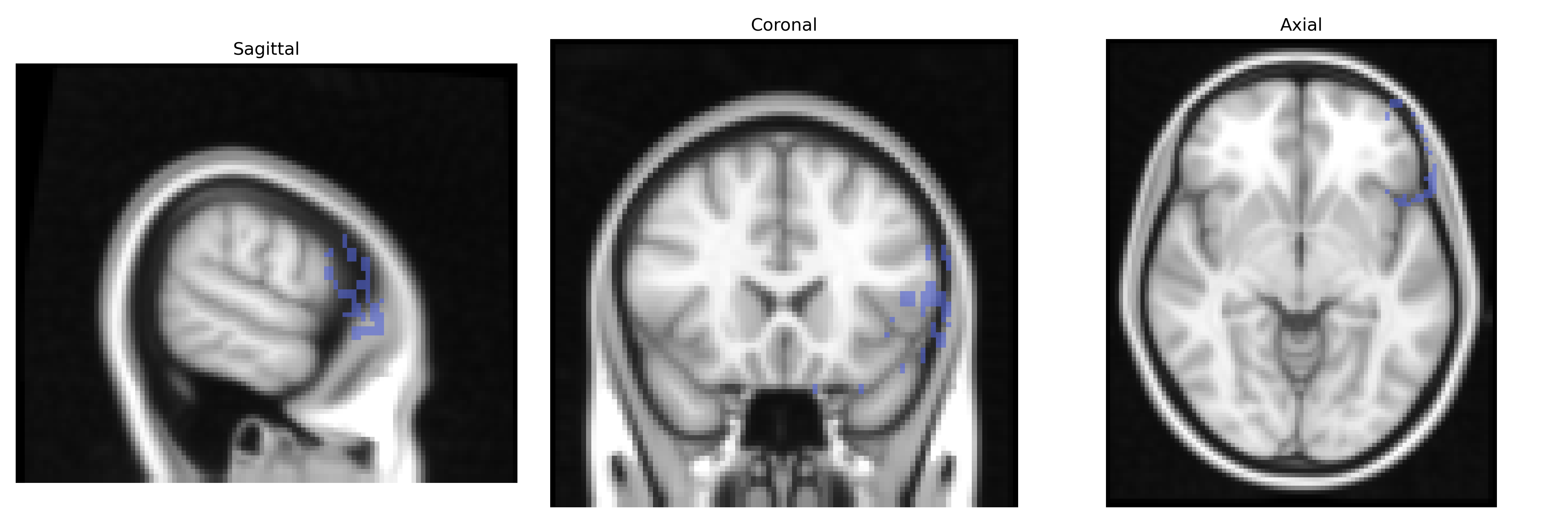
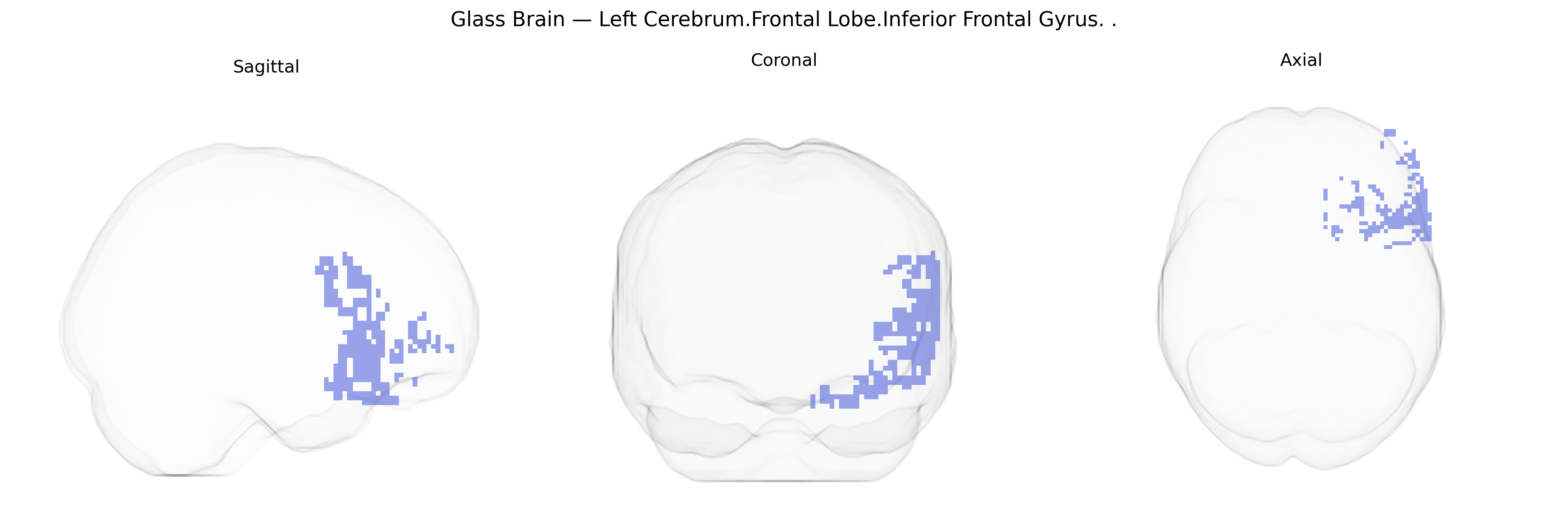
The bilateral Left Cerebrum.Frontal Lobe.Inferior Frontal Gyrus corresponds to a cortical region in the ventrolateral frontal lobe implicated in language, executive control, and social cognition. On the left, it substantially overlaps with Broca’s area (classically in pars opercularis and pars triangularis), supporting phonological processing, speech production, syntactic structuring, and aspects of semantic retrieval, while also contributing to verbal working memory and response inhibition. Bilaterally, the inferior frontal gyrus participates in higher-order cognitive control networks, including regulation of attention, integration of emotional and contextual information, and modulation of motor planning. Its cytoarchitectonic subdivisions (pars opercularis, pars triangularis, and pars orbitalis) are differentially connected with temporal, parietal, and limbic regions, enabling the coordinated processing of language, affect, and behavior.
The bilateral left inferior frontal gyrus (IFG) in the frontal lobe—often encompassing Broca’s area—has been repeatedly implicated in genetic studies of language, executive function, and psychiatric risk, although most GWAS and imaging genetics work use functional or anatomical parcellations rather than the Talairach 2 mm atlas specifically. Variants in genes such as FOXP2, CNTNAP2, and KIAA0319, classically associated with speech and language disorders and dyslexia, show structural and functional associations with left IFG volume, activation, or connectivity, linking this region to phonological processing and articulation. Large-scale GWAS of brain MRI phenotypes (e.g., ENIGMA, UK Biobank) have identified polygenic influences on frontal cortical thickness and surface area, including inferior frontal regions, with loci spanning genes involved in neurodevelopmental pathways (e.g., developing cortical lamination, synaptic formation) and overlapping with genetic architectures for cognitive ability and educational attainment. Imaging genetics studies in schizophrenia, bipolar disorder, major depression, and ADHD report that risk variants in genes such as CACNA1C, ZNF804A, and COMT modulate IFG activation during working memory, cognitive control, and language tasks, as well as gray matter volume in the left IFG, suggesting that part of the genetic liability for these disorders acts through altered frontal lobe circuitry. Furthermore, polygenic scores for psychosis, autism spectrum disorder, and externalizing traits have been associated with altered IFG activation and morphology, and GWAS of social communication traits and stuttering highlight overlapping genetic influences on left frontal speech–language networks. Collectively, these findings support a view in which the left IFG is a key genetically influenced hub for language, executive control, and social–cognitive processing, with pleiotropic genetic variants contributing to both normal trait variation and vulnerability to neurodevelopmental and psychiatric conditions.
Overview generated by GPT-4o (2026).
Region ID: 186
Hemisphere: bilateral
Atlas: Talairach labels 2mm
Full Quality Version: Download MP4
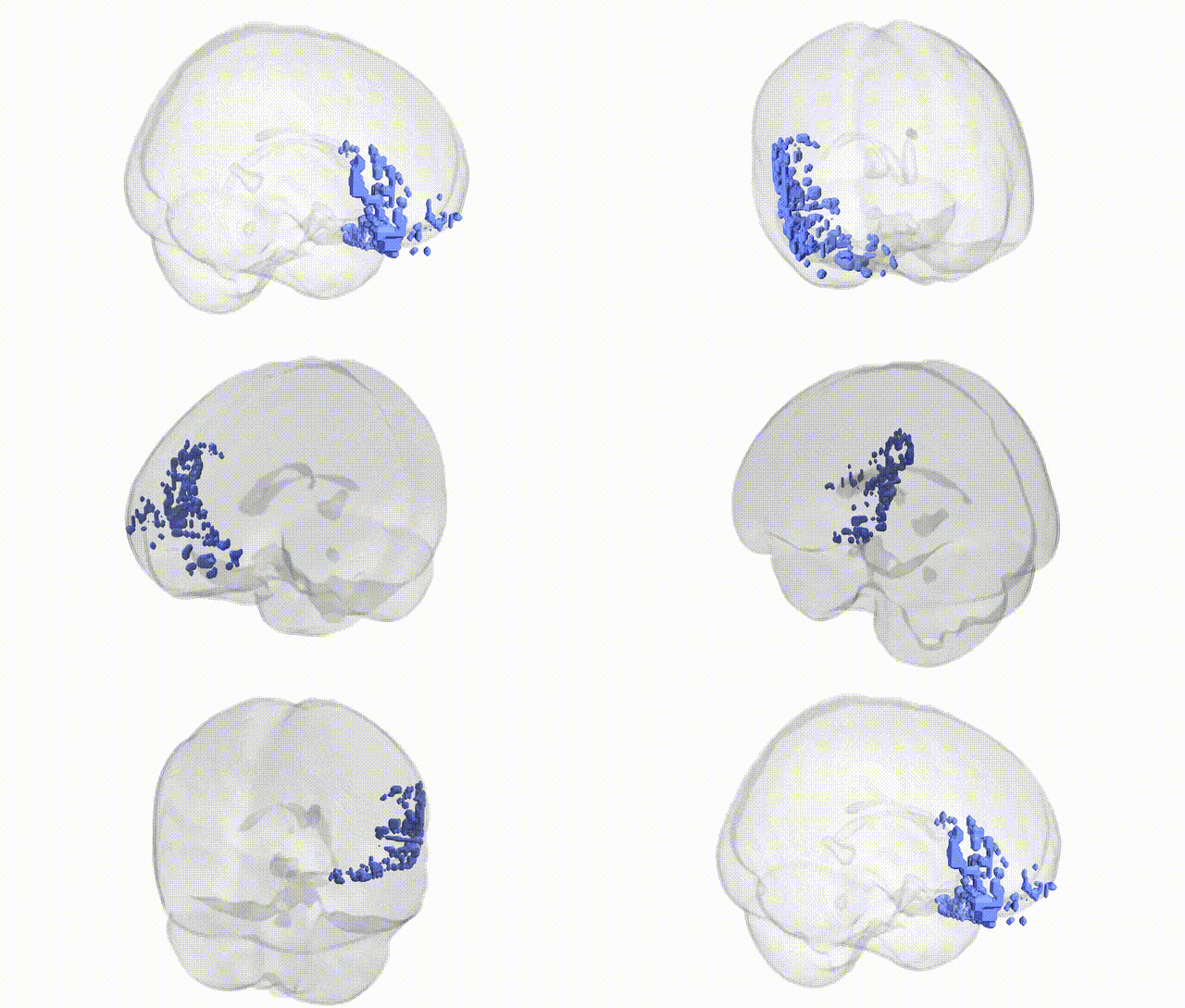
Full Quality Version: Download MP4
Wali Sidiqyar*, Gaurav Rudravaram*, Elyssa M. McMaster, Trent M. Schwartz, Adam M. Saunders, Kurt G. Schilling, Bennett A. Landman "Introducing SPINS: A Shared Public Visualization Library of Neuroanatomical Structures." Medical Imaging with Deep Learning- short paper
This resource is licensed under CC0 1.0 Universal (Public Domain).