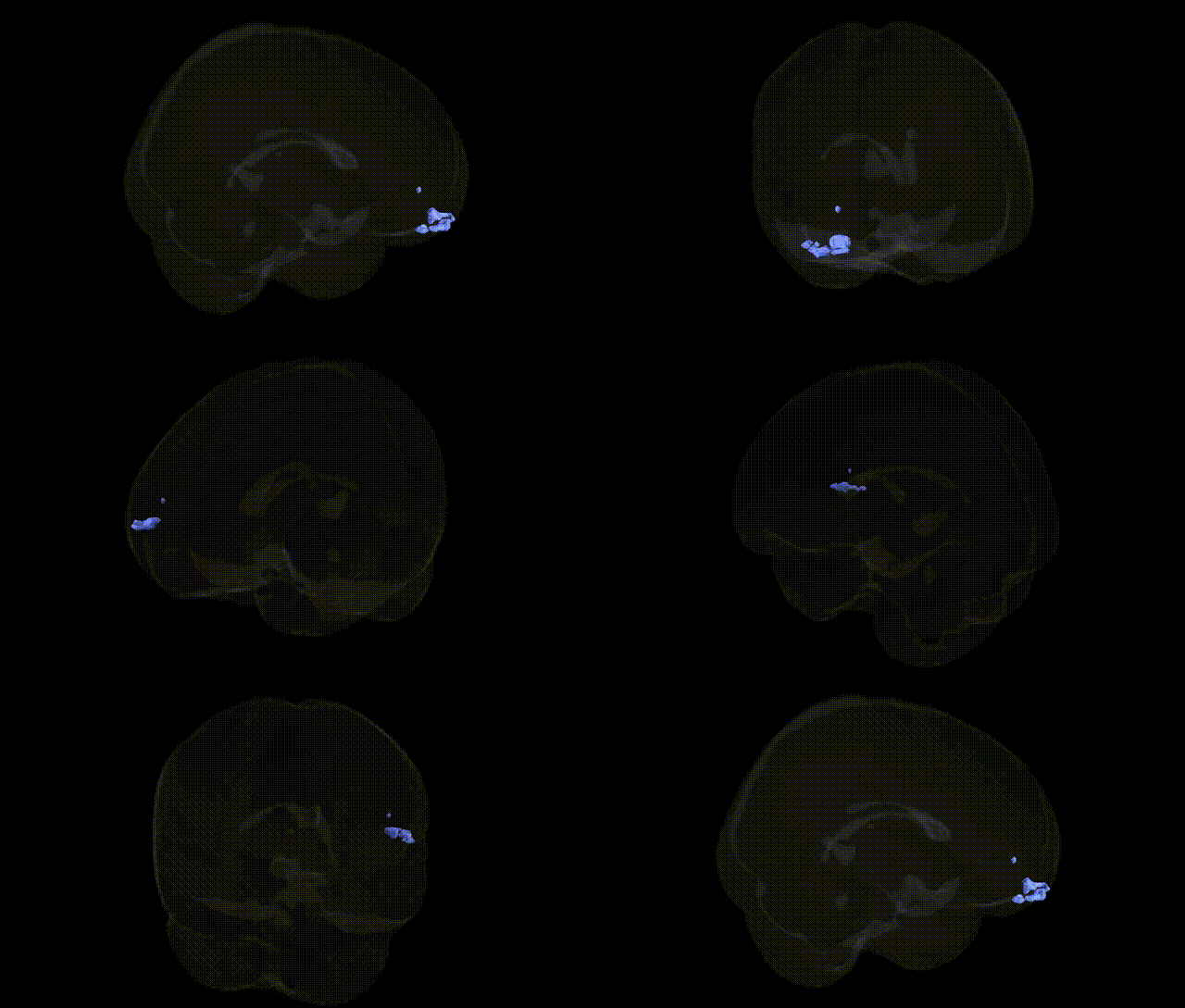
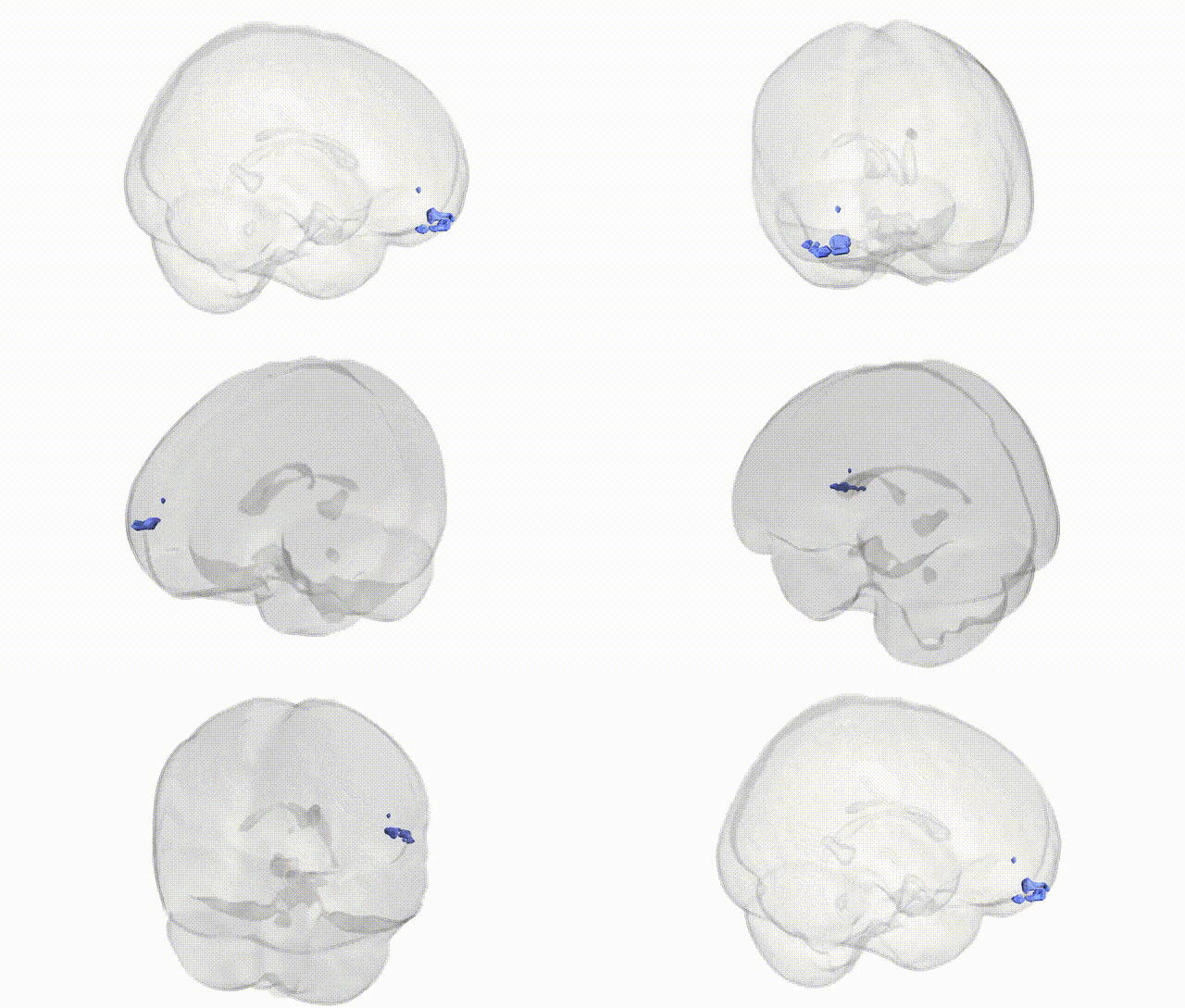
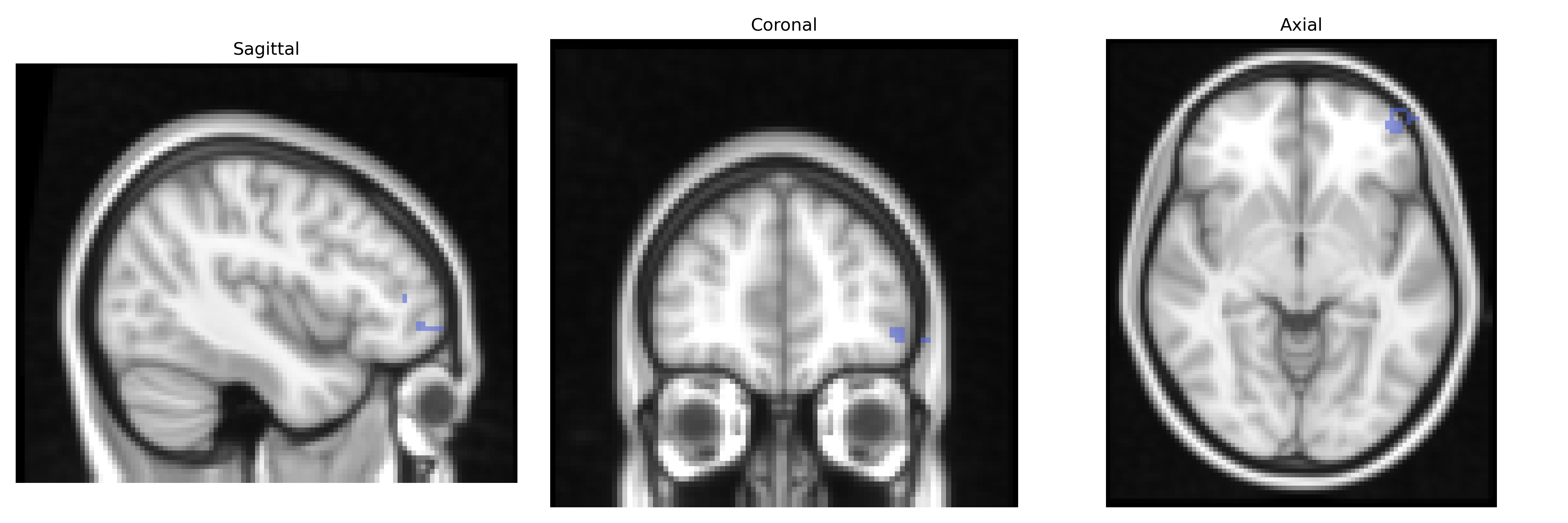
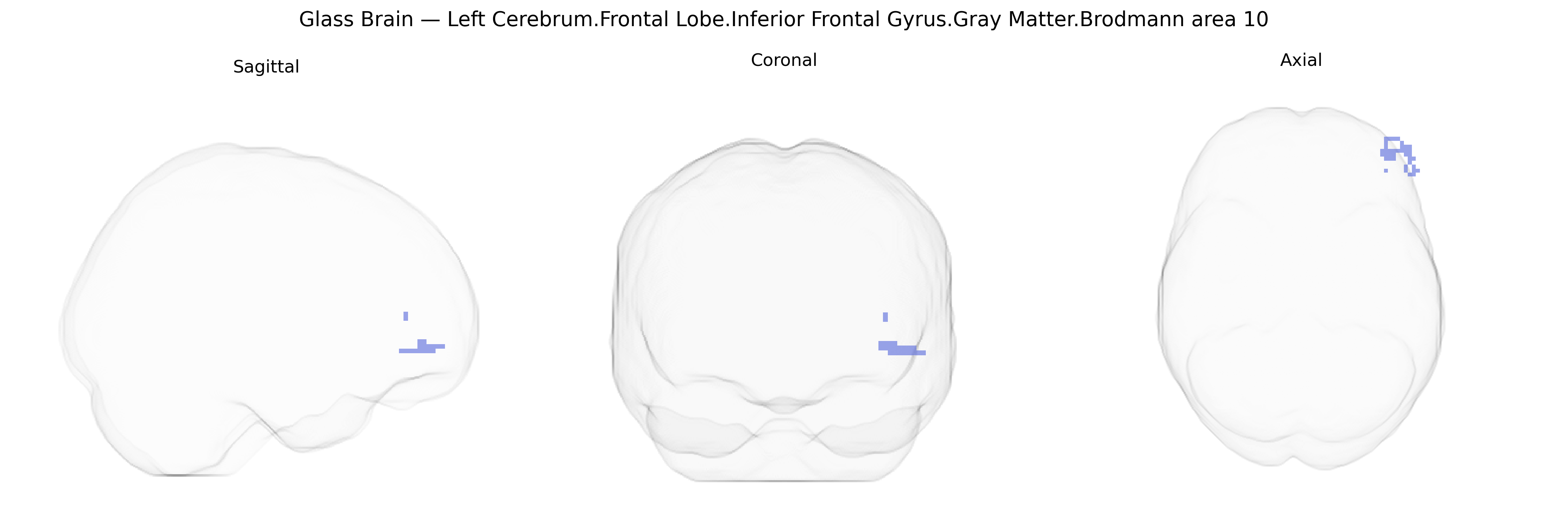
The bilateral Left Cerebrum.Frontal Lobe.Inferior Frontal Gyrus.Gray Matter.Brodmann area 10 corresponds to a high-order prefrontal cortical region located at the most anterior portion of the frontal lobe, extending into the frontal pole and overlapping with the anterior segment of the inferior frontal gyrus. Brodmann area 10 is heavily implicated in executive functions, including prospective memory, multitasking, complex decision-making, and integrating internal goals with external stimuli, and it plays a key role in abstract reasoning, social cognition, and the regulation of attention over extended time intervals. Cytoarchitectonically, this region is characterized by its highly developed granular cortex, extensive long-range connectivity with other prefrontal areas, limbic structures, and association cortices, and it functions as a hub for combining information across different cognitive and affective domains. There is no direct link for this exact Talairach label; a closely related structure is Brodmann area 10.
The bilateral left inferior frontal gyrus gray matter in Brodmann area 10, as defined in the Talairach 2 mm atlas, has been implicated in genetic associations primarily through imaging genetics and GWAS of brain structure, cognitive traits, and psychiatric risk, although most studies do not isolate this subregion with high specificity. Variants in genes related to synaptic function and neurodevelopment—such as CNTNAP2, FOXP2, COMT, and BDNF—have been linked to volumetric and functional differences in adjacent inferior frontal regions involved in language, executive control, and social cognition, with some work suggesting that allelic variation modulates local cortical thickness and activation patterns during tasks requiring higher-order cognitive control. Large-scale GWAS of cortical morphology (e.g., ENIGMA, UK Biobank) have identified numerous loci influencing frontal cortical surface area and thickness, including regions overlapping the anterior prefrontal cortex (BA10), although associations are generally reported at lobar or gyral levels rather than Talairach-defined parcels. Genetic risk for schizophrenia, bipolar disorder, major depression, and autism spectrum disorder shows polygenic effects on frontal pole and inferior frontal anatomy and connectivity, with some loci (such as those in CACNA1C and MIR137 regions) repeatedly associated with altered frontal structure and function. Additionally, GWAS of traits like general cognitive ability, educational attainment, impulsivity, and personality have found that polygenic scores predict variation in frontal pole and inferior frontal measures, supporting a role for distributed genetic architectures influencing BA10-related circuits rather than single gene–region relationships. Overall, current evidence points to complex, polygenic influences on this region’s structure and function, with overlapping genetic architectures for cognitive performance and risk for major neuropsychiatric disorders, but few findings that uniquely and specifically target Talairach-defined bilateral left BA10 gray matter in the inferior frontal gyrus.
Overview generated by GPT-4o (2026).
Region ID: 483
Hemisphere: bilateral
Atlas: Talairach labels 2mm
Full Quality Version: Download MP4
Full Quality Version: Download MP4
Wali Sidiqyar*, Gaurav Rudravaram*, Elyssa M. McMaster, Trent M. Schwartz, Adam M. Saunders, Kurt G. Schilling, Bennett A. Landman "Introducing SPINS: A Shared Public Visualization Library of Neuroanatomical Structures." Medical Imaging with Deep Learning- short paper
This resource is licensed under CC0 1.0 Universal (Public Domain).