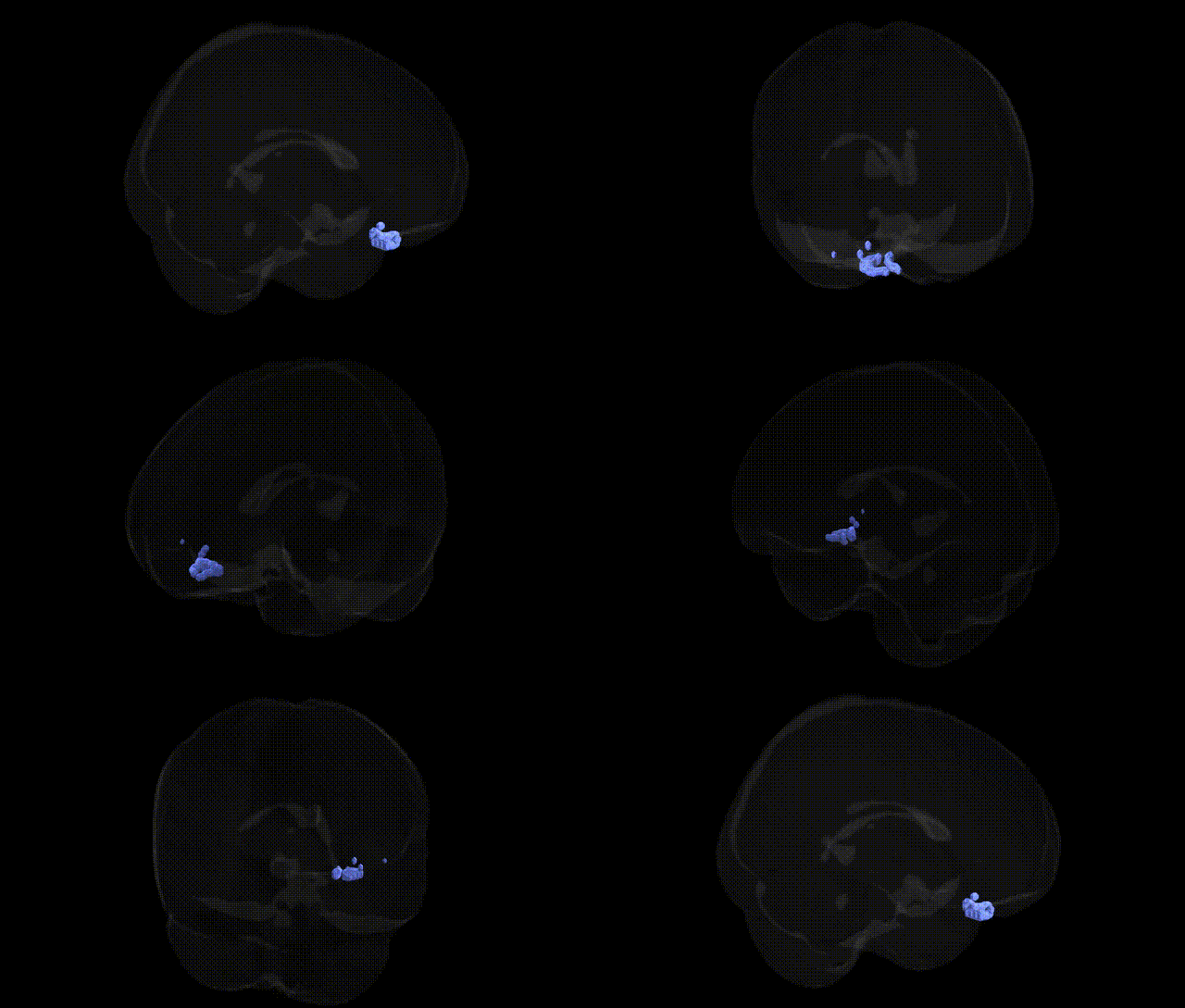
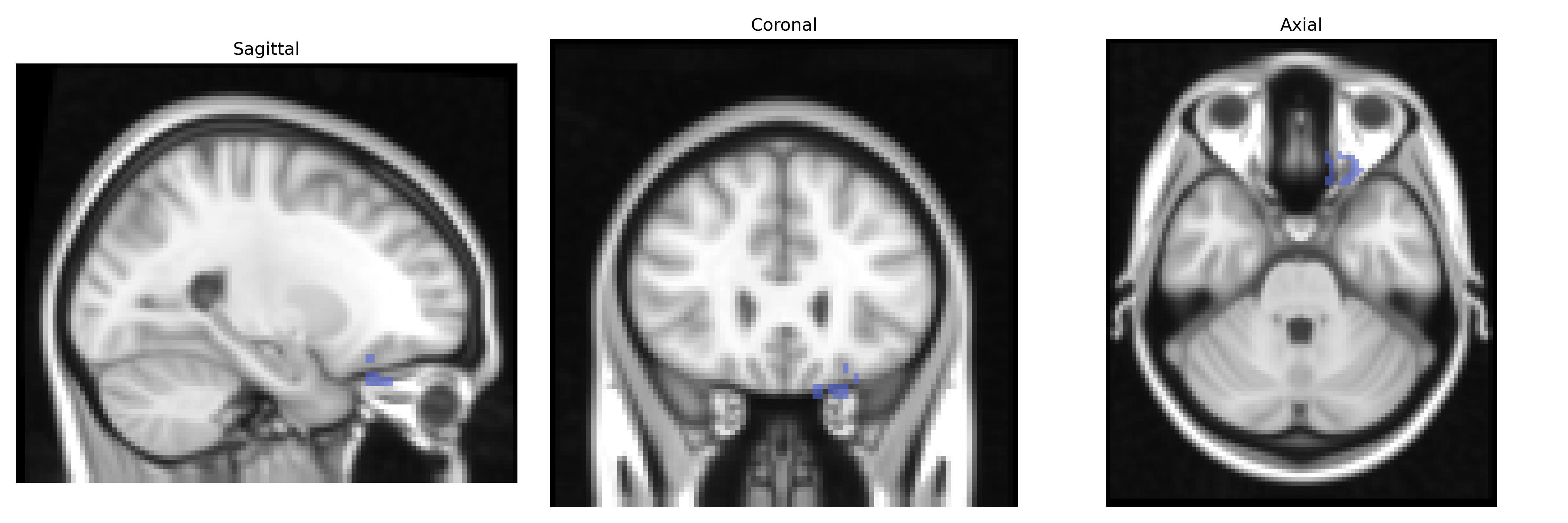
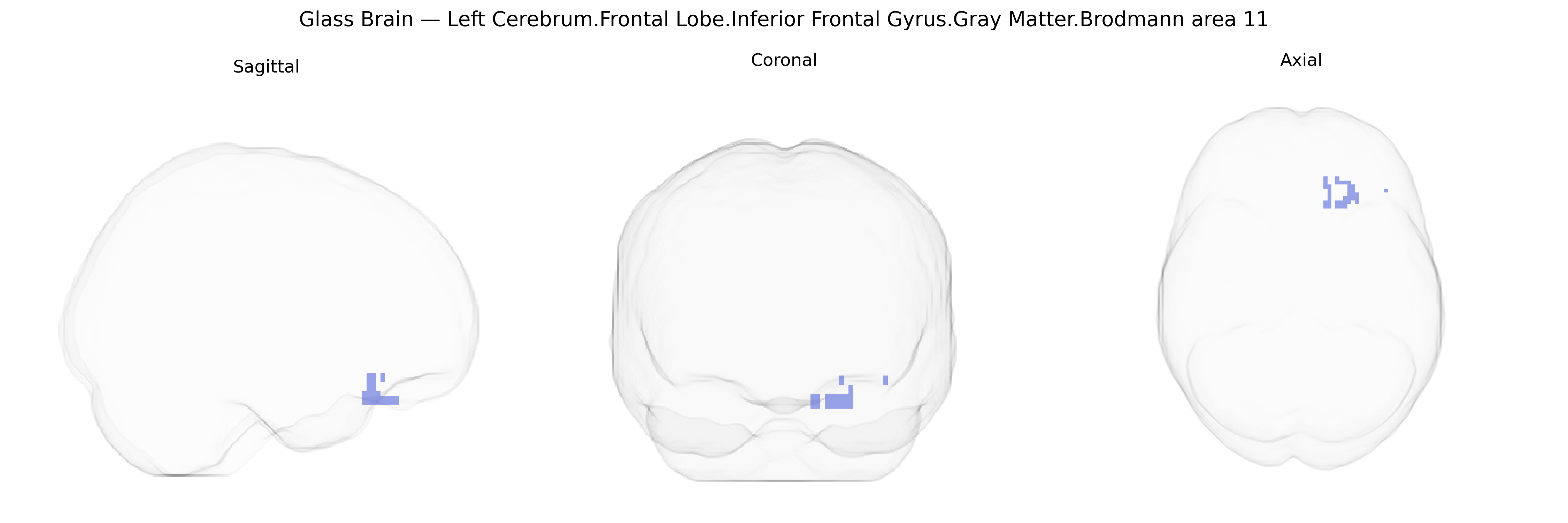
The bilateral Left Cerebrum.Frontal Lobe.Inferior Frontal Gyrus.Gray Matter.Brodmann area 11, as defined in the Talairach 2 mm atlas, refers to orbitofrontal portions of the inferior frontal gyrus within Brodmann area 11, a prefrontal region implicated in higher-order cognitive and affective processing. BA11 is part of the orbitofrontal cortex, receiving multimodal sensory and limbic inputs and contributing to evaluation of reward and punishment, decision-making under uncertainty, emotional regulation, and social behavior. Neuronal populations in this area integrate information about expected outcomes, value, and contingency to guide adaptive behavior, with connectivity to limbic structures (e.g., amygdala), striatum, and other prefrontal areas. In humans, functional imaging frequently associates BA11 with value-based choices, affective evaluation, and behavioral inhibition. There is no direct Wikipedia article specifically for “Brodmann area 11” as defined in this atlas label set; a closely related structure is the orbitofrontal cortex: Orbitofrontal cortex.
The bilateral Left Cerebrum.Frontal Lobe.Inferior Frontal Gyrus.Gray Matter.Brodmann area 11, a ventromedial prefrontal cortex region, has been implicated in genetic studies of psychiatric, cognitive, and behavioral phenotypes, though most evidence comes from imaging genetics rather than region-specific GWAS. Variants in genes related to synaptic plasticity and neurodevelopment, such as CACNA1C, BDNF, DISC1, and ZNF804A, have been associated with altered prefrontal volume or activity in tasks engaging orbitofrontal and inferior frontal regions, often overlapping Brodmann area 11. Large-scale neuroimaging GWAS (e.g., ENIGMA and UK Biobank studies) have identified polygenic influences on frontal cortical thickness and surface area, with loci near genes such as PLEKHM1, FOXP2, and GRIN2A contributing to variability in inferior frontal and adjacent orbitofrontal morphology, which in turn are linked to depression, schizophrenia, bipolar disorder, and anxiety risk. Functional imaging genetics has shown that common variants in serotonergic (SLC6A4, HTR1A), dopaminergic (COMT, DRD2), and glutamatergic genes modulate Brodmann area 11 activation during reward valuation, decision making, and emotional regulation, aligning with GWAS findings that polygenic risk for major depressive disorder, schizophrenia, and substance use traits correlates with structural and functional differences in ventromedial and inferior frontal regions. In addition, GWAS of personality, risk-taking, impulsivity, and neuroticism have demonstrated genetic correlations with prefrontal and orbitofrontal volume and connectivity, indirectly implicating Brodmann area 11 as a convergence point for common variants influencing affective regulation, valuation, and control processes, although specific SNP-level associations uniquely targeting this Talairach-defined subregion remain limited.
Overview generated by GPT-4o (2026).
Region ID: 191
Hemisphere: bilateral
Atlas: Talairach labels 2mm
Full Quality Version: Download MP4
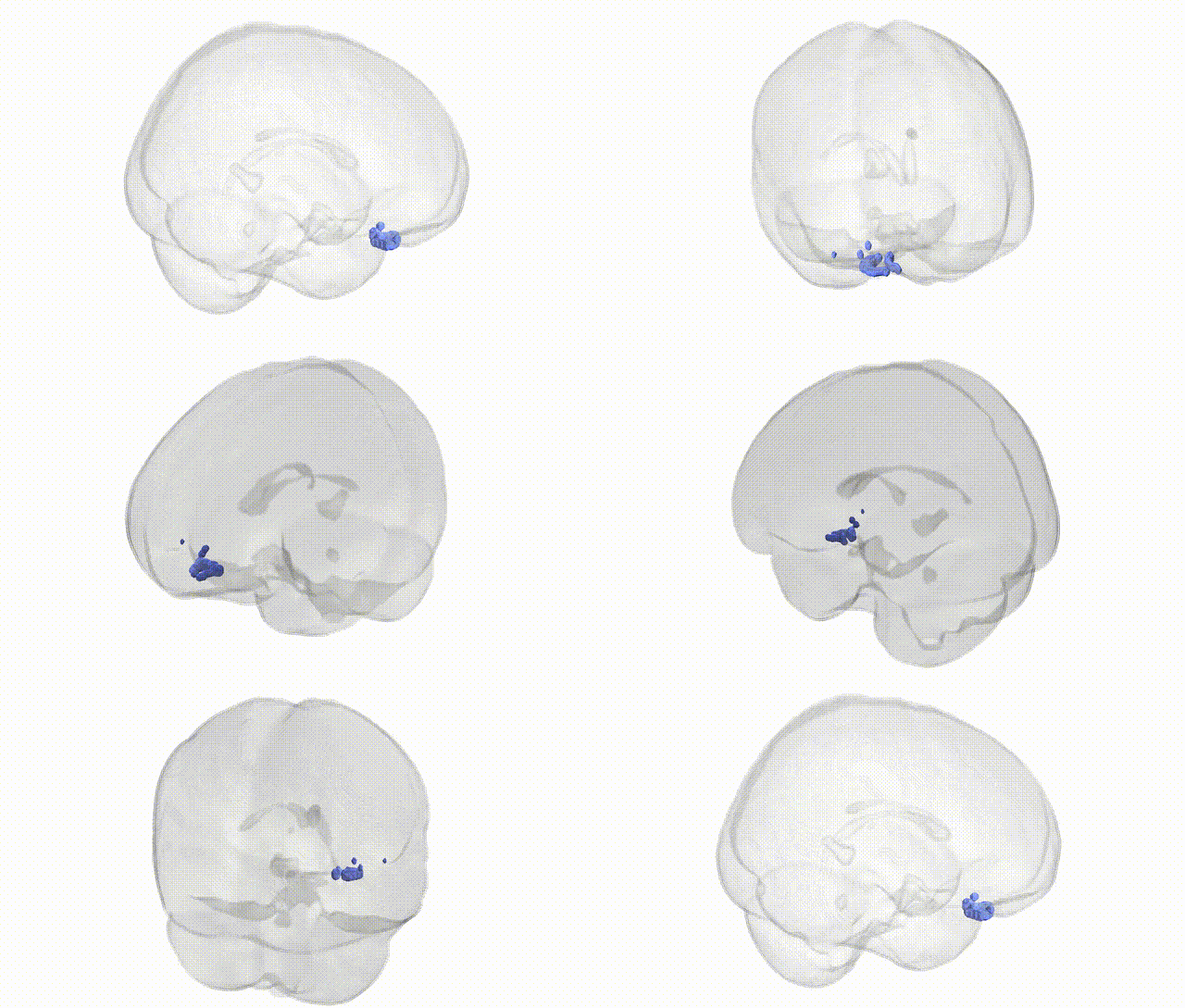
Full Quality Version: Download MP4
Wali Sidiqyar*, Gaurav Rudravaram*, Elyssa M. McMaster, Trent M. Schwartz, Adam M. Saunders, Kurt G. Schilling, Bennett A. Landman "Introducing SPINS: A Shared Public Visualization Library of Neuroanatomical Structures." Medical Imaging with Deep Learning- short paper
This resource is licensed under CC0 1.0 Universal (Public Domain).