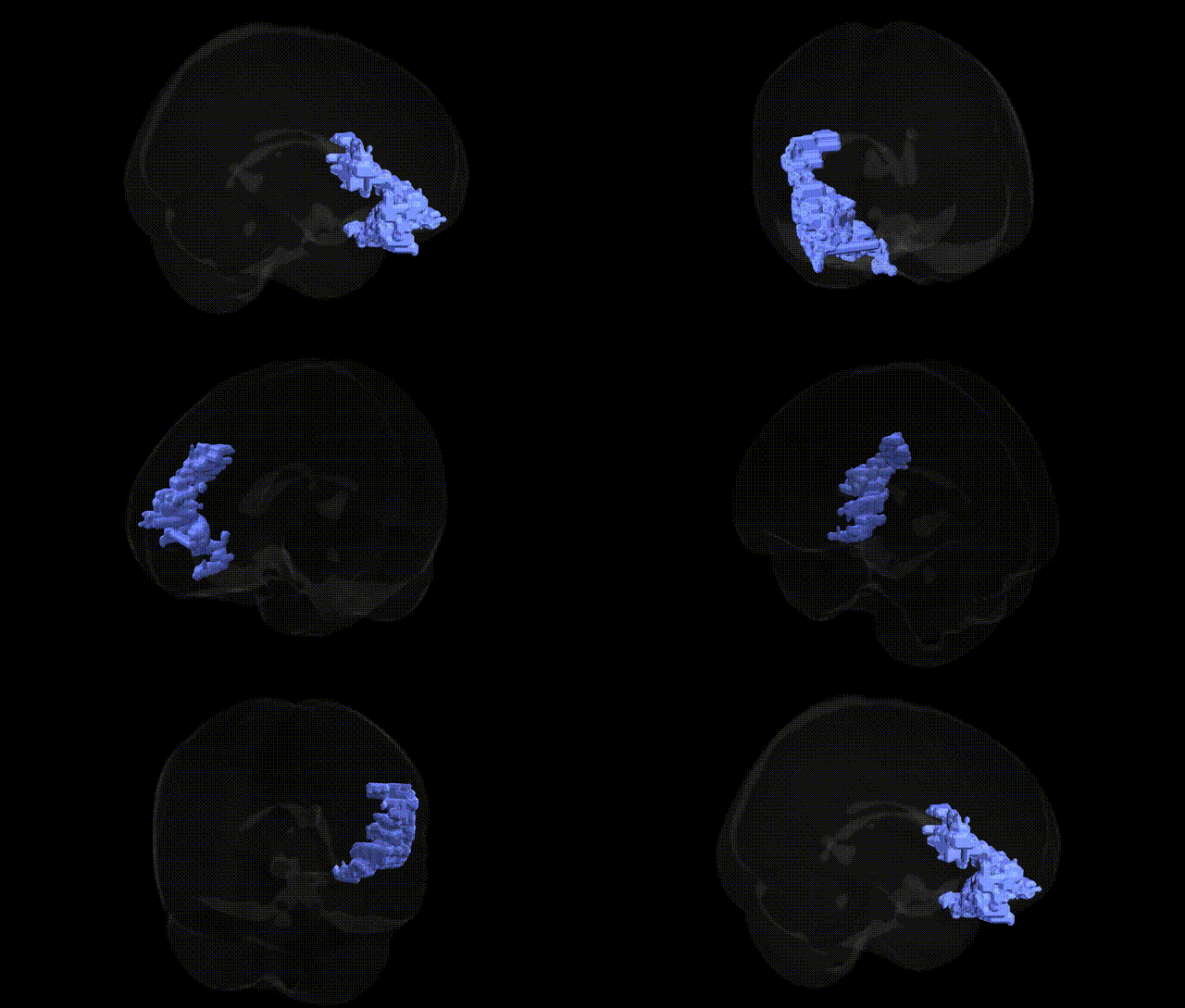
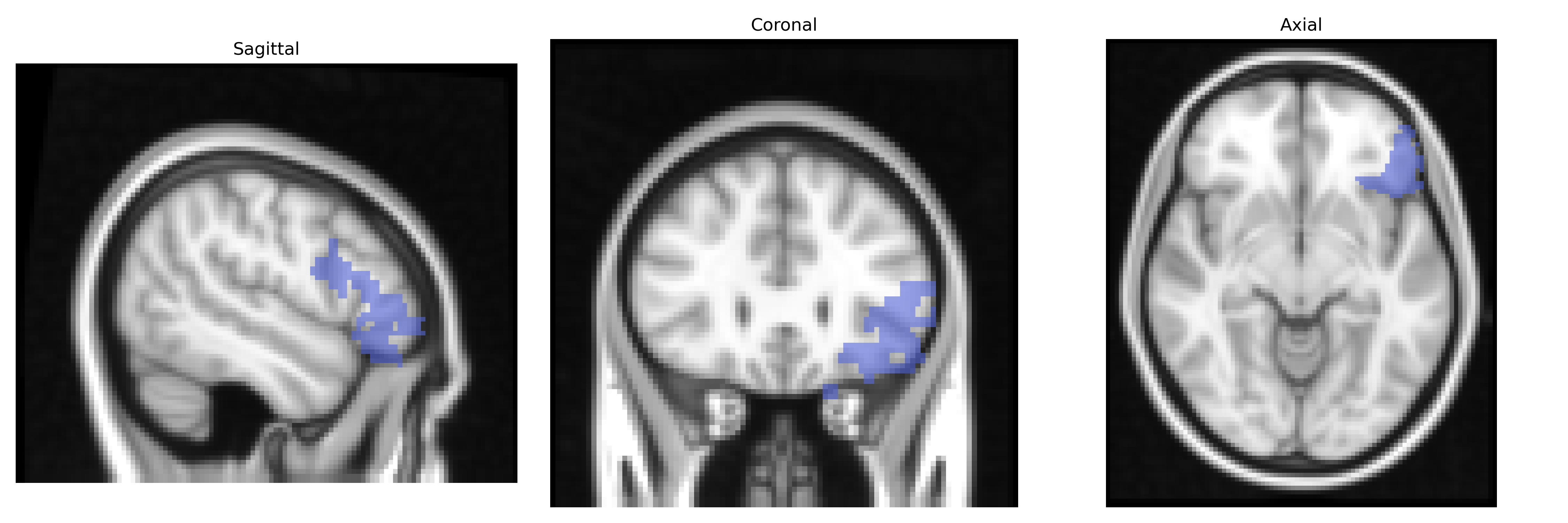
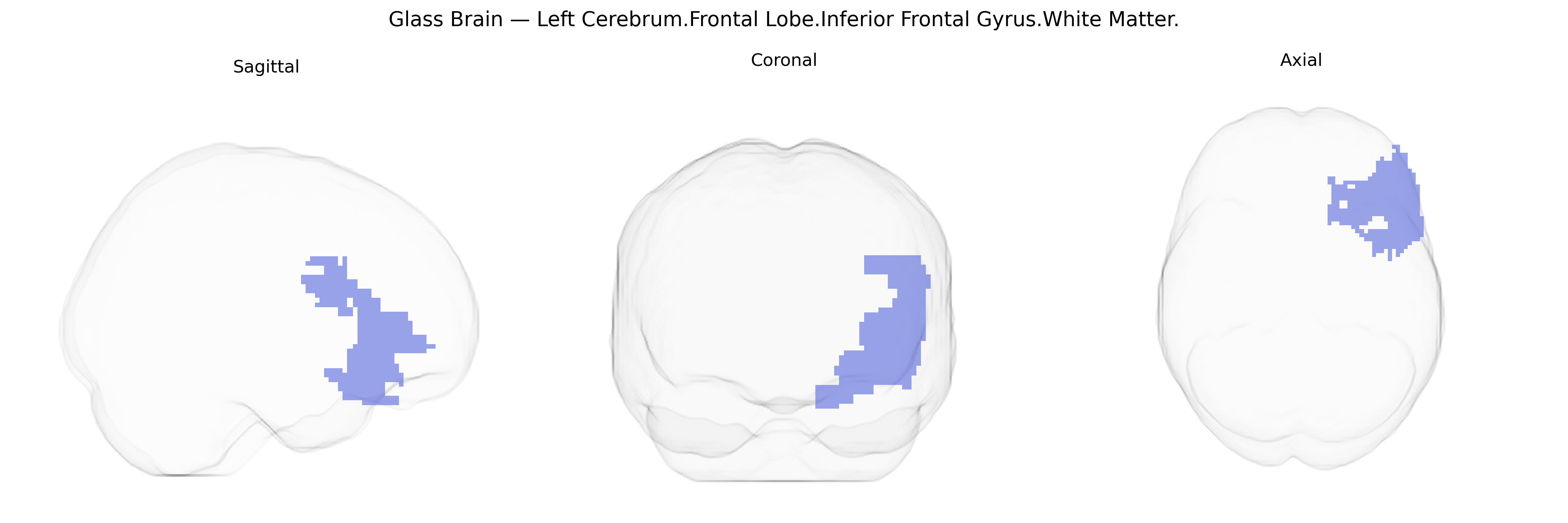
The bilateral Left Cerebrum.Frontal Lobe.Inferior Frontal Gyrus.White Matter corresponds to the subcortical fiber tracts underlying the inferior frontal gyrus, a frontal lobe region implicated in language production, speech articulation, and aspects of cognitive control. These white matter pathways include association fibers that interconnect inferior frontal regions with other frontal, temporal, and parietal areas, supporting networks involved in syntactic processing, phonological encoding, and executive functions such as response inhibition and working memory. In the left hemisphere, this area is closely associated with classical Broca’s region and its connectivity to temporal language regions via major tracts (e.g., segments of the arcuate fasciculus), forming part of the structural substrate for the dorsal language stream. There is no direct Wikipedia article for this precise white matter label; a closely related cortical region is the Inferior frontal gyrus.
The bilateral white matter underlying the inferior frontal gyrus (IFG) in the left frontal lobe—corresponding to language-related and executive-control tracts in the Talairach 2 mm atlas—has been implicated in several genetic associations from neuroimaging and GWAS studies. Structural and diffusion MRI GWAS of frontal white matter integrity and volume often highlight polygenic contributions involving genes related to axon guidance, myelination, and synaptic plasticity (e.g., CNTNAP2, NRG1, MAG and other oligodendrocyte/myelin genes), with frontal white matter measures appearing in large consortia such as ENIGMA and UK Biobank. Variants associated with schizophrenia, bipolar disorder, and major depressive disorder frequently show effects on IFG-connected frontal white matter tracts, including fronto-temporal and fronto-striatal pathways, paralleling case–control findings of reduced fractional anisotropy in these regions. Similarly, GWAS of cognitive traits (general intelligence, working memory, response inhibition, and educational attainment) and language-related abilities have linked polygenic scores to IFG white matter microstructure, suggesting that genetic influences on these tracts partly mediate individual differences in executive and language functions. Autism spectrum disorder and developmental language disorder risk variants (such as in FOXP2-related networks, CNTNAP2 and other synaptic genes) have been associated with atypical IFG connectivity and white matter organization, while GWAS of substance use, impulsivity, and externalizing behaviors show associations with frontal white matter integrity in IFG-adjacent regions, consistent with genetic modulation of inhibitory-control circuitry. Overall, current evidence indicates that the bilateral left inferior frontal gyrus white matter is a convergence zone for pleiotropic genetic effects spanning neurodevelopmental and psychiatric disorders, cognitive and language traits, and white matter structural phenotypes, although specific locus-to-tract mappings remain largely polygenic and distributed rather than region-unique.
Overview generated by GPT-4o (2026).
Region ID: 189
Hemisphere: bilateral
Atlas: Talairach labels 2mm
Full Quality Version: Download MP4
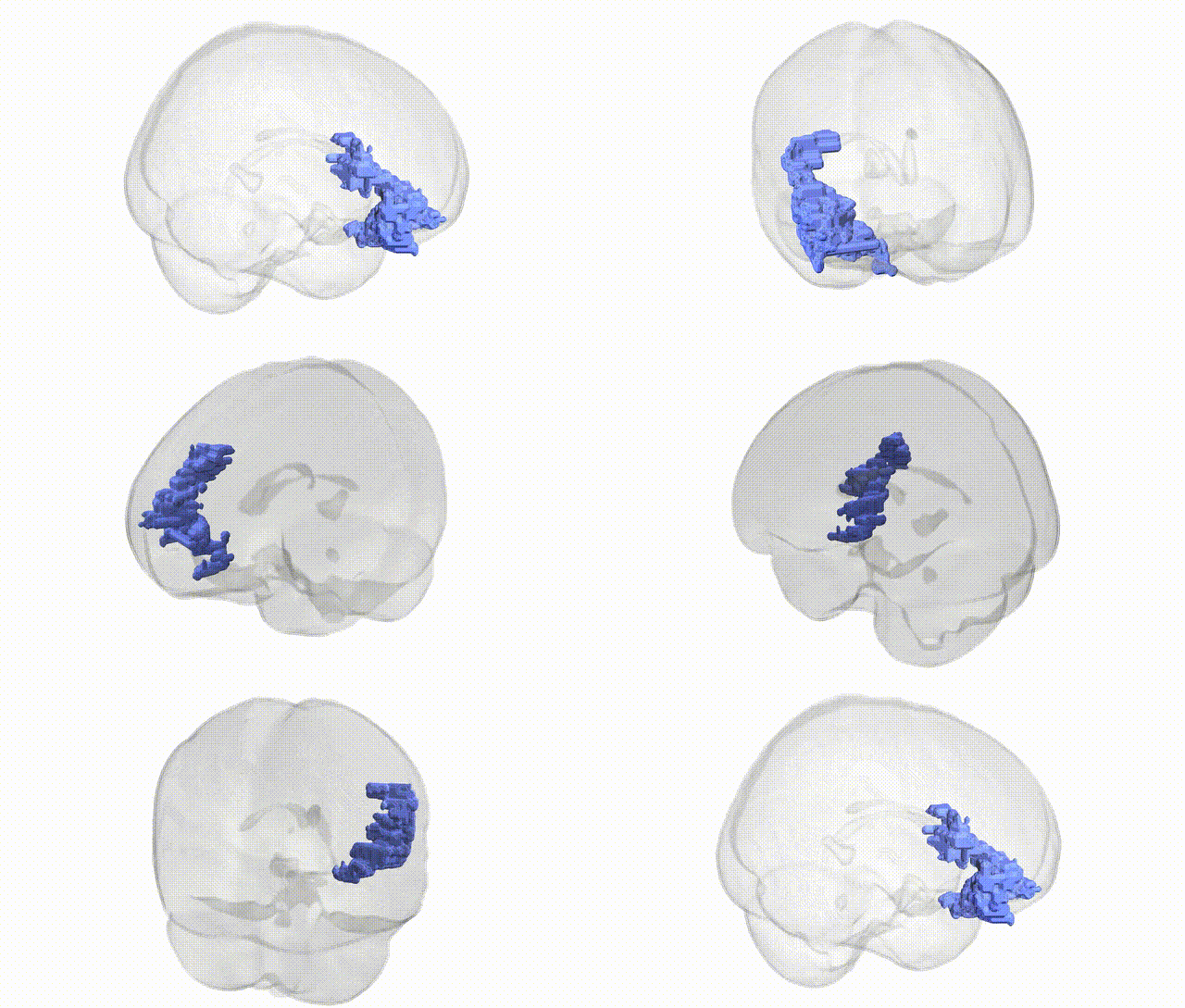
Full Quality Version: Download MP4
Wali Sidiqyar*, Gaurav Rudravaram*, Elyssa M. McMaster, Trent M. Schwartz, Adam M. Saunders, Kurt G. Schilling, Bennett A. Landman "Introducing SPINS: A Shared Public Visualization Library of Neuroanatomical Structures." Medical Imaging with Deep Learning- short paper
This resource is licensed under CC0 1.0 Universal (Public Domain).