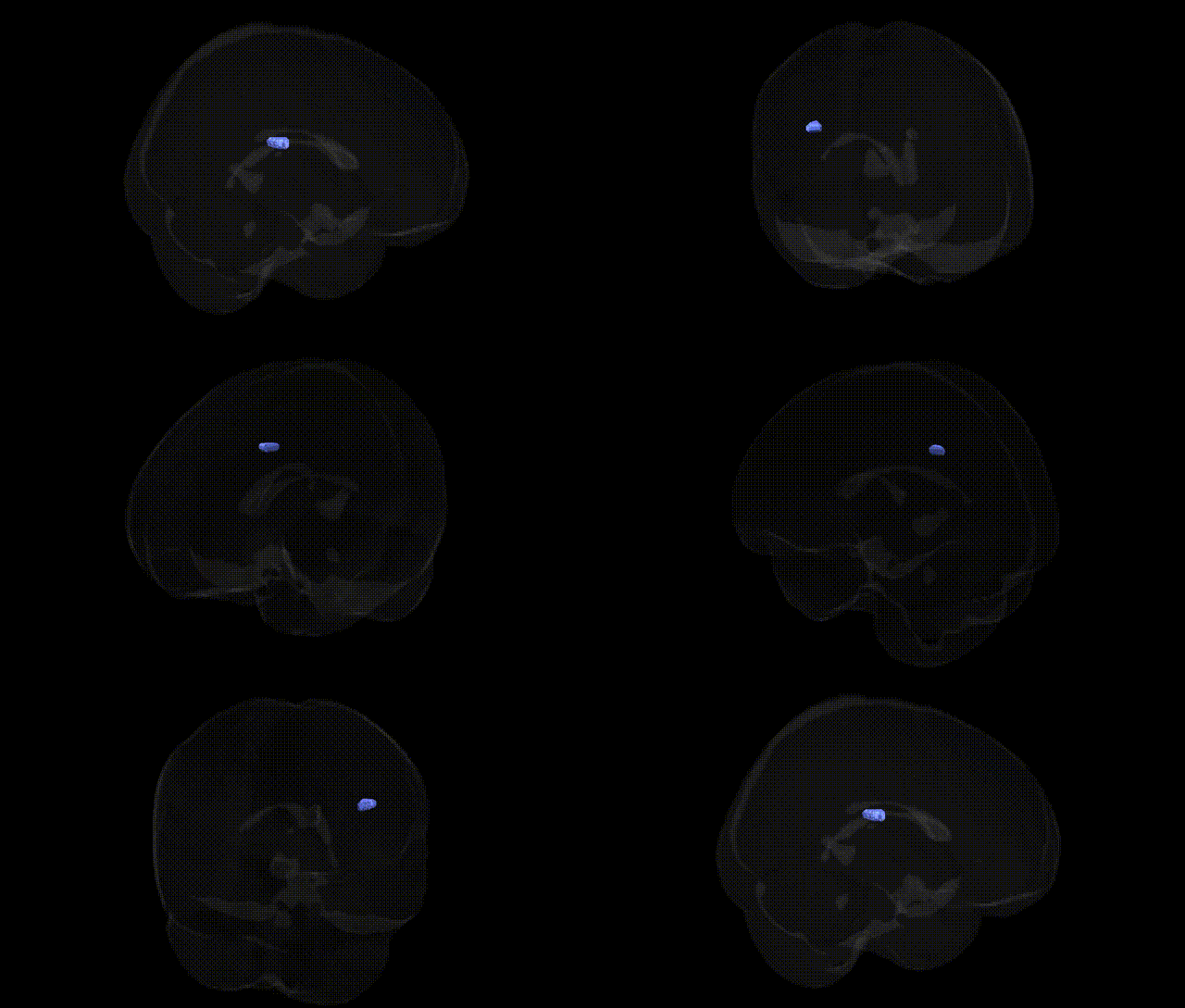
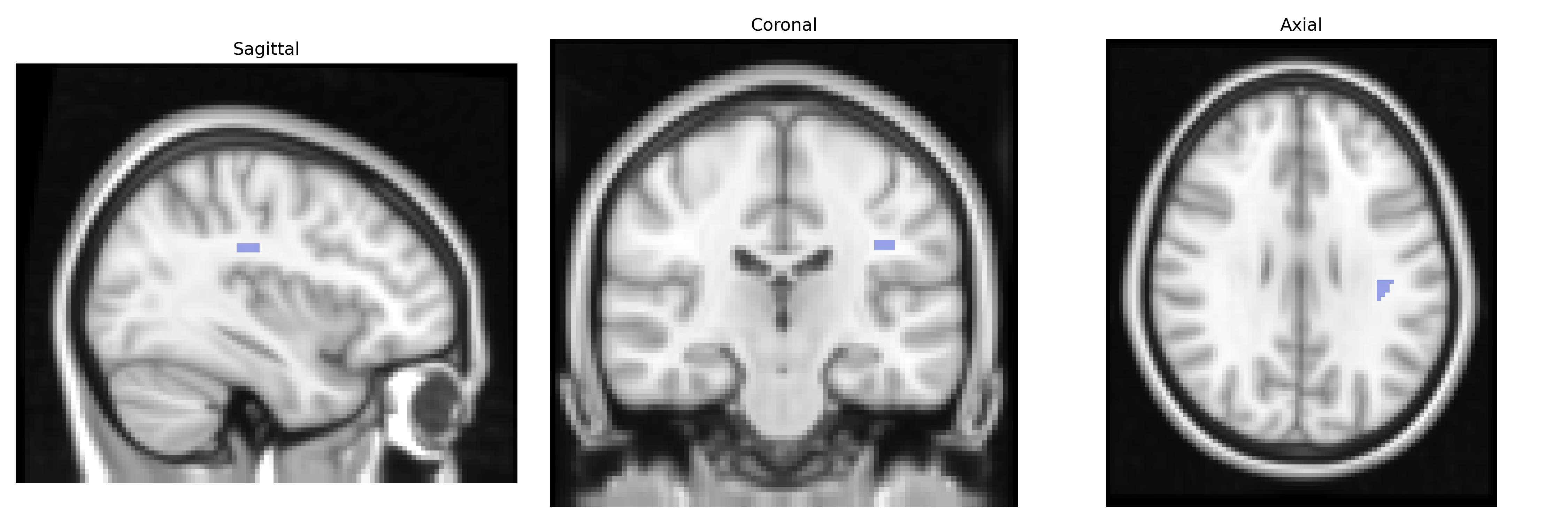
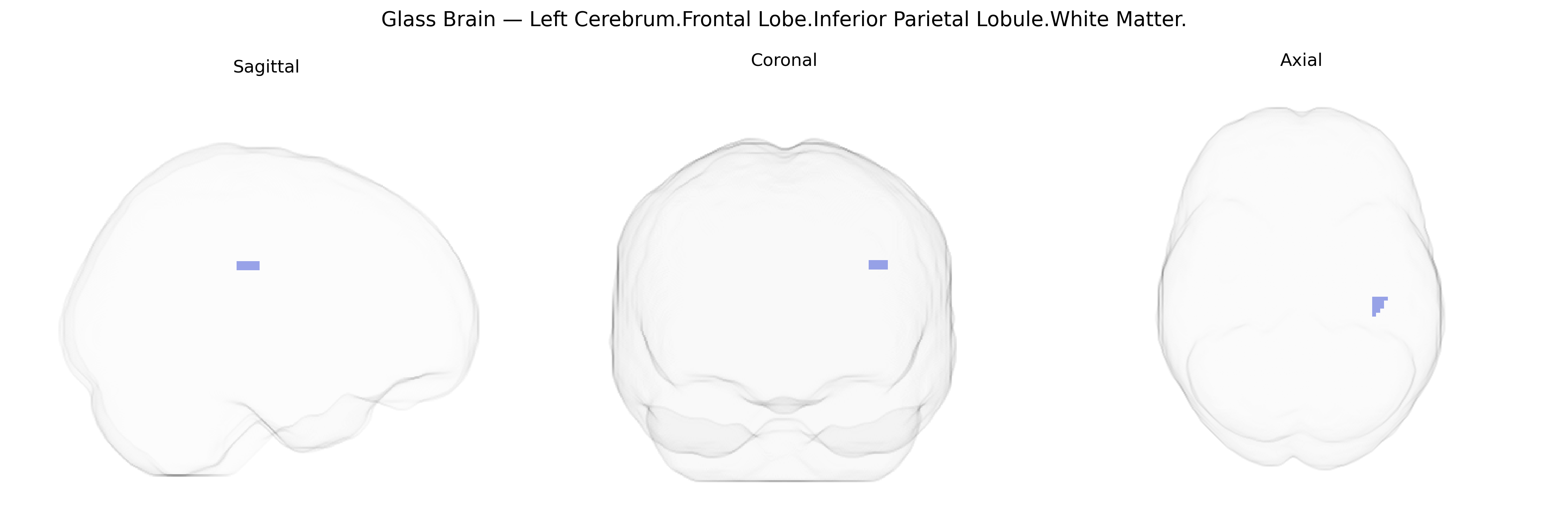
The bilateral Left Cerebrum.Frontal Lobe.Inferior Parietal Lobule.White Matter region, as defined in the Talairach 2 mm atlas, corresponds to subcortical white matter tracts underlying the inferior parietal lobule at the junction of the frontal and parietal lobes in the left hemisphere. These fibers include portions of long association pathways such as the superior longitudinal fasciculus and adjacent projection fibers that interconnect frontal executive and premotor areas with parietal regions involved in multisensory integration, spatial attention, and aspects of language and praxis. Functionally, this white matter supports the coordination of higher-order cognitive processes by enabling rapid information transfer between dorsal stream parietal systems and frontal control networks. There is no direct Wikipedia article for this specific white matter subdivision; a related cortical structure is the Inferior parietal lobule.
The bilateral left cerebrum frontal lobe–inferior parietal lobule white matter, as defined in the Talairach 2 mm atlas, lies within frontoparietal association networks whose microstructural properties have been repeatedly implicated in genetic studies of cognition, psychiatric risk, and neurodevelopment. Large-scale GWAS and imaging-genetics consortia (e.g., ENIGMA, UK Biobank) have identified heritable variation in white matter integrity (often measured via fractional anisotropy or mean diffusivity in frontoparietal tracts such as the superior longitudinal fasciculus and related fibers passing through this region) associated with common variants near genes involved in axon guidance, myelination, and synaptic plasticity, including but not limited to loci near genes such as CNTN4/CNTNAP family members, FOXP2-related networks, and oligodendrocyte/axon genes like MAG and MBP in broader white-matter GWAS. These frontoparietal white matter pathways have been genetically linked to general cognitive ability, working memory, language-related skills, and educational attainment, and have appeared as intermediate phenotypes in polygenic risk studies of schizophrenia, bipolar disorder, major depressive disorder, and autism spectrum disorder, where risk alleles correlate with reduced integrity or altered connectivity in frontoparietal circuits. Additionally, GWAS of white matter hyperintensities, small vessel disease, and stroke risk have implicated genes involved in vascular integrity (e.g., COL4A2 and related loci) that influence lesion burden and microstructural disruption in periventricular and deep frontal/parietal white matter, indirectly affecting this region. Although few studies target this exact Talairach label specifically, convergent imaging-genetic evidence indicates that the white matter underlying the inferior parietal and adjacent frontal regions is a genetically sensitive substrate for higher-order cognition and vulnerability to neuropsychiatric and cerebrovascular disorders.
Overview generated by GPT-4o (2026).
Region ID: 936
Hemisphere: bilateral
Atlas: Talairach labels 2mm
Full Quality Version: Download MP4
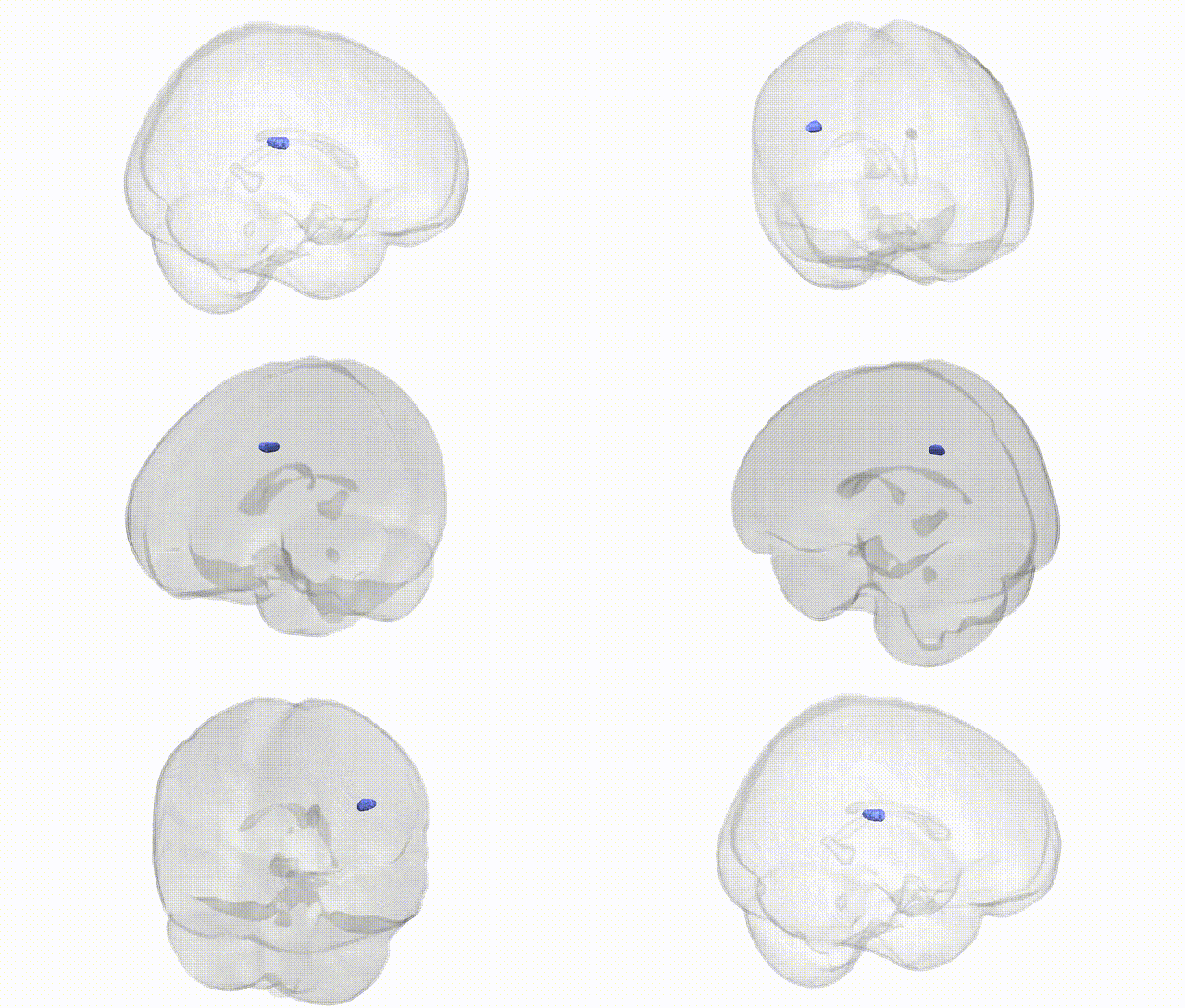
Full Quality Version: Download MP4
Wali Sidiqyar*, Gaurav Rudravaram*, Elyssa M. McMaster, Trent M. Schwartz, Adam M. Saunders, Kurt G. Schilling, Bennett A. Landman "Introducing SPINS: A Shared Public Visualization Library of Neuroanatomical Structures." Medical Imaging with Deep Learning- short paper
This resource is licensed under CC0 1.0 Universal (Public Domain).