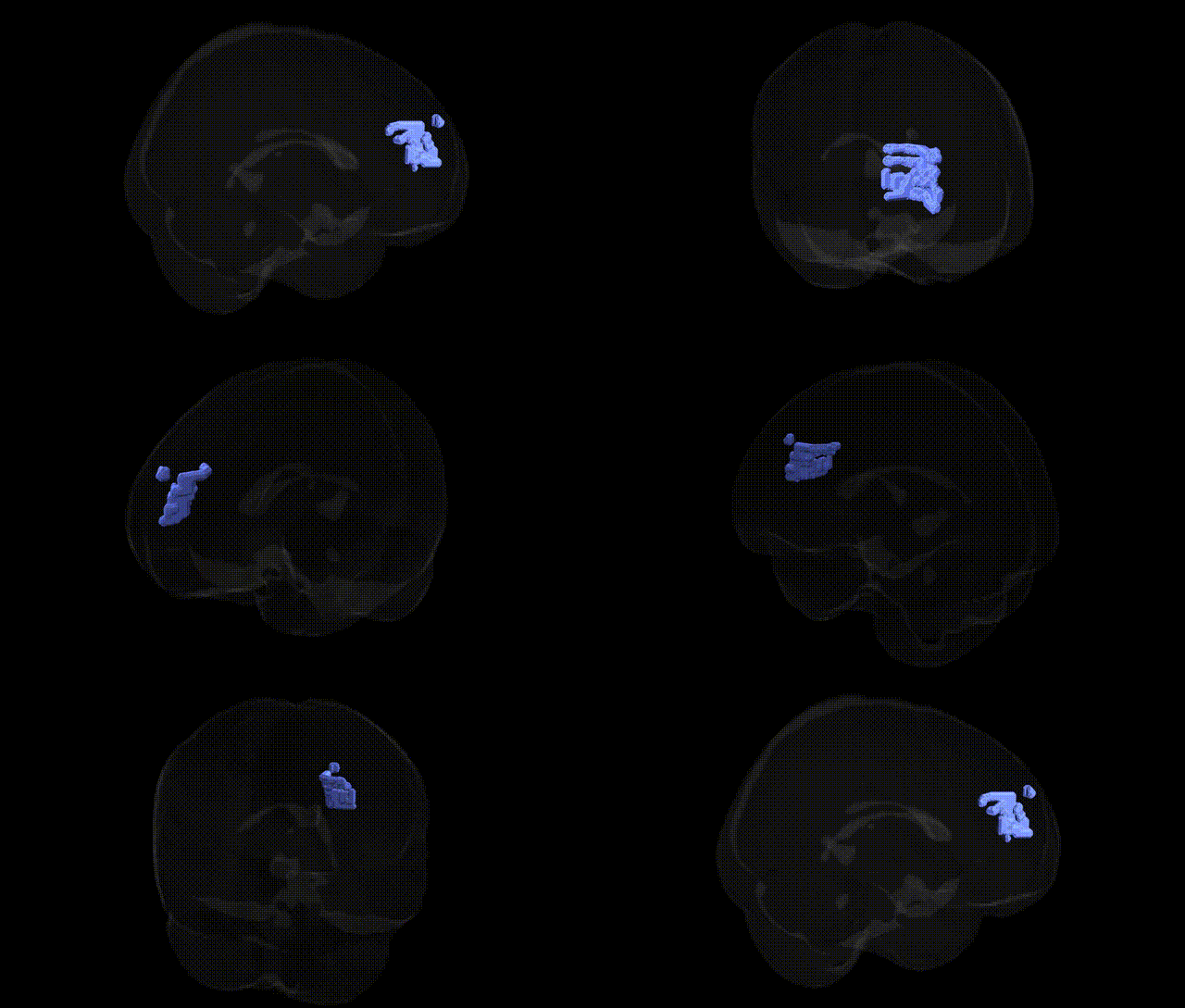
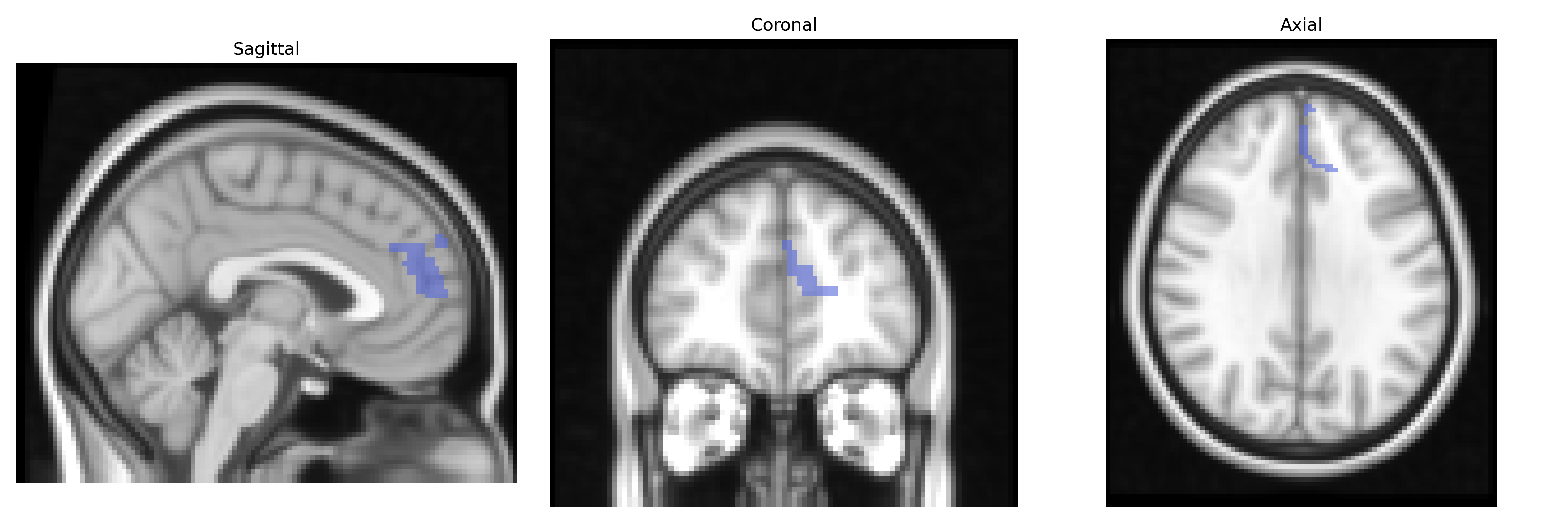
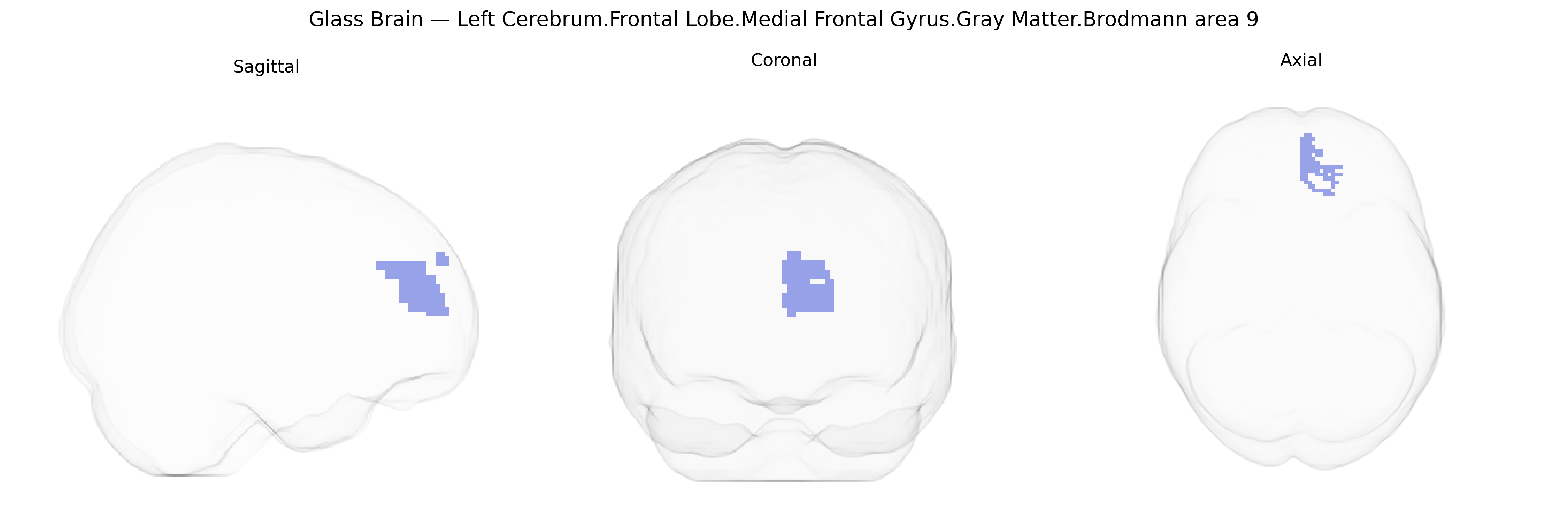
Bilateral Left Cerebrum.Frontal Lobe.Medial Frontal Gyrus.Gray Matter.Brodmann area 9 refers to higher-order association cortex located in the dorsomedial frontal lobe, encompassing medial portions of the superior frontal gyrus and adjacent medial frontal gyrus in both hemispheres but here labeled in the left cerebrum in the Talairach 2 mm Atlas. Brodmann area 9 is part of the dorsomedial prefrontal cortex and is implicated in executive functions, working memory, planning, cognitive control, and aspects of social cognition and metacognition, including self-referential thought and evaluation of actions and outcomes. Its gray matter cytoarchitecture is characterized by a well-developed granular layer and dense pyramidal neurons that form long-range connections with other prefrontal, parietal, and limbic regions, supporting integration of internal goals with external information during complex behavior. Brodmann area 9
The bilateral Left Cerebrum.Frontal Lobe.Medial Frontal Gyrus.Gray Matter.Brodmann area 9 (BA9) corresponds largely to dorsomedial/dorsolateral prefrontal cortex, a hub for executive control, working memory, and affective regulation, and has been repeatedly implicated in imaging genetics and GWAS of brain structure and function. Large-scale neuroimaging GWAS (e.g., ENIGMA, UK Biobank) have identified common variants near genes such as MHC region loci on chromosome 6, CACNA1C, GRM3, and ZNF804A that are associated with prefrontal cortical thickness, surface area, or activation, often overlapping with BA9, and these patterns frequently co-occur with polygenic risk for schizophrenia, bipolar disorder, and major depressive disorder. BA9 shows structural and functional alterations linked to risk alleles in serotonin transporter (SLC6A4), COMT (Val158Met), and BDNF (Val66Met), influencing medial frontal volume, connectivity, and activation during cognitive control and emotional tasks, and mediating genetic effects on anxiety, neuroticism, and stress reactivity. Imaging genetics studies have also related APOE, especially ε4, to frontal atrophy and functional changes including BA9 in aging and Alzheimer’s disease. Variants contributing to intelligence, educational attainment, and cognitive performance show enriched associations with frontoparietal networks including BA9, and GWAS of personality traits (e.g., neuroticism, conscientiousness) and ADHD implicate genes affecting frontostriatal circuitry with convergent BA9 involvement. Overall, although specific Talairach-2mm BA9 voxels are rarely targeted directly, converging evidence from GWAS and candidate-gene imaging studies indicates that multiple neurodevelopmental, synaptic, neurotransmitter, and immune-related loci modulate the structure and function of medial/dorsolateral prefrontal cortex encompassing Brodmann area 9, thereby contributing to risk for major psychiatric disorders, cognitive traits, and age-related neurodegeneration.
Overview generated by GPT-4o (2026).
Region ID: 814
Hemisphere: bilateral
Atlas: Talairach labels 2mm
Full Quality Version: Download MP4
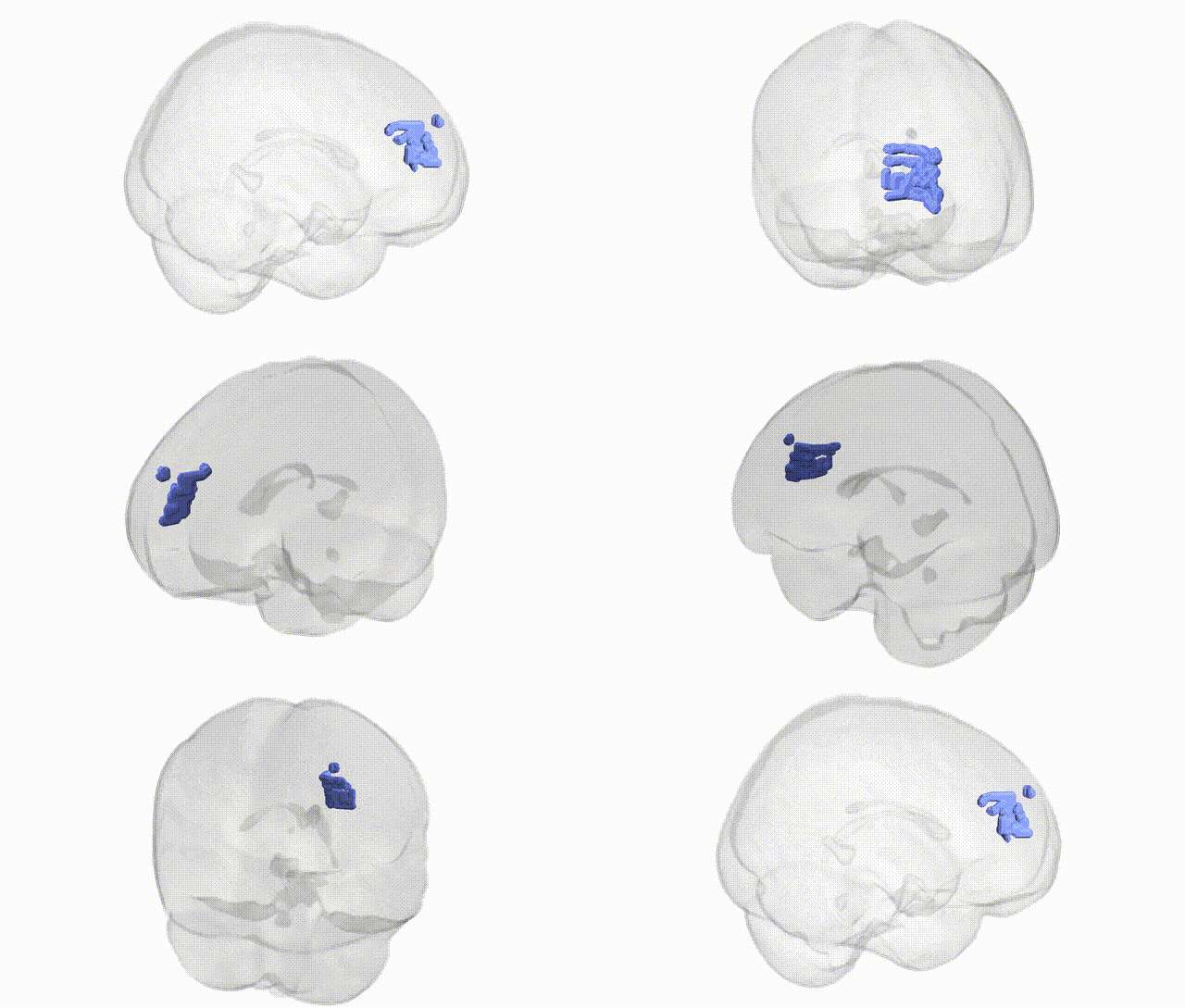
Full Quality Version: Download MP4
Wali Sidiqyar*, Gaurav Rudravaram*, Elyssa M. McMaster, Trent M. Schwartz, Adam M. Saunders, Kurt G. Schilling, Bennett A. Landman "Introducing SPINS: A Shared Public Visualization Library of Neuroanatomical Structures." Medical Imaging with Deep Learning- short paper
This resource is licensed under CC0 1.0 Universal (Public Domain).