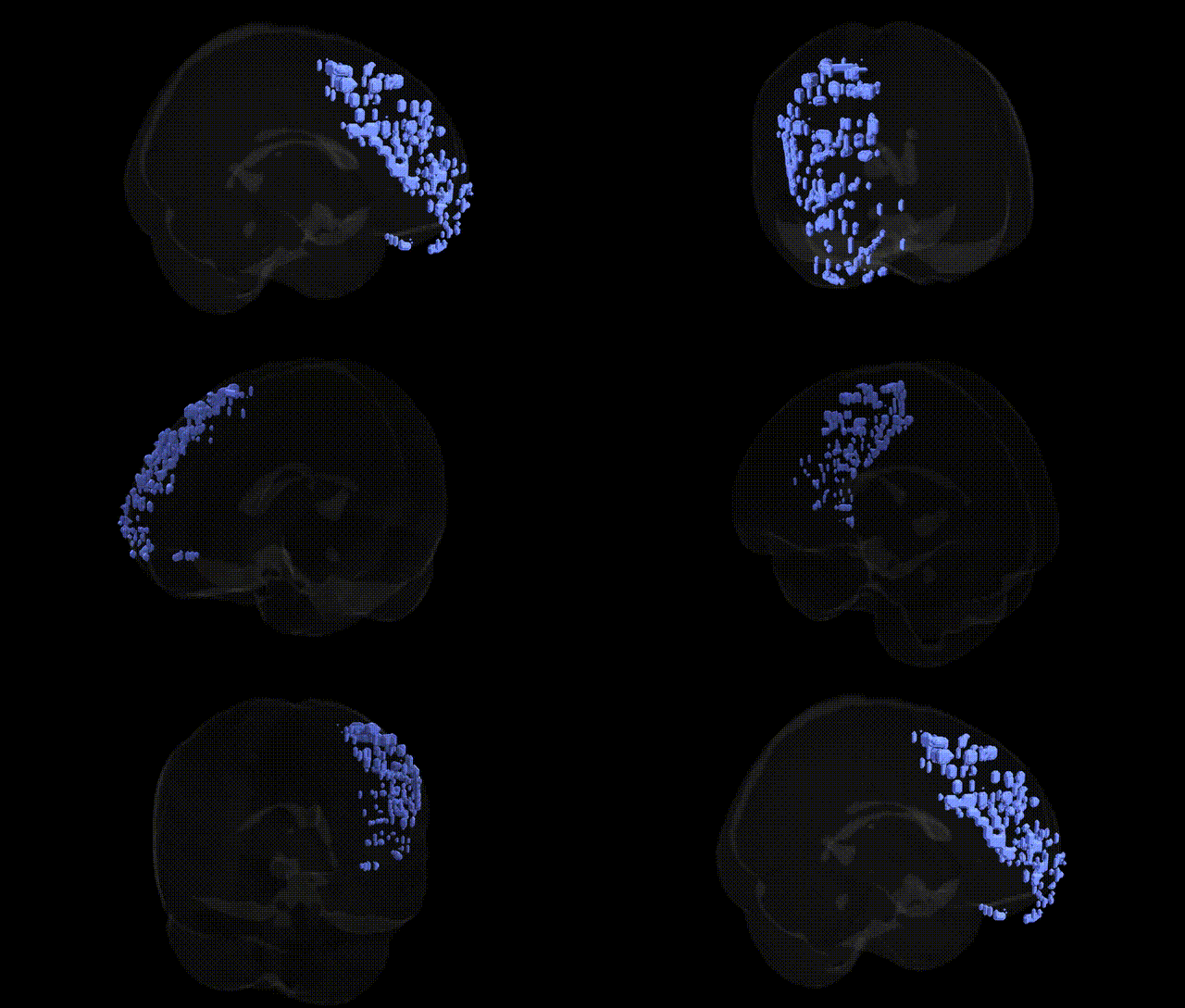
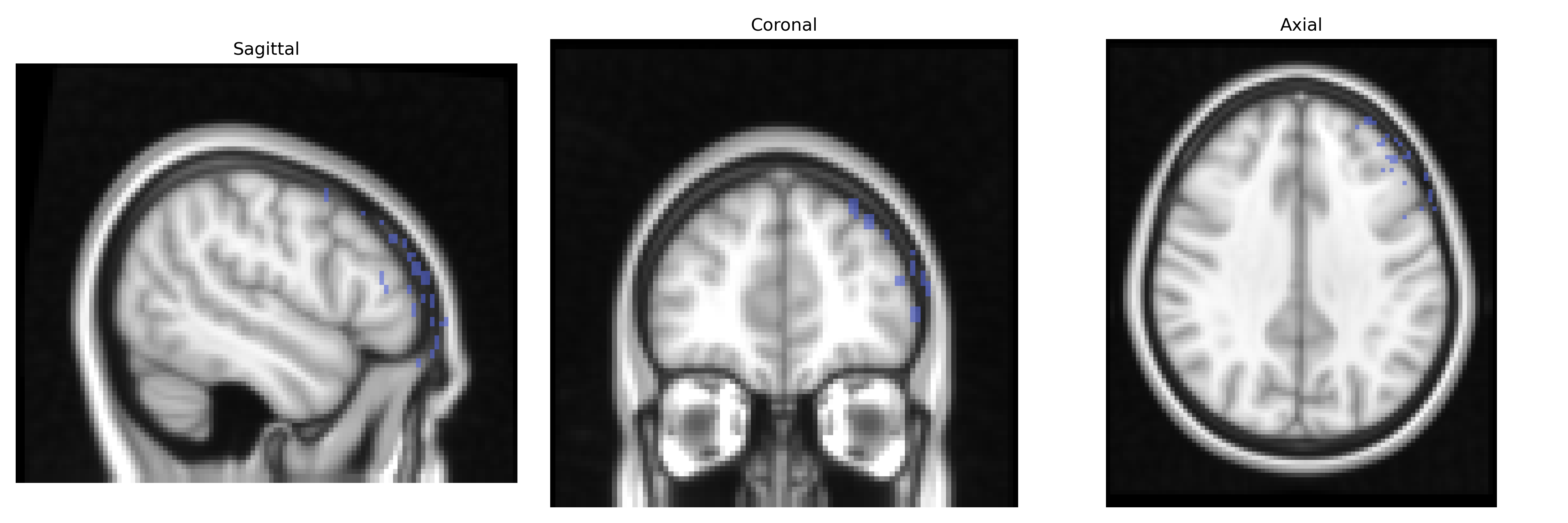
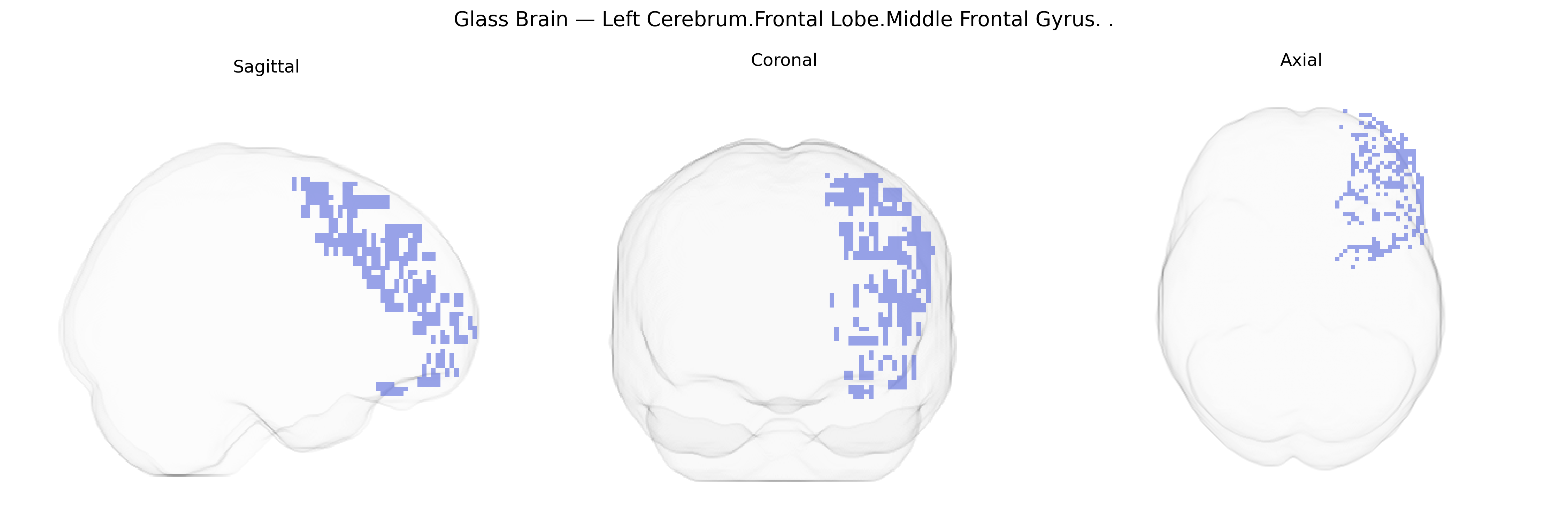
The bilateral Left Cerebrum.Frontal Lobe.Middle Frontal Gyrus corresponds to the middle frontal gyrus of the frontal lobe, a dorsolateral cortical region involved in higher-order executive functions. It participates in working memory, attentional control, planning, decision-making, and the regulation of goal-directed behavior, and is closely associated with the dorsolateral prefrontal cortex circuitry. This region integrates sensory and mnemonic information to guide complex cognitive operations, contributes to the selection and monitoring of actions, and is implicated in cognitive flexibility and aspects of social cognition. Although the Talairach label specifies the left cerebrum and a bilateral grouping, the anatomical term “middle frontal gyrus” generally refers to a symmetric structure present in both hemispheres, connected via interhemispheric fibers and interacting with parietal, temporal, and limbic areas. There is no direct Wikipedia article for the exact Talairach label; a closely related structure is the dorsolateral prefrontal cortex: Dorsolateral prefrontal cortex.
The bilateral middle frontal gyrus in the left frontal lobe, corresponding to the Talairach “Left Cerebrum.Frontal Lobe.Middle Frontal Gyrus” region, has been repeatedly implicated in genetic and genome‑wide association studies through its role in executive function, working memory, cognitive control, and emotion regulation. Imaging genetics work shows that common variants in genes related to dopaminergic and glutamatergic signaling (e.g., COMT, DRD2, DARPP‑32/PPP1R1B, GRM3), neurodevelopment and synaptic plasticity (e.g., BDNF, CNTNAP2, DISC1, NRG1), and cell adhesion/axon guidance (e.g., CADM2, NCAM1) modulate middle frontal gyrus activation and morphology during tasks involving working memory, response inhibition, and decision‑making. Large GWAS meta‑analyses of cortical structure have identified heritable variation in middle frontal gyrus thickness and surface area, often mapping to loci involved in neurodevelopmental pathways (Wnt signaling, chromatin regulation, neuronal migration). This region’s structure and function has been genetically associated with schizophrenia, bipolar disorder, major depressive disorder, ADHD, autism spectrum disorder, and anxiety disorders, where risk variants and polygenic risk scores for these conditions frequently predict reduced gray matter volume, altered connectivity, or abnormal activation in the middle frontal gyrus. GWAS of cognitive performance and educational attainment, as well as traits like impulsivity and risk‑taking, also point to genetic influences that partly act through prefrontal circuits including the middle frontal gyrus, linking common variants to both frontal cortical architecture and task‑related activation patterns in this region.
Overview generated by GPT-4o (2026).
Region ID: 233
Hemisphere: bilateral
Atlas: Talairach labels 2mm
Full Quality Version: Download MP4
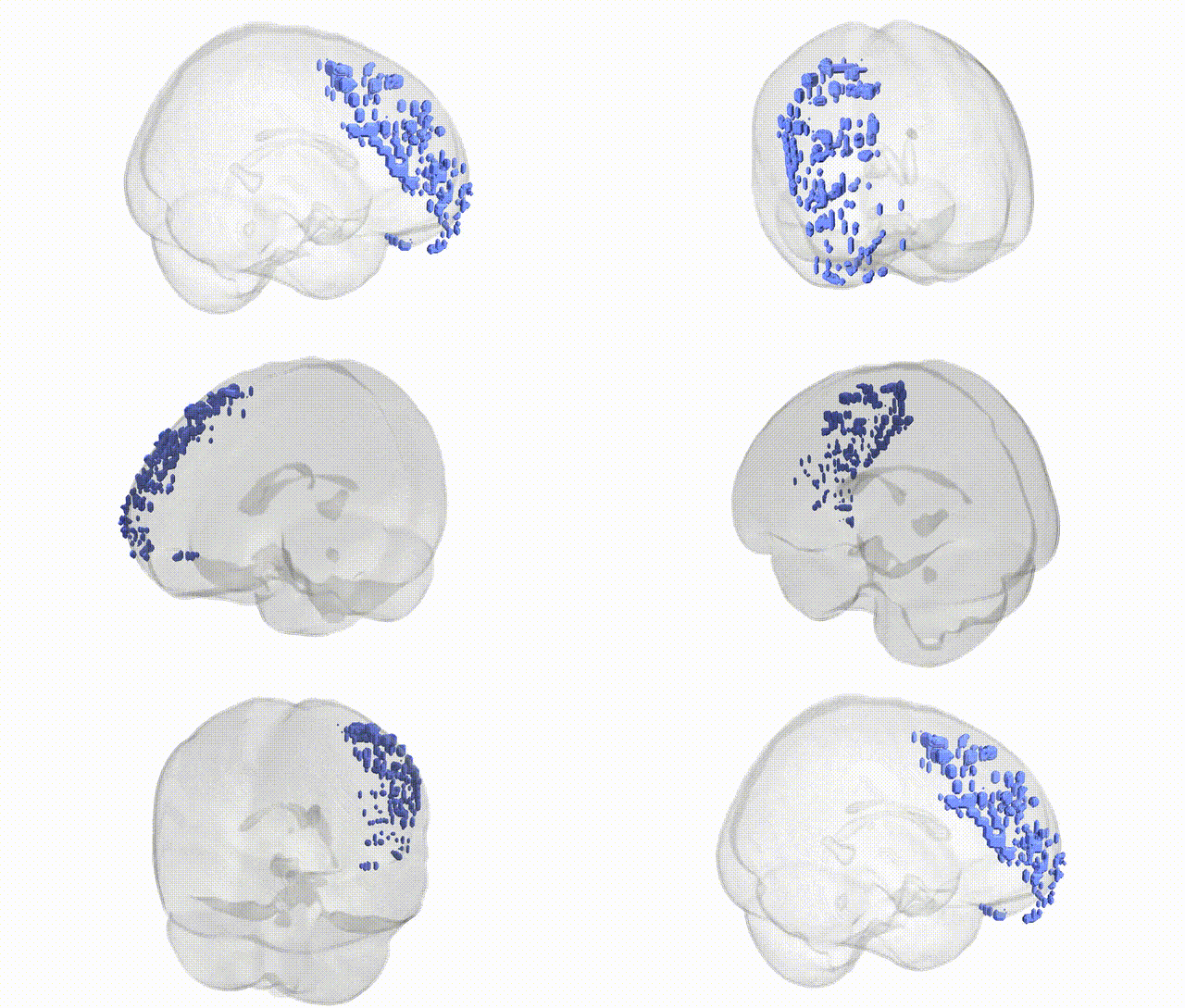
Full Quality Version: Download MP4
Wali Sidiqyar*, Gaurav Rudravaram*, Elyssa M. McMaster, Trent M. Schwartz, Adam M. Saunders, Kurt G. Schilling, Bennett A. Landman "Introducing SPINS: A Shared Public Visualization Library of Neuroanatomical Structures." Medical Imaging with Deep Learning- short paper
This resource is licensed under CC0 1.0 Universal (Public Domain).