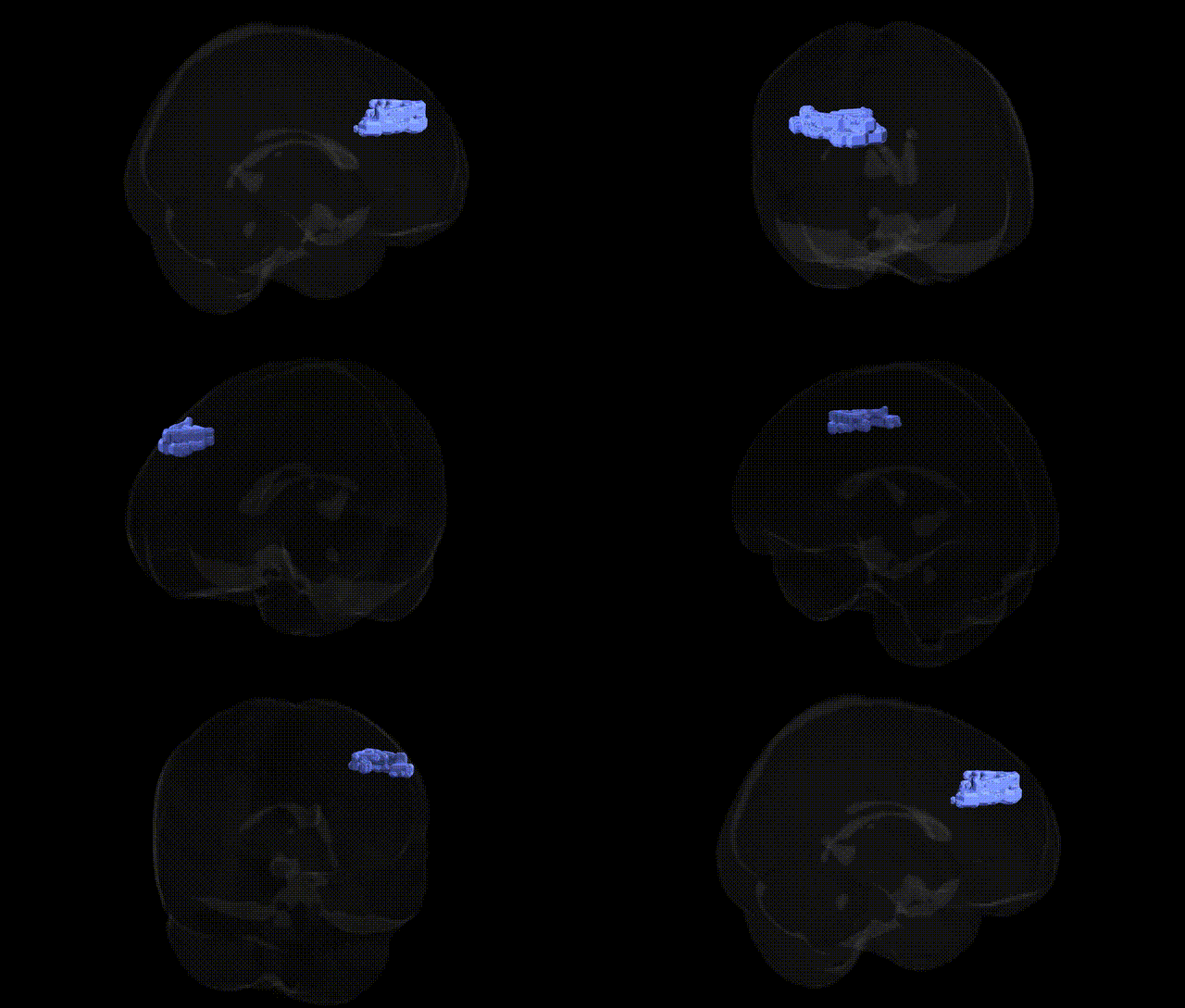
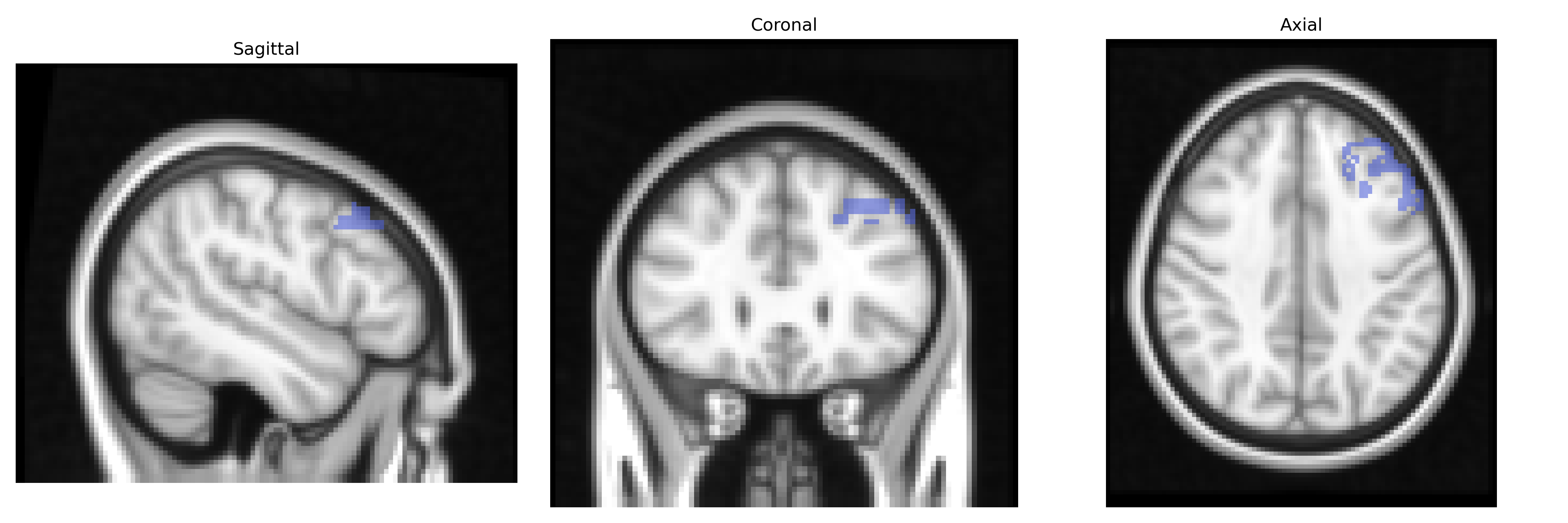
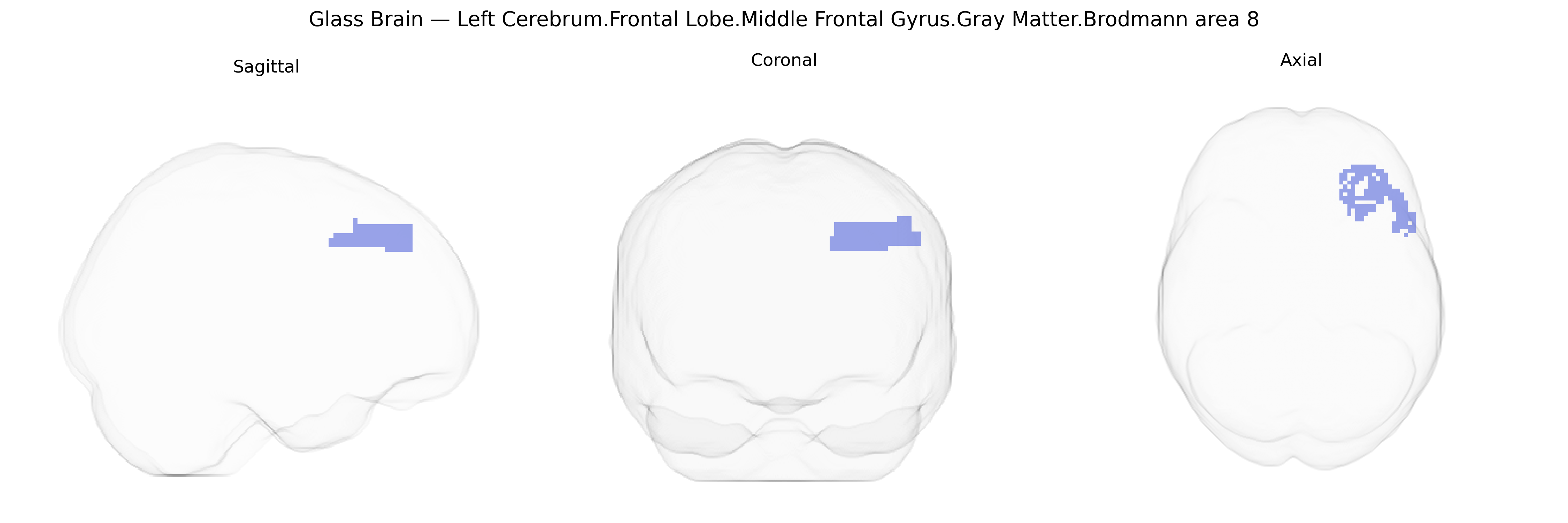
Bilateral Left Cerebrum.Frontal Lobe.Middle Frontal Gyrus.Gray Matter.Brodmann area 8 corresponds to a dorsal prefrontal cortical region implicated in the control of eye movements, spatial attention, and higher-order executive functions. Situated in the middle frontal gyrus of the frontal lobe within the left hemisphere, Brodmann area 8 contributes to voluntary saccadic eye control and orienting behavior, and participates in planning, decision-making, and working memory processes through its extensive connections with parietal, premotor, and subcortical structures. Functionally, it is often associated with the human frontal eye fields and is involved in integrating sensory information to guide goal-directed actions and cognitive control over behavior. There is no direct link for “Brodmann area 8”; a related structure is Frontal eye fields.
The bilateral left middle frontal gyrus (BA8) has been implicated in genetic studies largely through its role in cognitive control, working memory, and higher-order executive function, with structural and functional variation in this region emerging as a key intermediate phenotype in several GWAS and imaging-genetics analyses. Common variants near genes involved in synaptic plasticity and neurodevelopment, including CACNA1C, ZNF804A, and COMT, have been associated with altered prefrontal cortical thickness or activation, often encompassing BA8, in schizophrenia and bipolar disorder cohorts, while polygenic risk scores for these disorders correlate with reduced gray matter volume or disrupted connectivity in dorsolateral prefrontal areas including BA8. GWAS of general cognitive ability and educational attainment have identified many loci—such as those near FNBP1L, FOXO3, and MAPT—that show downstream associations with prefrontal morphology and activation patterns, and BA8 frequently appears in meta-analytic maps of intelligence, working memory, and fluid reasoning as a convergence zone for these polygenic effects. In major depressive disorder and anxiety, variants in serotonergic and glutamatergic genes (e.g., SLC6A4, GRM3) and large polygenic burdens have been linked to altered BA8 function during emotion regulation and conflict monitoring. Additionally, imaging-genetics work in ADHD, obsessive–compulsive disorder, and autism spectrum conditions has found that risk variants affecting frontostriatal and frontoparietal circuitry (including those in DRD4, CNTNAP2, and several synaptic scaffolding genes) are associated with structural and functional changes in mid-frontal regions overlapping BA8, suggesting that this area is a recurrent target of pleiotropic genetic influences on executive function, cognitive control, and psychiatric vulnerability, even though few loci are uniquely specific to BA8 itself.
Overview generated by GPT-4o (2026).
Region ID: 1025
Hemisphere: bilateral
Atlas: Talairach labels 2mm
Full Quality Version: Download MP4
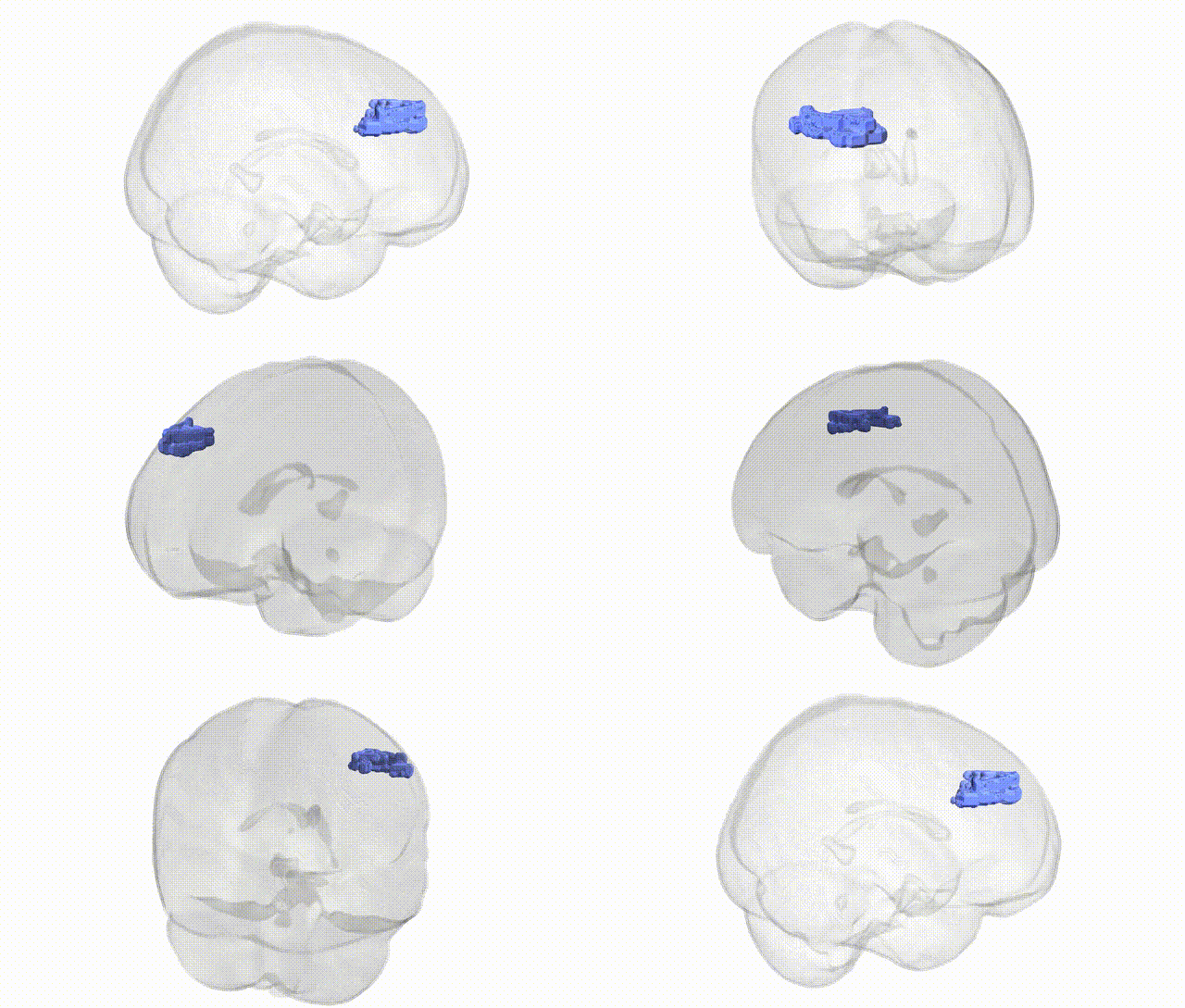
Full Quality Version: Download MP4
Wali Sidiqyar*, Gaurav Rudravaram*, Elyssa M. McMaster, Trent M. Schwartz, Adam M. Saunders, Kurt G. Schilling, Bennett A. Landman "Introducing SPINS: A Shared Public Visualization Library of Neuroanatomical Structures." Medical Imaging with Deep Learning- short paper
This resource is licensed under CC0 1.0 Universal (Public Domain).