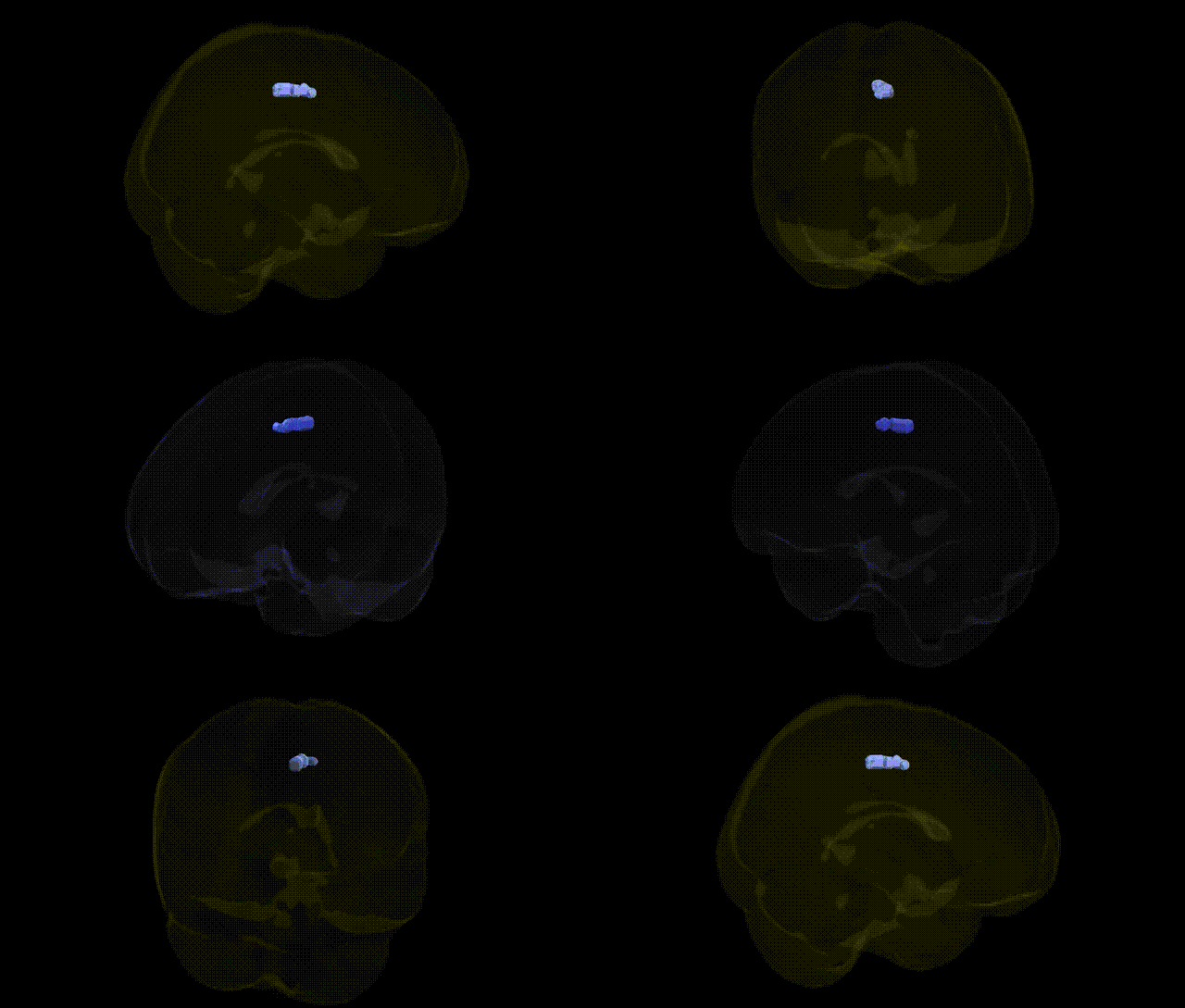
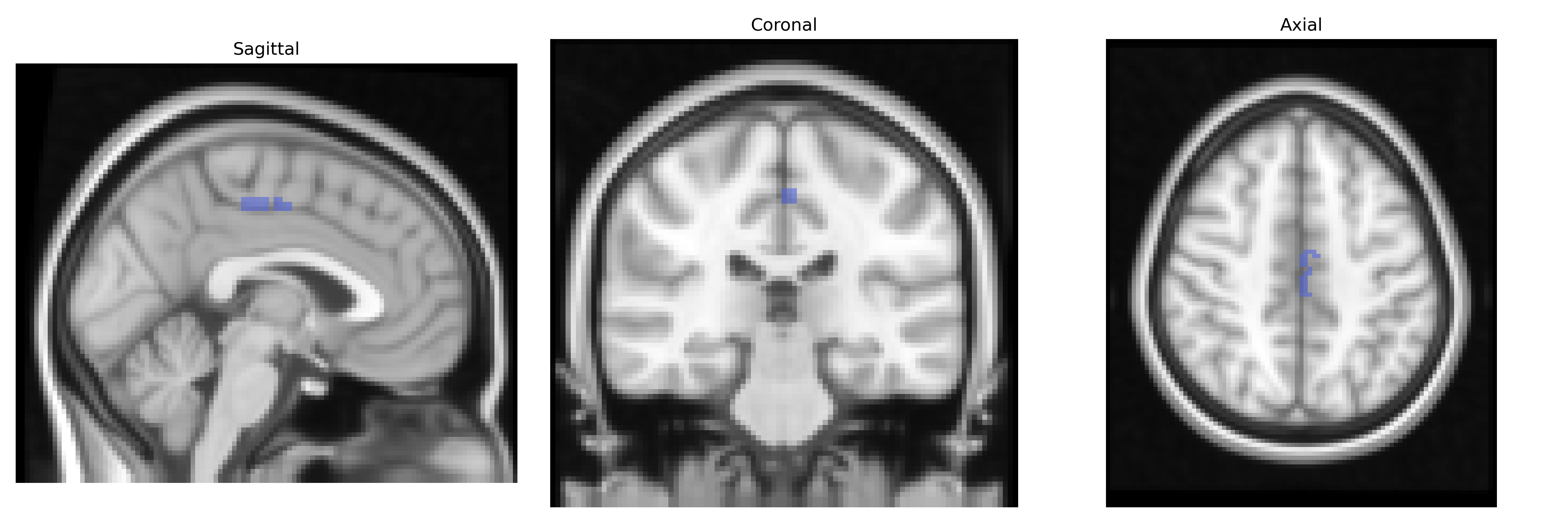
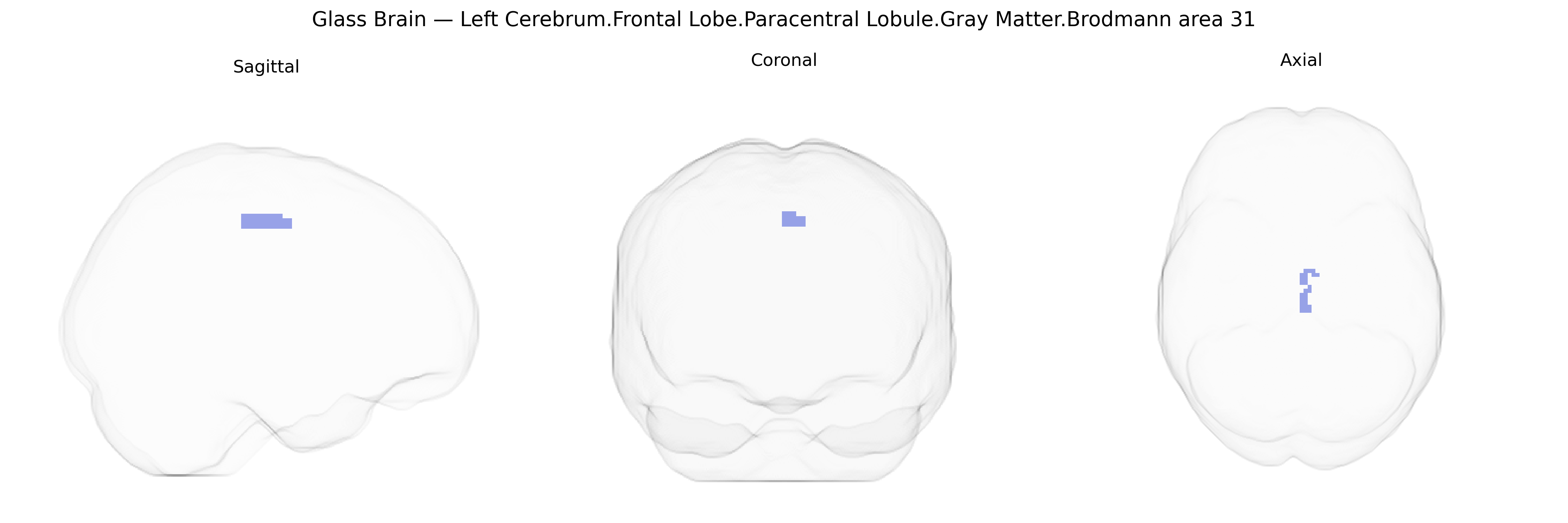
The bilateral Left Cerebrum.Frontal Lobe.Paracentral Lobule.Gray Matter.Brodmann area 31 region, as labeled in the Talairach 2 mm Atlas, represents a functional-parcellation overlap where the posterior-medial frontal/anterior parietal paracentral lobule is associated with the cytoarchitectonic territory of Brodmann area 31, a portion of the posterior cingulate/retrosplenial cortex. Functionally, BA31 is implicated in higher-order associative processes including visuospatial integration, self-referential thought, and components of the default mode network, while the paracentral lobule contributes to sensorimotor functions related to the lower extremities. The apparent co-labeling reflects atlas-based coordinate assignment rather than a strict anatomical correspondence, highlighting the convergence of motor/somatosensory processing with midline associative and attentional networks. There is no direct Wikipedia article for this composite region; a closely related structure is Brodmann area 31.
The bilateral Left Cerebrum.Frontal Lobe.Paracentral Lobule.Gray Matter.Brodmann area 31 region (a medial frontoparietal/posterior cingulate–adjacent territory in the Talairach 2 mm atlas) lies within the broader default mode and sensorimotor networks, and genetic associations for this specific label are typically inferred from imaging genetics and GWAS of brain structure and function rather than single-region candidate studies. Large-scale GWAS of cortical thickness and surface area (e.g., ENIGMA, UK Biobank) have identified polygenic influences from loci near genes such as MAPT, KIAA0586, and variants in microtubule and synaptic pathways that affect medial frontal and posterior cingulate morphology, which spatially overlaps Brodmann area 31 and adjacent paracentral lobule cortex. Imaging–genetic studies linking resting-state default mode connectivity and task-related activation to common variants in genes related to glutamatergic signaling (e.g., GRM3), dopamine (e.g., COMT), and neurodevelopment (e.g., CNTNAP2) frequently report effects in medial frontal and posterior cingulate regions that include BA31. GWAS of neuropsychiatric and cognitive traits—major depressive disorder (e.g., loci in SLC6A15, NEGR1), schizophrenia and psychosis (e.g., CACNA1C, ZNF804A), Alzheimer’s disease risk (e.g., APOE, CLU, PICALM), and general cognitive ability—have shown that polygenic risk burden alters gray matter volume, cortical thickness, and functional connectivity in this medial frontal/posterior cingulate zone, implicating BA31 in mood regulation, self-referential processing, and memory networks. Additionally, motor-related paracentral regions bordering BA31 have been linked via GWAS and imaging genetics to susceptibility for motor neuron disease, multiple sclerosis, and Parkinsonian traits, where risk variants modulate sensorimotor cortical structure and excitability. Overall, the genetic architecture of this Talairach-defined BA31/paracentral lobule region is highly polygenic, shared across many brain-wide traits, and most robustly characterized through large GWAS of cortical morphology, connectivity, and neuropsychiatric disease rather than studies targeting this label in isolation.
Overview generated by GPT-4o (2026).
Region ID: 1045
Hemisphere: bilateral
Atlas: Talairach labels 2mm
Full Quality Version: Download MP4
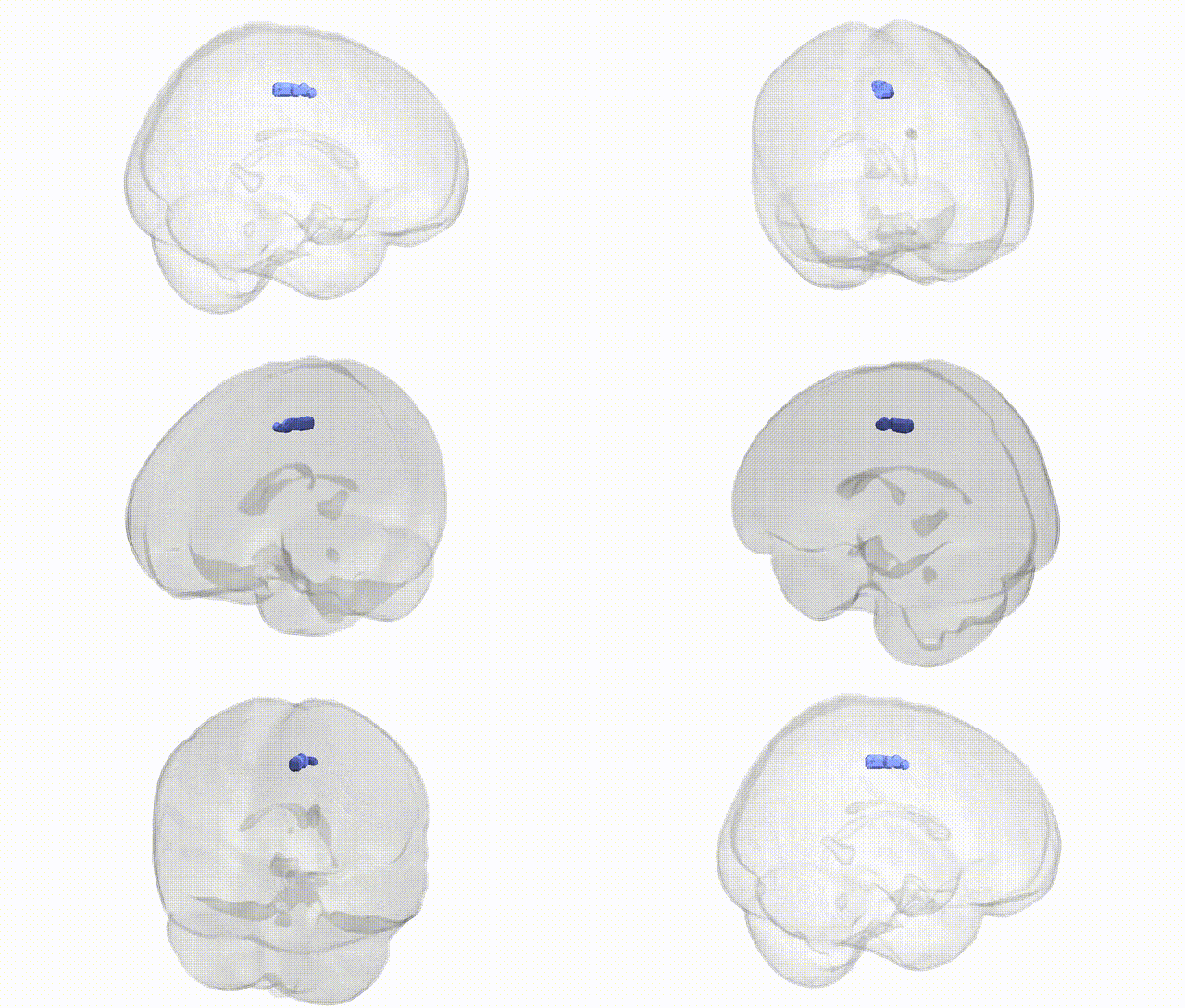
Full Quality Version: Download MP4
Wali Sidiqyar*, Gaurav Rudravaram*, Elyssa M. McMaster, Trent M. Schwartz, Adam M. Saunders, Kurt G. Schilling, Bennett A. Landman "Introducing SPINS: A Shared Public Visualization Library of Neuroanatomical Structures." Medical Imaging with Deep Learning- short paper
This resource is licensed under CC0 1.0 Universal (Public Domain).