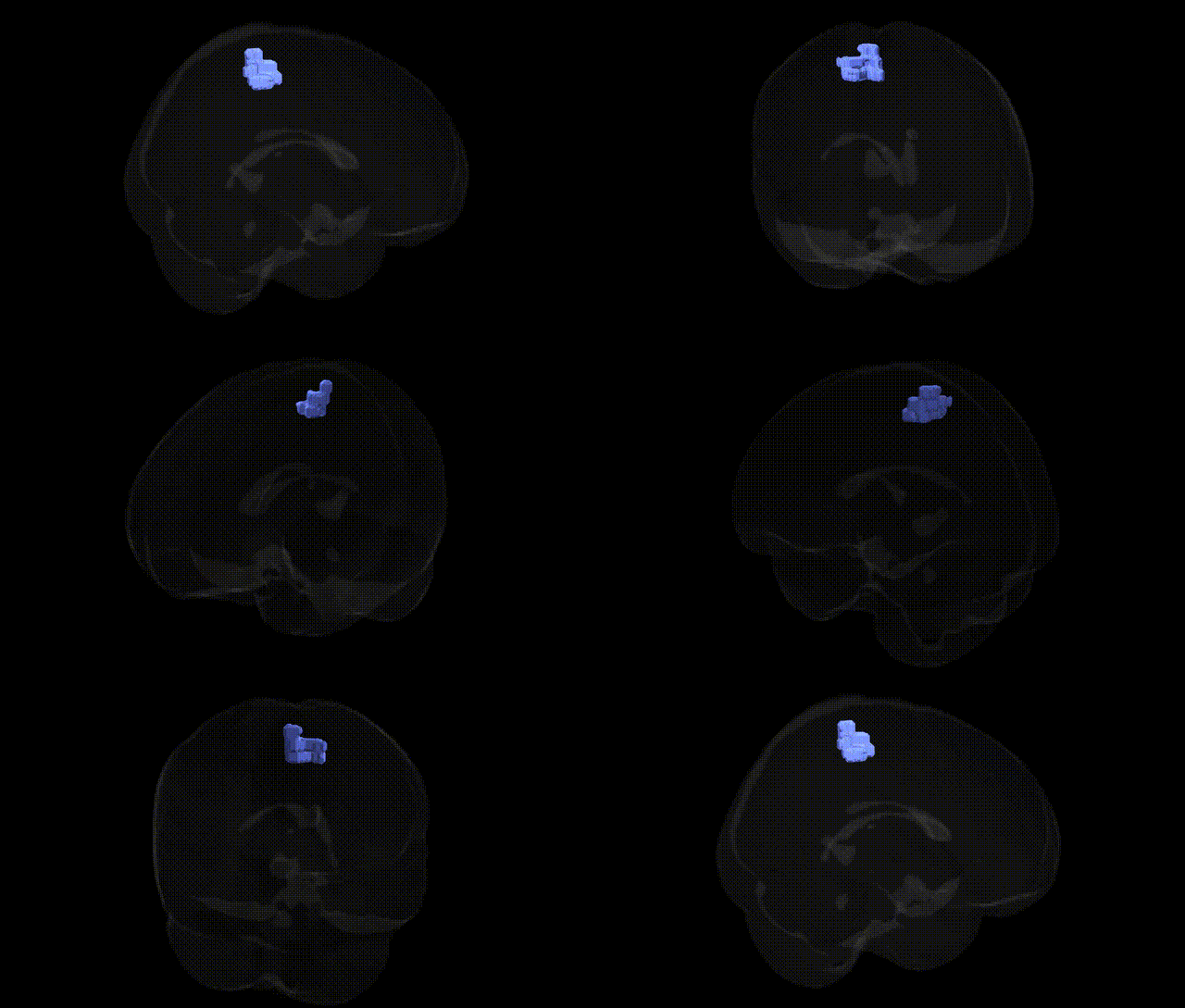
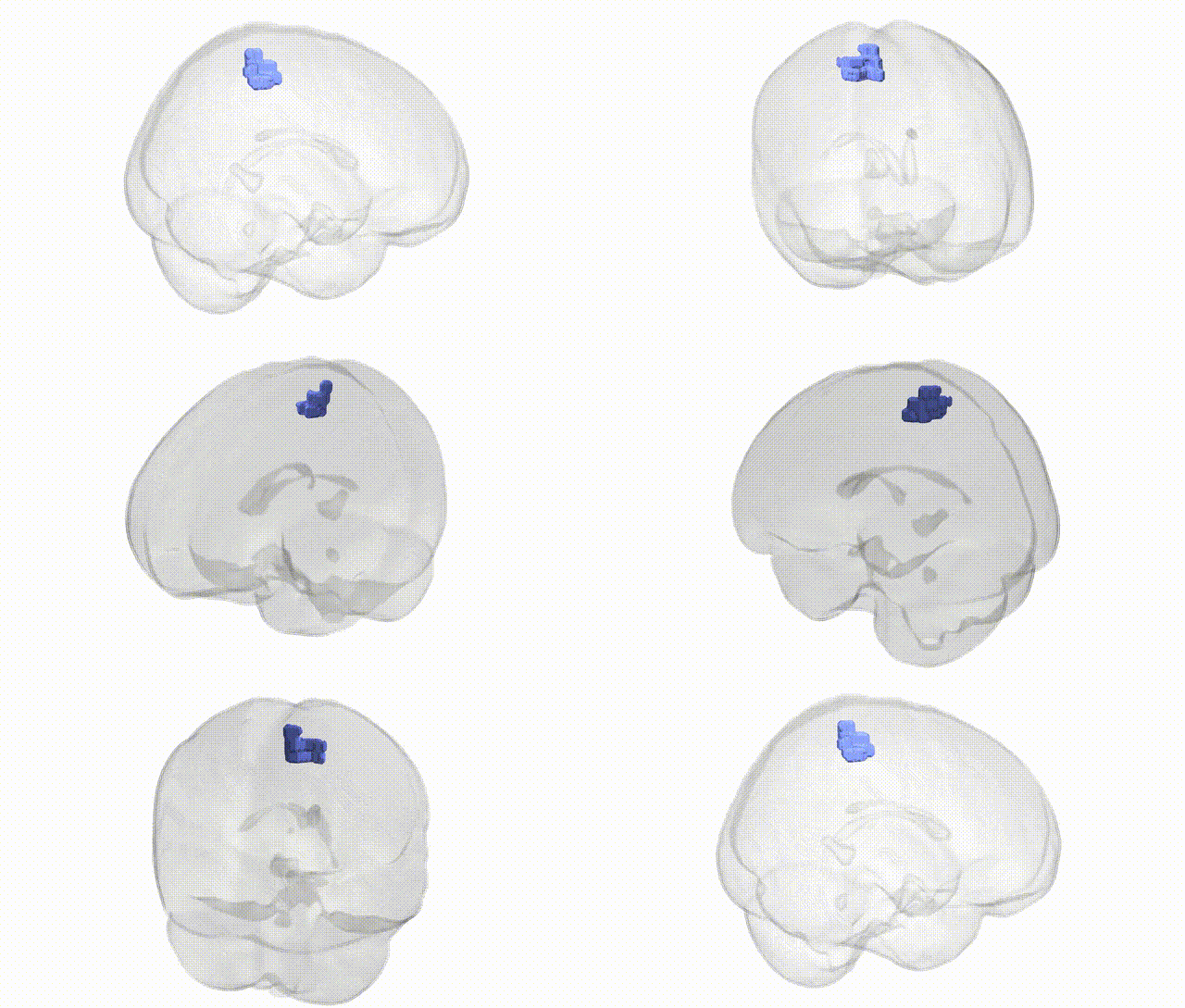
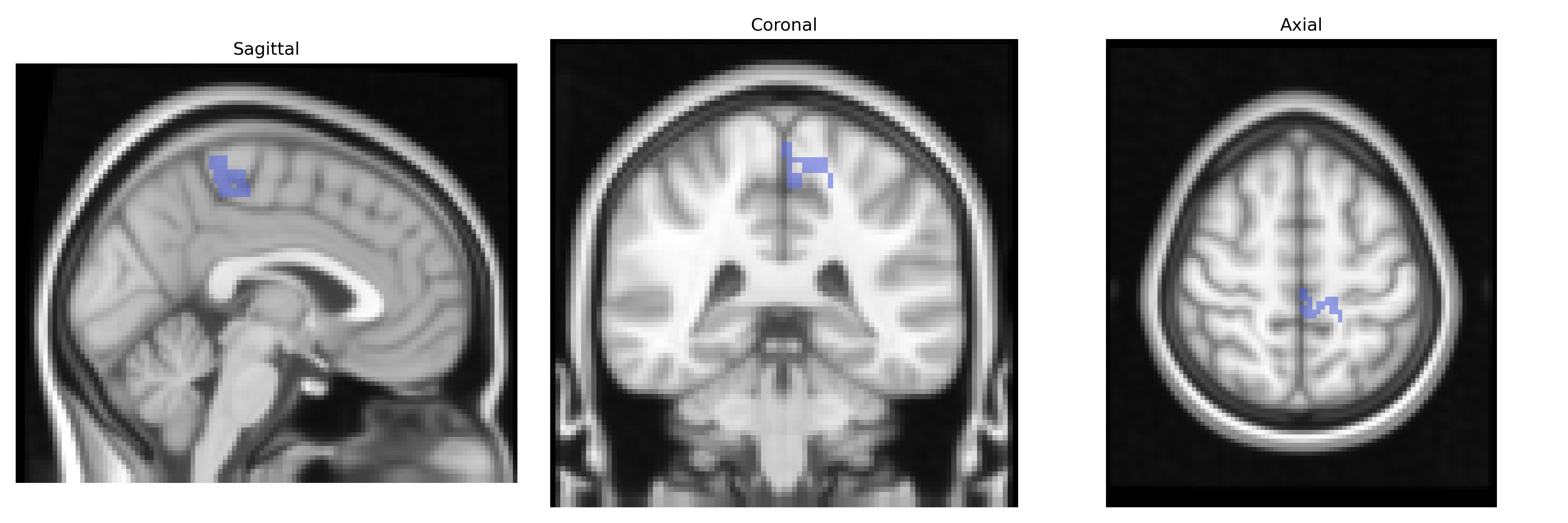
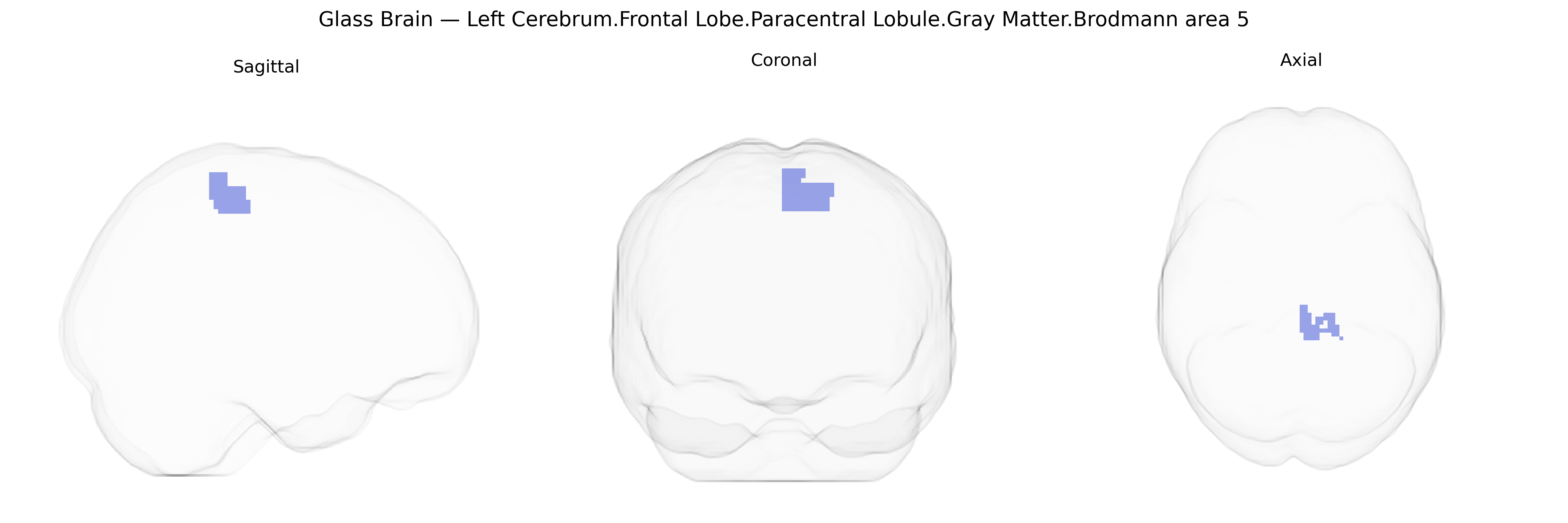
The bilateral Left Cerebrum.Frontal Lobe.Paracentral Lobule.Gray Matter.Brodmann area 5 corresponds to a superior medial cortical territory principally involved in higher-order somatosensory processing and sensorimotor integration. Although Brodmann area 5 is classically described in the superior parietal lobule, Talairach-based parcellations can extend its label into adjacent medial regions including the paracentral lobule, where it contributes to the integration of proprioceptive, tactile, and kinesthetic information essential for the planning and modulation of complex movements. This region receives dense input from primary somatosensory cortex (area 3) and projects to premotor and motor areas, supporting functions such as body schema representation, limb position awareness, and coordinated voluntary action. There is no direct link for this exact Talairach-defined region; a closely related structure is Brodmann area 5.
The bilateral Left Cerebrum.Frontal Lobe.Paracentral Lobule.Gray Matter.Brodmann area 5 (BA5) region, as defined in the Talairach 2 mm atlas, lies in medial sensorimotor cortex and is consistently implicated in genetic studies of motor function, somatosensory processing, and cortical morphology. GWAS of brain structure (e.g., ENIGMA and UK Biobank–based studies) have identified multiple loci influencing regional cortical thickness and surface area in medial paracentral/sensorimotor areas, including variants near genes such as MAPT and KANSL1 on 17q21.31, and broader neurodevelopmental genes like HMGA2, which show pleiotropic effects on global and regional cortical measures. This region participates in networks affected in neurodegenerative and neurodevelopmental conditions—motor cortex–adjoining paracentral areas show structural and functional alterations in amyotrophic lateral sclerosis, multiple sclerosis, and hereditary spastic paraplegia, where causal or risk genes (e.g., C9orf72, SPG7, KIF5A) have been associated with motor-system degeneration that includes medial frontal sensorimotor cortex. Large psychiatric GWAS consortia (schizophrenia, major depression, bipolar disorder, ADHD) report polygenic influences on frontal cortical thickness and connectivity, with paracentral/BA5 involvement within distributed networks, though these links are typically indirect and mediated via global or network-level imaging phenotypes rather than region-specific loci. Additionally, GWAS of pain sensitivity, gait and balance, and fine motor coordination have identified polygenic architectures that map in imaging–genetic studies to medial paracentral/somatosensory regions, suggesting that BA5 is a downstream anatomical substrate of genetic influences on sensorimotor and somatosensory traits, even though few associations are uniquely specific to this Brodmann area.
Overview generated by GPT-4o (2026).
Region ID: 1068
Hemisphere: bilateral
Atlas: Talairach labels 2mm
Full Quality Version: Download MP4
Full Quality Version: Download MP4
Wali Sidiqyar*, Gaurav Rudravaram*, Elyssa M. McMaster, Trent M. Schwartz, Adam M. Saunders, Kurt G. Schilling, Bennett A. Landman "Introducing SPINS: A Shared Public Visualization Library of Neuroanatomical Structures." Medical Imaging with Deep Learning- short paper
This resource is licensed under CC0 1.0 Universal (Public Domain).