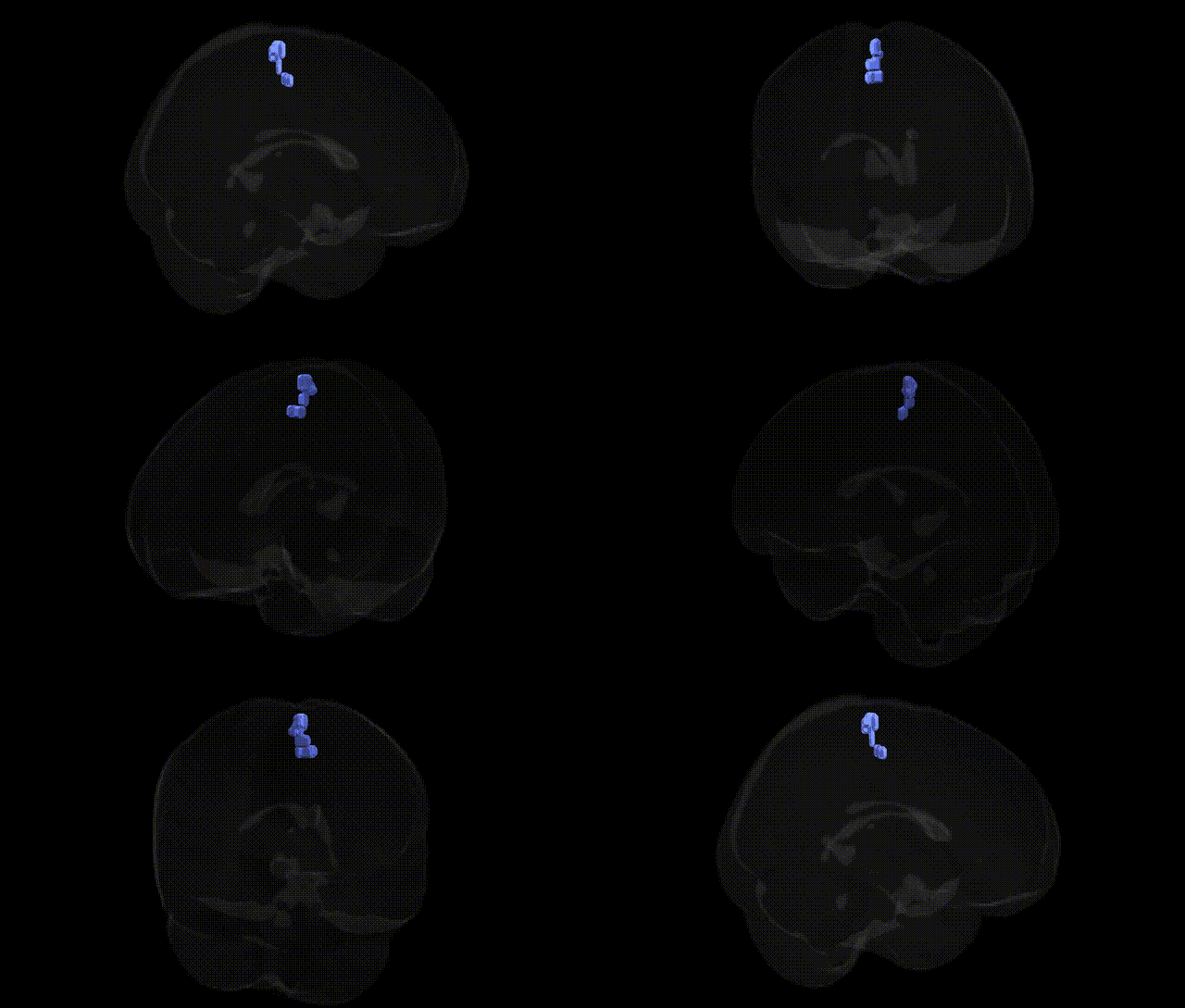
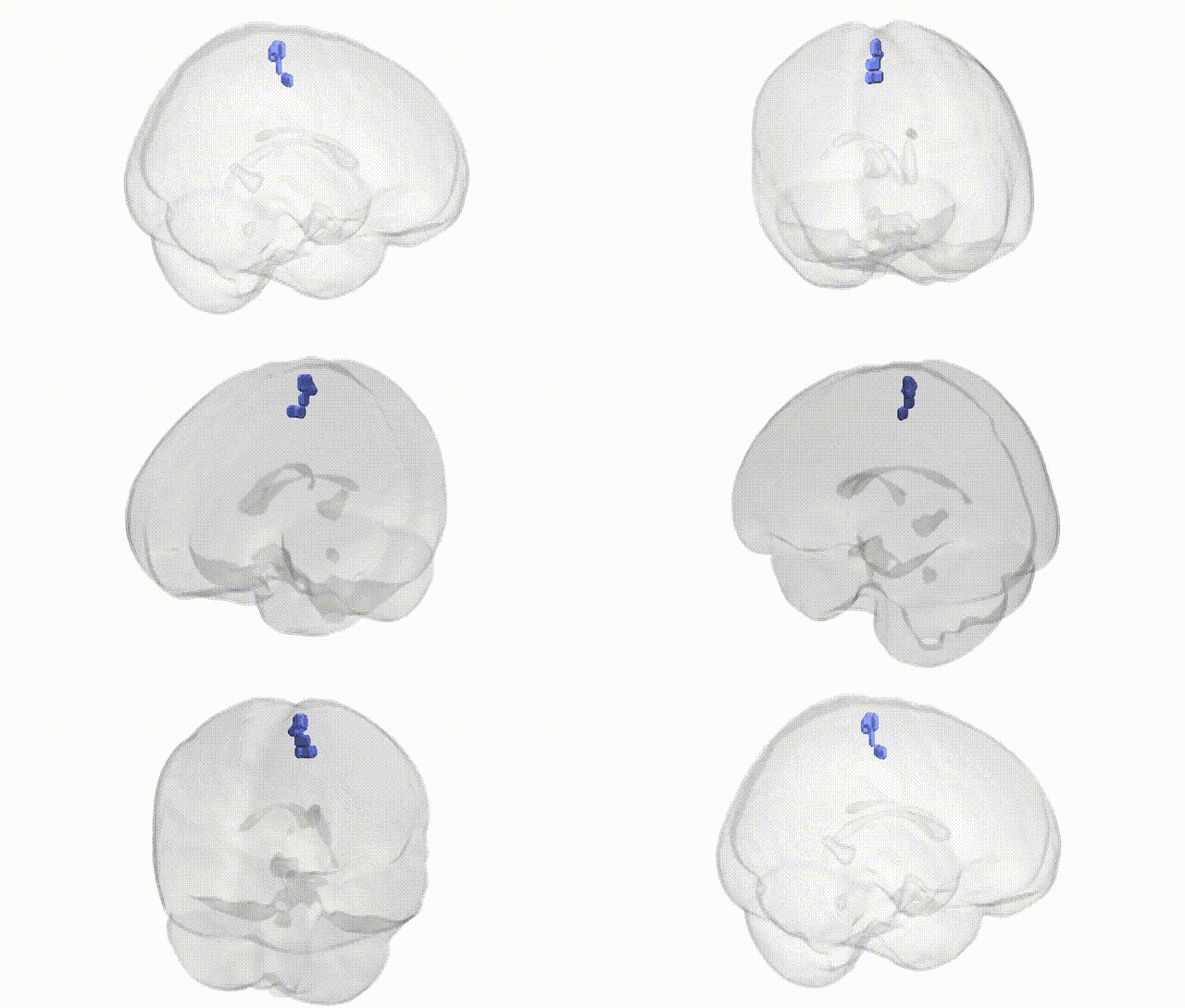
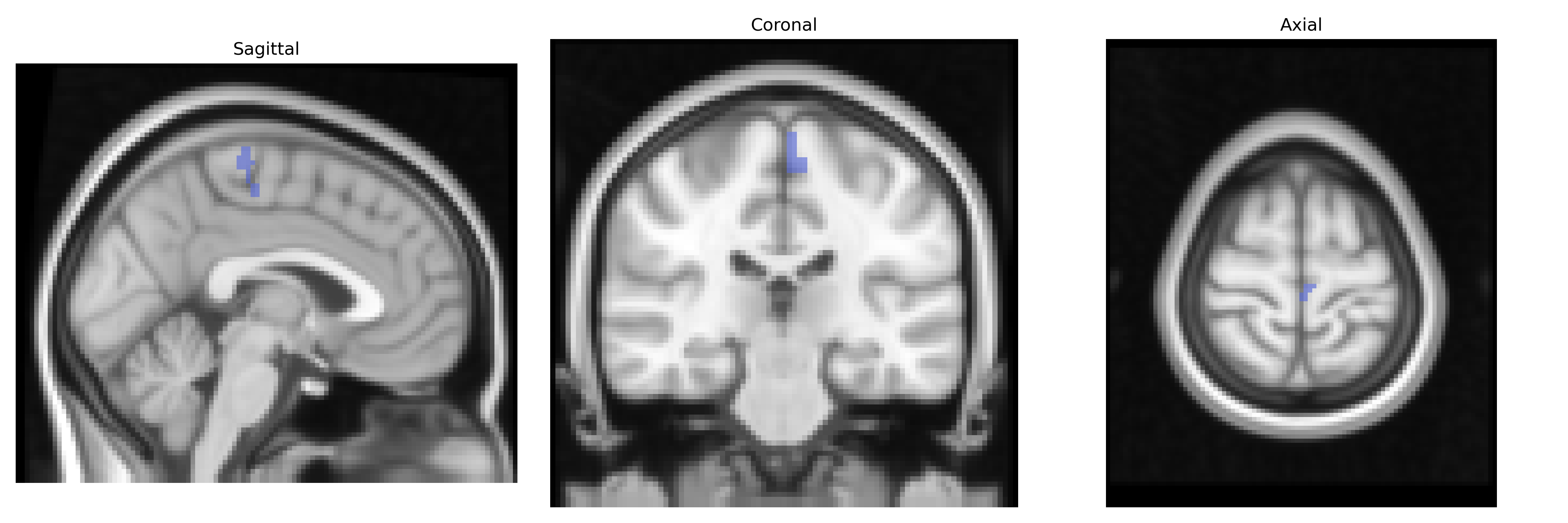
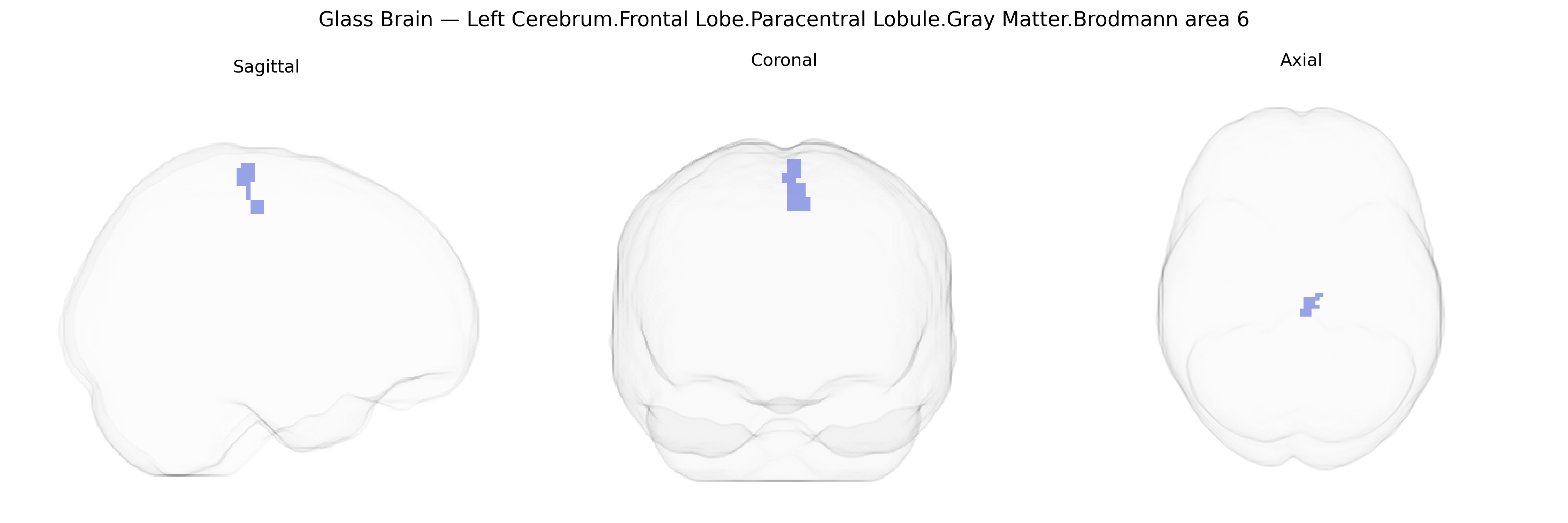
The bilateral Left Cerebrum.Frontal Lobe.Paracentral Lobule.Gray Matter.Brodmann area 6 corresponds to premotor and supplementary motor cortex located in the medial portion of the frontal lobe within the paracentral lobule, anterior to the primary motor cortex (Brodmann area 4). This agranular cortical field is involved in planning, preparation, and coordination of voluntary movements, particularly those requiring complex sequences and postural adjustments, and contributes to motor control of the lower limbs through its proximity to the medial primary motor representation. Functionally, it integrates sensory and cognitive information to organize motor programs before execution and is heavily connected with basal ganglia, cerebellum, and other frontal motor areas. There is no direct Wikipedia article for this specific Talairach-defined region; a closely related structure is Brodmann area 6.
The bilateral left paracentral lobule gray matter in Brodmann area 6 (premotor/supplementary motor territory within the frontal lobe) has been repeatedly implicated in genetic studies of motor control, sensorimotor integration, and higher-order cognitive and psychiatric traits. GWAS and imaging-genetics work using Talairach and related parcellations have linked variation in this region’s cortical thickness and surface area to common polymorphisms in neurodevelopmental and synaptic genes (e.g., CNTNAP2, DISC1, and glutamatergic pathway loci), as well as to polygenic scores for general cognitive ability, educational attainment, and intelligence. Structural and functional alterations in BA6/paracentral lobule have been associated with genetic risk for movement disorders such as Parkinson’s disease and essential tremor, and with motor symptom burden in neurodegenerative conditions, often mediated by genes affecting dopaminergic and axonal pathways (including MAPT and SNCA). Psychiatric GWAS and large consortia (ENIGMA, UK Biobank) have identified correlations between genetic risk for schizophrenia, bipolar disorder, ADHD, and autism spectrum conditions and morphometric measures or activation patterns in BA6, consistent with its role in motor planning, response inhibition, and action sequencing. Additionally, variants in immune and microglial regulatory genes (such as major histocompatibility complex loci) have been linked to subtle structural differences in this region, suggesting neuroimmune contributions to frontal motor network development. Overall, genetic associations converge on pathways governing cortical development, synaptic plasticity, and motor-cognitive integration, with BA6/paracentral lobule serving as a key node influenced by polygenic risk across movement, psychiatric, and cognitive phenotypes.
Overview generated by GPT-4o (2026).
Region ID: 1075
Hemisphere: bilateral
Atlas: Talairach labels 2mm
Full Quality Version: Download MP4
Full Quality Version: Download MP4
Wali Sidiqyar*, Gaurav Rudravaram*, Elyssa M. McMaster, Trent M. Schwartz, Adam M. Saunders, Kurt G. Schilling, Bennett A. Landman "Introducing SPINS: A Shared Public Visualization Library of Neuroanatomical Structures." Medical Imaging with Deep Learning- short paper
This resource is licensed under CC0 1.0 Universal (Public Domain).