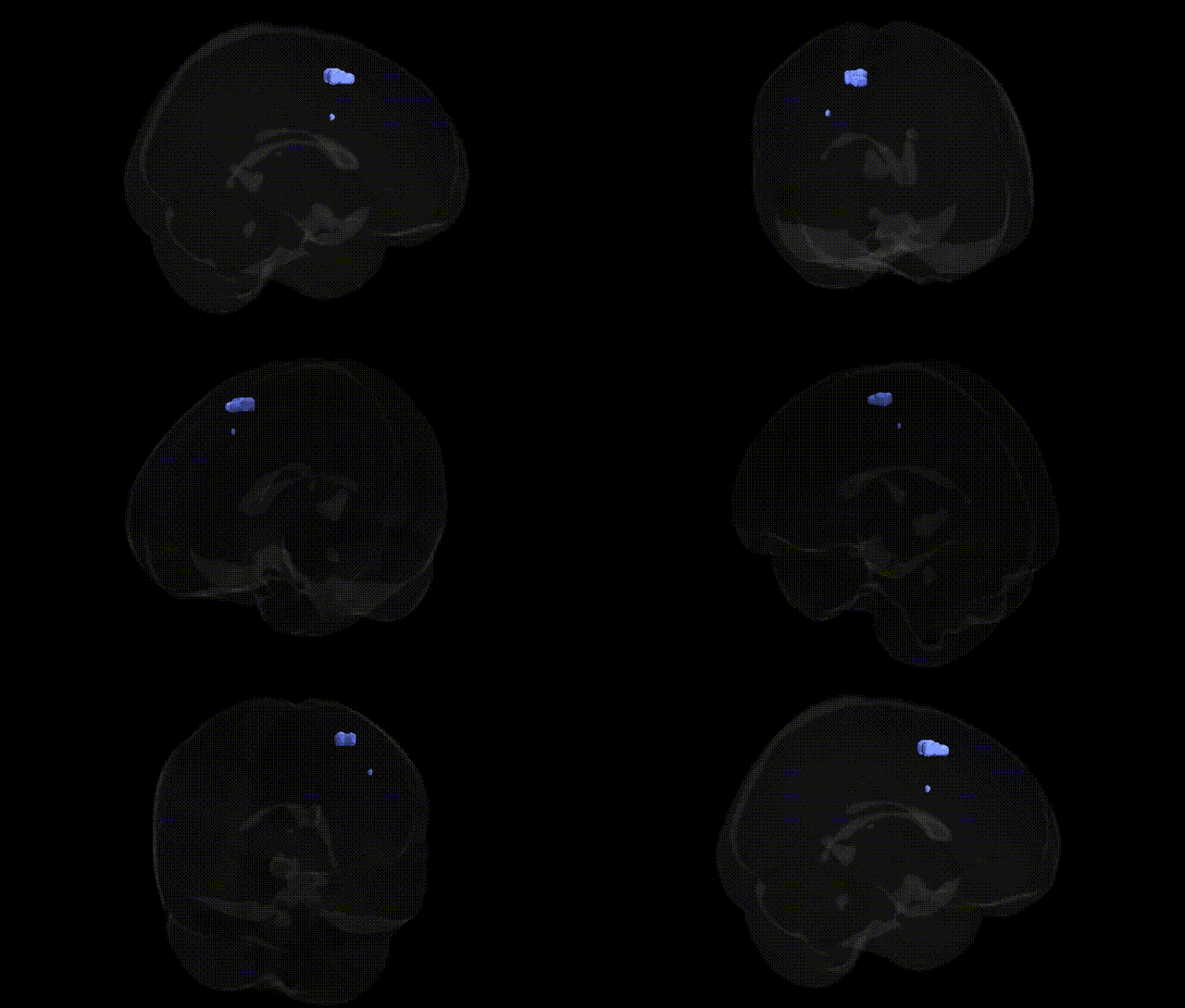
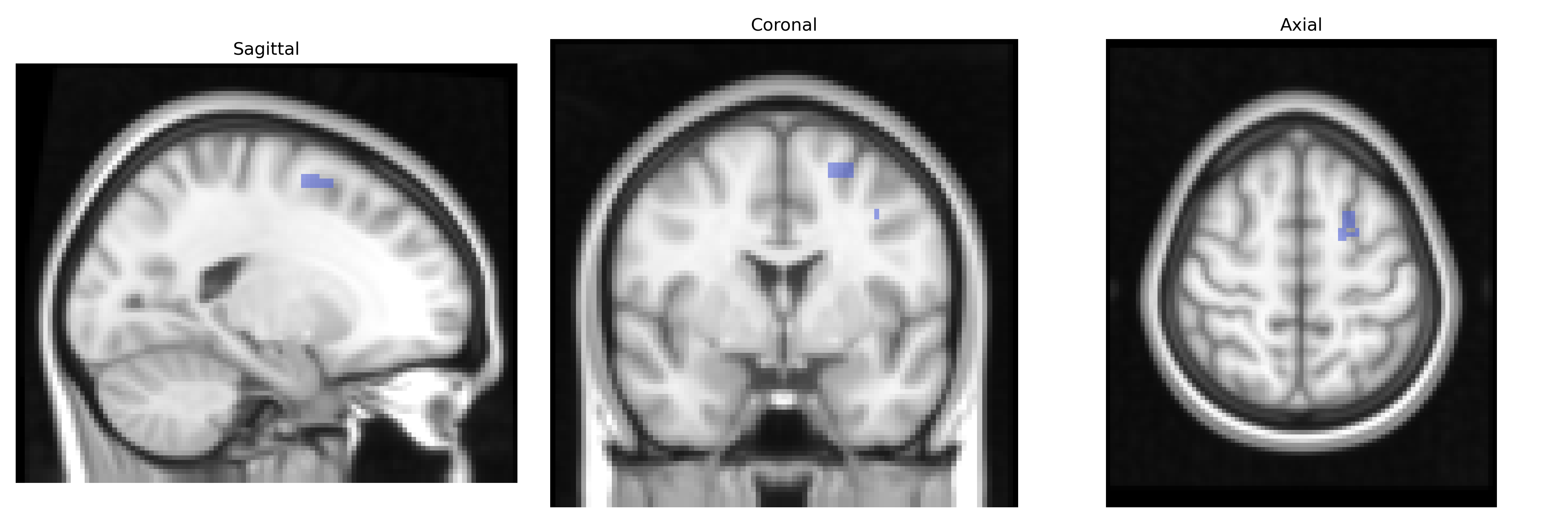
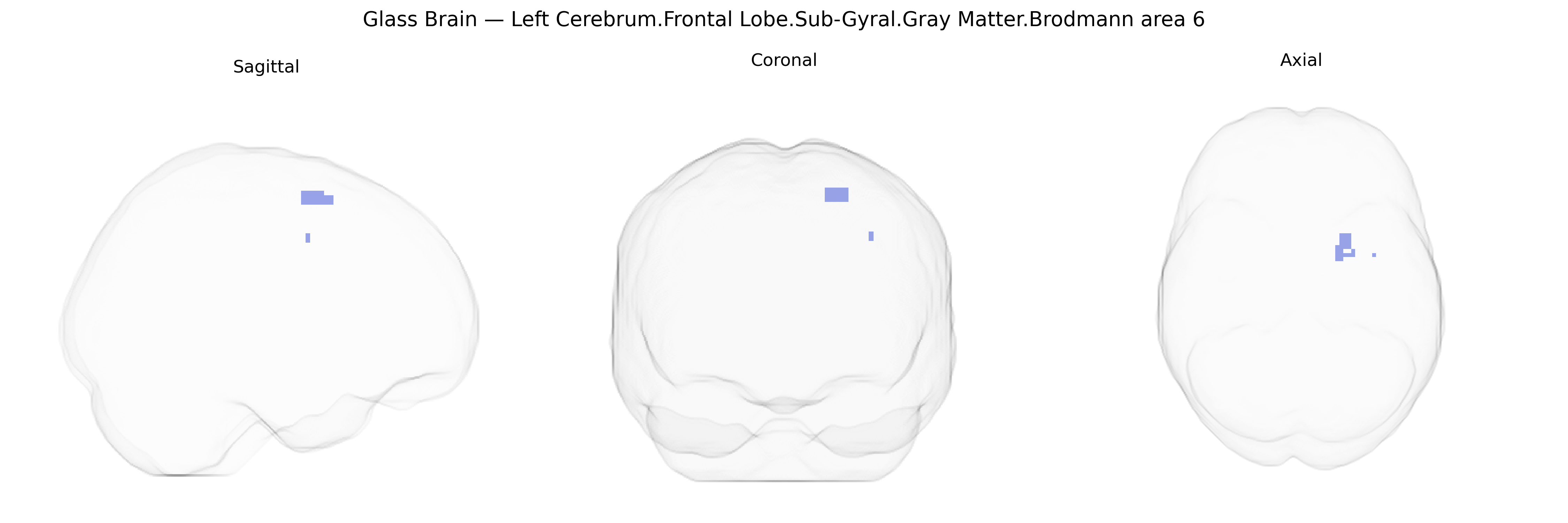
The bilateral Left Cerebrum.Frontal Lobe.Sub-Gyral.Gray Matter.Brodmann area 6 corresponds primarily to the premotor and supplementary motor cortices situated anterior to the primary motor cortex (Brodmann area 4) on the lateral and medial frontal lobes. Cytoarchitectonically, BA6 is agranular cortex involved in the planning, selection, and sequencing of voluntary movements, integration of sensory and proprioceptive information for motor preparation, and coordination of complex motor programs, including those related to eye, limb, and speech movements. Functionally, it contributes to motor imagery, motor learning, and the transformation of abstract action goals into executable motor patterns, working closely with basal ganglia, cerebellum, and parietal association areas. There is no direct link for this specific Talairach label; a closely related region is the Premotor cortex.
The bilateral Left Cerebrum.Frontal Lobe.Sub-Gyral.Gray Matter.Brodmann area 6, roughly corresponding to premotor and supplementary motor areas, has been implicated in multiple genetic and GWAS findings through its roles in motor planning, cognitive control, and cortico-striatal circuitry. Large-scale imaging genetics consortia (e.g., ENIGMA and UK Biobank) have identified associations between common variants in genes involved in neurodevelopment and synaptic plasticity—such as BDNF, MAPT, CNTNAP2, and several glutamatergic and GABAergic pathway genes—and structural measures (cortical thickness, surface area, and volume) in medial and lateral frontal premotor regions overlapping BA6. GWAS of motor function, reaction time, and general cognitive ability have linked polygenic scores and loci in genes like CADM2 and FOXP2 to activation and morphology in frontal motor and premotor cortices, including BA6. In clinical genetics, this region falls within circuits repeatedly implicated by risk variants for schizophrenia and bipolar disorder (e.g., in CACNA1C, GRIN2A, DRD2, and other synaptic and calcium-channel genes), with case–control and polygenic risk score studies showing BA6 volume and functional alterations associated with psychiatric risk. Additionally, BA6 has been highlighted in GWAS and candidate-gene work on attention-deficit/hyperactivity disorder, obsessive–compulsive disorder, autism spectrum conditions, and Tourette syndrome, where risk alleles in dopaminergic, serotonergic, and synaptic genes correlate with abnormal activation or structure in frontal motor-control networks. Finally, neurodegenerative GWAS (e.g., in ALS and frontotemporal dementia, including variants in C9orf72 and TBK1) often show involvement of premotor and supplementary motor cortices, with BA6 structural degeneration and connectivity changes serving as intermediate phenotypes linking genetic risk to clinical motor syndromes.
Overview generated by GPT-4o (2026).
Region ID: 1022
Hemisphere: bilateral
Atlas: Talairach labels 2mm
Full Quality Version: Download MP4
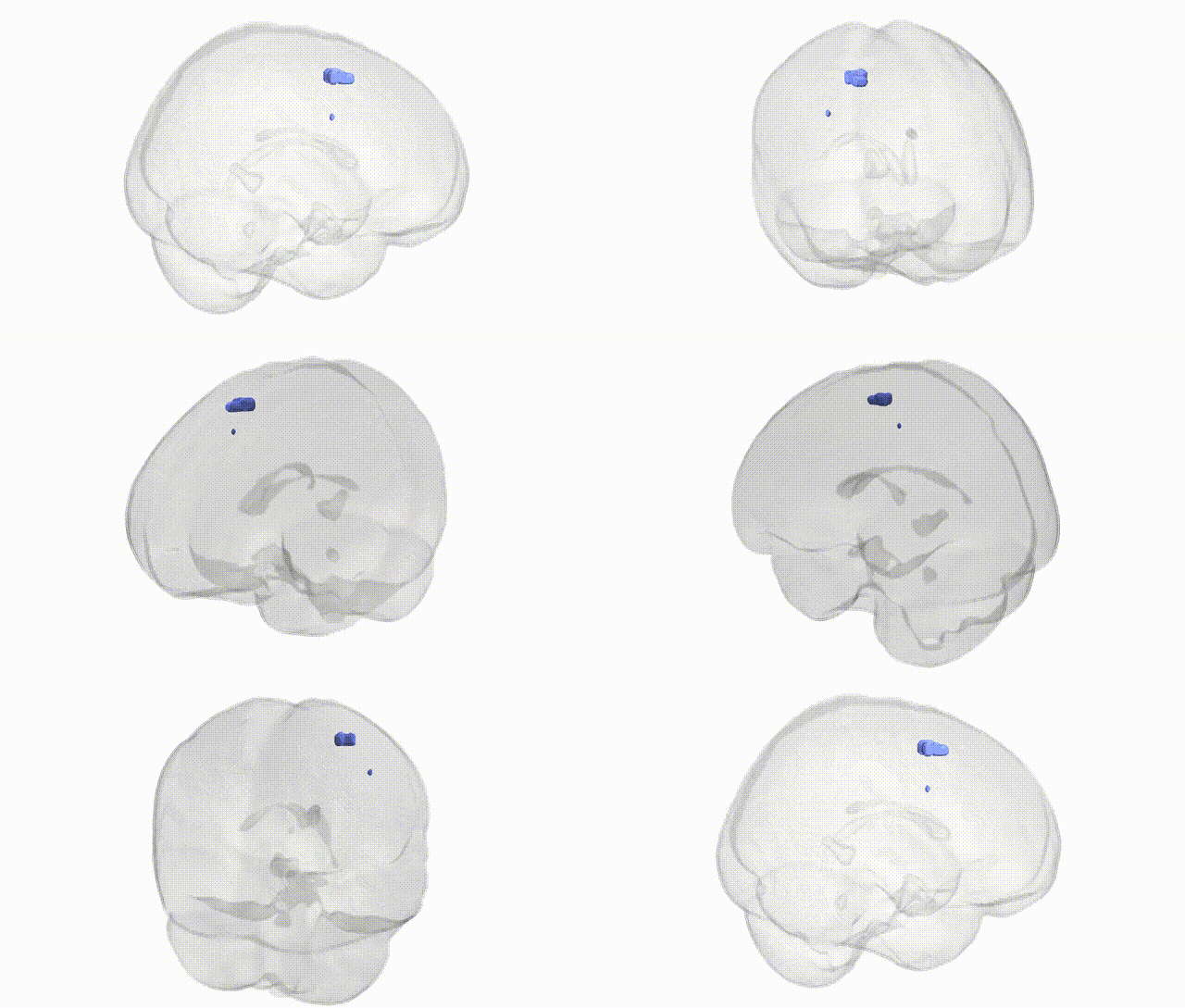
Full Quality Version: Download MP4
Wali Sidiqyar*, Gaurav Rudravaram*, Elyssa M. McMaster, Trent M. Schwartz, Adam M. Saunders, Kurt G. Schilling, Bennett A. Landman "Introducing SPINS: A Shared Public Visualization Library of Neuroanatomical Structures." Medical Imaging with Deep Learning- short paper
This resource is licensed under CC0 1.0 Universal (Public Domain).