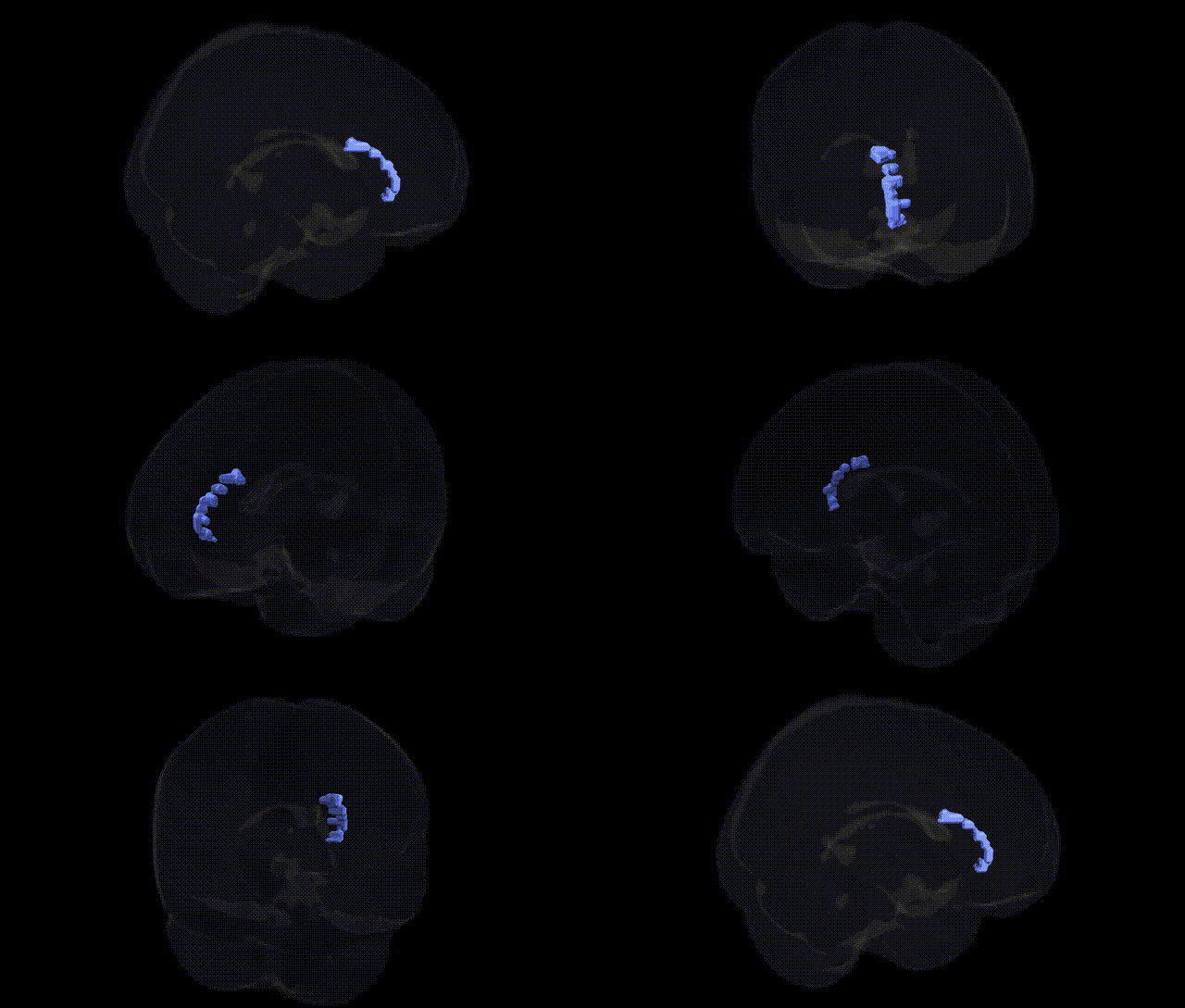
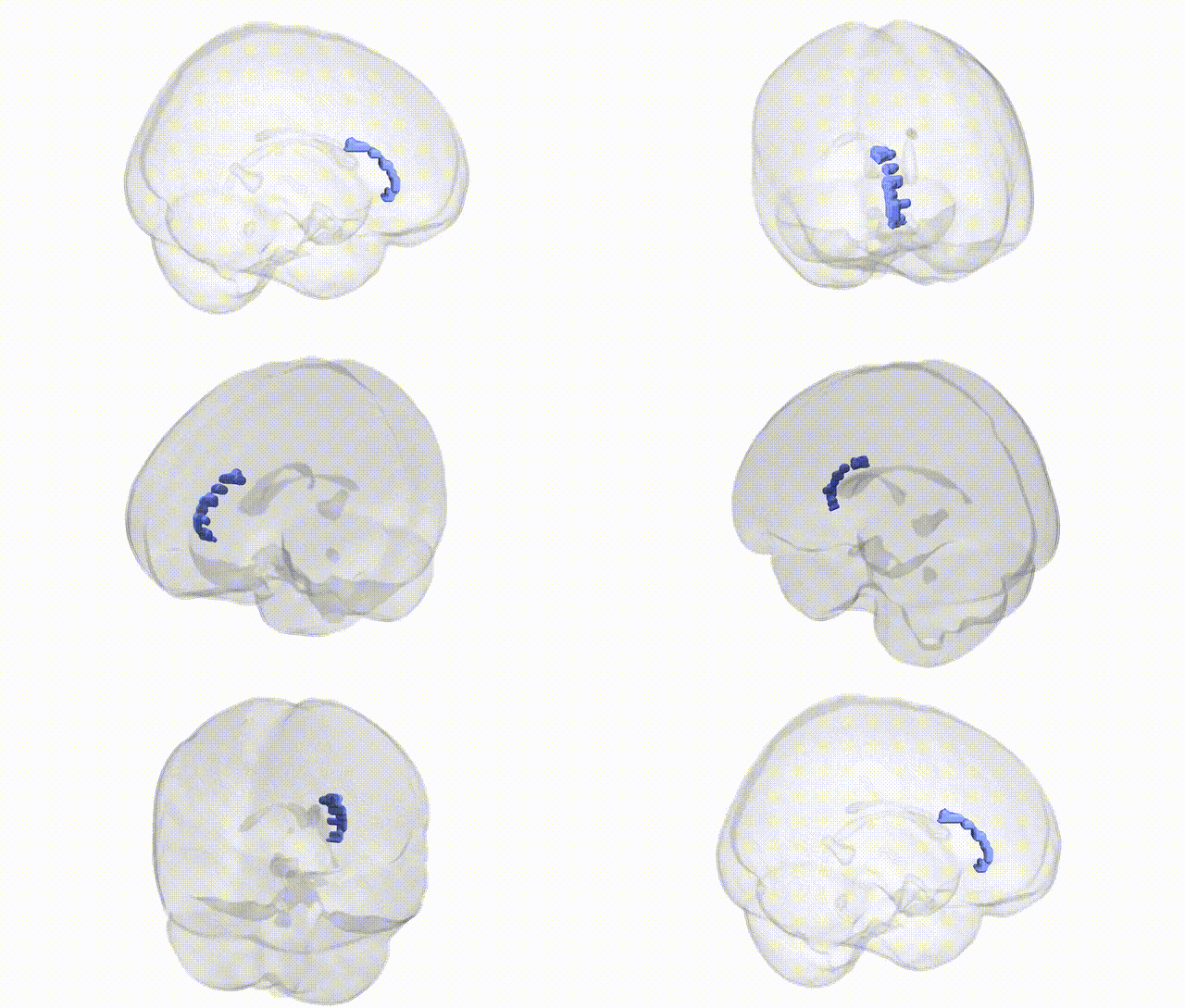
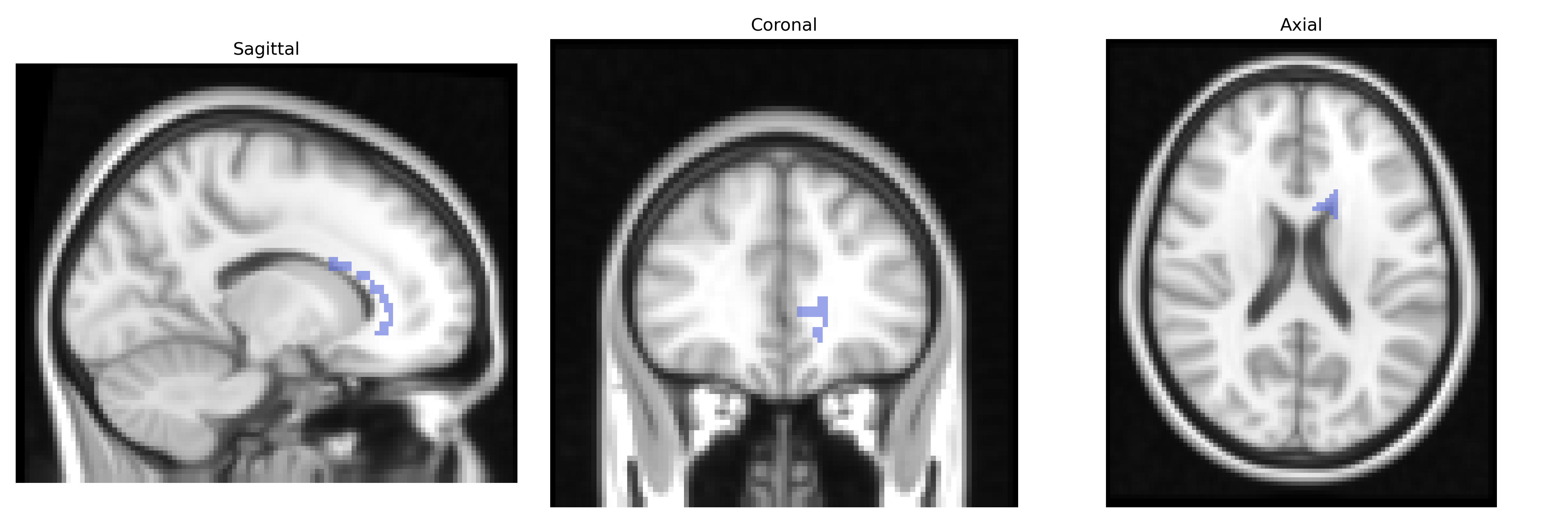
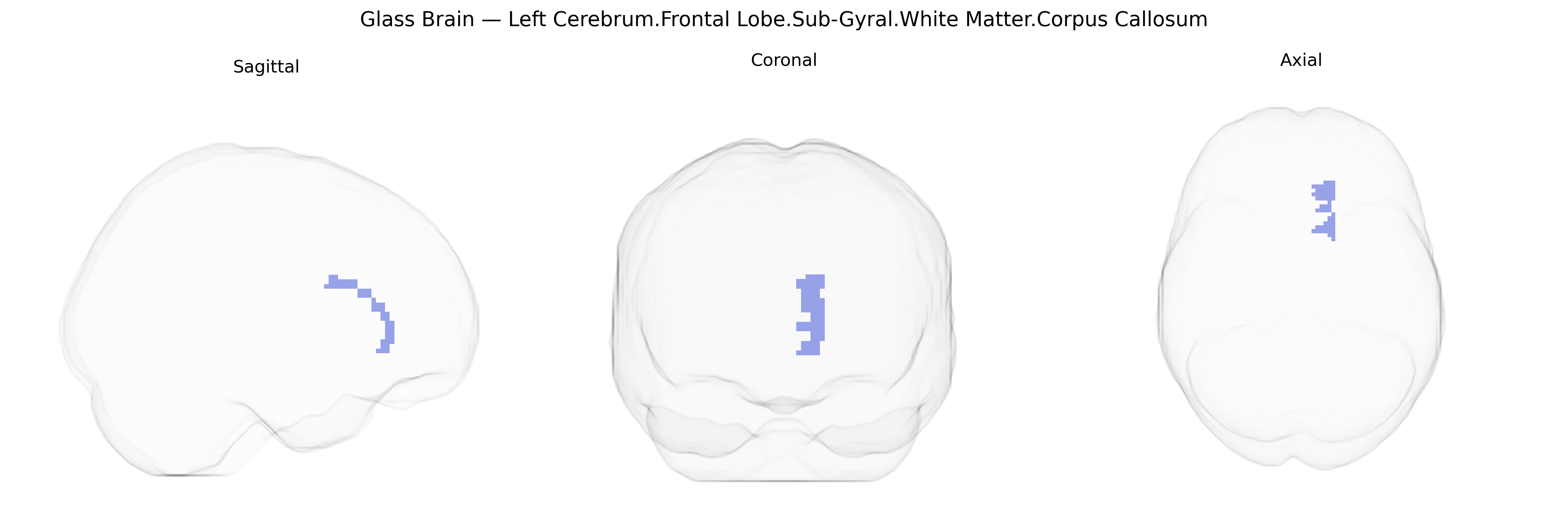
The bilateral Left Cerebrum.Frontal Lobe.Sub-Gyral.White Matter.Corpus Callosum region, as defined in the Talairach 2 mm Atlas, comprises deep frontal lobe white matter lying beneath the cortical gyri and incorporating commissural fibers of the corpus callosum that interconnect homologous frontal areas across hemispheres. This sub-gyral white matter contains long-range association and projection fibers involved in executive functions, motor planning, working memory, attention, and higher-order cognitive integration. Callosal fibers within this zone play a crucial role in interhemispheric transfer of information, allowing coordinated bilateral frontal activity that supports complex behaviors such as language, decision-making, and social cognition. There is no single direct article on this exact composite label; it corresponds primarily to the frontal lobe white matter and the Corpus Callosum.
The bilateral Left Cerebrum Frontal Lobe Sub-Gyral White Matter and adjacent Corpus Callosum, as defined in the Talairach 2 mm atlas, corresponds to frontal association and interhemispheric white-matter pathways that have been repeatedly implicated in genetic studies of brain structure and neuropsychiatric traits. GWAS of regional and global white-matter volumes, fractional anisotropy, and corpus callosum microstructure (e.g., ENIGMA and UK Biobank consortia) have identified robust associations with variants in genes involved in axon guidance, myelination, and neurodevelopment, including but not limited to CNTNAP2, NRG1/NRG3, MAG, MOBP, and multiple loci within the major histocompatibility complex. These frontal and callosal regions show genetically influenced alterations in schizophrenia, bipolar disorder, major depression, autism spectrum disorder, ADHD, and cognitive traits such as intelligence and processing speed, where risk alleles often correlate with reduced frontal white-matter integrity or altered callosal thickness. Heritability estimates from twin and family studies indicate strong genetic control over frontal white-matter and corpus callosum morphology, and polygenic risk scores for psychiatric disorders and educational attainment have been linked to subtle structural variation in these areas, supporting a role for common genetic variation in shaping interhemispheric frontal connectivity underlying complex behavioral and clinical phenotypes.
Overview generated by GPT-4o (2026).
Region ID: 514
Hemisphere: bilateral
Atlas: Talairach labels 2mm
Full Quality Version: Download MP4
Full Quality Version: Download MP4
Wali Sidiqyar*, Gaurav Rudravaram*, Elyssa M. McMaster, Trent M. Schwartz, Adam M. Saunders, Kurt G. Schilling, Bennett A. Landman "Introducing SPINS: A Shared Public Visualization Library of Neuroanatomical Structures." Medical Imaging with Deep Learning- short paper
This resource is licensed under CC0 1.0 Universal (Public Domain).