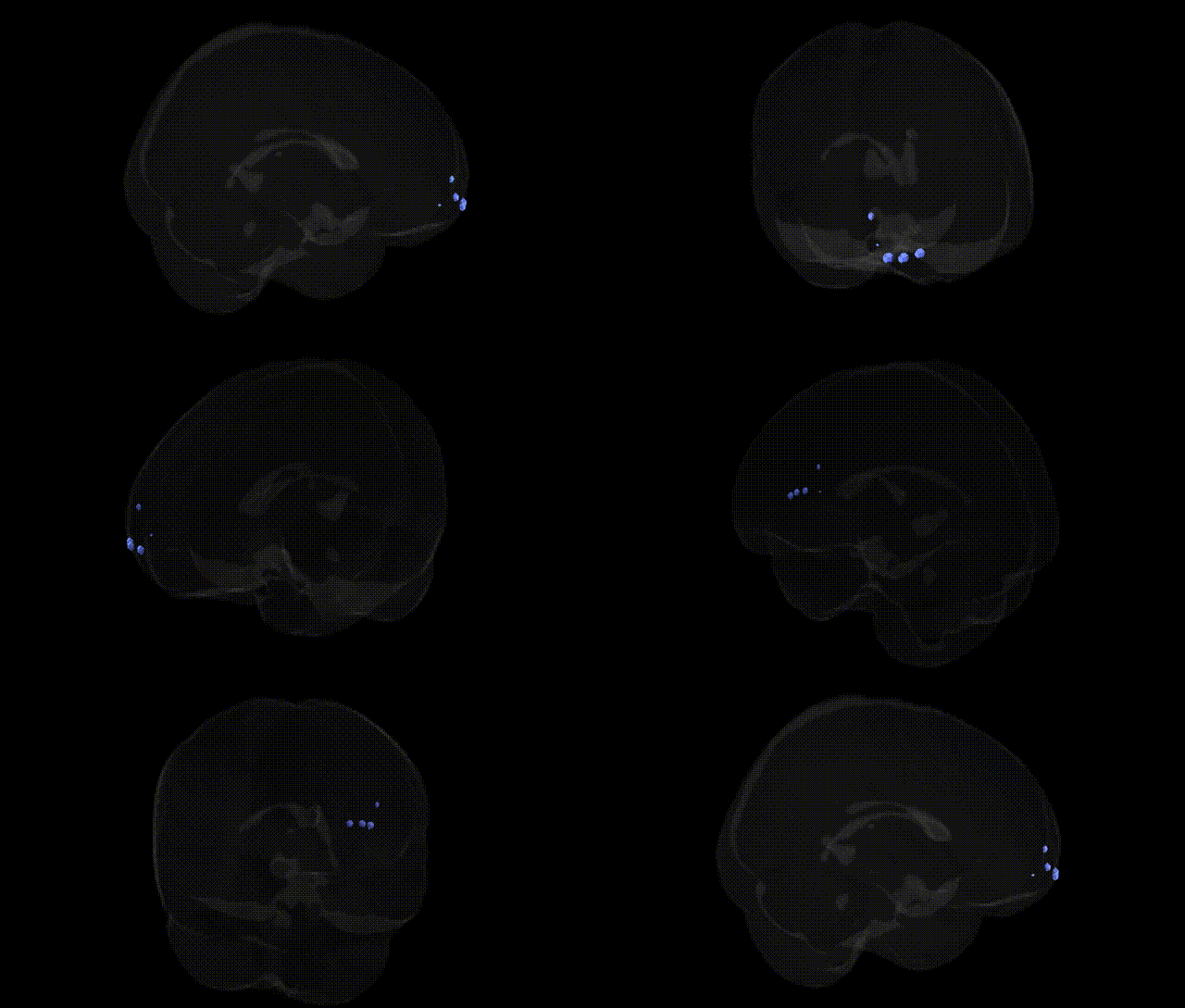
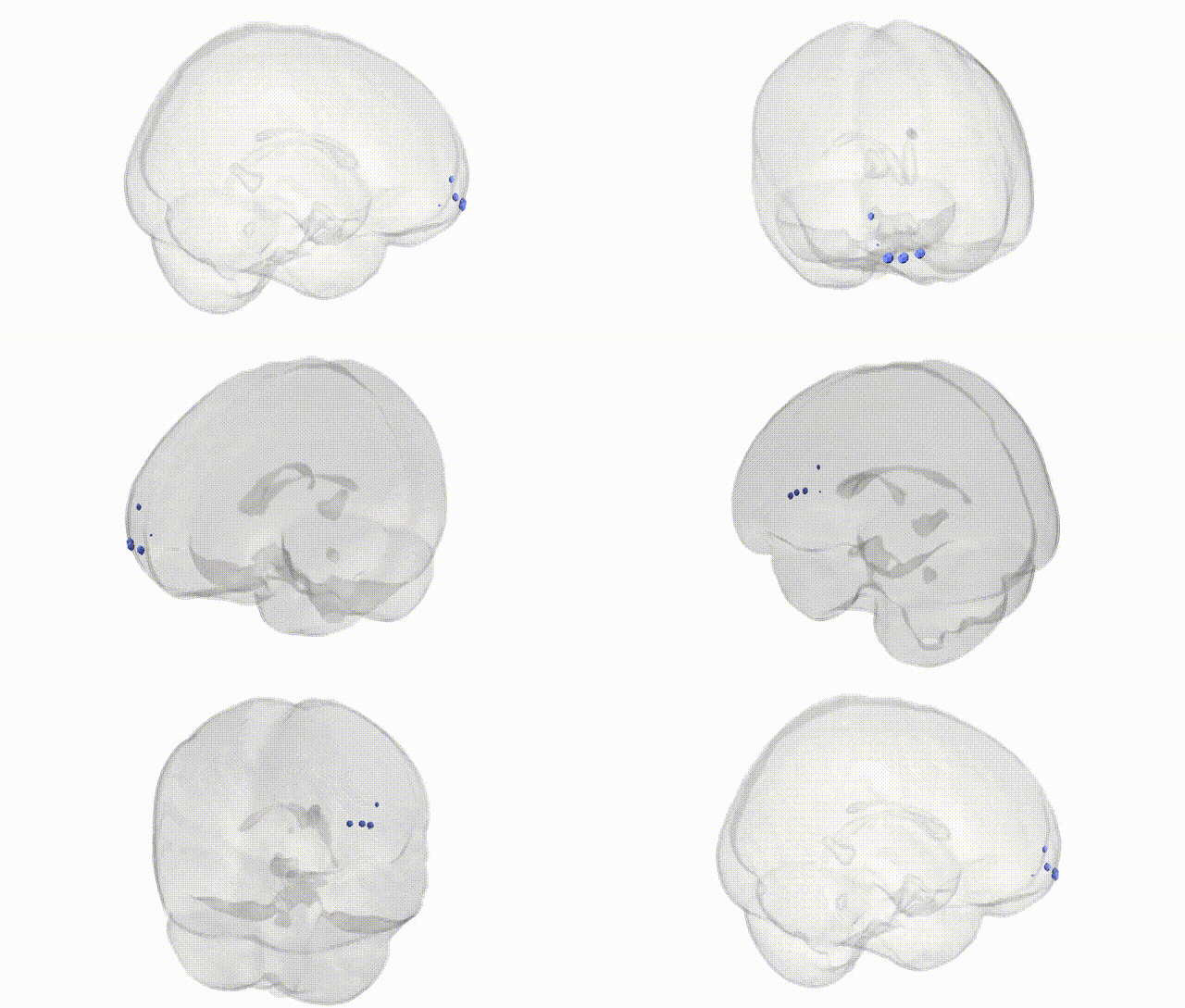
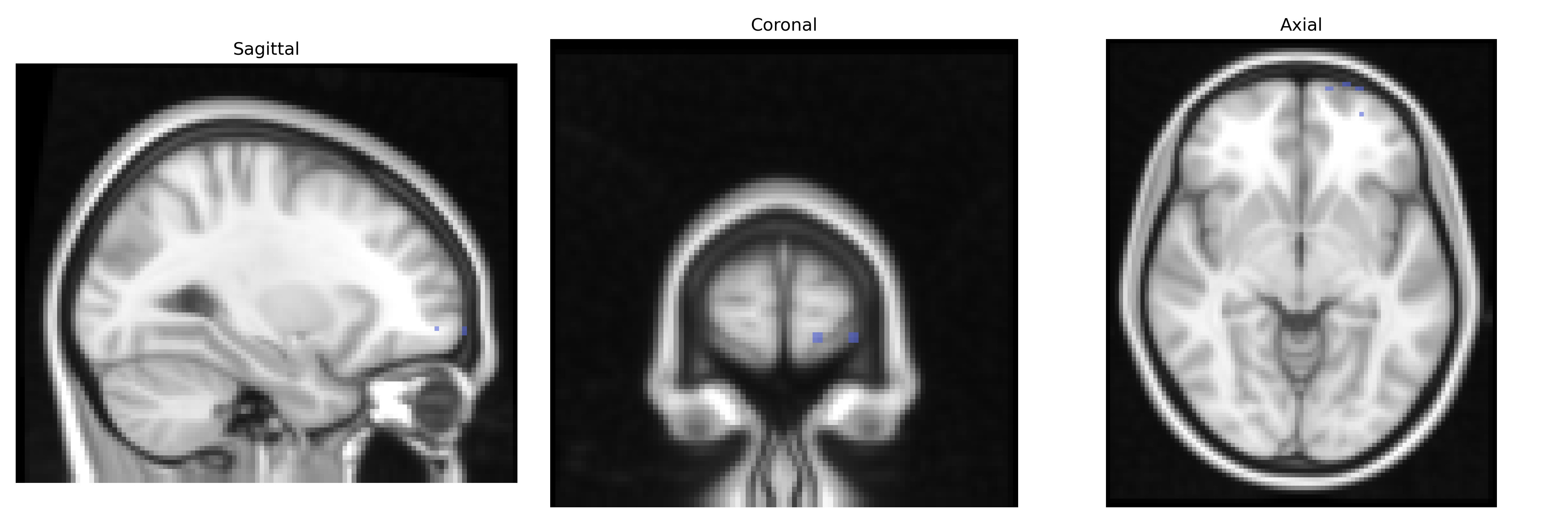
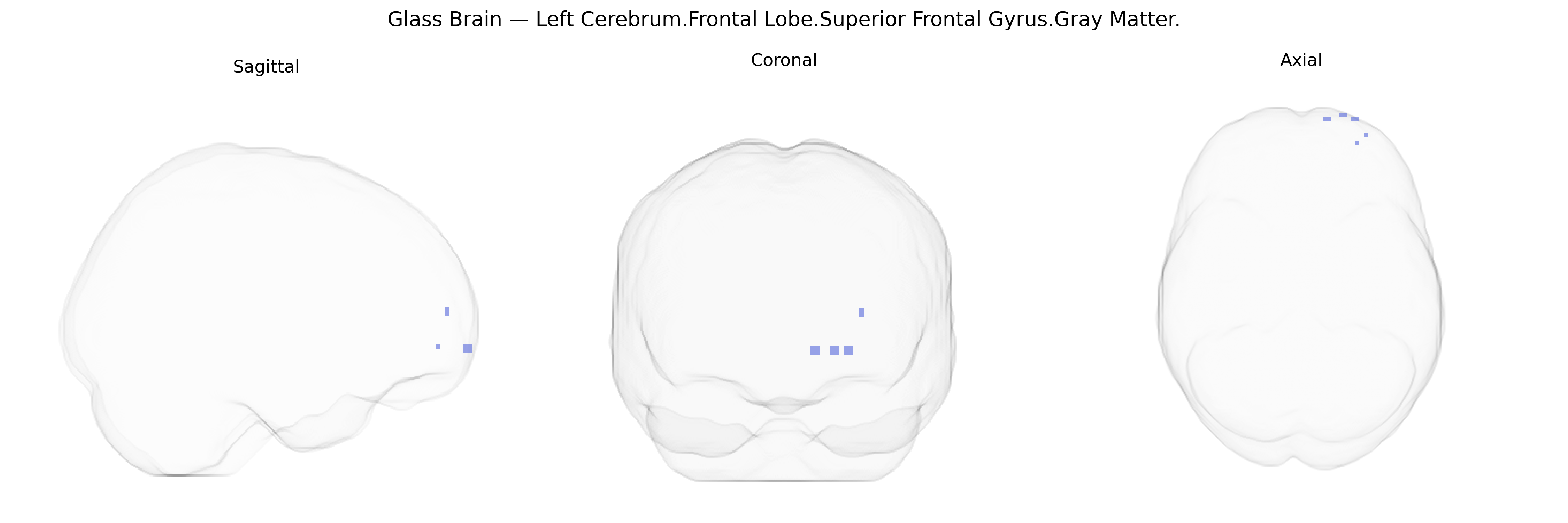
The bilateral Left Cerebrum.Frontal Lobe.Superior Frontal Gyrus.Gray Matter corresponds to cortical gray matter within the superior frontal gyrus of the frontal lobe, predominantly encompassing portions of Brodmann areas 6, 8, and 9. This region participates in higher-order executive functions, including working memory, planning, decision making, and attentional control, and contributes to aspects of self-generated thought and introspection via connections with the dorsolateral prefrontal cortex and medial prefrontal networks. It is also involved in motor planning and preparation, interfacing with premotor and supplementary motor areas, and forms part of large-scale networks such as the default mode and frontoparietal control networks. There is no direct Wikipedia link for this exact Talairach label; a closely related structure is the Superior frontal gyrus.
The bilateral Left Cerebrum Frontal Lobe Superior Frontal Gyrus gray matter (Talairach labels 2mm Atlas) has been implicated in genetic studies through its involvement in executive function, working memory, self-referential processing, and higher-order cognitive control, with multiple GWAS and imaging genetics studies linking variation in its structure and function to both common traits and neuropsychiatric disorders. Common variants in genes related to synaptic plasticity, neurodevelopment, and myelination (e.g., BDNF, COMT, DISC1, CACNA1C, NCAN, GRM3) have been associated with cortical thickness, surface area, or activation patterns in superior frontal regions, often in the context of large-scale neuroimaging consortia such as ENIGMA and UK Biobank. Polygenic risk scores for schizophrenia, bipolar disorder, major depressive disorder, ADHD, and autism spectrum conditions show associations with altered gray matter volume or connectivity in superior frontal cortex, and GWAS of general cognitive ability, educational attainment, and intelligence frequently report enrichment of signals in networks that prominently include this region. Additionally, variants influencing brain age, cortical maturation, and susceptibility to neurodegenerative disorders such as Alzheimer’s disease have been linked to superior frontal morphology and atrophy patterns, suggesting that genetic effects on this region contribute to vulnerability for mood and psychotic disorders, cognitive performance, and age-related cognitive decline, although most findings reflect distributed polygenic influences rather than region-specific single-gene effects.
Overview generated by GPT-4o (2026).
Region ID: 615
Hemisphere: bilateral
Atlas: Talairach labels 2mm
Full Quality Version: Download MP4
Full Quality Version: Download MP4
Wali Sidiqyar*, Gaurav Rudravaram*, Elyssa M. McMaster, Trent M. Schwartz, Adam M. Saunders, Kurt G. Schilling, Bennett A. Landman "Introducing SPINS: A Shared Public Visualization Library of Neuroanatomical Structures." Medical Imaging with Deep Learning- short paper
This resource is licensed under CC0 1.0 Universal (Public Domain).