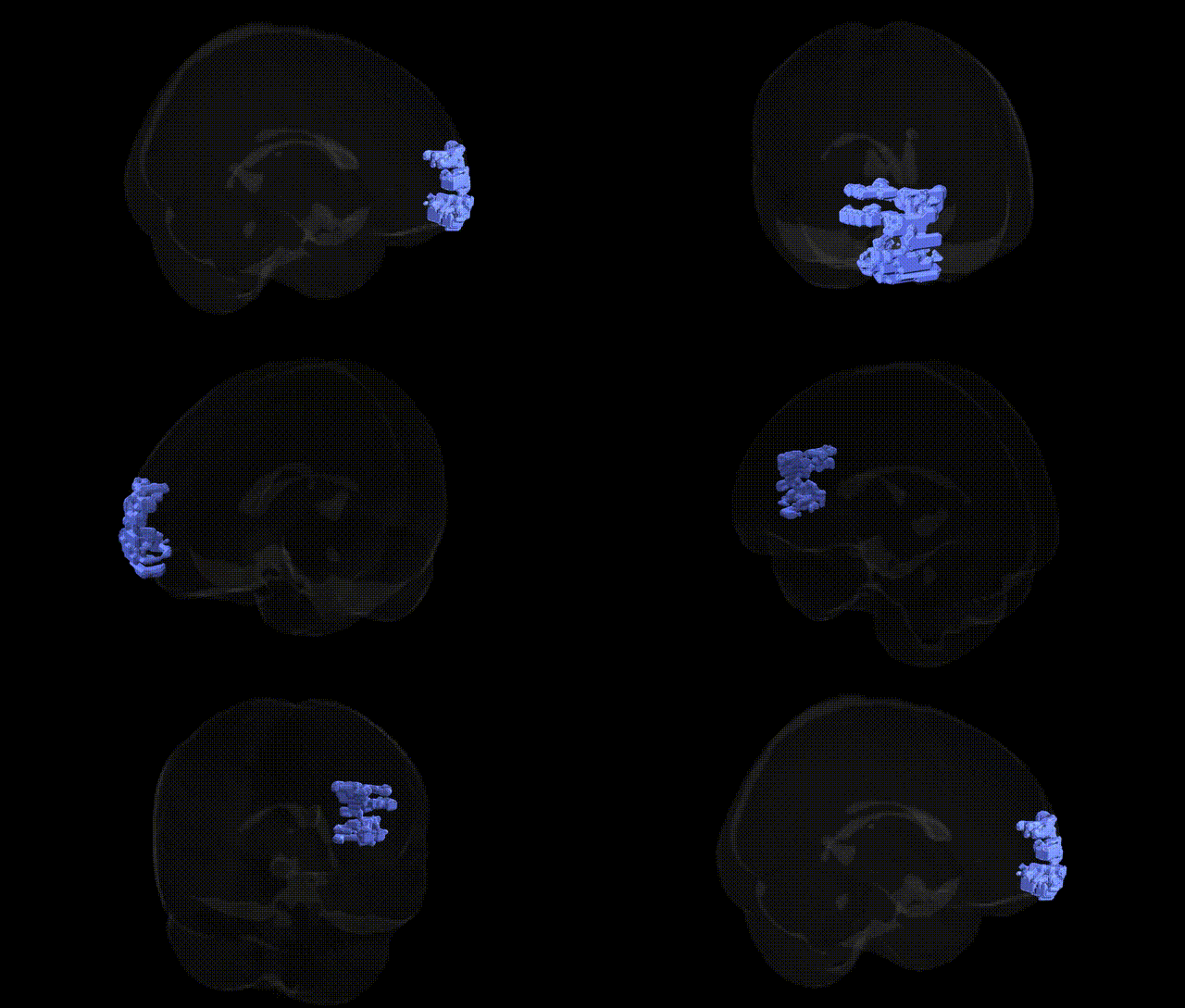
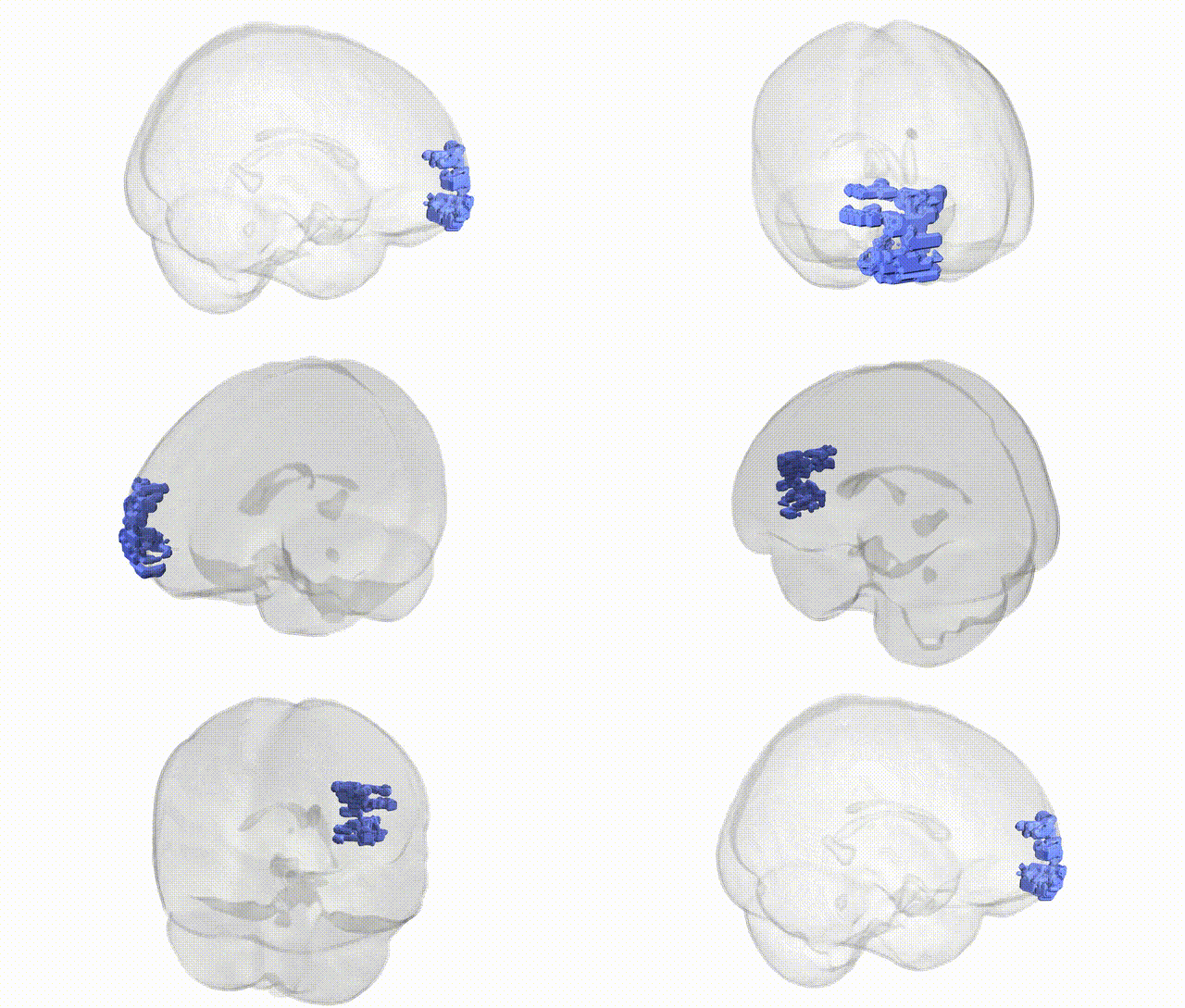
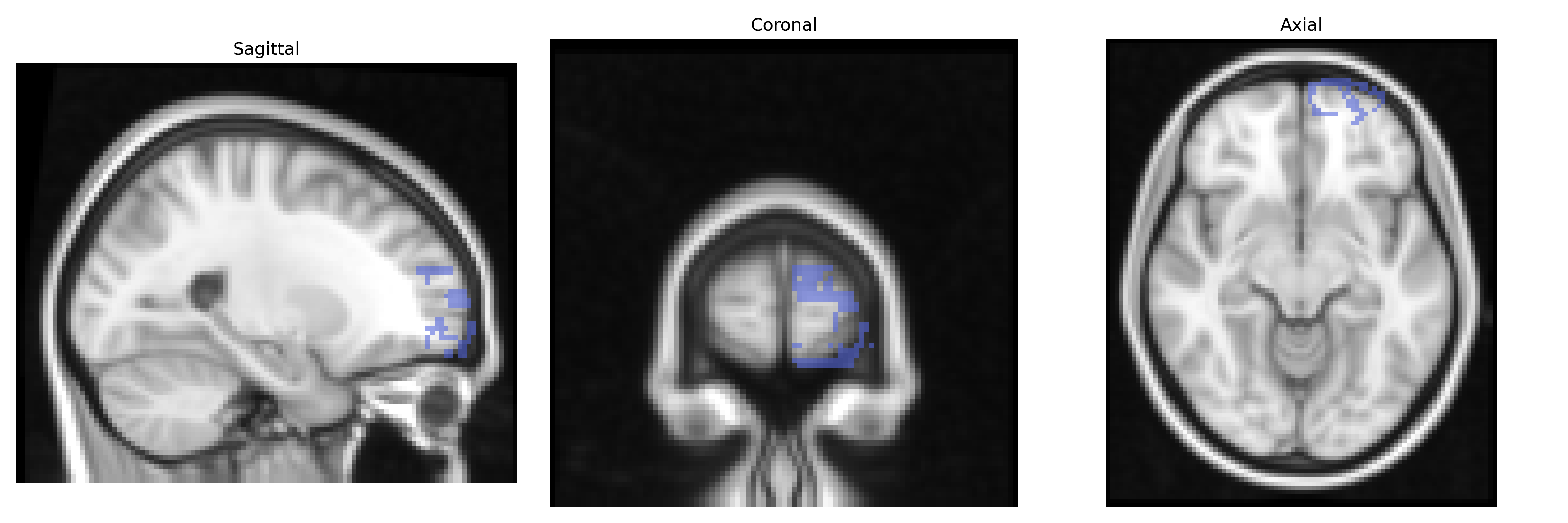
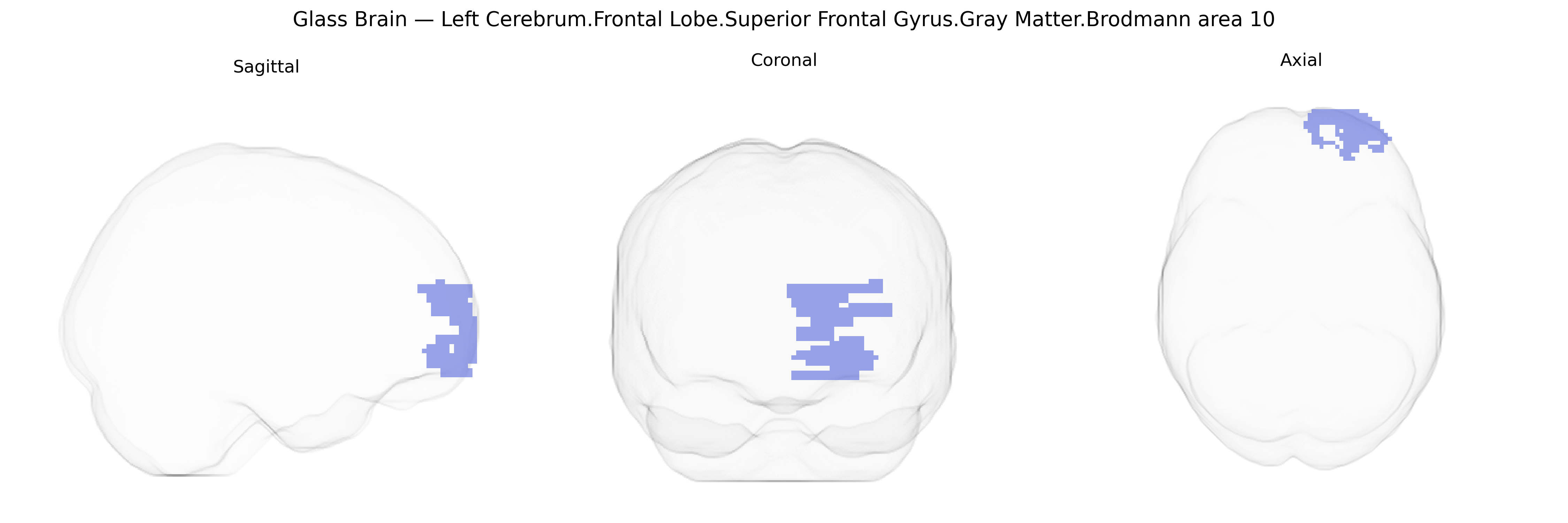
Bilateral Left Cerebrum.Frontal Lobe.Superior Frontal Gyrus.Gray Matter.Brodmann area 10 corresponds to the rostral and most anterior portion of the prefrontal cortex, forming part of the frontal pole and high-order association cortex. This region integrates information across sensory, emotional, and mnemonic domains to support complex cognition, including prospective memory, multitasking, mentalizing, and evaluation of internally generated goals. It is heavily interconnected with other prefrontal areas, limbic structures, and association cortices, and shows extensive involvement in abstract reasoning, decision-making under uncertainty, and the regulation of behavior over extended time scales. While Brodmann area 10 itself does not have a dedicated Wikipedia page, it is part of the frontal pole of the prefrontal cortex: Frontal pole.
The bilateral Left Cerebrum Frontal Lobe Superior Frontal Gyrus Gray Matter Brodmann area 10 (BA10), a key component of anterior prefrontal cortex, has been implicated in numerous genetic and GWAS findings, particularly for higher-order cognition, psychiatric risk, and brain structural variation. Large neuroimaging GWAS (e.g., ENIGMA, UK Biobank) have identified multiple common variants associated with cortical thickness and surface area across frontal pole/BA10 territories, including loci near genes such as HMGA2, IGF1, and variants in microtubule and synaptic pathways, though most effects are polygenic and broadly distributed rather than BA10-specific. BA10 shows structural and functional alterations linked to schizophrenia, major depressive disorder, bipolar disorder, attention-deficit/hyperactivity disorder, and autism spectrum disorder, with genetic risk converging on synaptic, glutamatergic, and neurodevelopmental genes (e.g., CACNA1C, GRIN2A, DRD2, DISC1) that influence prefrontal circuitry and working memory, decision-making, and social cognition—functions strongly associated with BA10 activity. In Alzheimer’s disease and frontotemporal dementia, risk variants in APOE, MAPT, and GRN are associated with widespread cortical atrophy patterns that include BA10, reflecting its vulnerability in neurodegeneration. GWAS of personality and cognitive traits (e.g., educational attainment, general intelligence, risk-taking, neuroticism) have linked polygenic scores to BA10 volume and activation patterns, suggesting that genetic influences on these traits partly act through anterior prefrontal development and connectivity. Overall, genetic associations relevant to BA10 are characterized by highly polygenic, distributed effects and overlap strongly with genes and loci implicated in executive function, psychiatric liability, and neurodegenerative processes that affect frontal association cortex.
Overview generated by GPT-4o (2026).
Region ID: 413
Hemisphere: bilateral
Atlas: Talairach labels 2mm
Full Quality Version: Download MP4
Full Quality Version: Download MP4
Wali Sidiqyar*, Gaurav Rudravaram*, Elyssa M. McMaster, Trent M. Schwartz, Adam M. Saunders, Kurt G. Schilling, Bennett A. Landman "Introducing SPINS: A Shared Public Visualization Library of Neuroanatomical Structures." Medical Imaging with Deep Learning- short paper
This resource is licensed under CC0 1.0 Universal (Public Domain).