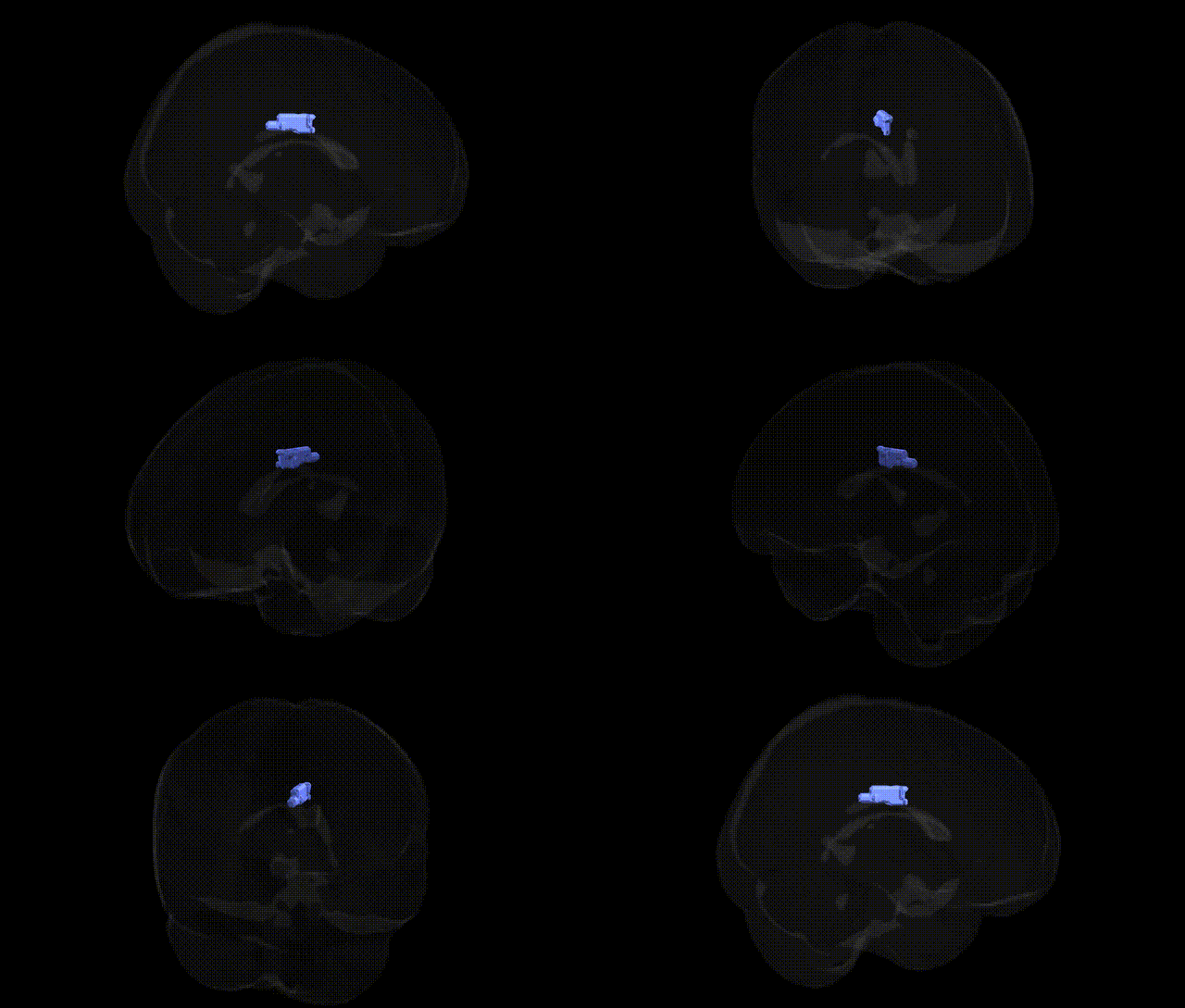
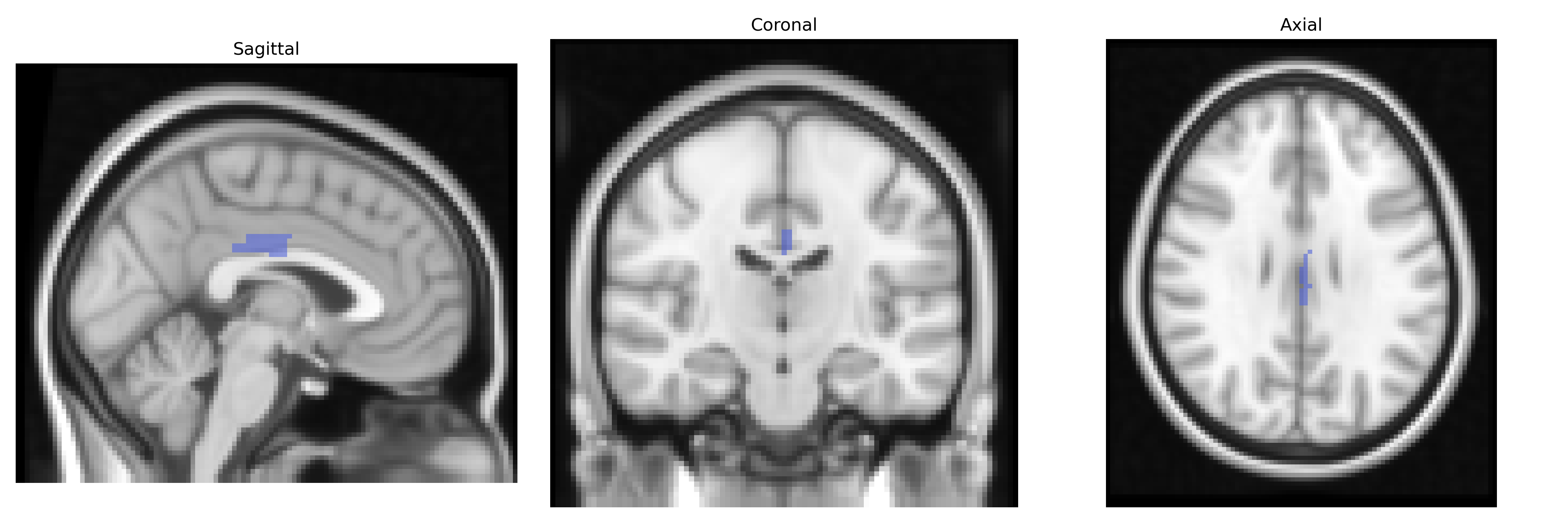
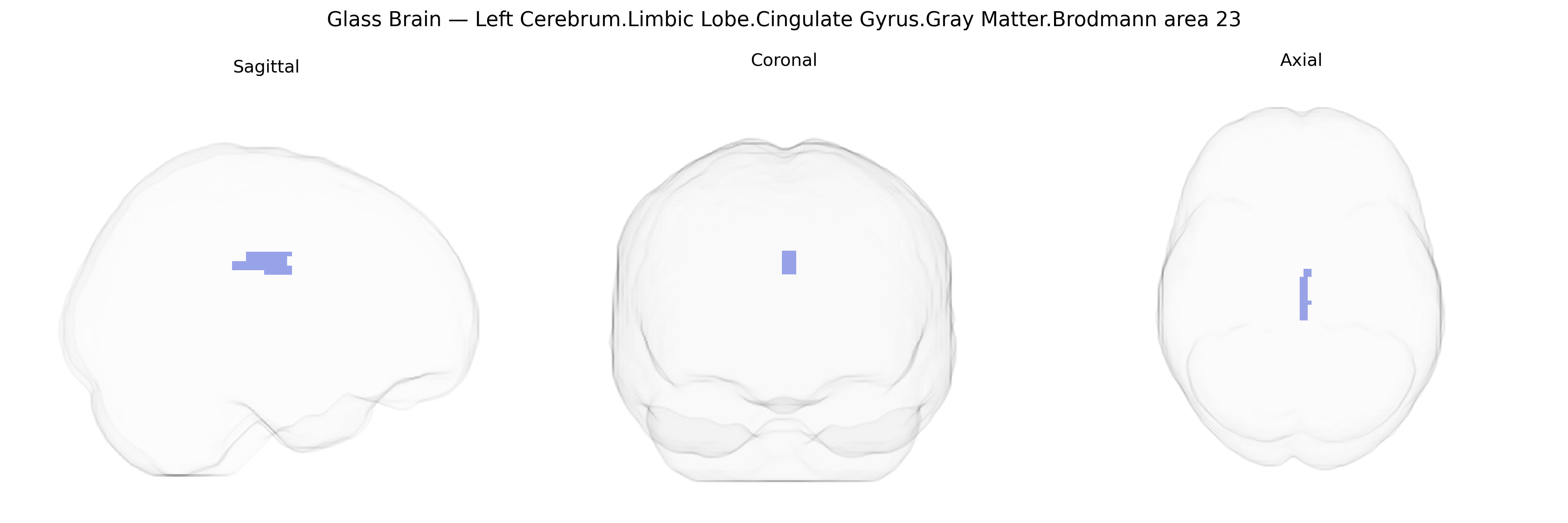
The bilateral Left Cerebrum.Limbic Lobe.Cingulate Gyrus.Gray Matter.Brodmann area 23 corresponds to the ventral portion of the posterior cingulate cortex within the limbic lobe, situated on the medial aspect of the cerebral hemispheres along the cingulate gyrus. Brodmann area 23 is primarily associated with internally directed attention, emotional evaluation, autobiographical and episodic memory processing, and integration of sensory information with limbic and default-mode network activity. Cytoarchitectonically, it is agranular to dysgranular cortex, with dense interconnections to the hippocampal formation, retrosplenial cortex, and other cingulate and prefrontal regions, supporting a role in visuo-spatial orientation, contextual memory, and affective regulation. There is no direct Wikipedia article for Brodmann area 23; a closely related structure is the Posterior cingulate cortex.
The bilateral left cerebrum limbic lobe cingulate gyrus gray matter Brodmann area 23 (BA23), a core component of the posterior cingulate cortex (PCC), has been implicated in multiple genetic studies, particularly GWAS of neuropsychiatric and neurodegenerative traits. Variants in genes involved in synaptic plasticity, immune signaling, and lipid metabolism (such as APOE, TREM2, CLU, and CR1) have been associated with structural and functional alterations in PCC/BA23, especially in the context of Alzheimer’s disease, where APOE ε4 status robustly relates to PCC atrophy and hypometabolism. GWAS of schizophrenia, major depressive disorder, bipolar disorder, and anxiety have identified polygenic risk scores that correlate with PCC/BA23 volume or functional connectivity, suggesting this region as a convergence point for distributed genetic risk affecting default mode network integrity. Imaging-genetics work has further linked common variants in genes such as BDNF, COMT, and serotonin-related loci to PCC activation patterns during memory, self-referential processing, and emotional regulation tasks. Large-scale brain morphology GWAS (e.g., ENIGMA and UK Biobank studies) have associated multiple loci across the genome with cingulate and PCC thickness or surface area, indicating that BA23 structure is influenced by widespread polygenic effects rather than single loci. Additionally, genetic risk for traits such as neuroticism, cognitive performance, and chronic pain shows correlations with PCC/BA23 measures, supporting the role of this region as a genetically modulated hub in emotional, cognitive, and pain-related networks.
Overview generated by GPT-4o (2026).
Region ID: 934
Hemisphere: bilateral
Atlas: Talairach labels 2mm
Full Quality Version: Download MP4
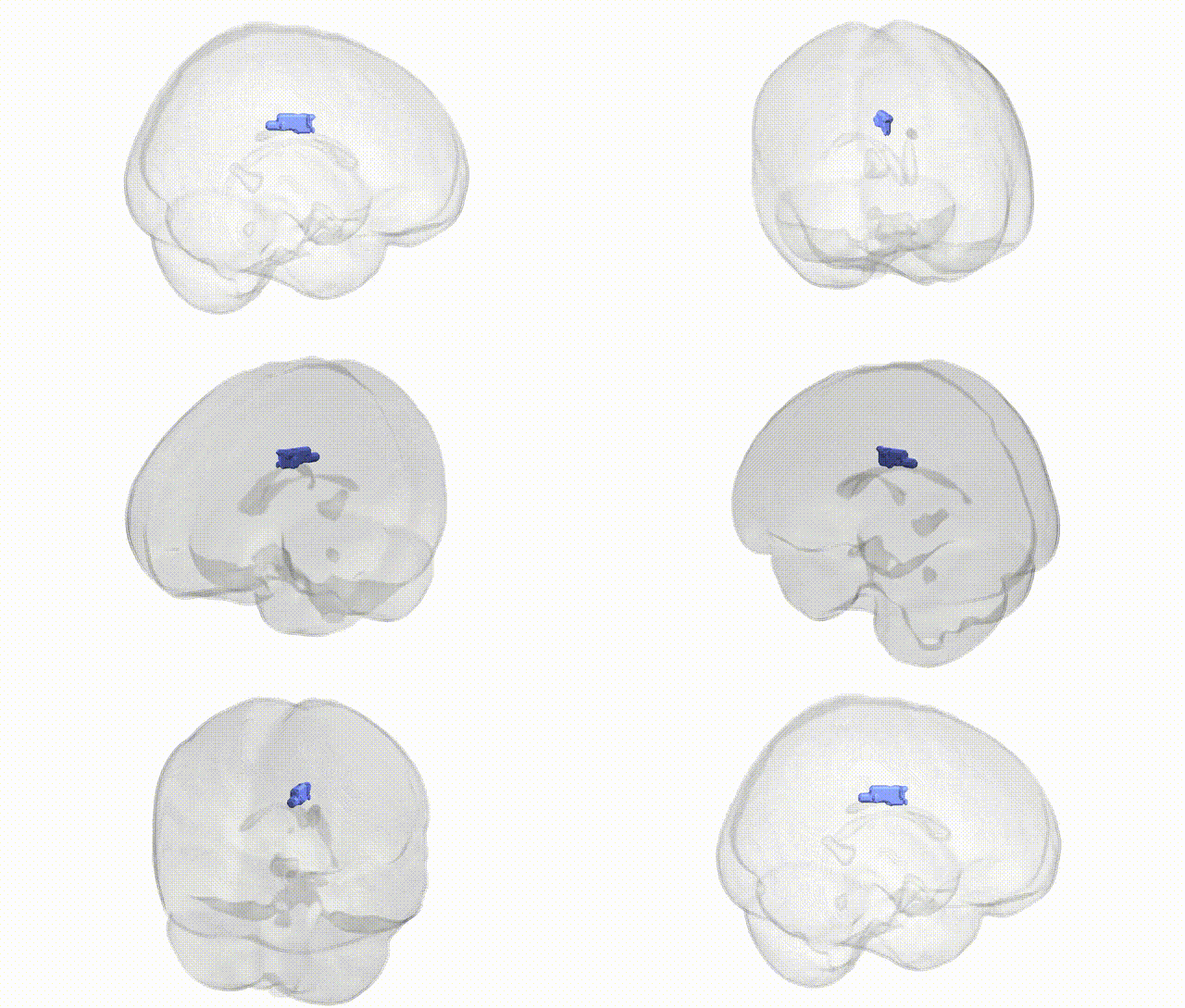
Full Quality Version: Download MP4
Wali Sidiqyar*, Gaurav Rudravaram*, Elyssa M. McMaster, Trent M. Schwartz, Adam M. Saunders, Kurt G. Schilling, Bennett A. Landman "Introducing SPINS: A Shared Public Visualization Library of Neuroanatomical Structures." Medical Imaging with Deep Learning- short paper
This resource is licensed under CC0 1.0 Universal (Public Domain).