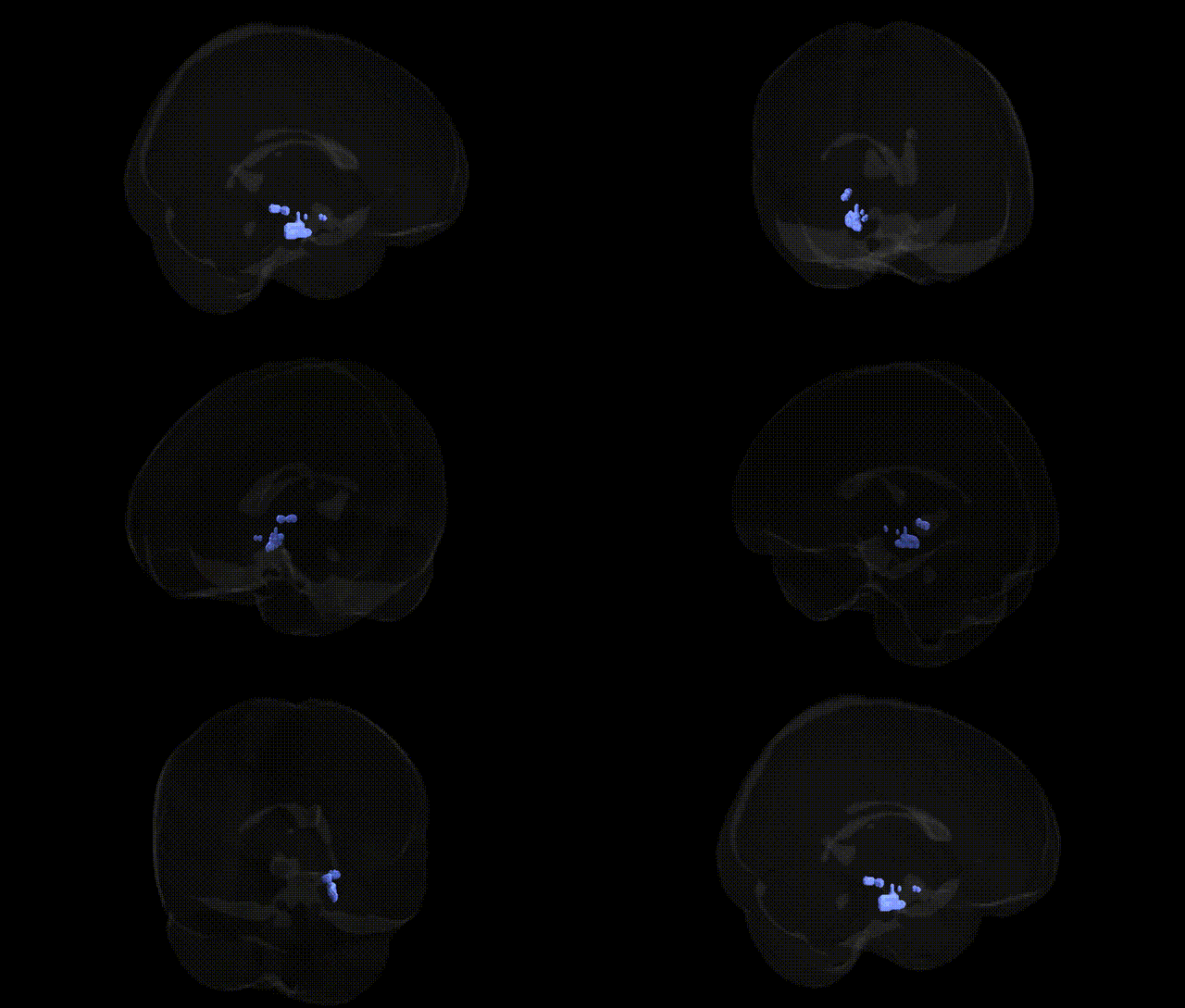
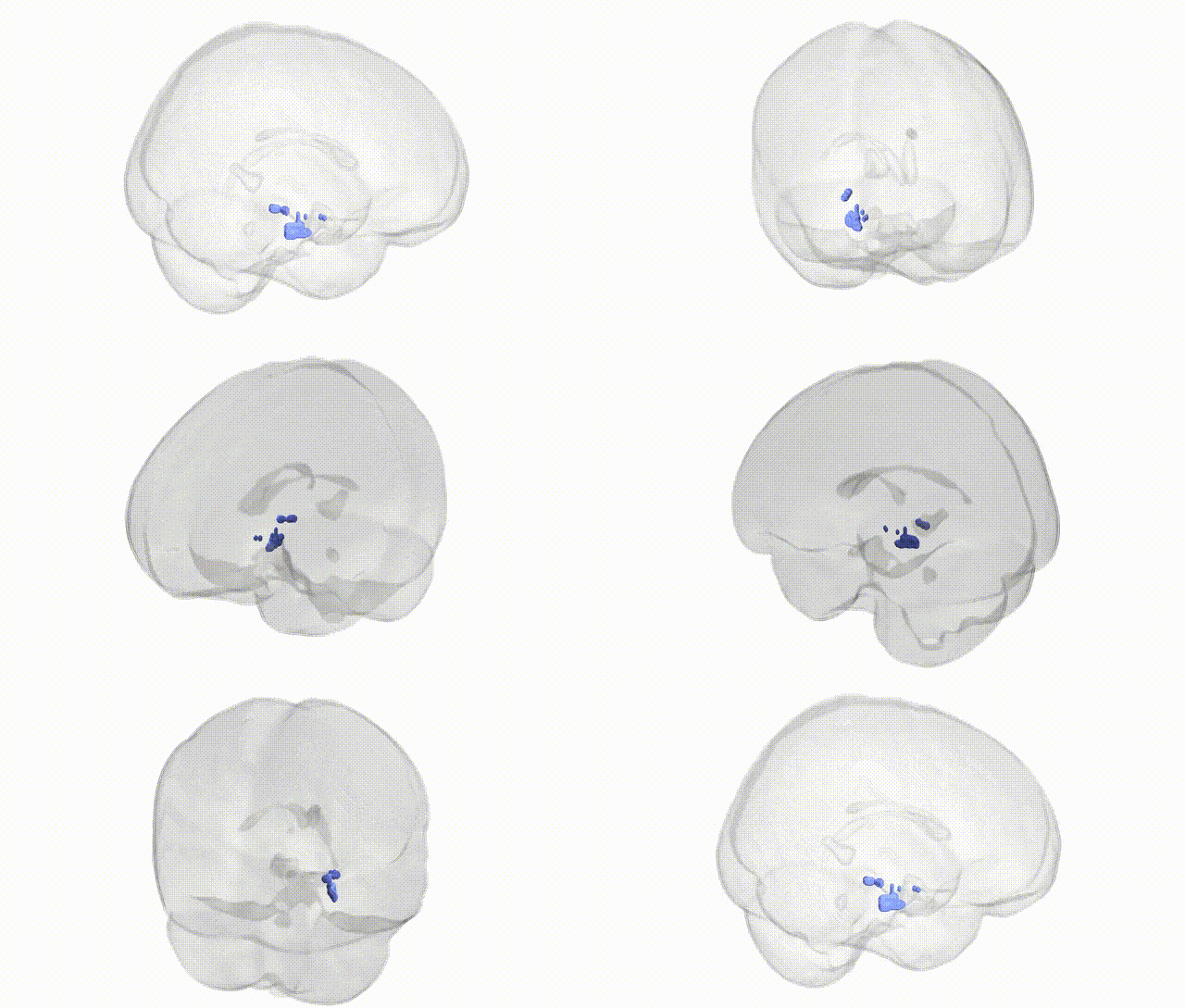
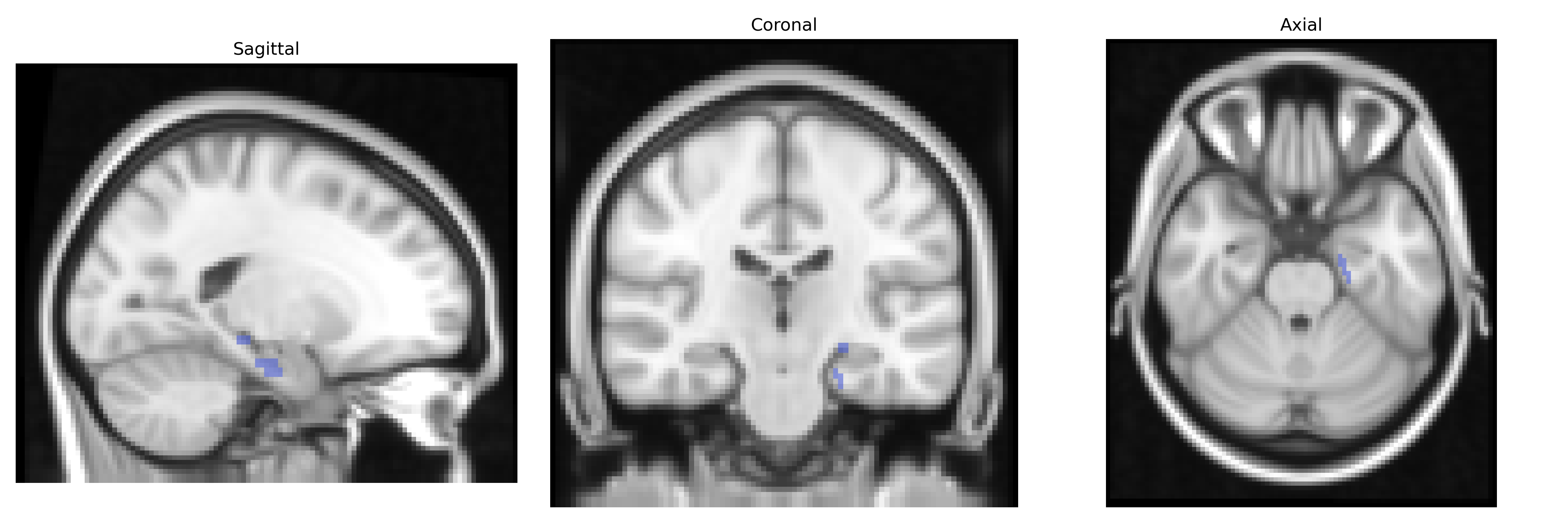
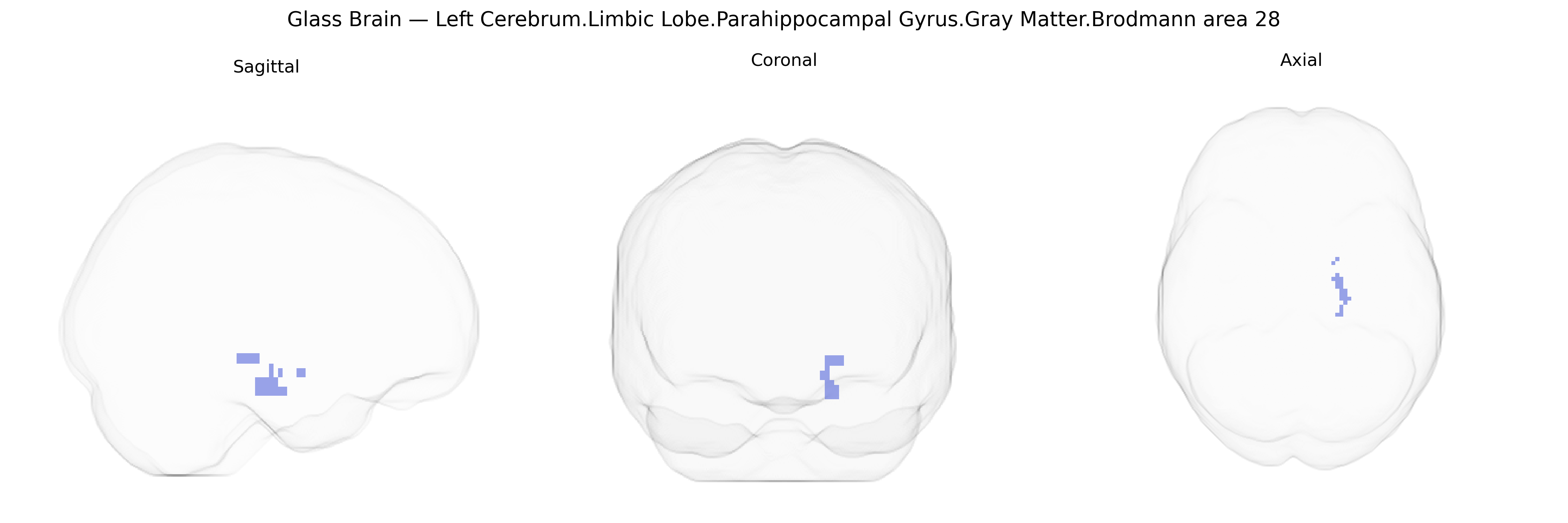
The bilateral Left Cerebrum.Limbic Lobe.Parahippocampal Gyrus.Gray Matter.Brodmann area 28 corresponds to the entorhinal cortex, a key gateway between neocortical sensory association areas and the hippocampal formation. Located in the anterior medial temporal lobe within the parahippocampal gyrus, BA28 consists of agranular cortex with dense reciprocal connections to the hippocampus, amygdala, and widespread cortical regions. Functionally, this region is critical for episodic memory formation, spatial navigation, and consolidation of declarative memories, acting as a hub for integrating multimodal information into hippocampal circuits. It is among the first regions affected in Alzheimer’s disease and is implicated in temporal lobe epilepsy and other memory-related disorders, reflecting its central role in limbic system processing. Entorhinal cortex
The bilateral parahippocampal gyrus gray matter in Brodmann area 28 (entorhinal cortex region in the limbic lobe) has been repeatedly implicated in genetic studies of memory, Alzheimer’s disease, and related neurodegenerative and psychiatric traits. GWAS and imaging-genetics studies show that common variation in genes central to amyloid and tau pathology (notably APOE, particularly the ε4 allele, as well as BIN1, CLU, PICALM, ABCA7 and CR1) is associated with reduced parahippocampal/entorhinal cortical thickness and volume and with accelerated age-related atrophy, consistent with this region’s role as one of the earliest sites of Alzheimer’s pathology. Variants in genes involved in synaptic plasticity and neurodevelopment (e.g., BDNF, COMT, DISC1, and several glutamatergic and GABAergic pathway genes identified in large neuroimaging GWAS) have been linked to structural and functional variation in this area, with downstream associations to episodic memory performance, spatial navigation, and general cognitive ability. Psychiatric GWAS and imaging-genetics work in major depressive disorder, schizophrenia, PTSD and anxiety disorders have associated polygenic risk scores and specific loci (including CACNA1C, ZNF804A, and other neurodevelopmental risk genes) with altered parahippocampal gray matter metrics and connectivity within limbic circuits. In addition, large consortia such as ENIGMA and UK Biobank have identified numerous common variants across the genome (e.g., in HMGA2, IGF1, and multiple intergenic regions) that influence entorhinal/parahippocampal thickness and volume, indicating that Brodmann area 28 is a highly heritable structure whose morphology and vulnerability to disease reflect polygenic influences spanning neurodevelopmental, synaptic, and neurodegenerative pathways.
Overview generated by GPT-4o (2026).
Region ID: 169
Hemisphere: bilateral
Atlas: Talairach labels 2mm
Full Quality Version: Download MP4
Full Quality Version: Download MP4
Wali Sidiqyar*, Gaurav Rudravaram*, Elyssa M. McMaster, Trent M. Schwartz, Adam M. Saunders, Kurt G. Schilling, Bennett A. Landman "Introducing SPINS: A Shared Public Visualization Library of Neuroanatomical Structures." Medical Imaging with Deep Learning- short paper
This resource is licensed under CC0 1.0 Universal (Public Domain).