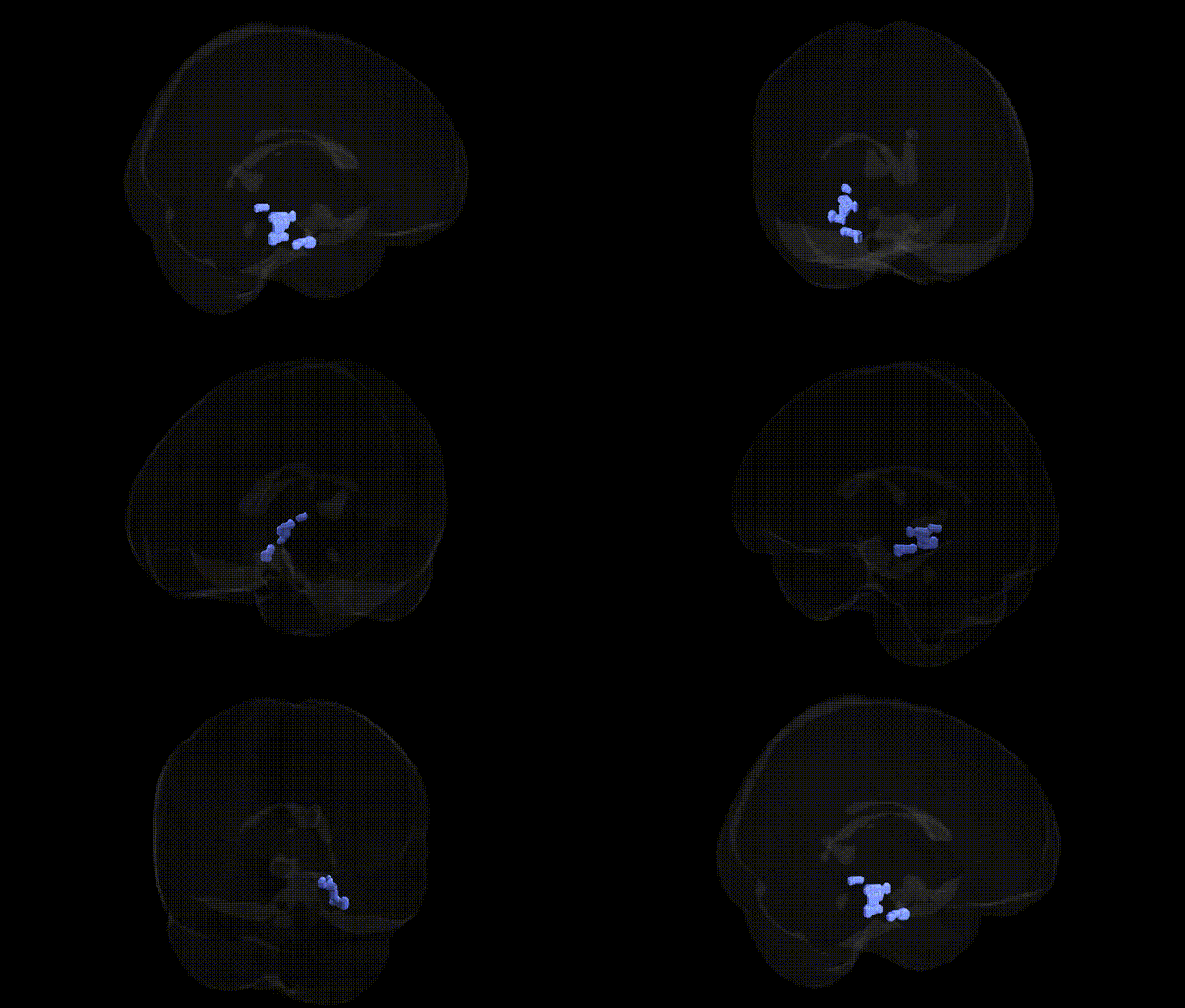
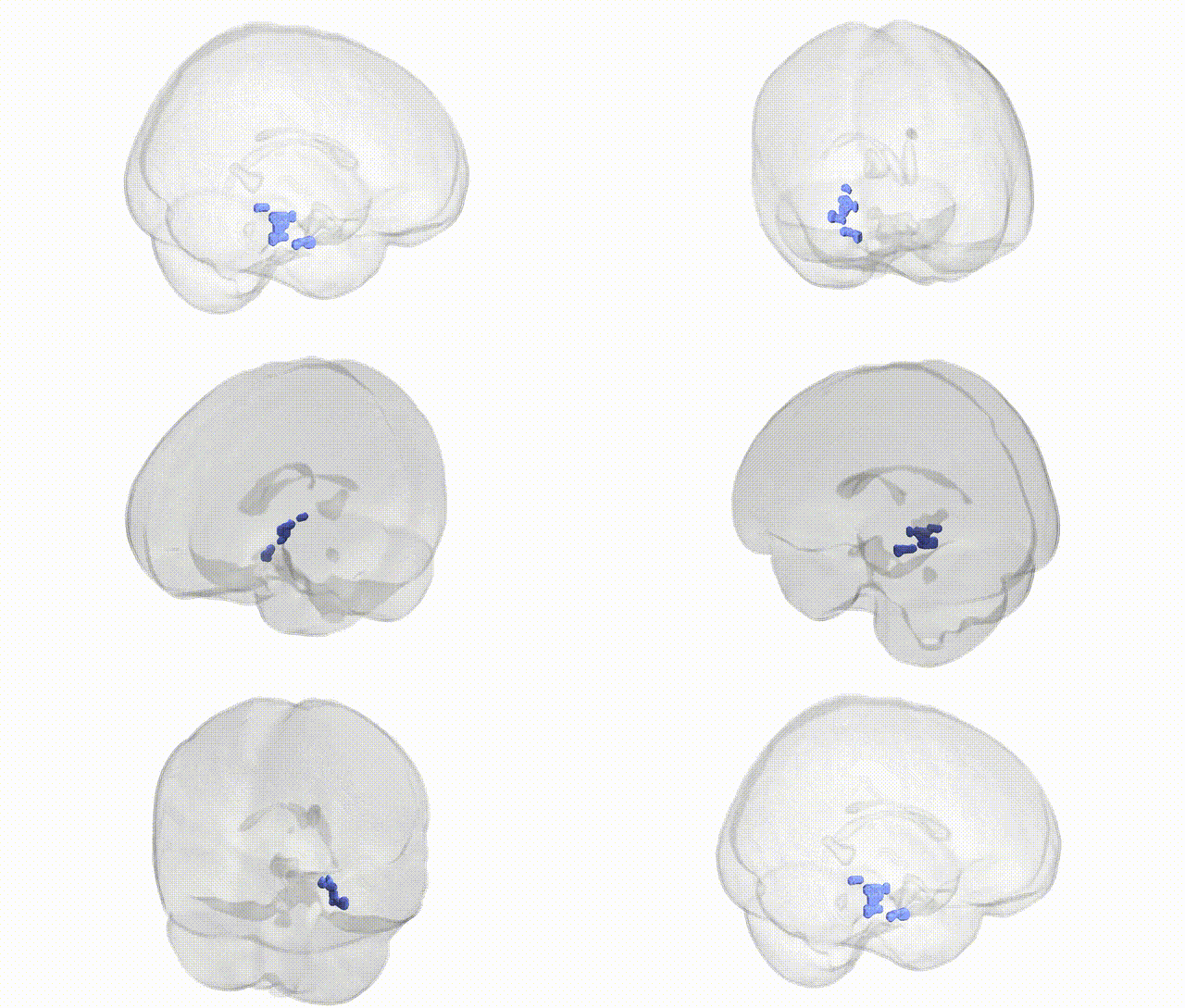
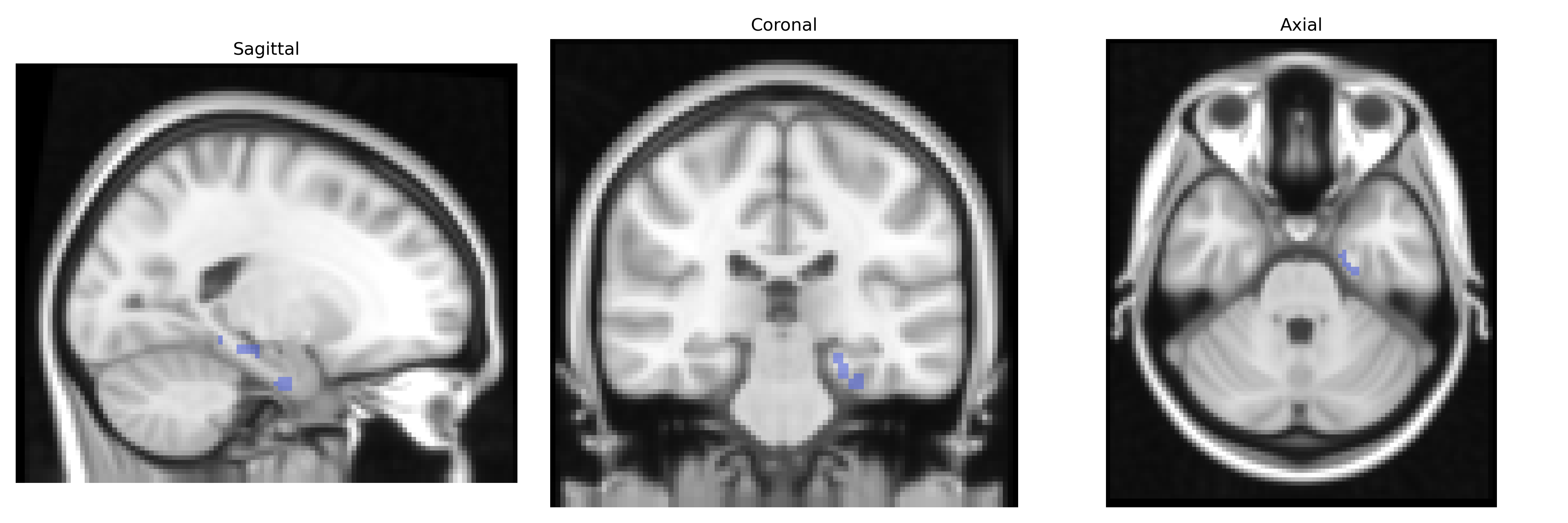
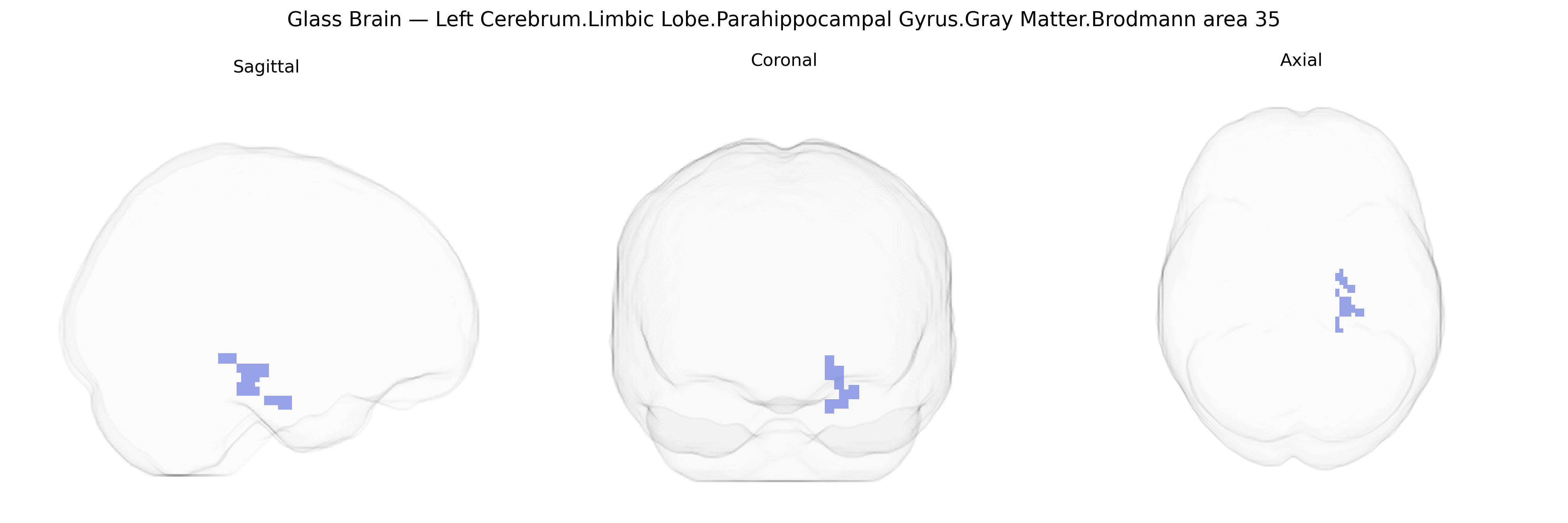
The bilateral Left Cerebrum.Limbic Lobe.Parahippocampal Gyrus.Gray Matter.Brodmann area 35 corresponds to the perirhinal cortex, a narrow strip of cortical gray matter located in the medial temporal lobe along the anterior portion of the parahippocampal gyrus. Cytoarchitectonically distinct from adjacent entorhinal and parahippocampal areas, BA35 is heavily interconnected with hippocampal formation, entorhinal cortex, and high-order visual and polymodal association cortices. Functionally, it plays a key role in recognition memory, familiarity-based object processing, and integration of multimodal sensory information, and is implicated in semantic memory and associative learning. BA35 is also an early site of neurofibrillary pathology in Alzheimer’s disease, reflecting its importance in medial temporal lobe memory circuits. There is no direct link for Brodmann area 35; a closely related structure is the Perirhinal cortex.
The bilateral parahippocampal gyrus gray matter in Brodmann area 35, a key component of the medial temporal lobe and limbic system, has been implicated in multiple genetic and GWAS findings primarily through its role in episodic memory, affect regulation, and neurodegenerative disease. Variants in genes central to Alzheimer’s disease pathophysiology—such as APOE (particularly the ε4 allele), CLU, BIN1, CR1, PICALM, and SORL1—have been associated with structural and functional changes in medial temporal regions including BA35, often manifesting as reduced gray matter volume and accelerated atrophy in at-risk individuals. GWAS of hippocampal and parahippocampal volume and cortical thickness (e.g., ENIGMA and UK Biobank imaging-genetics consortia) have identified multiple loci, including variants near genes involved in neurodevelopment, synaptic plasticity, and tau processing (such as MAPT), that show significant associations with medial temporal lobe metrics encompassing the parahippocampal/BA35 region. Genetic studies in major depressive disorder, schizophrenia, and bipolar disorder repeatedly link polygenic risk scores and specific risk variants (e.g., in CACNA1C, ZNF804A, and other synaptic and calcium-channel genes) to structural and connectivity alterations in limbic and parahippocampal circuits, suggesting shared developmental and stress-response mechanisms. GWAS of memory performance, spatial navigation, and episodic recollection have also highlighted variants influencing medial temporal activity patterns, including BA35, and imaging-genetics work in post-traumatic stress disorder and anxiety traits has associated risk alleles in FKBP5, BDNF, and other stress-response genes with altered parahippocampal activation and gray matter. Collectively, the genetic architecture of BA35-related structure and function appears substantially polygenic, overlapping with risk pathways for Alzheimer’s disease, mood and psychotic disorders, and cognitive traits that depend on medial temporal-limbic integrity.
Overview generated by GPT-4o (2026).
Region ID: 140
Hemisphere: bilateral
Atlas: Talairach labels 2mm
Full Quality Version: Download MP4
Full Quality Version: Download MP4
Wali Sidiqyar*, Gaurav Rudravaram*, Elyssa M. McMaster, Trent M. Schwartz, Adam M. Saunders, Kurt G. Schilling, Bennett A. Landman "Introducing SPINS: A Shared Public Visualization Library of Neuroanatomical Structures." Medical Imaging with Deep Learning- short paper
This resource is licensed under CC0 1.0 Universal (Public Domain).