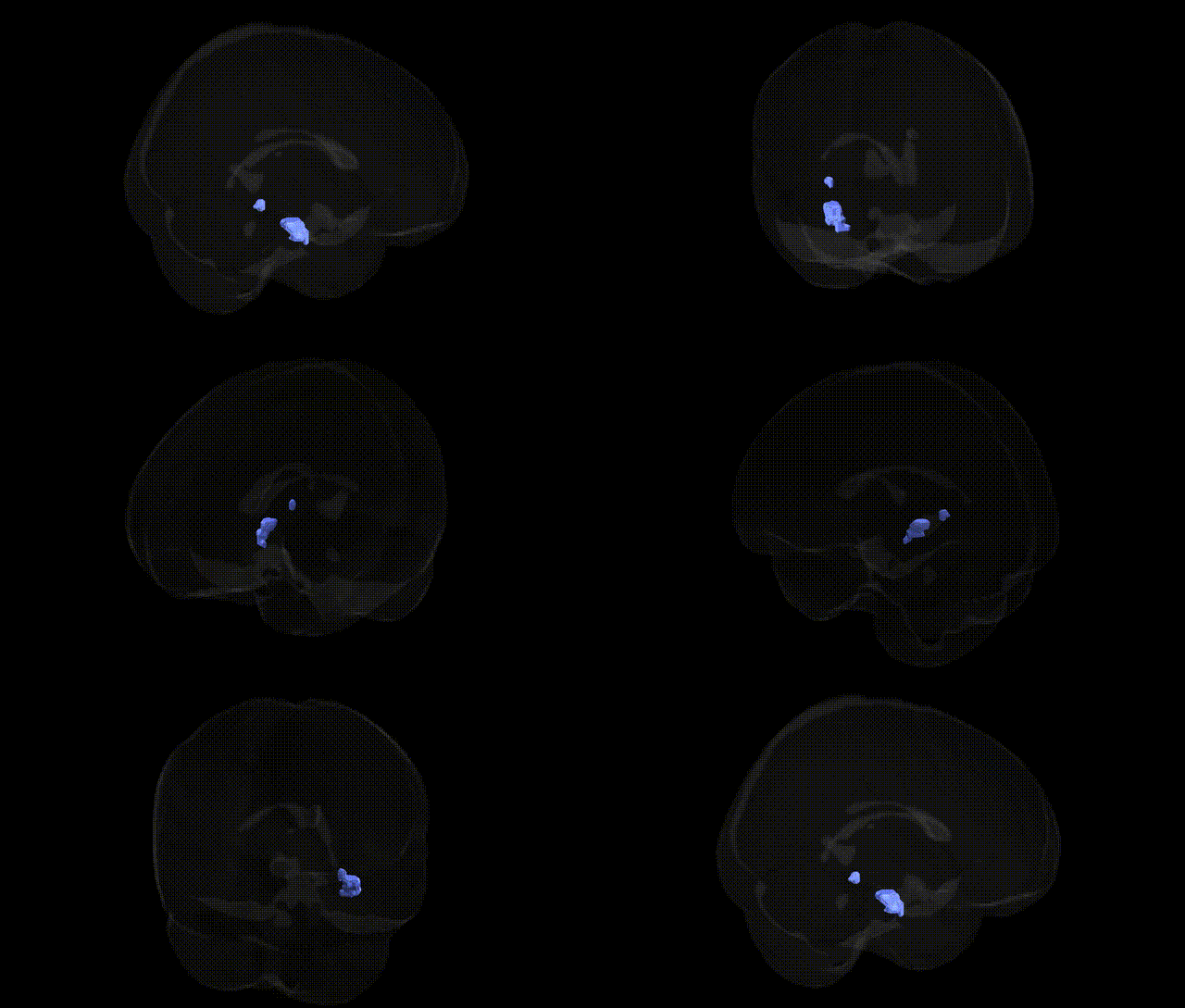
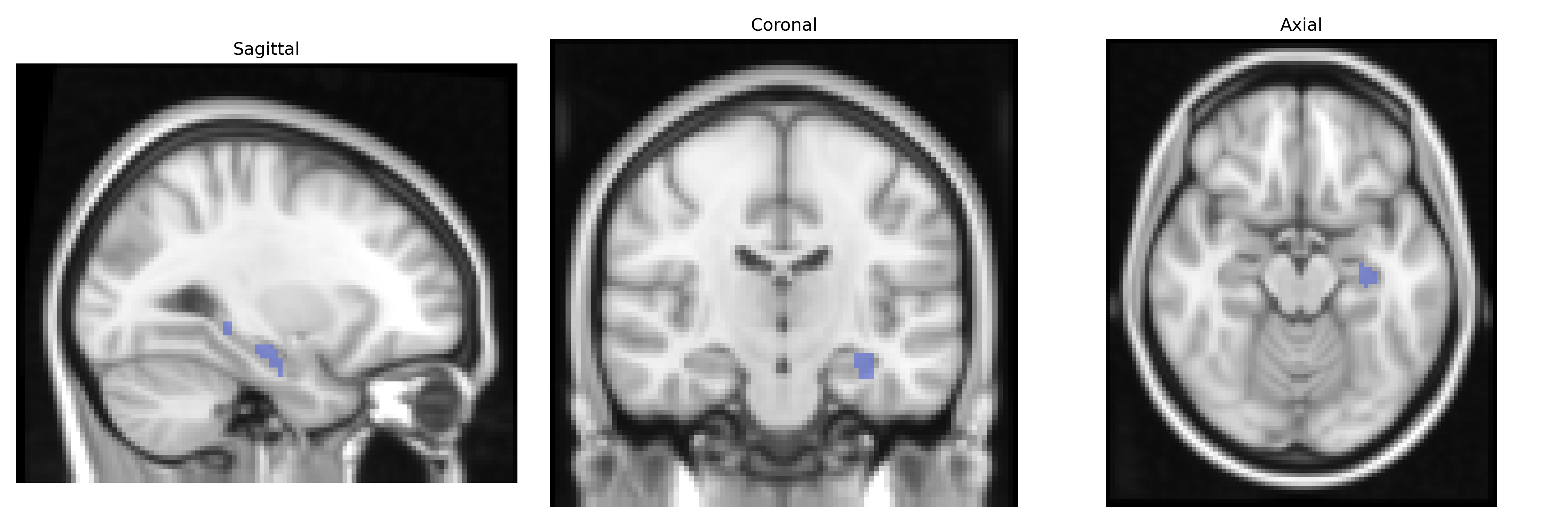
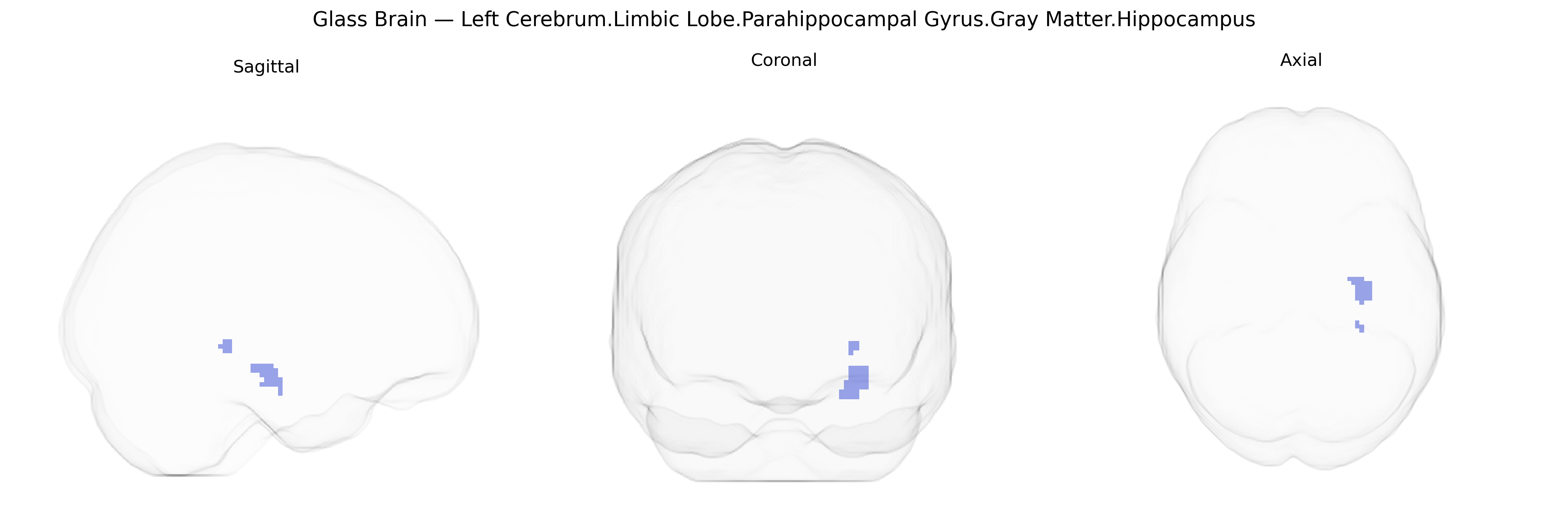
The bilateral Left Cerebrum Limbic Lobe Parahippocampal Gyrus Gray Matter Hippocampus region, as defined in the Talairach 2 mm atlas, corresponds to gray matter structures of the hippocampal formation lying within the medial temporal lobe and closely associated with the parahippocampal gyrus. This area is a key component of the limbic system, critically involved in the formation, consolidation, and retrieval of episodic and declarative memories, as well as spatial navigation and contextual processing of experience. Its neuronal circuitry, including the dentate gyrus, CA fields, and subiculum, supports synaptic plasticity mechanisms such as long-term potentiation that underlie learning. Bilateral integrity of this region is essential for normal memory function, and damage or degeneration is strongly implicated in conditions such as medial temporal lobe epilepsy and Alzheimer’s disease. Hippocampus
The bilateral left hippocampus and parahippocampal gyrus (limbic lobe gray matter) are key structures in episodic memory, spatial navigation, and stress regulation, and numerous genetic studies, including large-scale GWAS, have linked variation in and around this region to diverse neuropsychiatric and neurodegenerative traits. Common variants near or within genes such as APOE, MAPT, BIN1, CLU, PICALM, and ABCA7, as well as loci in SORL1, CR1, and TREM2, show strong associations with hippocampal volume and risk for Alzheimer’s disease and related dementias. GWAS of hippocampal and parahippocampal morphology have identified multiple volume-associated loci (e.g., variants near DPP4, ASTN2, HMGA2, BDNF, and CADM2), some of which overlap with genetic risk factors for cognitive performance, intelligence, and educational attainment, as well as major depressive disorder and schizophrenia. Heritable differences in hippocampal structure and function have also been linked to stress-related and anxiety disorders, including PTSD, with implicated genes often involved in synaptic plasticity, neurogenesis, and HPA-axis regulation (such as FKBP5 and BDNF). Additionally, polygenic risk scores for Alzheimer’s disease, schizophrenia, and depression correlate with reduced hippocampal and parahippocampal gray matter volume, supporting a genetically mediated vulnerability of this region across multiple brain disorders.
Overview generated by GPT-4o (2026).
Region ID: 175
Hemisphere: bilateral
Atlas: Talairach labels 2mm
Full Quality Version: Download MP4
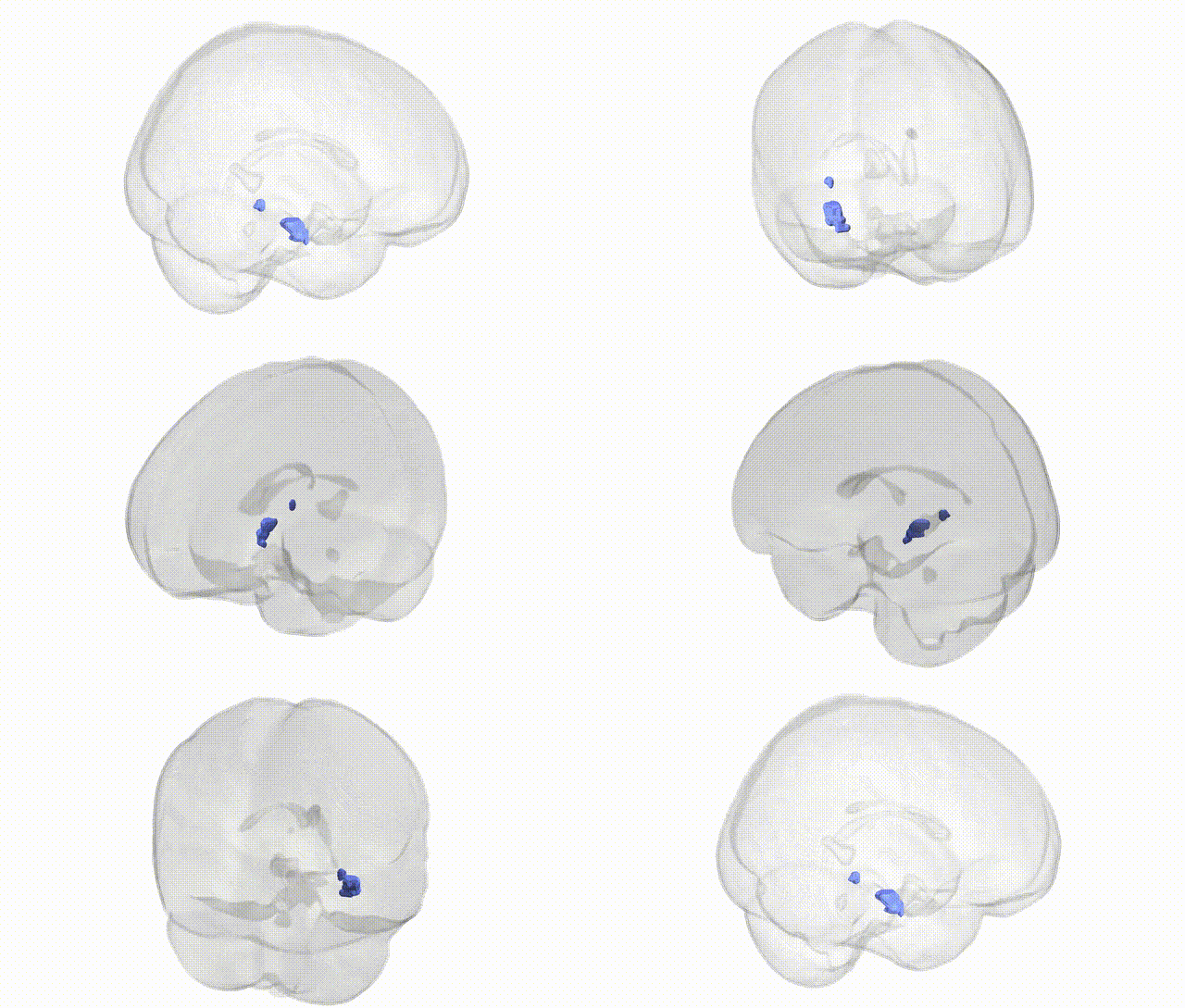
Full Quality Version: Download MP4
Wali Sidiqyar*, Gaurav Rudravaram*, Elyssa M. McMaster, Trent M. Schwartz, Adam M. Saunders, Kurt G. Schilling, Bennett A. Landman "Introducing SPINS: A Shared Public Visualization Library of Neuroanatomical Structures." Medical Imaging with Deep Learning- short paper
This resource is licensed under CC0 1.0 Universal (Public Domain).