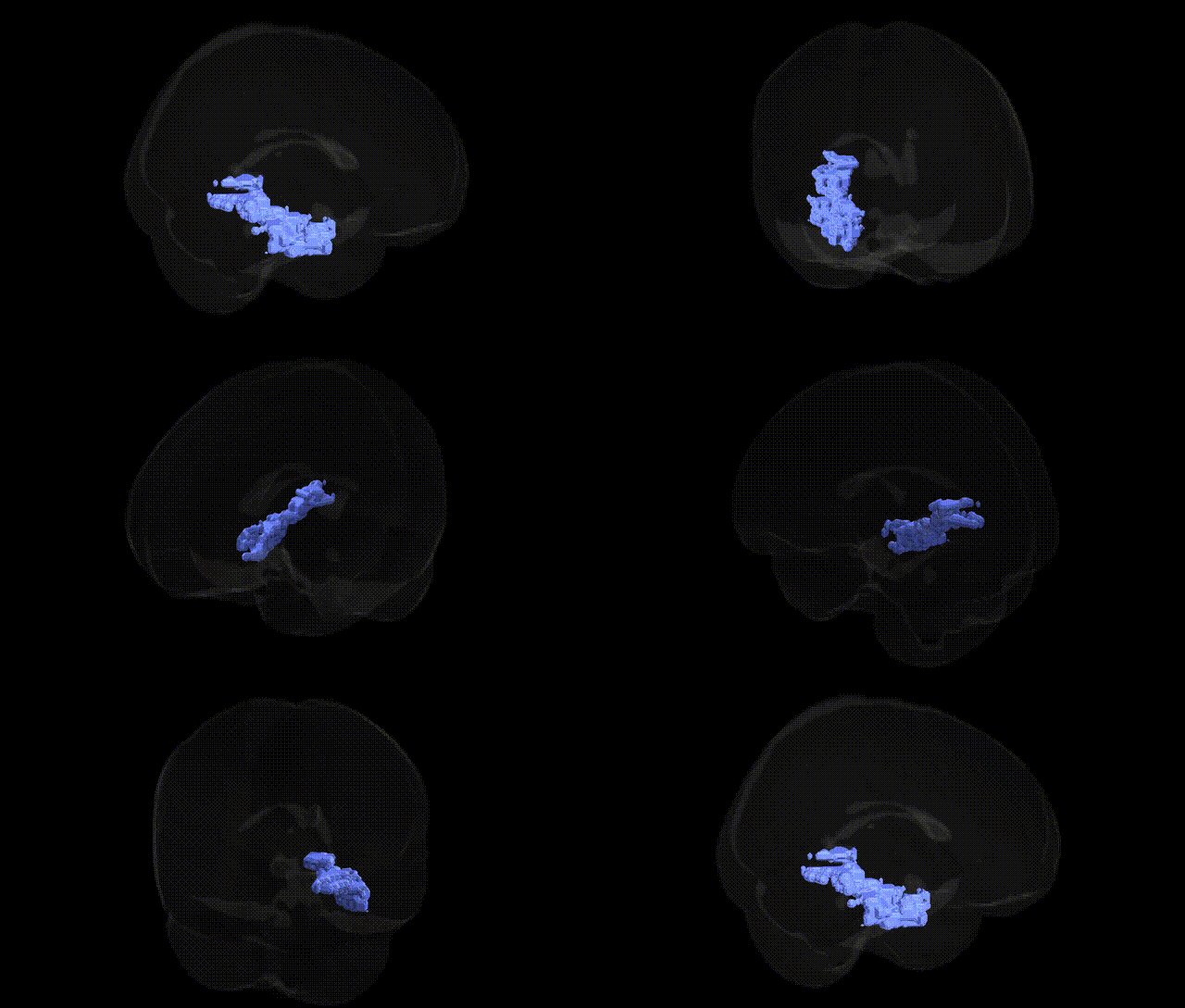
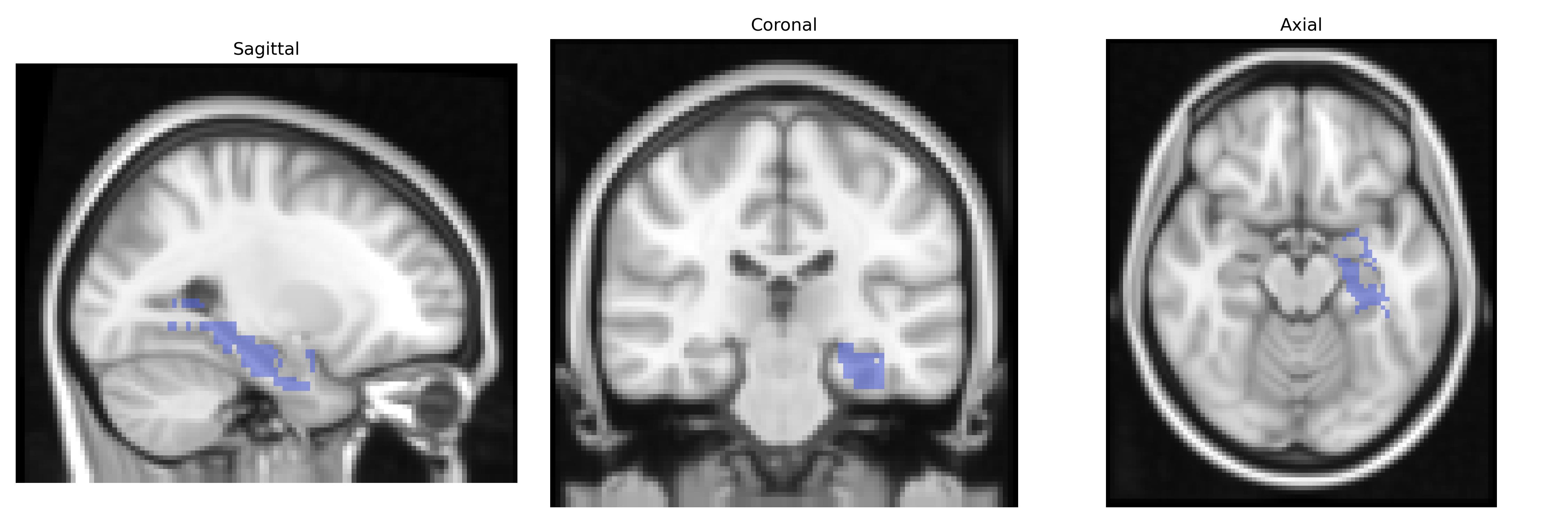
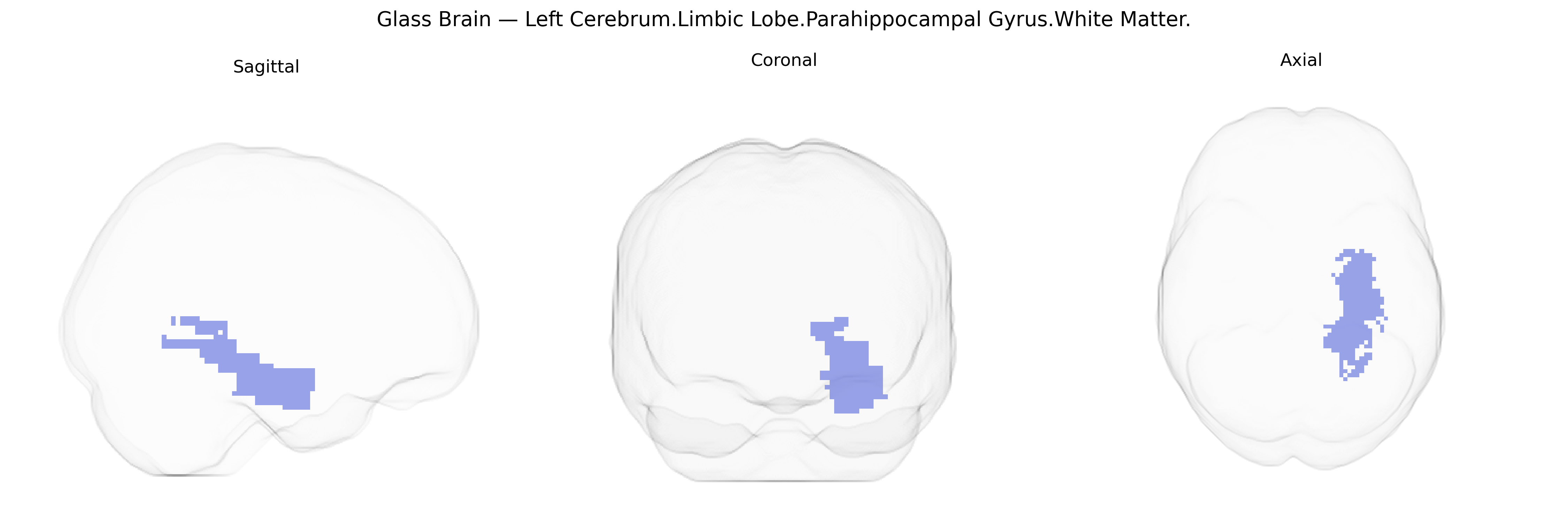
The bilateral Left Cerebrum Limbic Lobe Parahippocampal Gyrus white matter comprises the subcortical fiber tracts underlying the parahippocampal gyrus, a medial temporal lobe structure of the limbic system involved in memory encoding, contextual association, and spatial navigation. This white matter includes afferent and efferent pathways linking the parahippocampal cortex with the hippocampal formation, entorhinal cortex, and other limbic and association areas, supporting integration of multisensory information into episodic and spatial memory representations. Functionally, these fibers are critical for the relay of processed cortical input to the hippocampus and for the distribution of hippocampal output back to widespread neocortical and limbic territories, and they are often implicated in disorders affecting medial temporal lobe connectivity, such as temporal lobe epilepsy and neurodegenerative dementias. There is no direct Wikipedia article for this specific white matter region; a closely related structure is the Parahippocampal gyrus.
The bilateral parahippocampal white matter, as defined in the Talairach 2 mm atlas, is a key conduit linking medial temporal structures with limbic and association cortices, and genetic associations typically implicate it via measures of microstructure (e.g., diffusion MRI) or regional volume rather than the atlas label itself. Twin and heritability studies indicate strong genetic influences on parahippocampal white matter integrity, and large imaging‑genetics consortia (e.g., ENIGMA, UK Biobank) have shown that common variants in genes involved in axonal guidance, myelination, and synaptic plasticity (including loci near genes such as BDNF, CNTNAP2, DISC1, and multiple Alzheimer’s disease risk genes like APOE and CLU) are associated with structural measures of the parahippocampal region and adjacent medial temporal pathways (such as the cingulum and parahippocampal component of the uncinate fasciculus). GWAS of hippocampal and parahippocampal volumes and white matter integrity have linked this region to risk for Alzheimer’s disease and amnestic mild cognitive impairment, schizophrenia and psychosis-related traits, major depressive disorder, and anxiety, with many associations mediated by polygenic scores for these disorders that predict reduced integrity or altered connectivity in parahippocampal and limbic white matter tracts. Additional GWAS of memory performance, spatial navigation, and general cognitive ability have identified variants whose effects on these traits partially map onto parahippocampal and medial temporal white matter measures, supporting a genetically influenced role of this region in episodic memory and contextual processing, although most findings are at the level of broader medial temporal or limbic networks rather than the specific “Left Cerebrum.Limbic Lobe.Parahippocampal Gyrus.White Matter” label.
Overview generated by GPT-4o (2026).
Region ID: 133
Hemisphere: bilateral
Atlas: Talairach labels 2mm
Full Quality Version: Download MP4
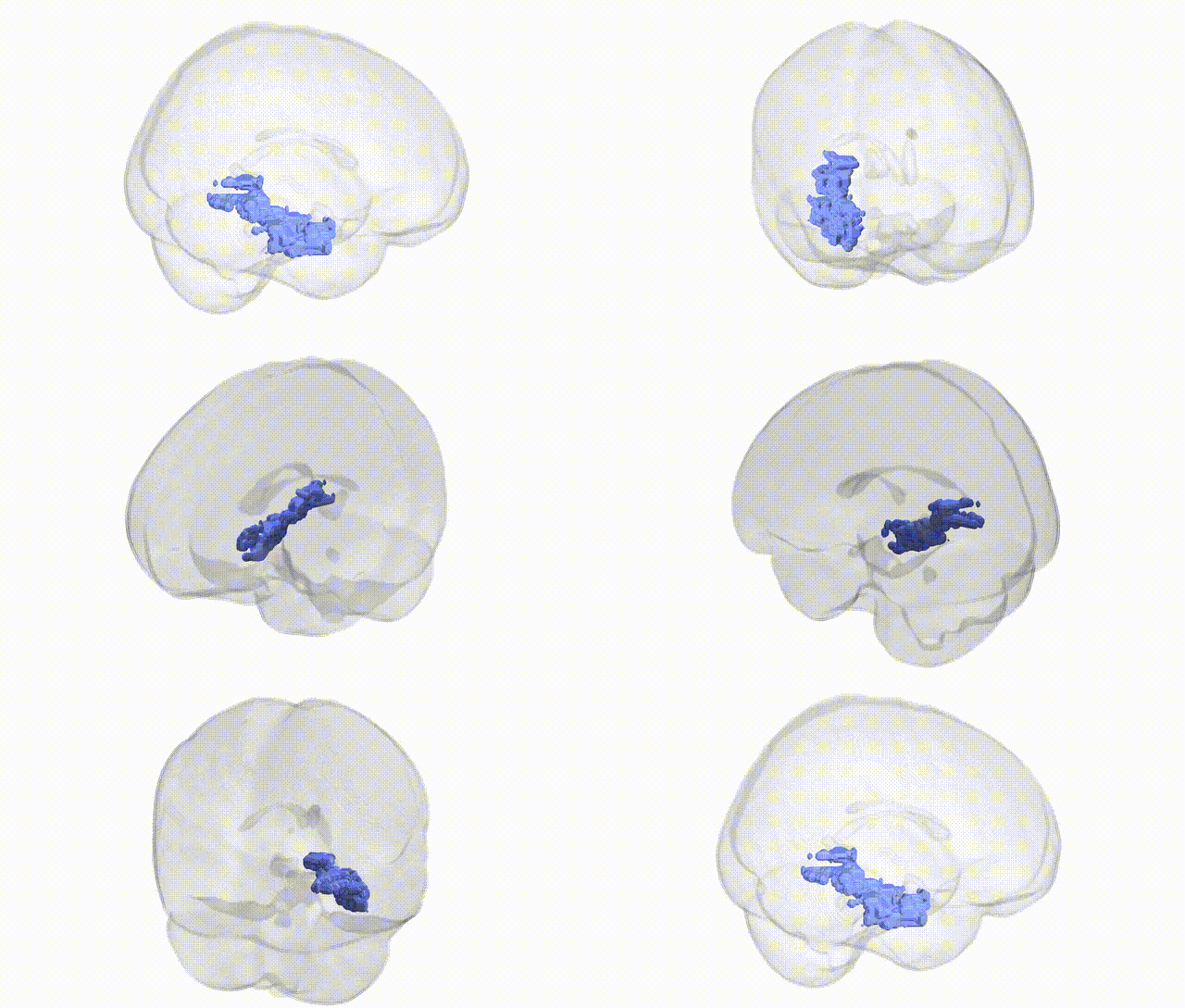
Full Quality Version: Download MP4
Wali Sidiqyar*, Gaurav Rudravaram*, Elyssa M. McMaster, Trent M. Schwartz, Adam M. Saunders, Kurt G. Schilling, Bennett A. Landman "Introducing SPINS: A Shared Public Visualization Library of Neuroanatomical Structures." Medical Imaging with Deep Learning- short paper
This resource is licensed under CC0 1.0 Universal (Public Domain).