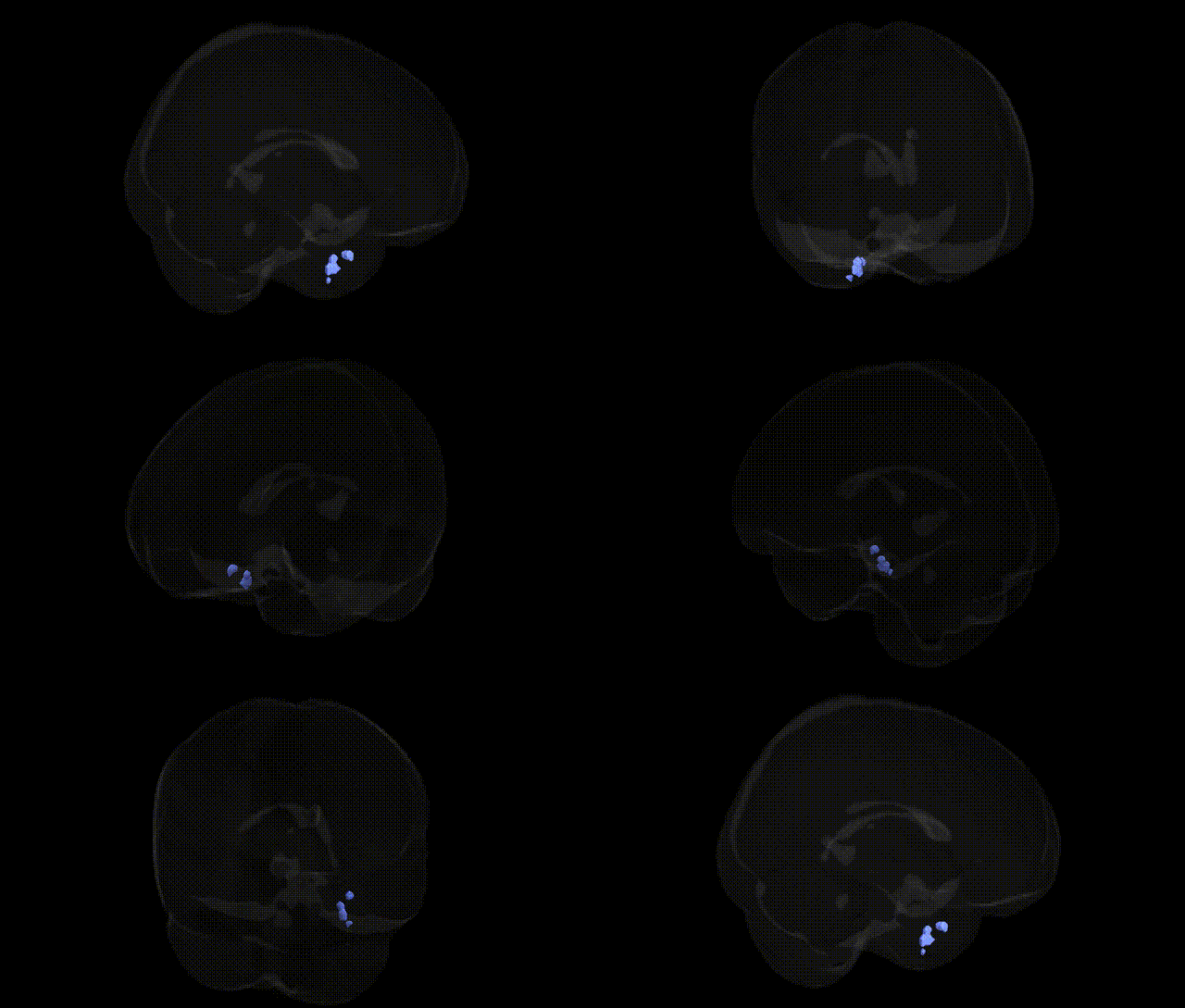
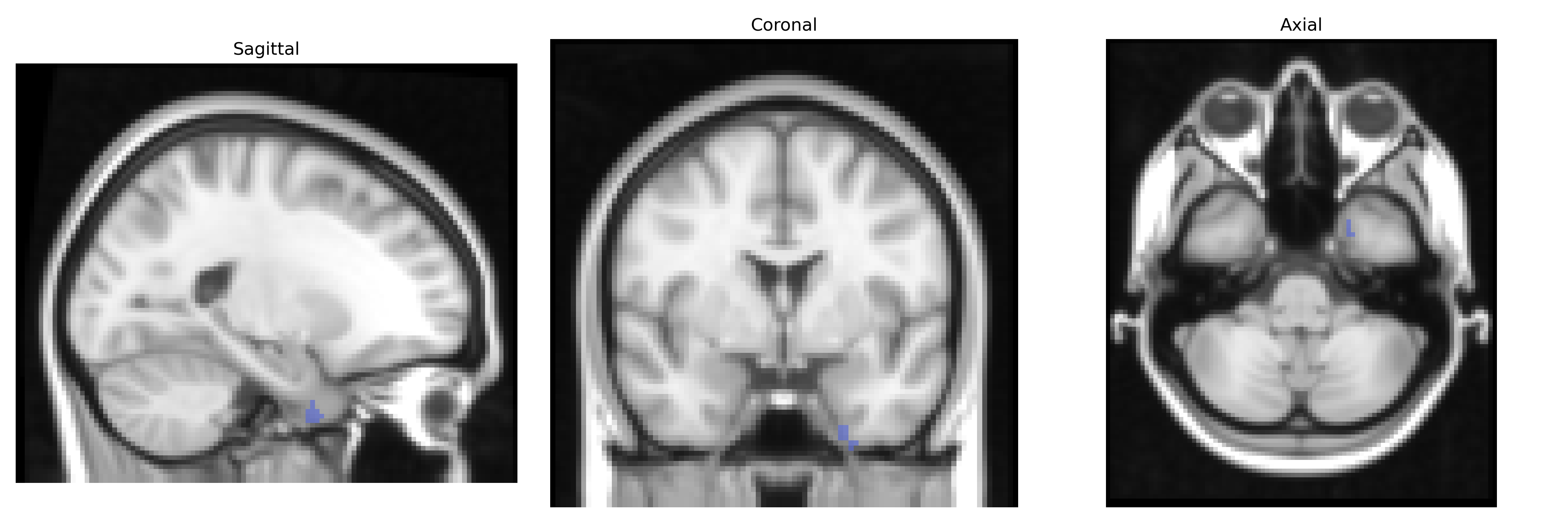
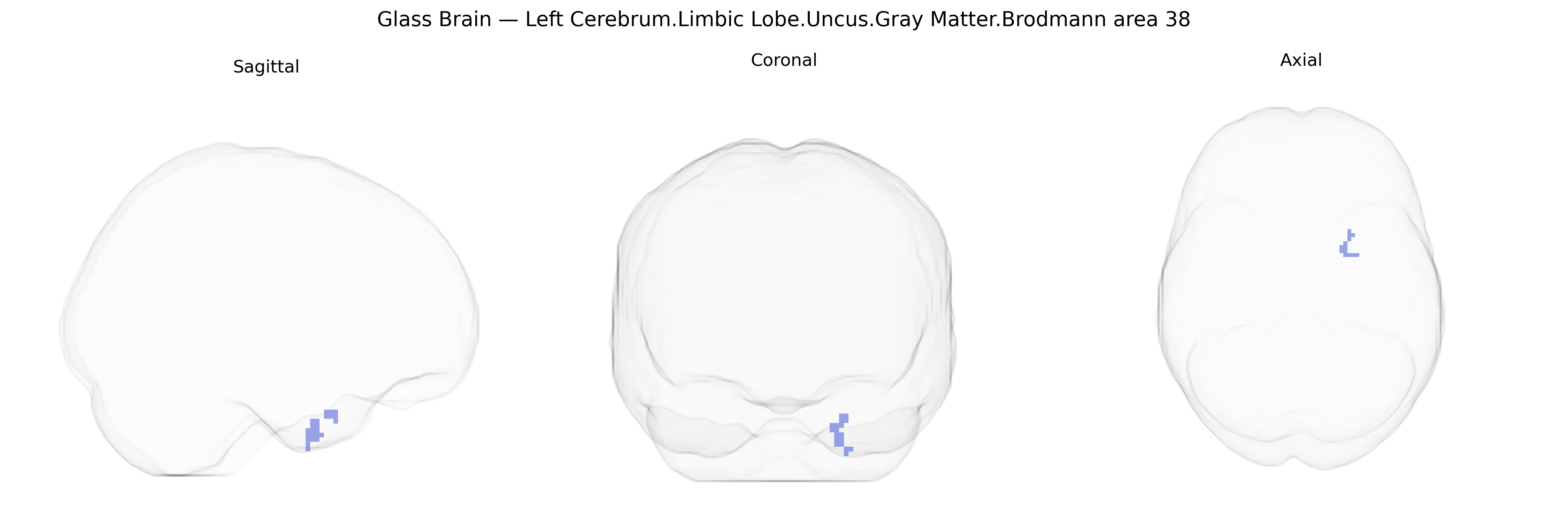
The bilateral Left Cerebrum.Limbic Lobe.Uncus.Gray Matter.Brodmann area 38 corresponds to a cortical territory at the anterior temporal pole, closely associated with the uncus and limbic structures. Brodmann area 38 (temporal pole) is involved in high-order multimodal integration of sensory, emotional, and social information, including semantic memory, affective processing, and aspects of social cognition and language. Its position at the anterior end of the temporal lobe and proximity to the amygdala and hippocampal formation supports roles in emotional valence assignment, autobiographical memory, and integration of visceral-limbic signals with complex perceptual representations. There is no direct link for this exact Talairach label; a related structure is the Temporal pole.
The left Brodmann area 38 (temporal pole/uncus within the limbic system) has been implicated in genetic studies primarily through its roles in social-emotional processing, semantic memory, and affective regulation, rather than through region-specific GWAS signals. Twin and heritability studies indicate moderate to high genetic influence on temporal pole gray matter volume and cortical thickness, often in the context of broader temporal lobe measures. Large-scale neuroimaging genetics consortia (e.g., ENIGMA) and GWAS of cortical structure have identified common variants in genes related to neurodevelopment and synaptic function (such as those near KIAA0586, TBR1, and other neuronal differentiation loci) that associate with temporal cortical thickness or surface area, likely encompassing BA38, although not isolating it as a unique target. Clinically, genetic risk for temporal lobe epilepsy (including mesial/limbic structures like the uncus) has been linked to variants in synaptic and ion-channel genes (e.g., SCN1A, LGI1), and BA38 is part of networks affected in frontotemporal dementia and Alzheimer’s disease, where risk alleles in genes such as APOE, MAPT, GRN, and C9orf72 contribute to atrophy and functional disruption in anterior temporal regions. Psychiatric GWAS for autism spectrum disorder, schizophrenia, and major depression have associated polygenic risk with altered connectivity and morphology in temporal pole/limbic circuitry, suggesting that genetic architectures influencing social cognition and emotional regulation exert their effects partly through BA38, but current evidence supports a distributed, network-level genetic influence rather than a set of variants uniquely tied to this specific Talairach-defined region.
Overview generated by GPT-4o (2026).
Region ID: 34
Hemisphere: bilateral
Atlas: Talairach labels 2mm
Full Quality Version: Download MP4
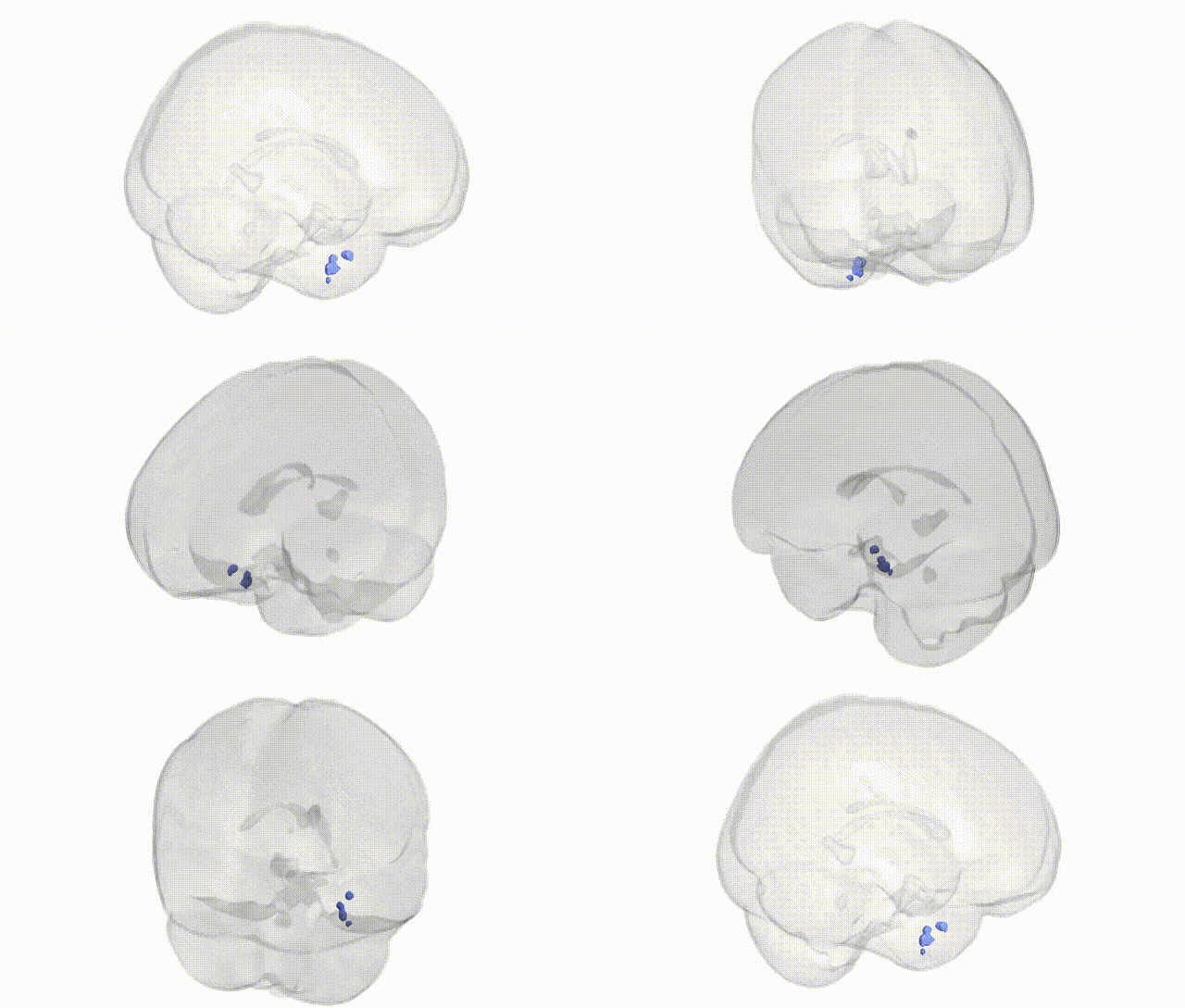
Full Quality Version: Download MP4
Wali Sidiqyar*, Gaurav Rudravaram*, Elyssa M. McMaster, Trent M. Schwartz, Adam M. Saunders, Kurt G. Schilling, Bennett A. Landman "Introducing SPINS: A Shared Public Visualization Library of Neuroanatomical Structures." Medical Imaging with Deep Learning- short paper
This resource is licensed under CC0 1.0 Universal (Public Domain).