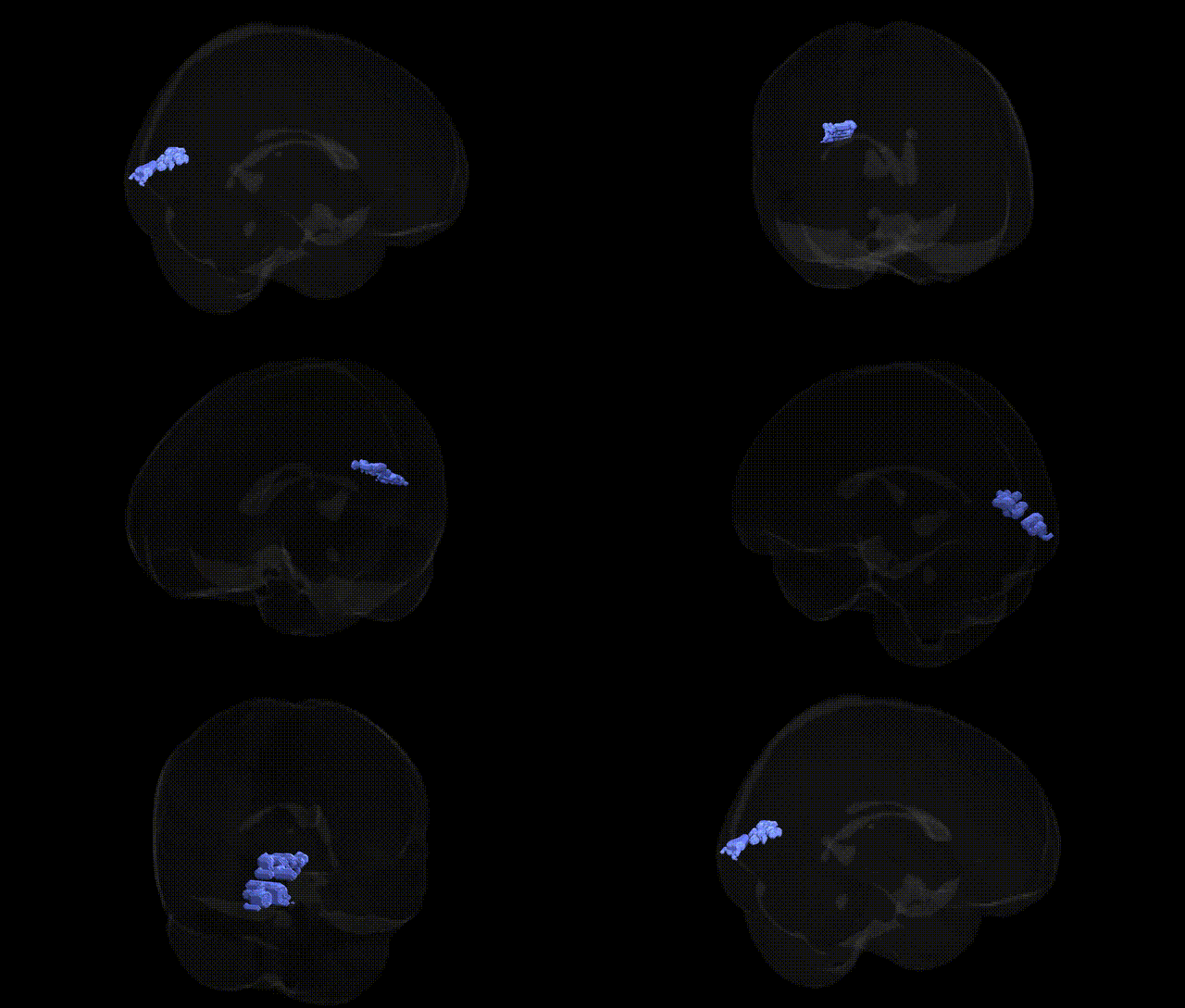
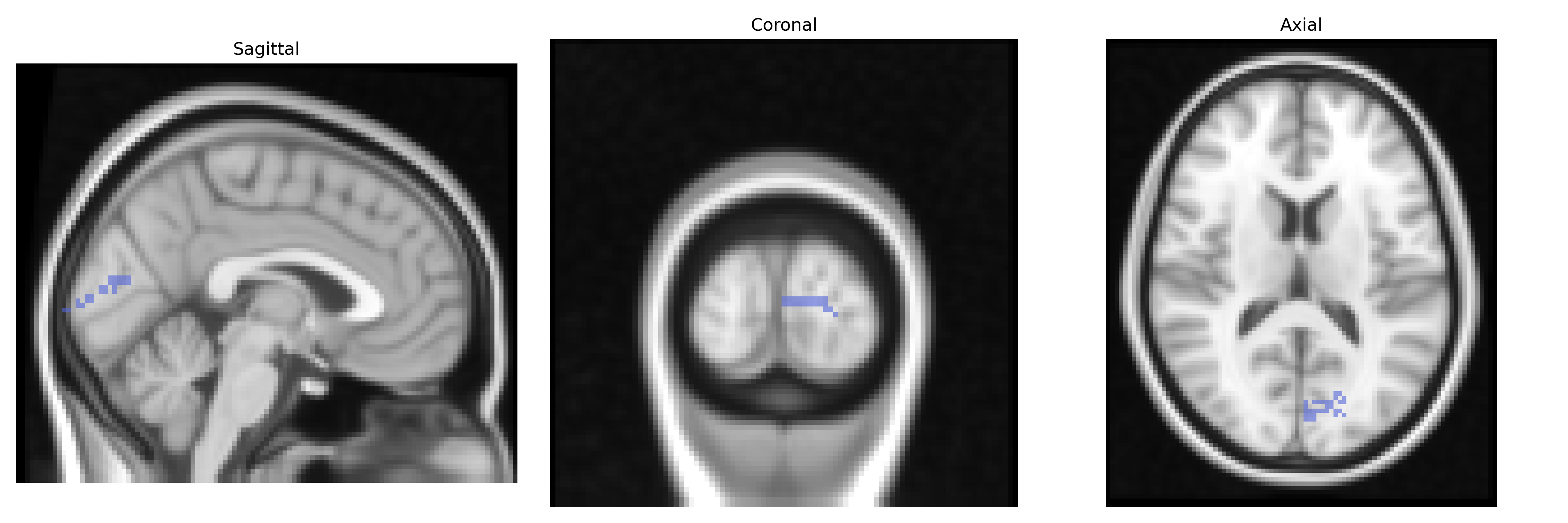
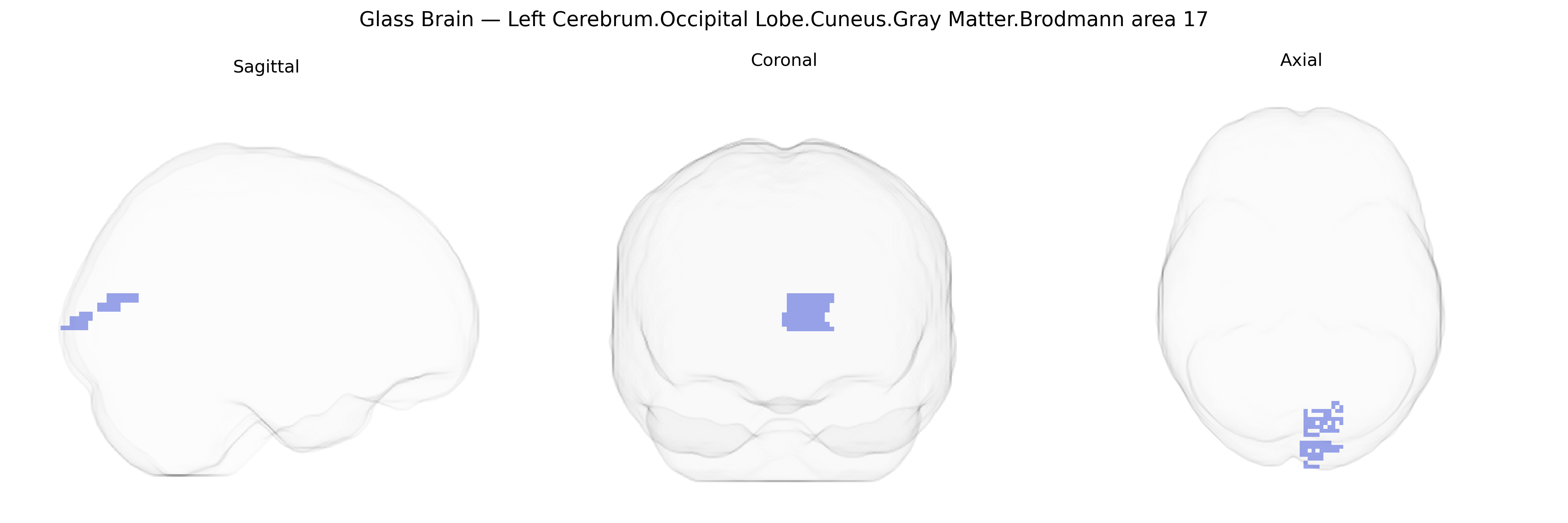
Bilateral Left Cerebrum.Occipital Lobe.Cuneus.Gray Matter.Brodmann area 17 corresponds to the primary visual cortex (V1), located along the calcarine sulcus in the occipital lobe and extending into the cuneus on the medial surface of the cerebral hemisphere. This cytoarchitectonic area is the main cortical recipient of visual input from the lateral geniculate nucleus of the thalamus and is characterized by a highly laminated structure, including the prominent stria of Gennari. Neuronal organization in Brodmann area 17 exhibits retinotopic mapping, whereby adjacent regions of cortex represent adjacent regions of the visual field, with central (foveal) vision occupying disproportionately large cortical territory. Functionally, this region is essential for basic visual processing such as detection of orientation, contrast, and spatial frequency, and serves as the gateway for subsequent processing in extrastriate visual areas.
Primary visual cortex
The bilateral left cerebrum occipital lobe cuneus gray matter Brodmann area 17 (primary visual cortex, V1) has been implicated in several genetic and imaging-genetics findings, though most evidence relates to broader occipital or visual cortex measures rather than this exact Talairach parcel. Twin and family studies show high heritability of V1 surface area, cortical thickness, and visual cortical map size, with common variants in genes involved in neurodevelopment and synaptic function (e.g., BDNF, NRG1, GRIN2B, and other glutamatergic and neuroplasticity-related loci) associated with occipital cortical structure and visual processing. Large-scale GWAS of brain MRI phenotypes (ENIGMA, UK Biobank) have reported associations between variants near genes such as PAX6, TCF4, CADM2, and others with occipital cortical thickness and surface area, indirectly implicating BA17 in genetically driven variability of visual cortex anatomy. BA17 activity and structure show genetic correlations with disorders that include prominent visual or perceptual components, such as schizophrenia (e.g., polygenic risk scores linked to occipital volume and activation differences), bipolar disorder, and major depression, as well as traits like visual acuity, reading and dyslexia, migraine with visual aura, and visual hallucinations in Parkinson’s disease, though these are typically identified at the level of occipital or calcarine cortex rather than narrowly defined BA17. In sum, primary visual cortex is highly heritable, influenced by common neurodevelopmental and synaptic genetic variants, and participates in the genetic architecture of neuropsychiatric conditions and visual cognitive traits, but precise GWAS hits specifically annotated to “Left Cerebrum.Occipital Lobe.Cuneus.Gray Matter.Brodmann area 17” in the Talairach 2 mm atlas remain limited.
Overview generated by GPT-4o (2026).
Region ID: 475
Hemisphere: bilateral
Atlas: Talairach labels 2mm
Full Quality Version: Download MP4
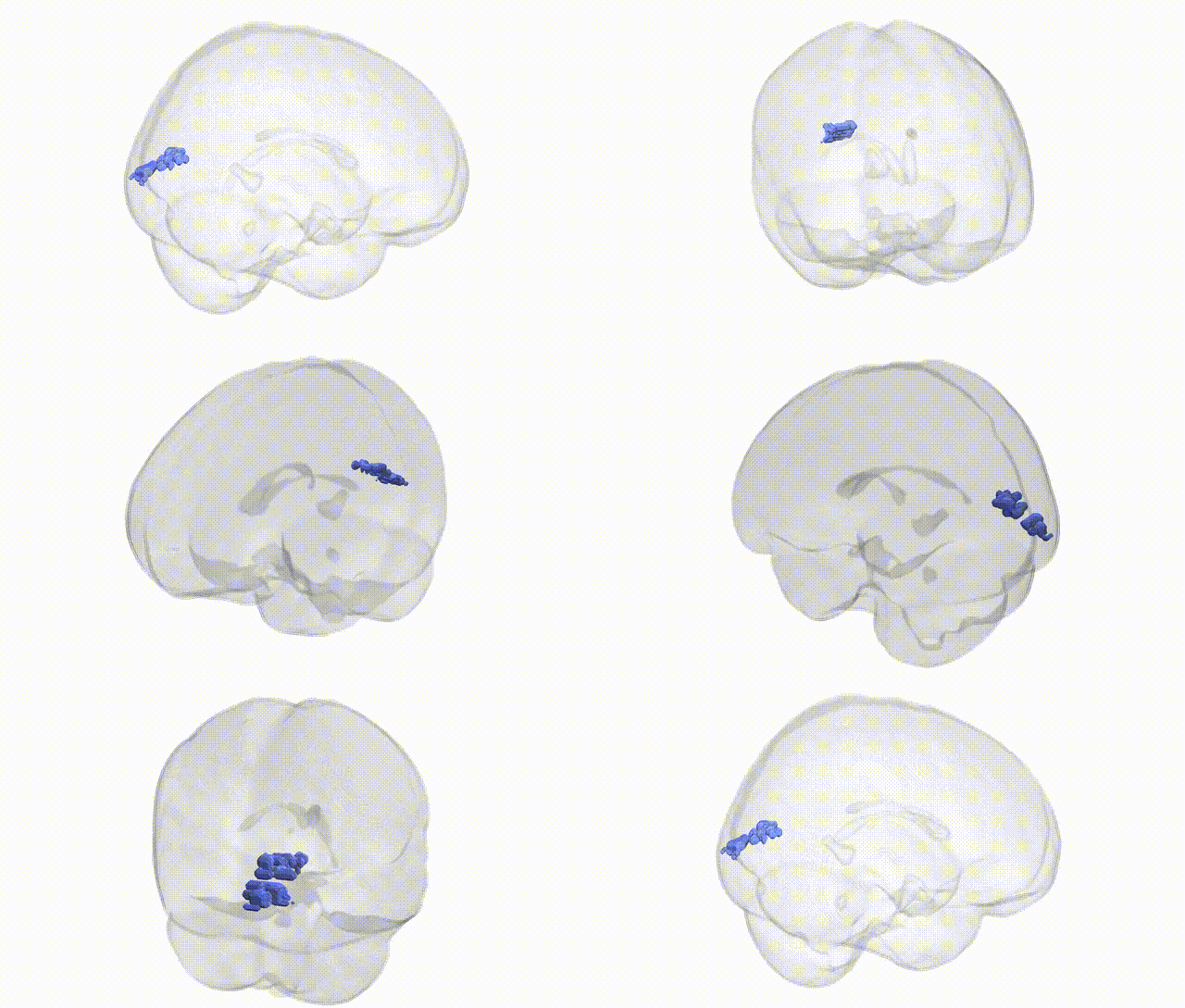
Full Quality Version: Download MP4
Wali Sidiqyar*, Gaurav Rudravaram*, Elyssa M. McMaster, Trent M. Schwartz, Adam M. Saunders, Kurt G. Schilling, Bennett A. Landman "Introducing SPINS: A Shared Public Visualization Library of Neuroanatomical Structures." Medical Imaging with Deep Learning- short paper
This resource is licensed under CC0 1.0 Universal (Public Domain).