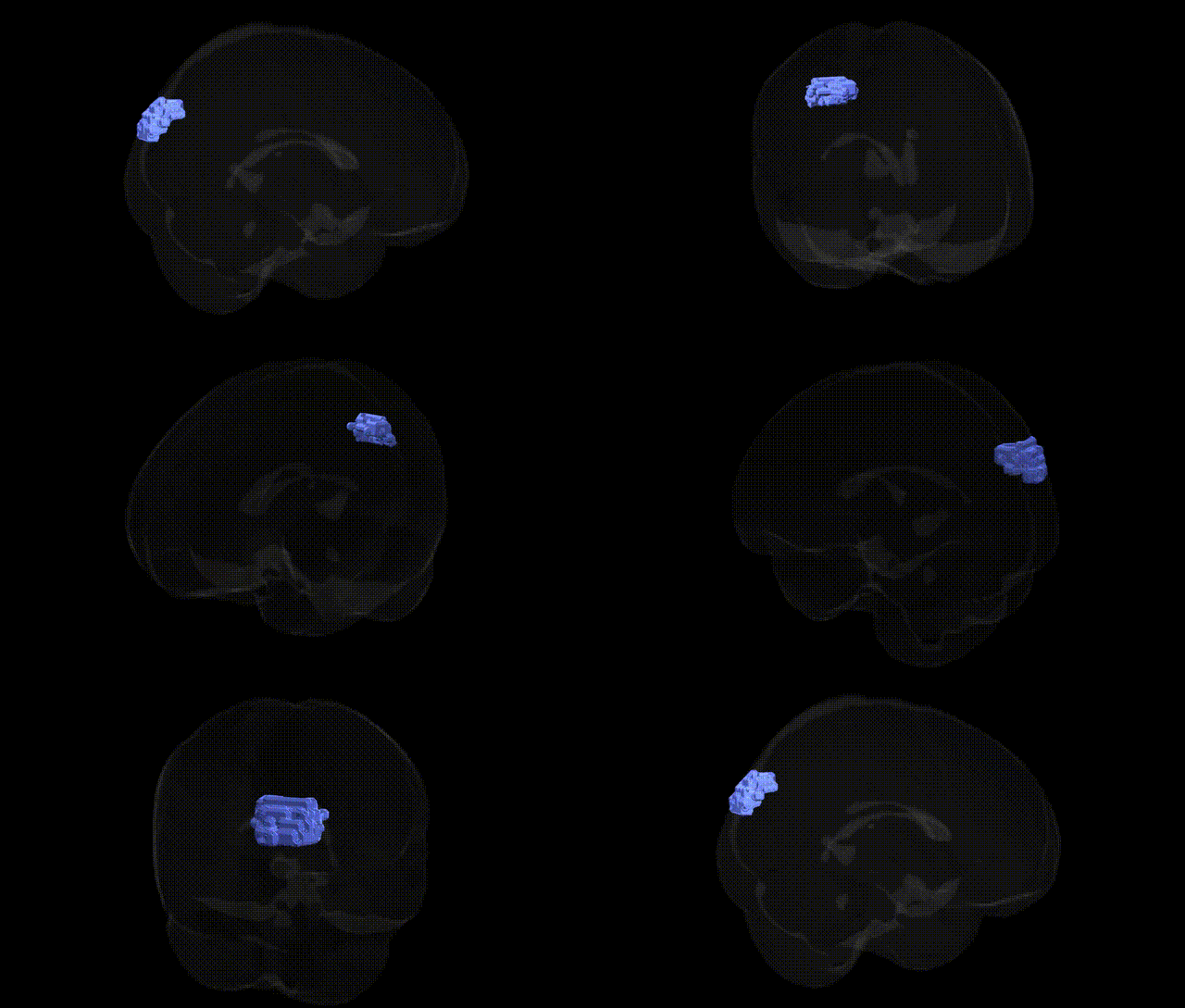
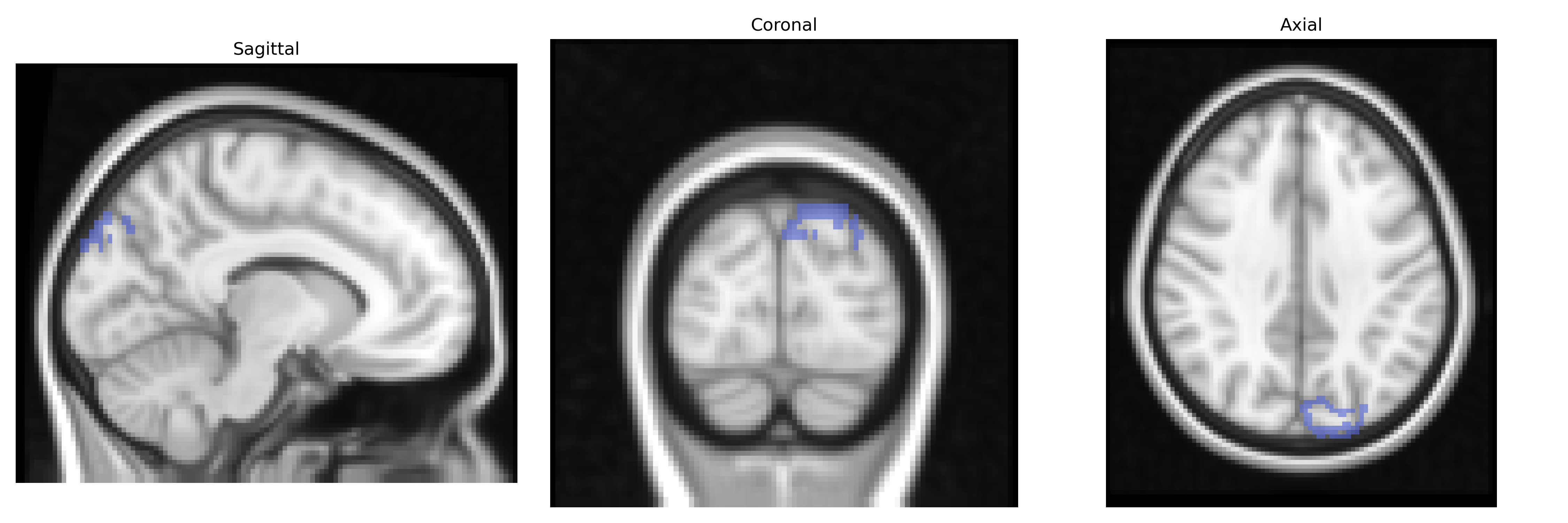
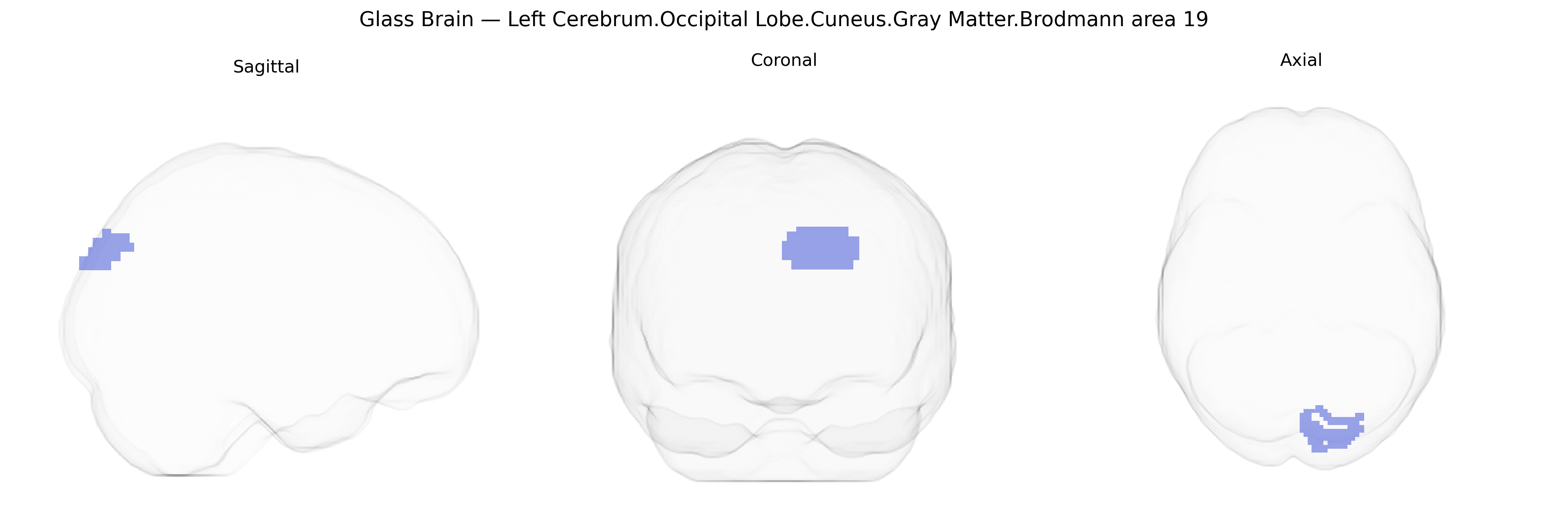
Bilateral Left Cerebrum.Occipital Lobe.Cuneus.Gray Matter.Brodmann area 19 corresponds to associative visual cortex located in the dorsal portion of the occipital lobe within the cuneus, just anterior and superior to primary visual cortex (BA17) and secondary visual cortex (BA18). This region is involved in higher-order visual processing, including integration of complex visual features, object recognition, motion and form analysis, and the interpretation of visual scenes, receiving extensive input from earlier visual areas and projecting to parietal and temporal visual streams. Its gray matter contains pyramidal neurons and interneurons organized in six cortical layers typical of neocortex, supporting distributed networks for visuospatial processing and visual memory. There is no dedicated Wikipedia article for this exact Talairach label; a closely related structure is Brodmann area 19.
The bilateral left cerebral occipital lobe cuneus gray matter corresponding to Brodmann area 19, a higher-order visual association cortex, has been indirectly implicated in several genetic and imaging-genetic studies, though few findings target this precise Talairach-defined subdivision. GWAS and large-scale neuroimaging consortia (e.g., ENIGMA, UK Biobank) have identified multiple common variants associated with occipital and cuneus cortical thickness, surface area, and volume—frequently near genes involved in synaptic development, axon guidance, and visual pathway function (such as genes related to neurodevelopmental signaling and cell adhesion), though specific loci vary across studies and often map to broader occipital regions rather than BA19 alone. Imaging-genetic work has linked occipital/cuneus structure or activation to polygenic risk for disorders with visual or visuospatial components, including schizophrenia, major depressive disorder, autism spectrum disorder, and migraine, where risk alleles sometimes correspond to altered occipital gray matter measures or functional connectivity involving BA19. Variants affecting white matter tracts of the visual system (e.g., optic radiation and posterior callosal fibers) and genes associated with myelination and neuroinflammation have also been related to occipital morphometry in GWAS of brain structure. Additionally, genetic influences on traits such as visual acuity and contrast sensitivity, reading and dyslexia, and visuospatial attention have been linked to functional differences in lateral occipital and cuneus regions, suggesting pleiotropic effects of neurodevelopmental and synaptic genes on both sensory traits and BA19-related cortical architecture. Overall, evidence supports substantial heritability of structural and functional measures in the cuneus/BA19 region, with associated variants distributed across numerous loci rather than a small set of region-specific “BA19 genes,” and with most associations reported at the level of broader occipital or visual association cortex rather than this exact Talairach parcel.
Overview generated by GPT-4o (2026).
Region ID: 843
Hemisphere: bilateral
Atlas: Talairach labels 2mm
Full Quality Version: Download MP4
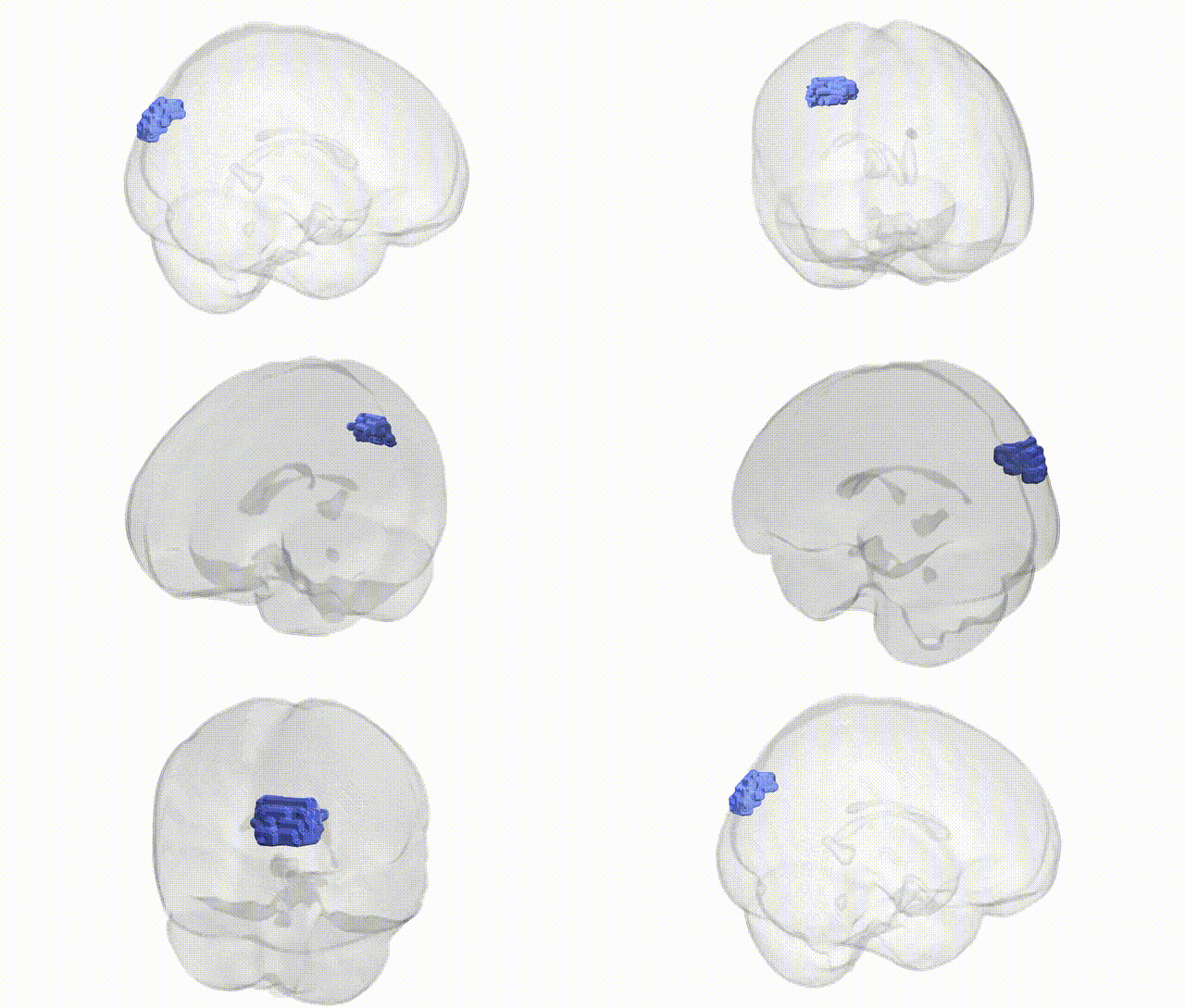
Full Quality Version: Download MP4
Wali Sidiqyar*, Gaurav Rudravaram*, Elyssa M. McMaster, Trent M. Schwartz, Adam M. Saunders, Kurt G. Schilling, Bennett A. Landman "Introducing SPINS: A Shared Public Visualization Library of Neuroanatomical Structures." Medical Imaging with Deep Learning- short paper
This resource is licensed under CC0 1.0 Universal (Public Domain).