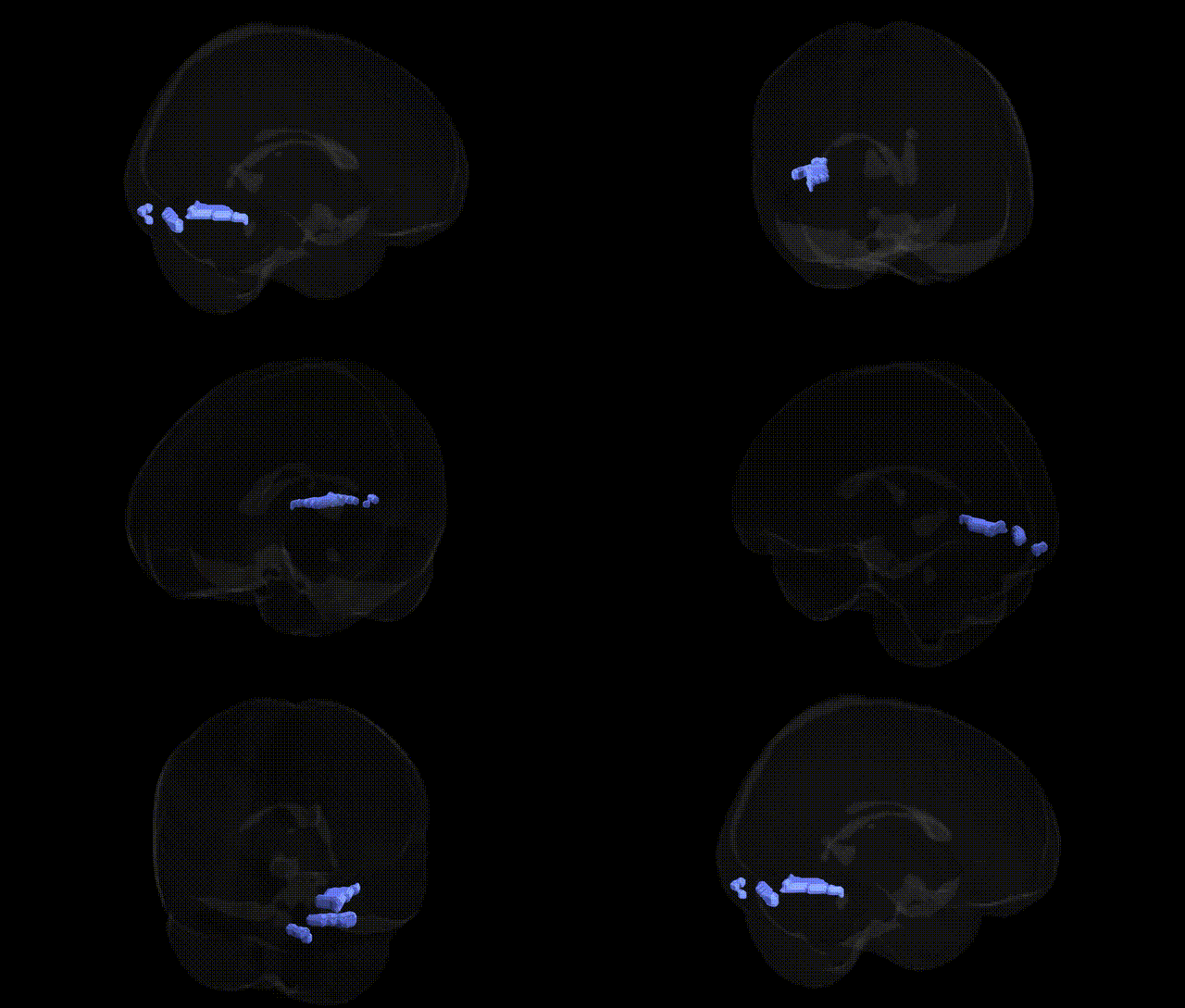
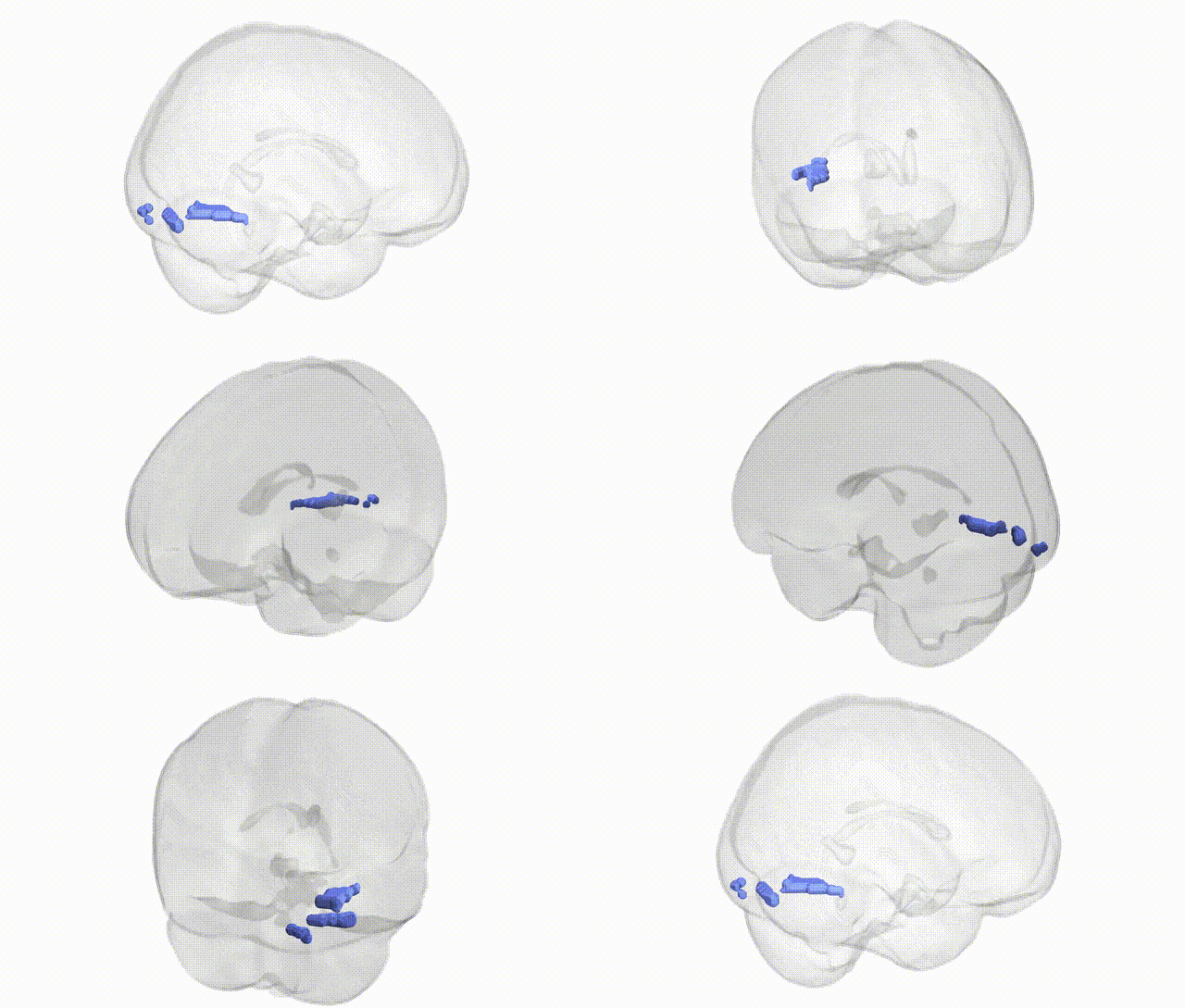
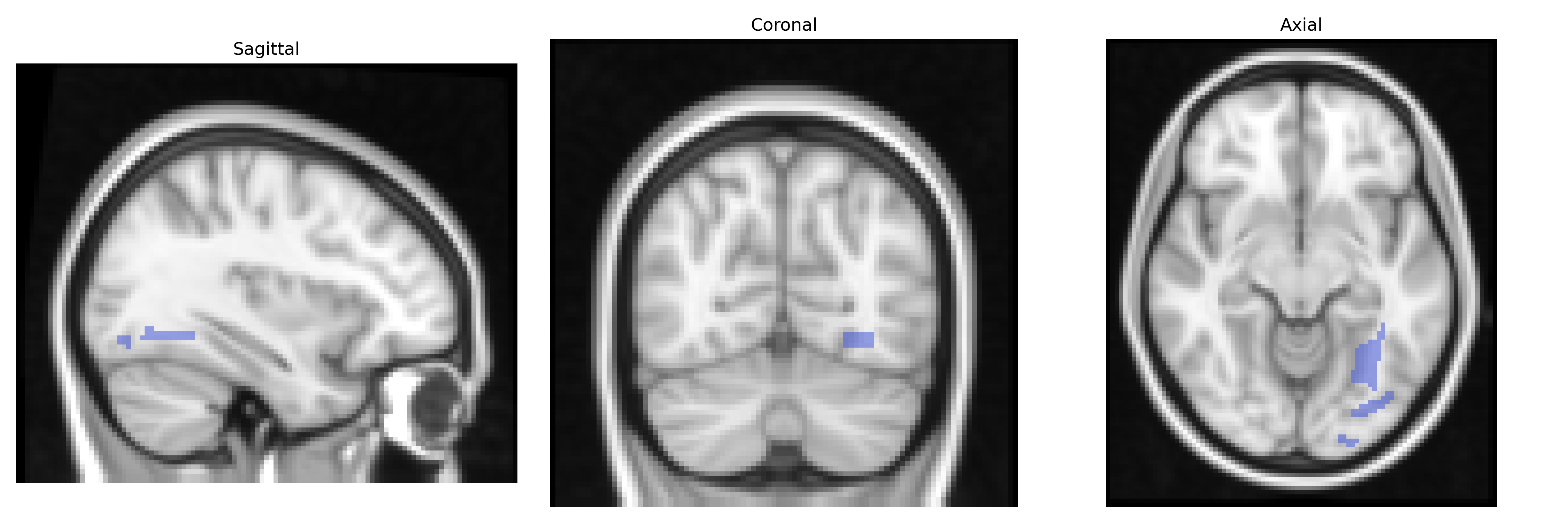
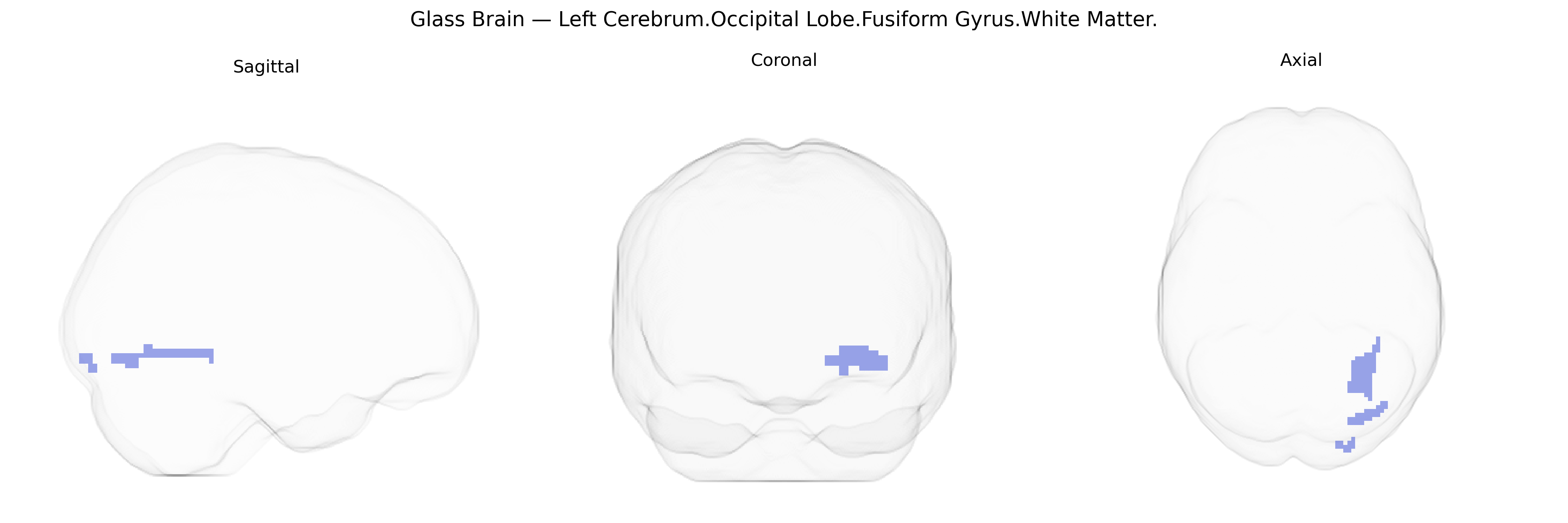
The bilateral Left Cerebrum.Occipital Lobe.Fusiform Gyrus.White Matter refers to the subcortical fiber tracts underlying the fusiform gyrus within the occipital lobe of the left cerebral hemisphere, involved in transmitting visual information between primary and associative visual cortices and higher-order ventral temporal regions. This white matter includes portions of long association pathways such as the inferior longitudinal fasciculus and related fibers that support object, face, and word-form recognition by linking occipital visual processing areas with temporal lobe regions. Although the Talairach label specifies left occipital fusiform white matter, functionally related networks often involve bilateral fusiform connections that contribute to complex visual perception and category-specific processing. There is no direct Wikipedia article for this exact white matter region; a related cortical structure is the Fusiform gyrus.
The bilateral left occipital-lobe fusiform gyrus white matter (Talairach 2 mm atlas) corresponds predominantly to association fibers linking visual, limbic, and temporal regions involved in high-level visual processing (including face and object recognition), and genetic associations to this region arise mainly from imaging–genetics and GWAS of brain structure and function rather than locus-specific studies. Large GWAS of cortical surface area and thickness (e.g., ENIGMA, UK Biobank) have identified multiple common variants in neurodevelopmental and axon-guidance genes (such as variants near KIAA0586, WNT genes, and genes involved in synaptic development and myelination) that affect occipito-temporal cortical measures, including fusiform-related regions, although these associations usually map to broader parcels rather than this specific Talairach-defined white matter zone. Imaging-genetics work in neurodevelopmental and psychiatric disorders has repeatedly implicated fusiform and adjacent occipito-temporal white matter in autism spectrum disorder (e.g., common variants in CNTNAP2, NRXN1, and other synaptic/adhesion genes associated with altered fusiform connectivity and face-processing networks), schizophrenia and bipolar disorder (polygenic risk scores linked to microstructural changes in occipito-temporal tracts), and dyslexia and other reading disorders (variants in DCDC2, KIAA0319, and related genes associated with white matter differences in occipito-temporal pathways supporting orthographic processing). In addition, GWAS of traits such as general cognitive ability and educational attainment have reported associations between polygenic scores and white matter integrity in occipito-temporal tracts, including segments passing through or adjacent to the fusiform gyrus, highlighting a polygenic influence on the development and maintenance of this region’s white matter rather than a single, well-characterized locus specifically tied to “Left Cerebrum.Occipital Lobe.Fusiform Gyrus.White Matter” in the Talairach atlas.
Overview generated by GPT-4o (2026).
Region ID: 206
Hemisphere: bilateral
Atlas: Talairach labels 2mm
Full Quality Version: Download MP4
Full Quality Version: Download MP4
Wali Sidiqyar*, Gaurav Rudravaram*, Elyssa M. McMaster, Trent M. Schwartz, Adam M. Saunders, Kurt G. Schilling, Bennett A. Landman "Introducing SPINS: A Shared Public Visualization Library of Neuroanatomical Structures." Medical Imaging with Deep Learning- short paper
This resource is licensed under CC0 1.0 Universal (Public Domain).