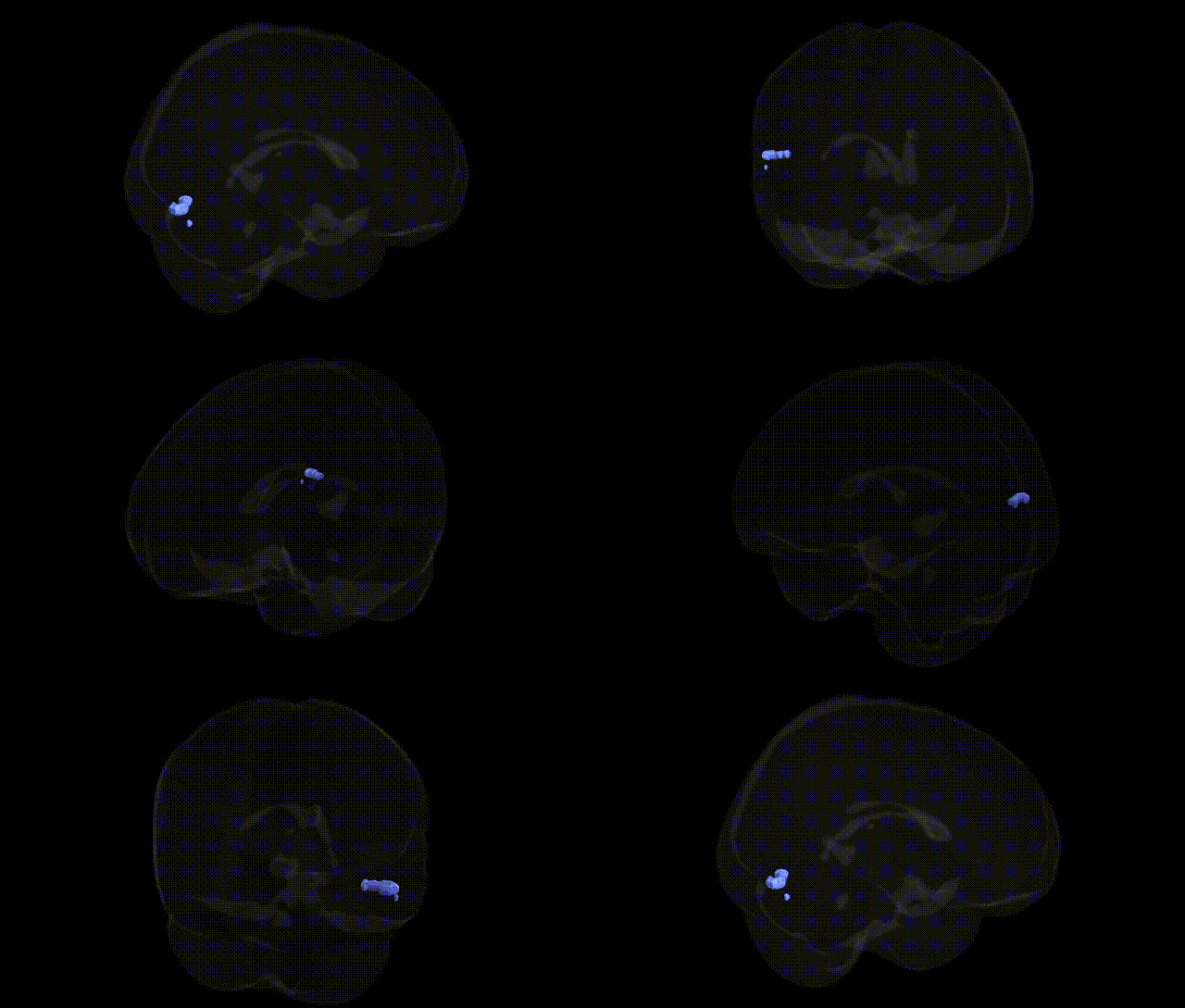
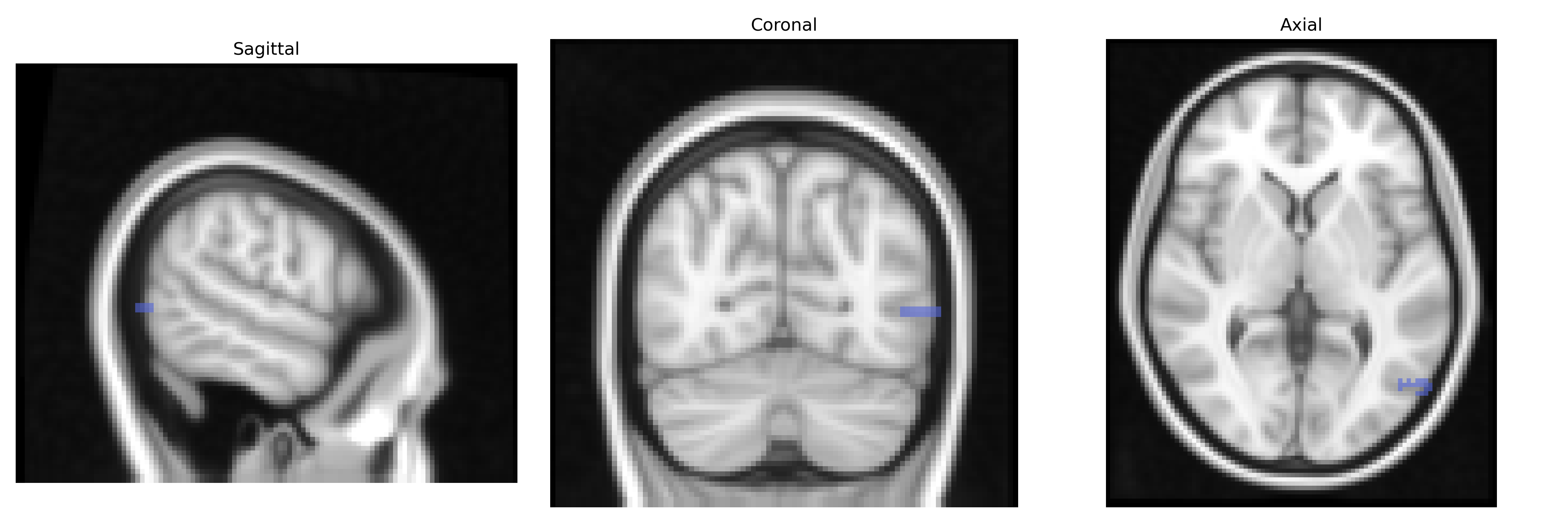
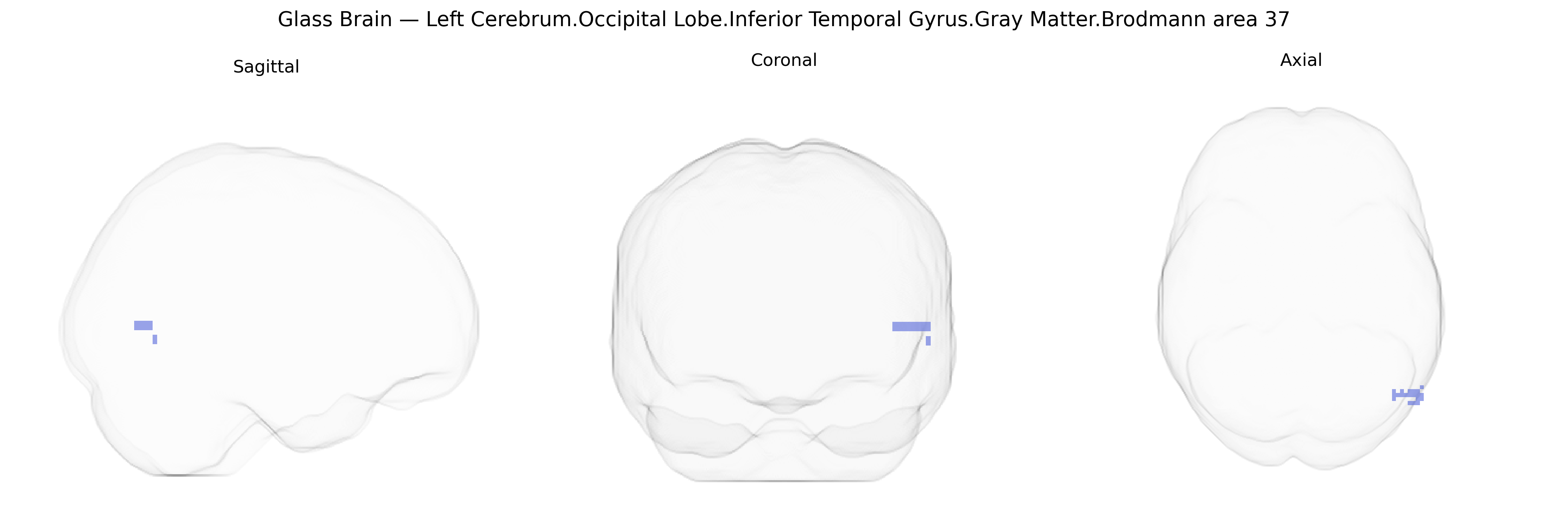
Bilateral Left Cerebrum.Occipital Lobe.Inferior Temporal Gyrus.Gray Matter.Brodmann area 37 corresponds to a ventral occipitotemporal association region involved in high-level visual processing, particularly in object and face recognition, and in linking visual input to lexical and semantic representations. Cytoarchitectonically defined as Brodmann area 37, it occupies the posterior portion of the inferior temporal gyrus and adjacent fusiform areas at the occipitotemporal junction, integrating inputs from primary and secondary visual cortices to form complex, category-specific representations. Functional neuroimaging and lesion studies implicate this region in visual word form processing, multimodal semantic integration, and aspects of episodic memory retrieval, with damage associated with visual agnosias and naming deficits. There is no direct link; a closely related structure is the Fusiform gyrus.
The bilateral left occipital/inferior temporal Brodmann area 37 (fusiform/inferior temporal region) is strongly implicated in genetic studies of higher-order visual and language-related functions, particularly face and word recognition. Twin and imaging-genetics studies show high heritability of fusiform gyrus volume and activity, with variants in genes affecting synaptic plasticity and neurodevelopment (e.g., BDNF, NRGN, CNTNAP2, FOXP2-related pathways) associated with structural and functional differences in this area. GWAS of cortical thickness and surface area have linked polygenic influences on BA37 to general cognitive ability and educational attainment, as well as distributed genetic factors related to neuronal differentiation and axon guidance. In neurodevelopmental and psychiatric GWAS, autism spectrum disorder, schizophrenia, and dyslexia show convergent imaging–genetic evidence involving BA37, particularly in face-processing and orthographic networks; rare variants and CNVs in synaptic and cell-adhesion genes (such as NRXN1 and SHANK family genes) have been linked to atypical fusiform structure or activation in these conditions. Alzheimer’s disease and frontotemporal dementia GWAS, while primarily targeting other regions, also implicate BA37 through polygenic risk scores associated with reduced ventral temporal gray matter and impaired semantic processing. Overall, genetic influences on BA37 appear highly polygenic and pleiotropic, with many common variants of small effect contributing to individual differences in visual word/form and face processing, social cognition, and vulnerability to neurodevelopmental and neurodegenerative disorders.
Overview generated by GPT-4o (2026).
Region ID: 420
Hemisphere: bilateral
Atlas: Talairach labels 2mm
Full Quality Version: Download MP4
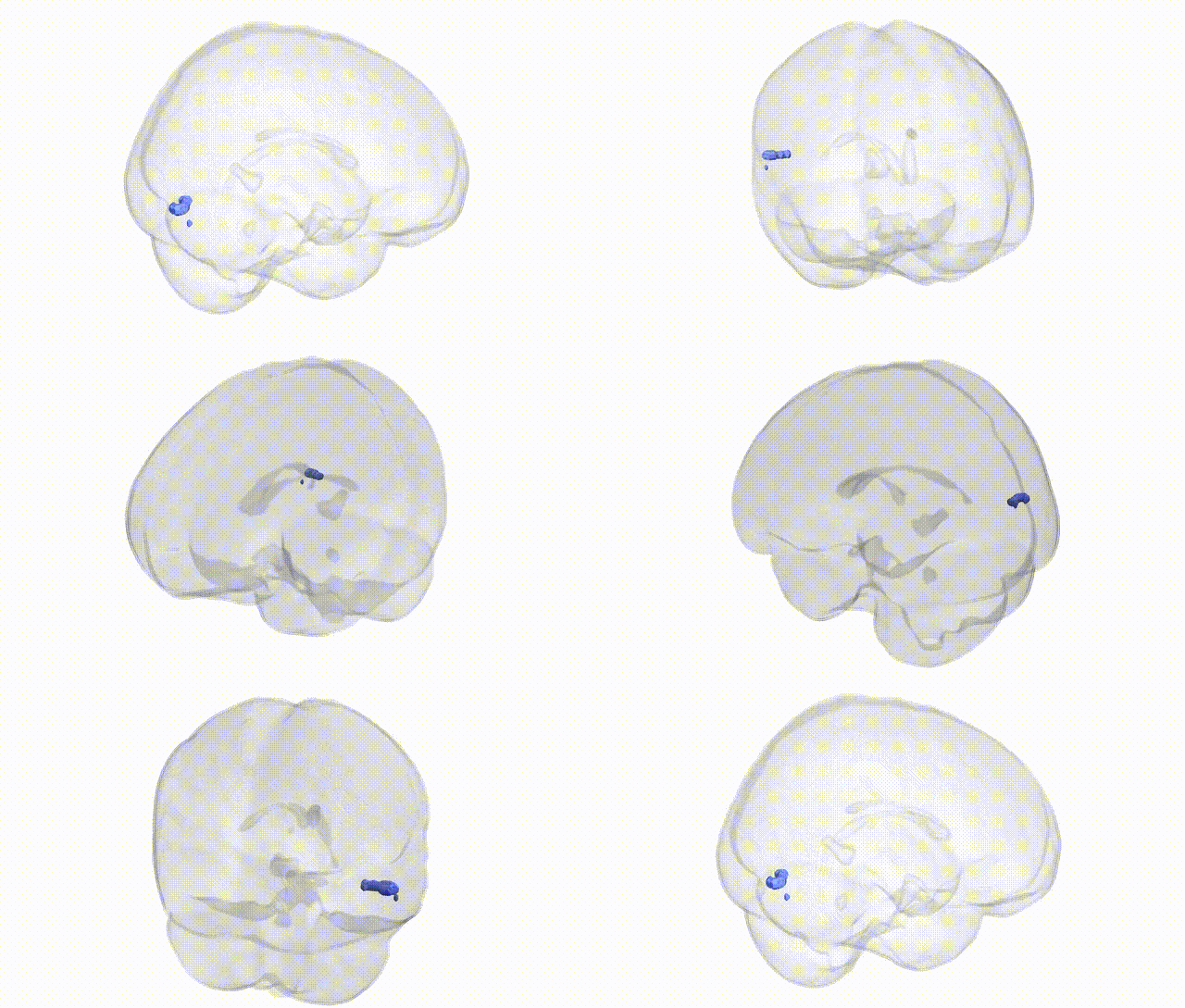
Full Quality Version: Download MP4
Wali Sidiqyar*, Gaurav Rudravaram*, Elyssa M. McMaster, Trent M. Schwartz, Adam M. Saunders, Kurt G. Schilling, Bennett A. Landman "Introducing SPINS: A Shared Public Visualization Library of Neuroanatomical Structures." Medical Imaging with Deep Learning- short paper
This resource is licensed under CC0 1.0 Universal (Public Domain).