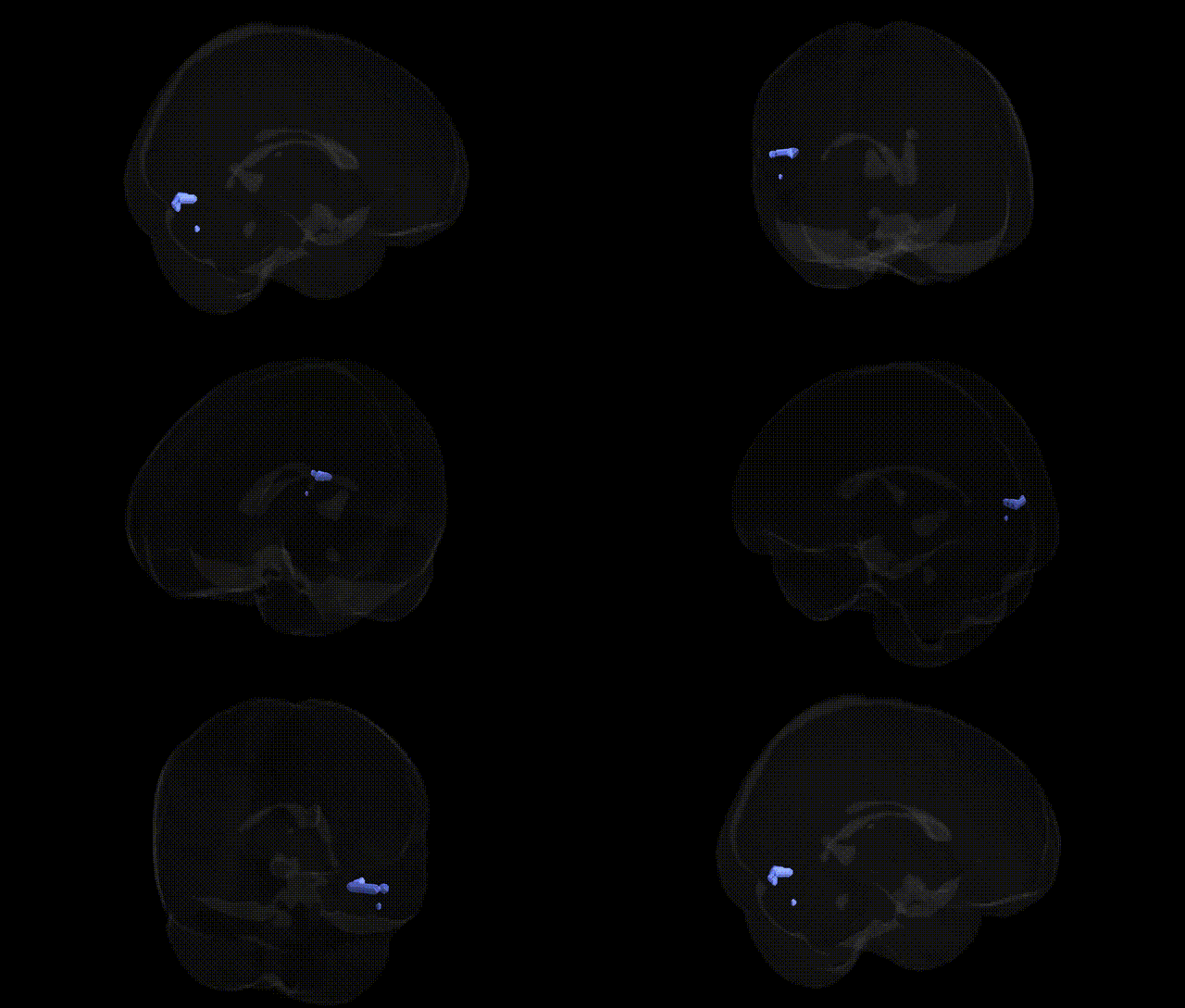
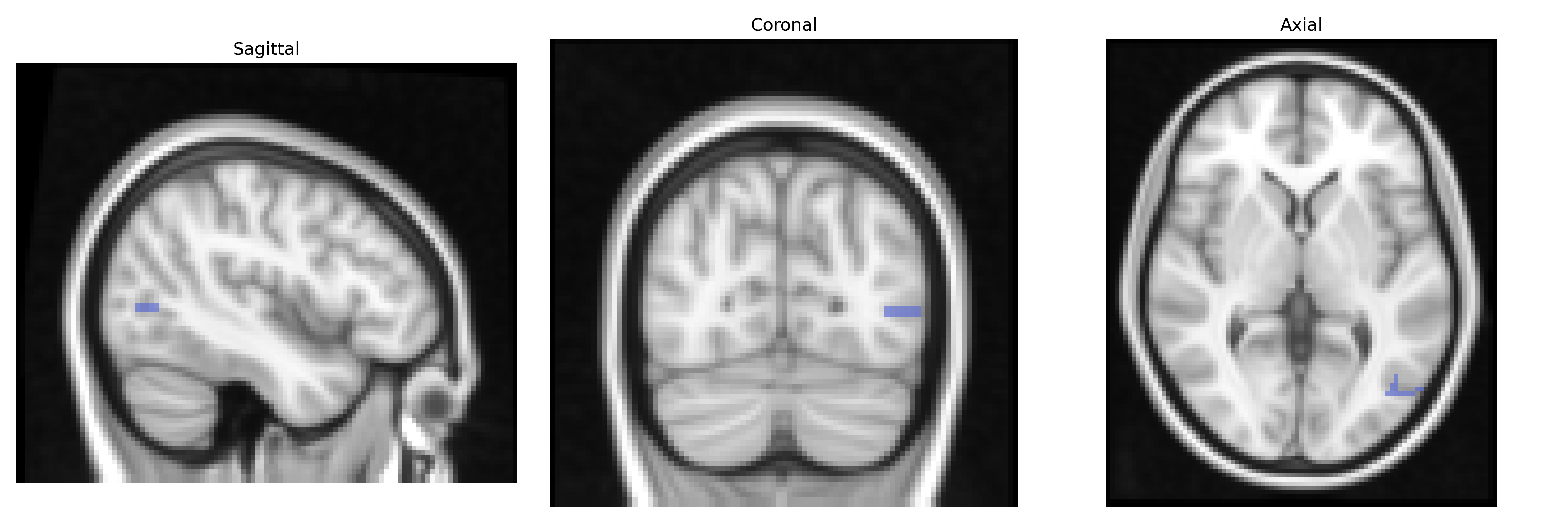
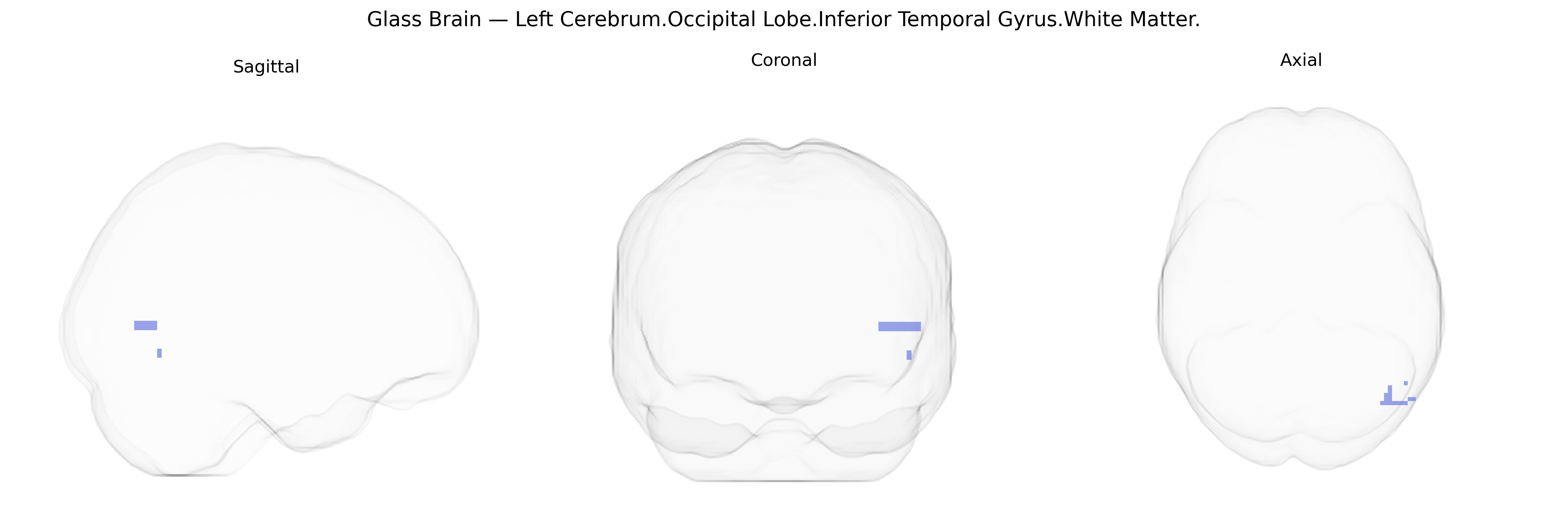
The bilateral Left Cerebrum.Occipital Lobe.Inferior Temporal Gyrus.White Matter corresponds to deep fiber pathways underlying the inferior temporal gyrus at the cortico-subcortical boundary between occipital and temporal regions. These white matter tracts contain myelinated axons that interconnect visual association cortices of the occipital lobe with ventral temporal areas involved in object recognition, including pathways such as portions of the inferior longitudinal fasciculus and adjacent association fibers. Functionally, this region participates in the transmission and integration of high-level visual information (form, color, and complex object features) critical for the ventral “what” visual processing stream. Damage to these fibers can disrupt communication between occipital visual areas and temporal recognition systems, contributing to visual agnosias and related higher-order visual deficits. There is no direct link for this composite Talairach label; see the related cortical area: Inferior temporal gyrus.
The bilateral Left Cerebrum Occipital Lobe Inferior Temporal Gyrus white matter, as defined in the Talairach 2 mm atlas, lies within ventral visual and object-recognition pathways whose structure and connectivity have been repeatedly implicated in imaging genetics and GWAS of brain morphology, cognition, and neuropsychiatric disease. Large-scale neuroimaging GWAS (e.g., ENIGMA, UK Biobank) have associated common variants in genes involved in axonal guidance, myelination, and synaptic plasticity—such as BDNF, CNTNAP2, NRXN1, DISC1, GRIN2B, and loci near FOXP2—with white-matter microstructure (fractional anisotropy, mean diffusivity) and cortical thickness in inferior temporal and adjacent occipito-temporal regions, which support face and object processing, language-related semantic representations, and high-level visual perception. Risk variants for autism spectrum disorder, schizophrenia, and developmental language disorders have been linked to altered connectivity and volume in inferior temporal/occipital white matter tracts, including the inferior longitudinal fasciculus that passes through this region, while GWAS of general cognitive ability, reading skill, and educational attainment have identified polygenic influences that partially manifest as variability in these temporal–occipital pathways. Although few studies isolate the Talairach-defined inferior temporal gyrus white matter specifically, convergent genetic evidence indicates that this region is a key substrate through which neurodevelopmental and synaptic genes shape visual recognition, semantic processing, and vulnerability to neuropsychiatric and cognitive phenotypes.
Overview generated by GPT-4o (2026).
Region ID: 326
Hemisphere: bilateral
Atlas: Talairach labels 2mm
Full Quality Version: Download MP4
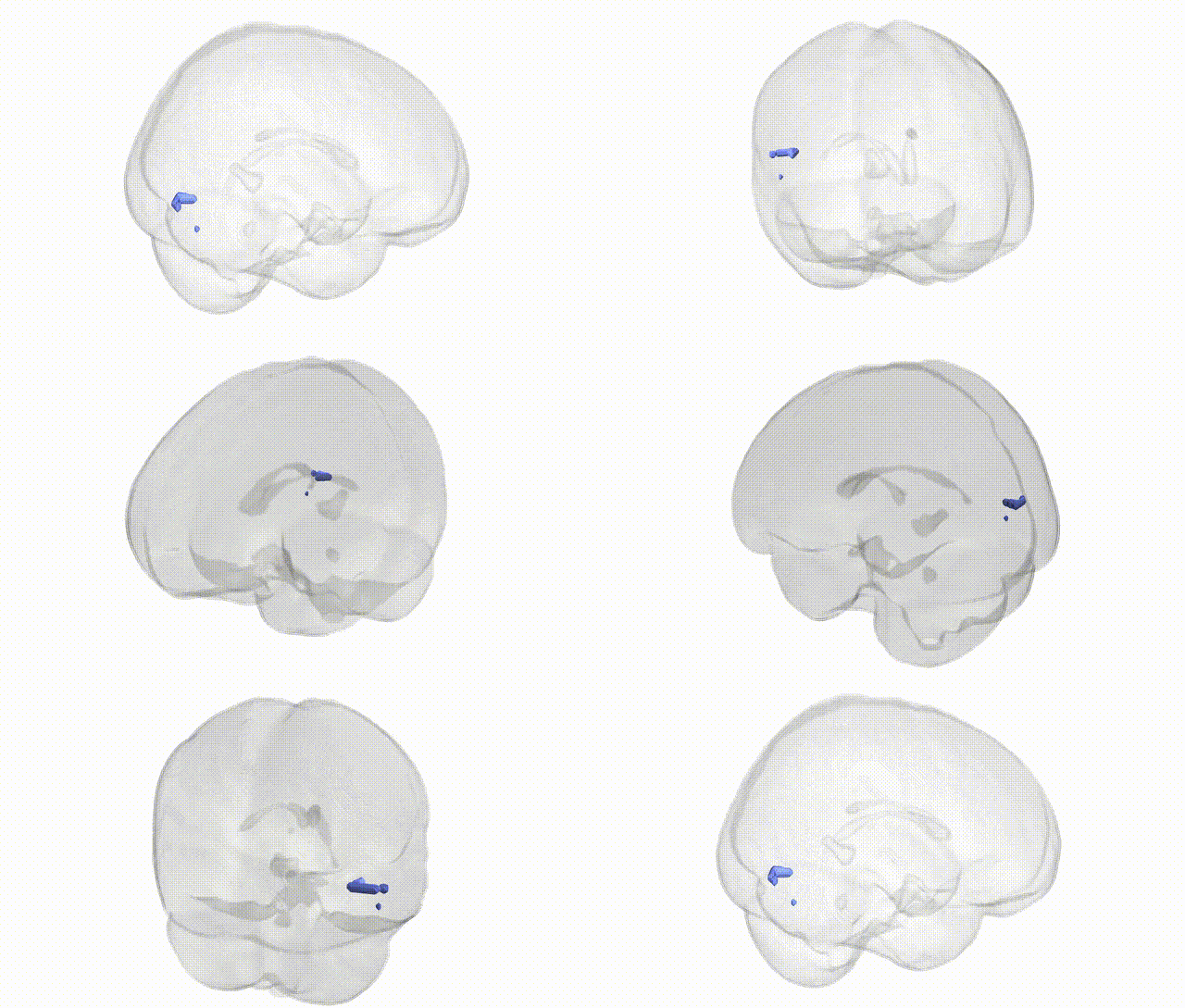
Full Quality Version: Download MP4
Wali Sidiqyar*, Gaurav Rudravaram*, Elyssa M. McMaster, Trent M. Schwartz, Adam M. Saunders, Kurt G. Schilling, Bennett A. Landman "Introducing SPINS: A Shared Public Visualization Library of Neuroanatomical Structures." Medical Imaging with Deep Learning- short paper
This resource is licensed under CC0 1.0 Universal (Public Domain).