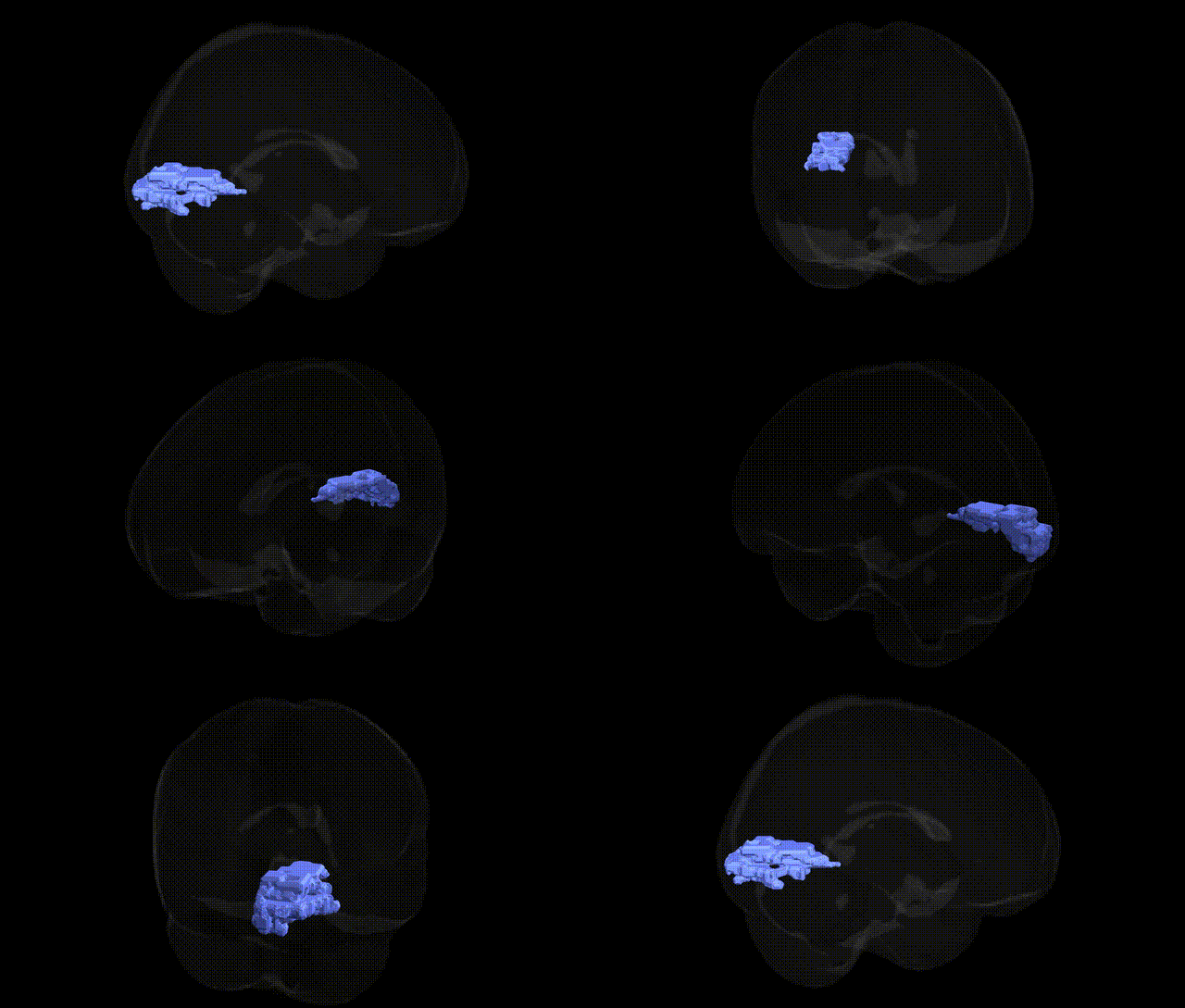
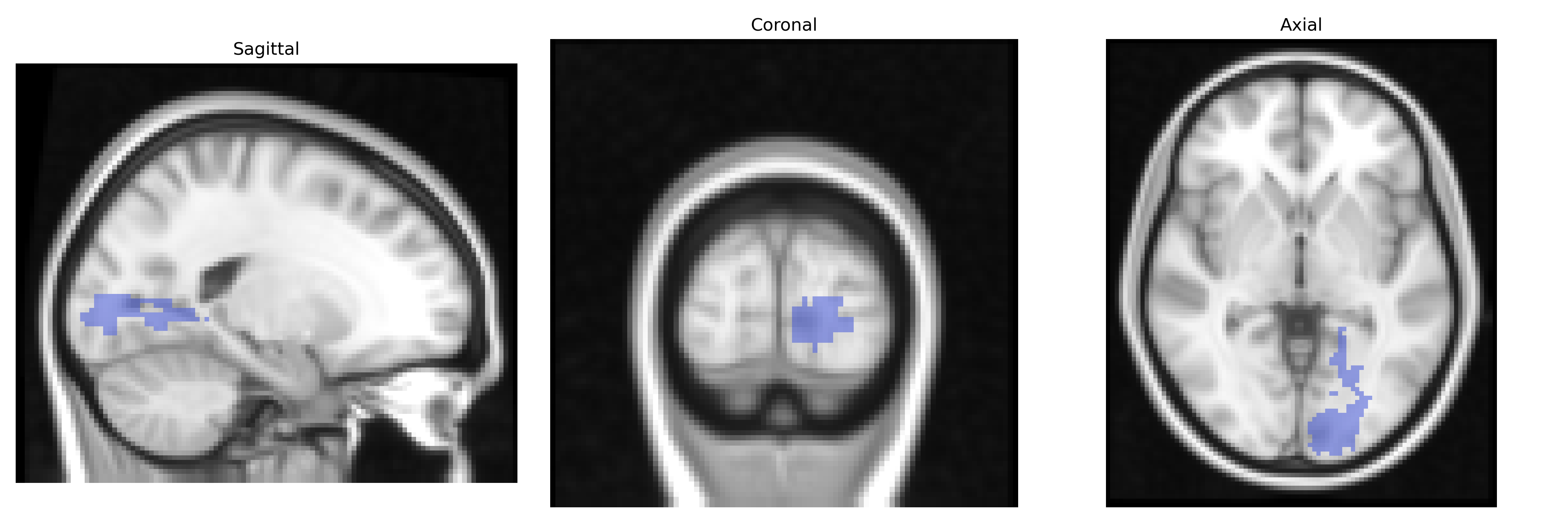
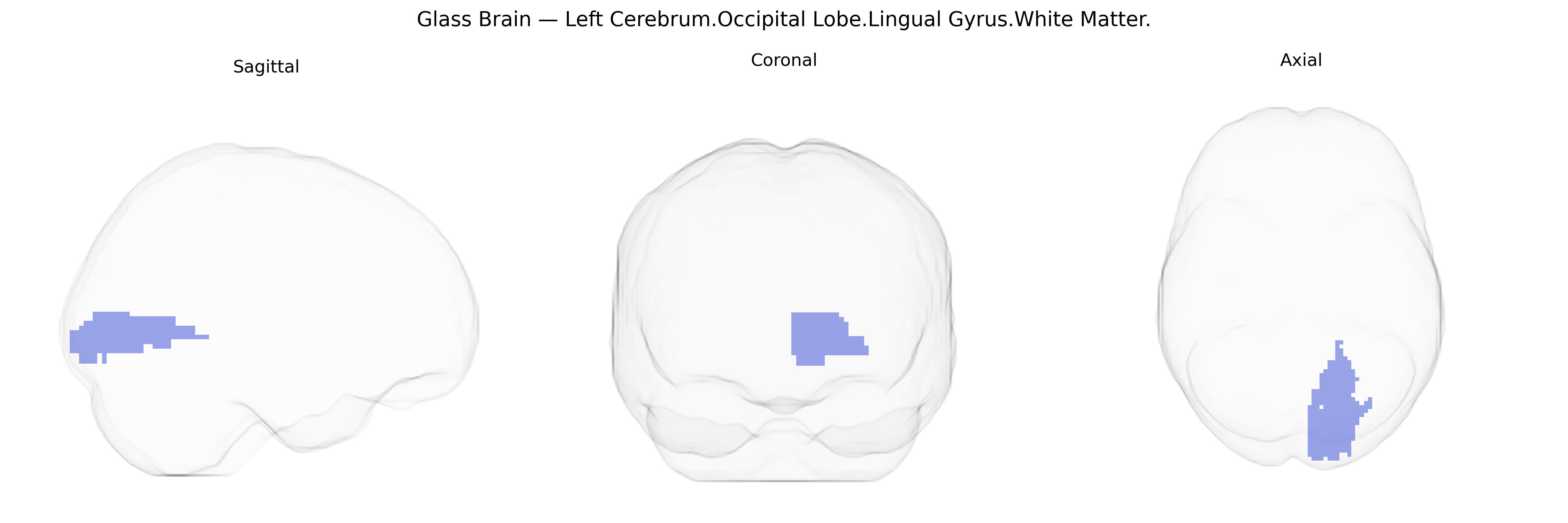
The bilateral Left Cerebrum.Occipital Lobe.Lingual Gyrus.White Matter corresponds to the subcortical fiber pathways underlying the lingual gyrus in the occipital lobe, primarily involved in transmitting visual information between primary and associative visual cortices and higher-order processing regions. These white matter tracts support functions related to visual pattern recognition, complex scene analysis, and aspects of visual memory and imagery, including contributions to processing of letters, words, and other complex visual stimuli. The region’s fibers interconnect the lingual gyrus with adjacent occipital and temporal areas, forming part of larger visual networks that participate in ventral stream processing. There is no direct Wikipedia article for the white matter of the lingual gyrus; a closely related cortical structure is the Lingual gyrus.
Genetic associations specific to the bilateral Left Cerebrum.Occipital Lobe.Lingual Gyrus.White Matter, as defined in the Talairach 2 mm atlas, have not been systematically cataloged at this fine-grained regional and tissue (white matter) level, but several lines of evidence link variants affecting occipital and lingual gyrus structure and connectivity to visual, cognitive, and neuropsychiatric traits. Large neuroimaging GWAS studies (e.g., ENIGMA, UK Biobank) have identified common variants in genes related to axonal guidance, myelination, and synaptic development (such as CNTNAP2, NRG1, and GRIN2B) that influence occipital lobe white matter microstructure (fractional anisotropy and mean diffusivity) and cortical thickness, which often encompass or border the lingual gyrus. Genetic loci associated with visual processing traits, reading ability and dyslexia (including KIAA0319, DCDC2), and face/object recognition have been functionally linked to occipitotemporal networks that include lingual gyrus white matter pathways. Additionally, polygenic risk for disorders such as schizophrenia, bipolar disorder, major depressive disorder, and autism spectrum conditions has been associated in imaging–genetics studies with altered occipital and lingual gyrus connectivity and integrity, suggesting that risk variants in neurodevelopmental and synaptic genes exert downstream effects on this region’s white matter. However, current evidence is largely indirect—focusing on broader occipital or visual networks rather than this precise Talairach-defined parcel—so genetic findings are best interpreted as affecting distributed visual and cognitive circuits that include, but are not exclusive to, the lingual gyrus white matter.
Overview generated by GPT-4o (2026).
Region ID: 252
Hemisphere: bilateral
Atlas: Talairach labels 2mm
Full Quality Version: Download MP4
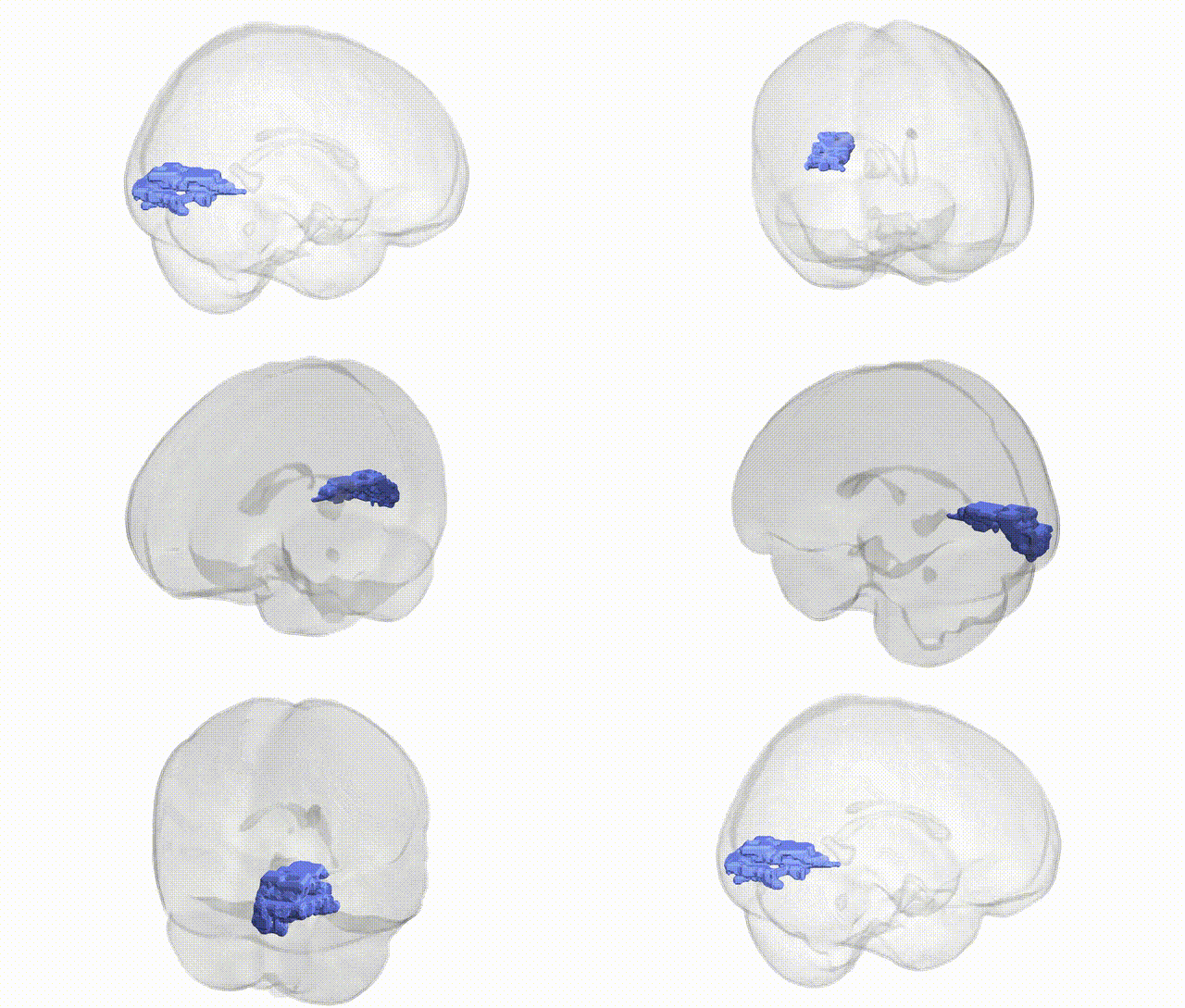
Full Quality Version: Download MP4
Wali Sidiqyar*, Gaurav Rudravaram*, Elyssa M. McMaster, Trent M. Schwartz, Adam M. Saunders, Kurt G. Schilling, Bennett A. Landman "Introducing SPINS: A Shared Public Visualization Library of Neuroanatomical Structures." Medical Imaging with Deep Learning- short paper
This resource is licensed under CC0 1.0 Universal (Public Domain).