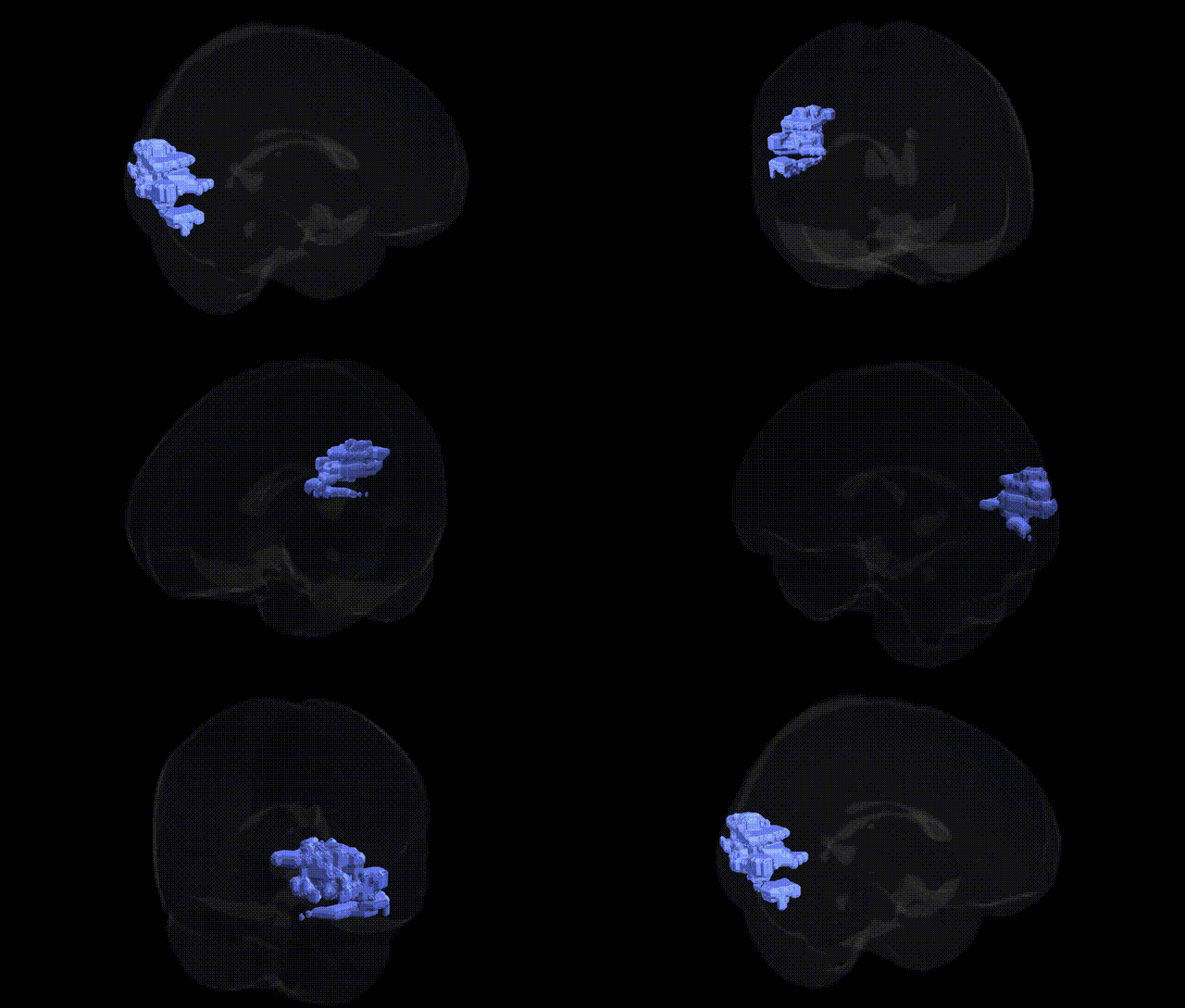
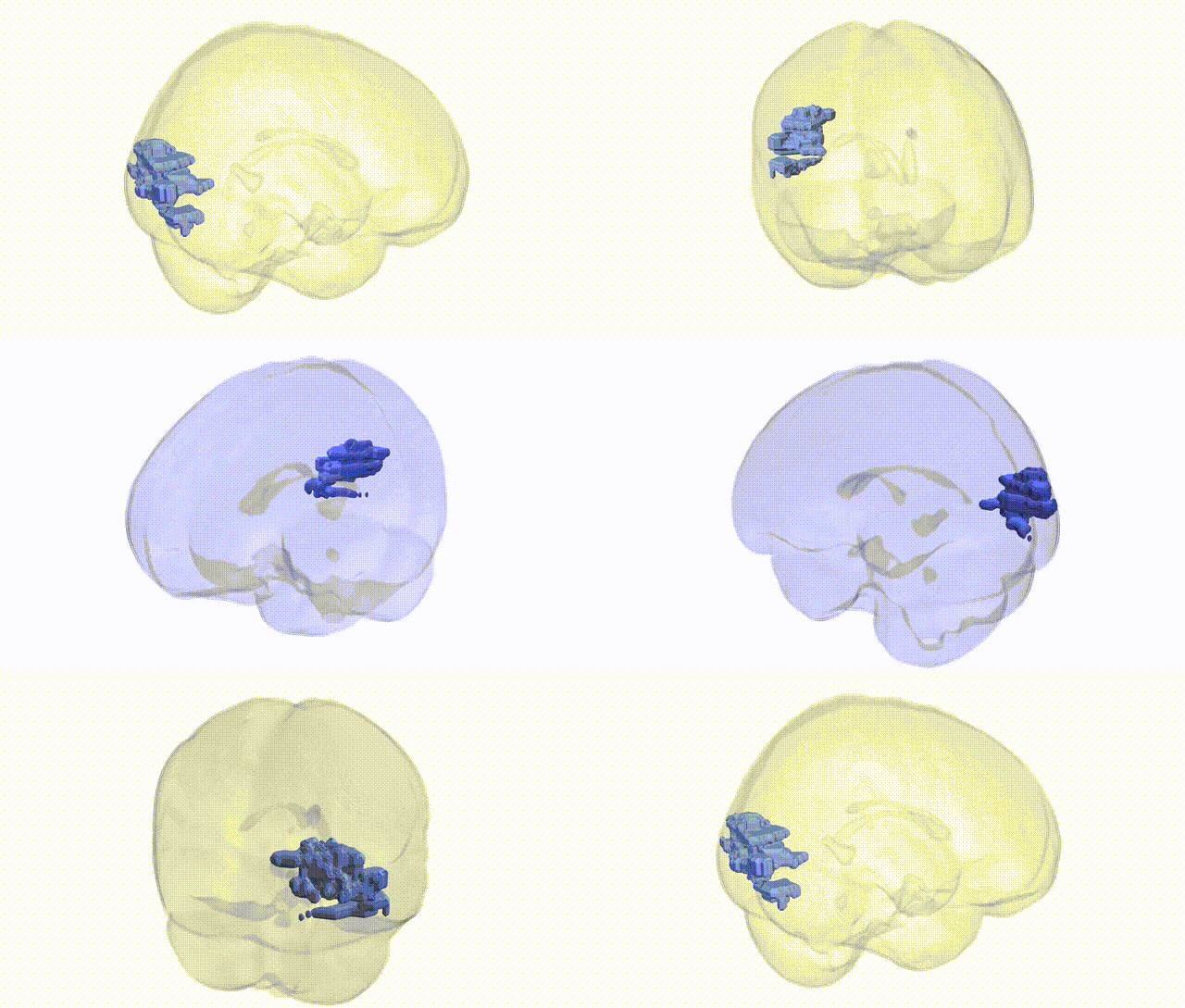
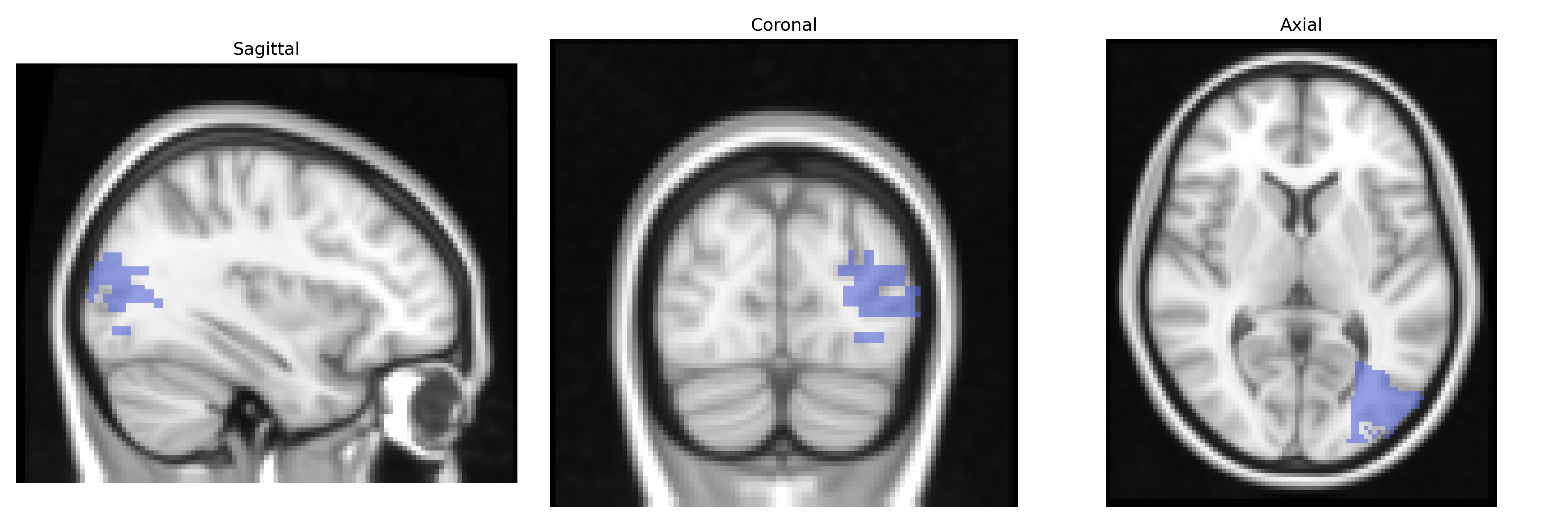
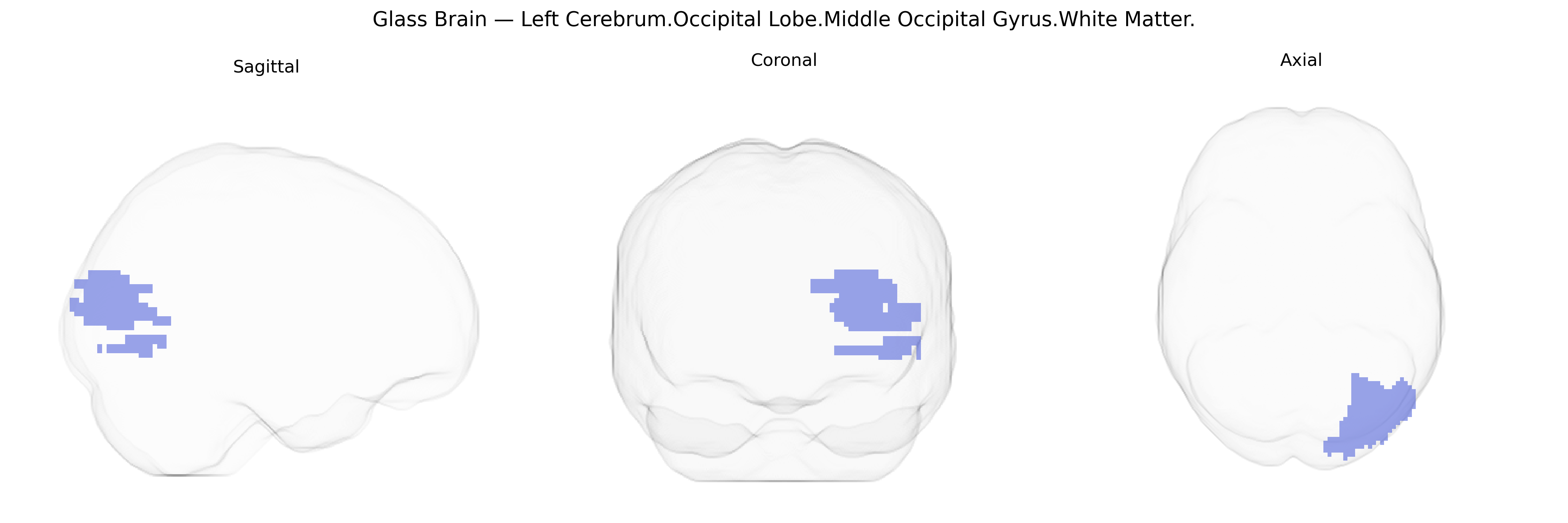
The bilateral Left Cerebrum.Occipital Lobe.Middle Occipital Gyrus.White Matter corresponds to the deep subcortical fiber pathways underlying the middle occipital gyrus in the occipital lobe, primarily involved in visual information transfer and integration. This white matter region contains association fibers interconnecting occipital visual cortices with temporal and parietal regions, supporting processes such as object recognition, visuospatial analysis, and higher-order visual perception. It contributes to communication between primary and extrastriate visual areas and is part of larger occipito-temporal and occipito-parietal networks that underlie the dorsal and ventral visual streams. There is no direct link for the middle occipital gyrus white matter; a related cortical structure is the Occipital lobe.
The bilateral middle occipital gyrus white matter (Left Cerebrum.Occipital Lobe.Middle Occipital Gyrus.White Matter, Talairach 2 mm) has been implicated in genetic studies largely through its role in visual processing and connectivity within occipital and dorsal visual pathways, rather than via region-specific loci. Genome-wide association studies (GWAS) of neuroimaging-derived phenotypes—such as cortical thickness, surface area, and diffusion tensor imaging (DTI) measures of occipital white matter tracts—have linked variation in this region’s structure and microstructure to common variants near genes involved in axon guidance, myelination, and synaptic development (e.g., CNTNAP2, NRG1, and various HLA-region and neurodevelopmental loci), though these associations are typically reported for broader occipital or visual pathway regions rather than the middle occipital gyrus alone. Occipital white matter abnormalities overlapping this region have been reported in genetic and neurodevelopmental disorders such as schizophrenia, autism spectrum disorder, dyslexia, and migraine, with GWAS for these conditions identifying risk variants that may influence occipital connectivity (for example, visual processing and visual attention circuits), but the mapping is indirect and usually at the level of networks rather than a single gyrus. Large consortia (e.g., ENIGMA) have reported heritability of occipital white matter integrity and associations with polygenic risk scores for psychiatric disorders, cognitive traits, and educational attainment, suggesting that genetic influences on general neurodevelopment and cognitive ability contribute to interindividual differences in the structure and function of white matter within the middle occipital gyrus, although no robust, widely replicated GWAS signals are currently known that uniquely and specifically target this bilateral Talairach-defined region.
Overview generated by GPT-4o (2026).
Region ID: 308
Hemisphere: bilateral
Atlas: Talairach labels 2mm
Full Quality Version: Download MP4
Full Quality Version: Download MP4
Wali Sidiqyar*, Gaurav Rudravaram*, Elyssa M. McMaster, Trent M. Schwartz, Adam M. Saunders, Kurt G. Schilling, Bennett A. Landman "Introducing SPINS: A Shared Public Visualization Library of Neuroanatomical Structures." Medical Imaging with Deep Learning- short paper
This resource is licensed under CC0 1.0 Universal (Public Domain).