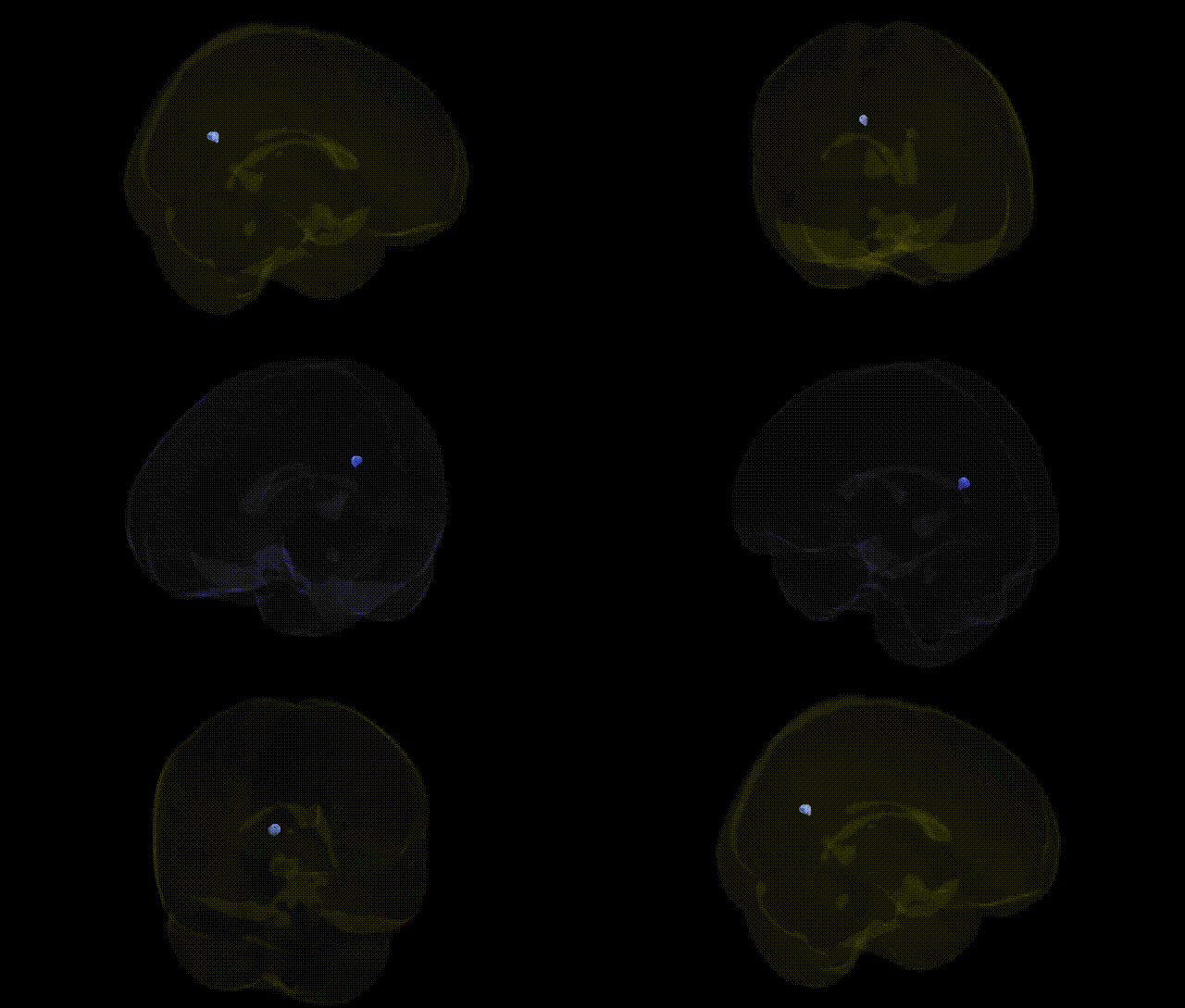
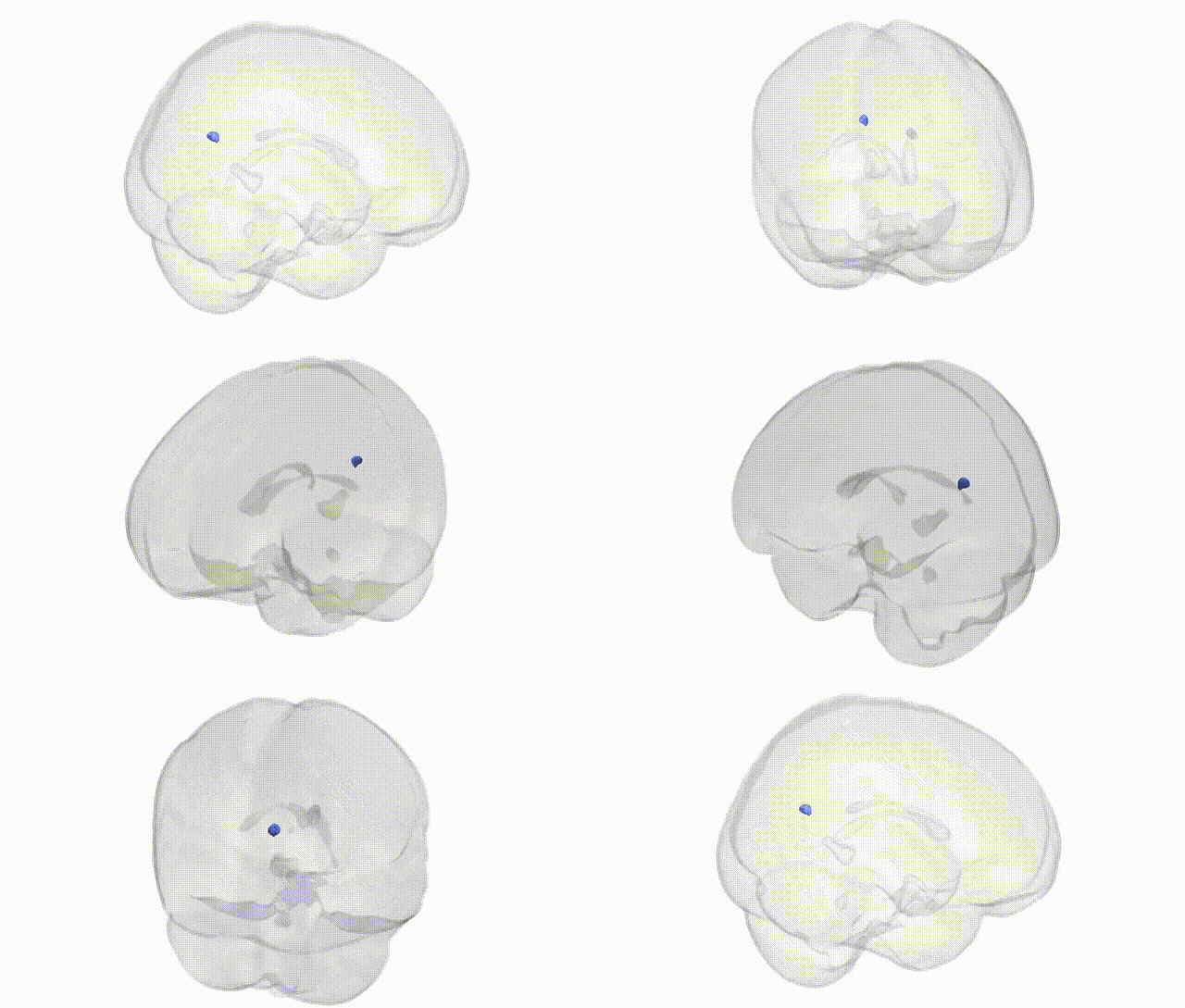
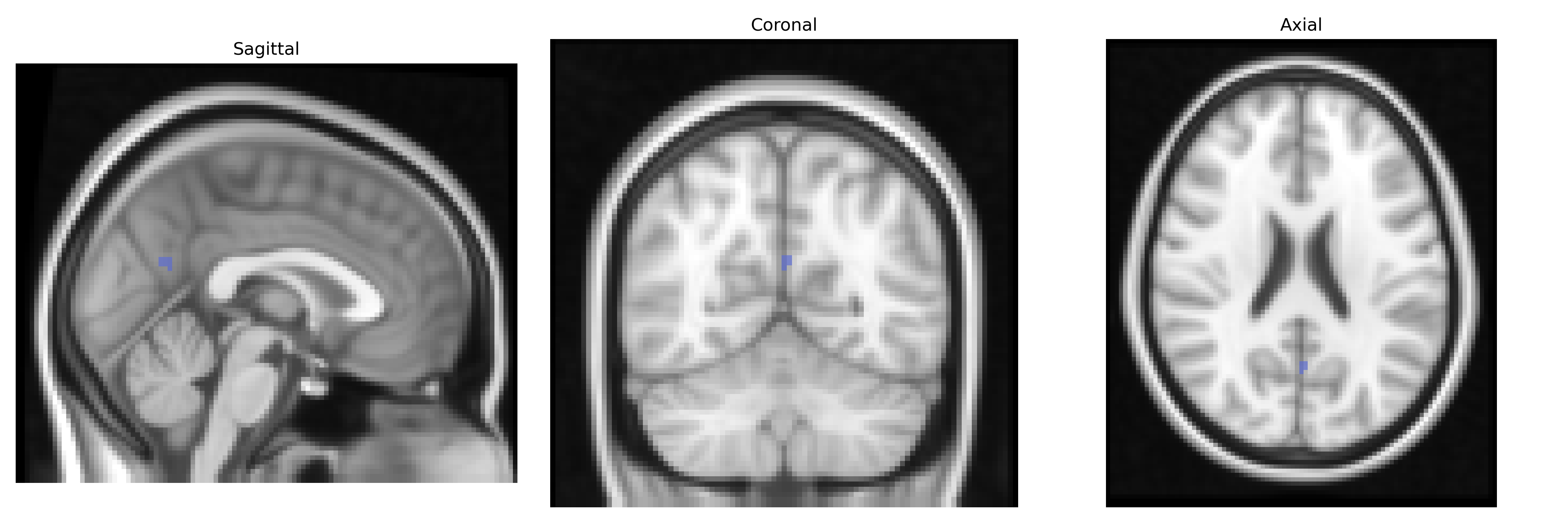
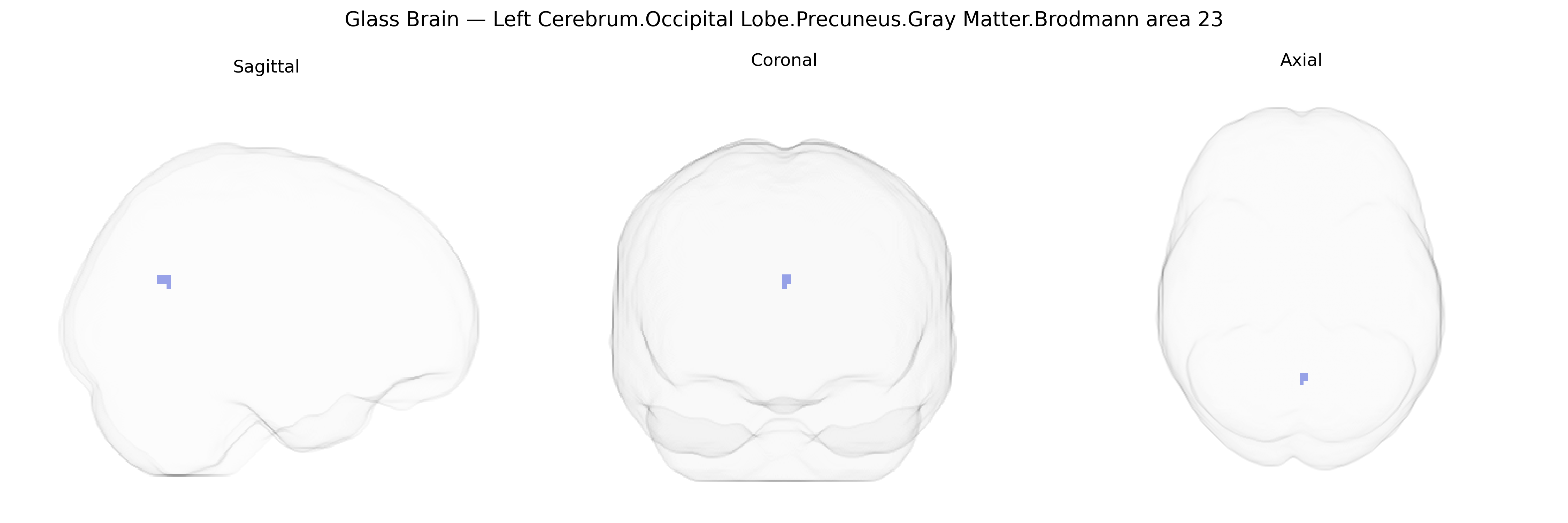
The bilateral Left Cerebrum.Occipital Lobe.Precuneus.Gray Matter.Brodmann area 23 corresponds to gray matter within the posterior medial cortex, specifically engaging the precuneus region functionally associated with the retrosplenial/caudal cingulate cortex (BA23). Brodmann area 23 is a key component of the limbic system and default mode network, involved in episodic memory retrieval, spatial navigation, self-referential processing, and integration of visuospatial information with emotional and contextual significance. Although labeled in the Talairach atlas under the occipital lobe and precuneus, BA23 is classically described as part of the posterior cingulate/retrosplenial complex, receiving multimodal inputs from visual, hippocampal, and parietal association areas and contributing to internal mentation and scene construction. There is no direct link for this exact Talairach label; a closely related structure is Brodmann area 23.
The bilateral left precuneus gray matter in Brodmann area 23 (posterior cingulate/medial parietal territory within the occipito-parietal region) has been repeatedly implicated in genetic studies of brain structure and function, although most work references the broader precuneus or posterior cingulate rather than Talairach-specific BA23. Large-scale GWAS of cortical thickness and surface area have identified multiple loci (e.g., near genes such as HMGA2, FOXO3, and various neurodevelopmental and synaptic genes) that influence inter-individual variation in precuneus and adjacent posterior cingulate morphology, with SNP-based heritability estimates in the moderate range. Imaging genetics studies link variation in this region to risk alleles for Alzheimer’s disease (APOE ε4, CLU, PICALM, and others), often via effects on resting-state default mode network connectivity, amyloid deposition, and early metabolic changes. Structural and functional alterations in the precuneus/posterior cingulate have also been associated with genetic liability to schizophrenia and major depression, including polygenic risk scores, and with variants in genes related to glutamatergic and GABAergic signaling, although findings are heterogeneous and not restricted to BA23. GWAS of cognitive traits, particularly episodic memory, self-referential processing, and general intelligence, have reported correlations between risk variants and precuneus/posterior cingulate volume or activity, supporting a genetically mediated role of this region in core default-mode and higher-order cognitive functions. Overall, evidence indicates that bilateral BA23 gray matter is a genetically influenced hub linking neurodegeneration, psychiatric vulnerability, and cognition, but specific gene–region associations at the fine Talairach BA23 level remain incompletely resolved and typically emerge within broader parietal–medial network analyses.
Overview generated by GPT-4o (2026).
Region ID: 829
Hemisphere: bilateral
Atlas: Talairach labels 2mm
Full Quality Version: Download MP4
Full Quality Version: Download MP4
Wali Sidiqyar*, Gaurav Rudravaram*, Elyssa M. McMaster, Trent M. Schwartz, Adam M. Saunders, Kurt G. Schilling, Bennett A. Landman "Introducing SPINS: A Shared Public Visualization Library of Neuroanatomical Structures." Medical Imaging with Deep Learning- short paper
This resource is licensed under CC0 1.0 Universal (Public Domain).