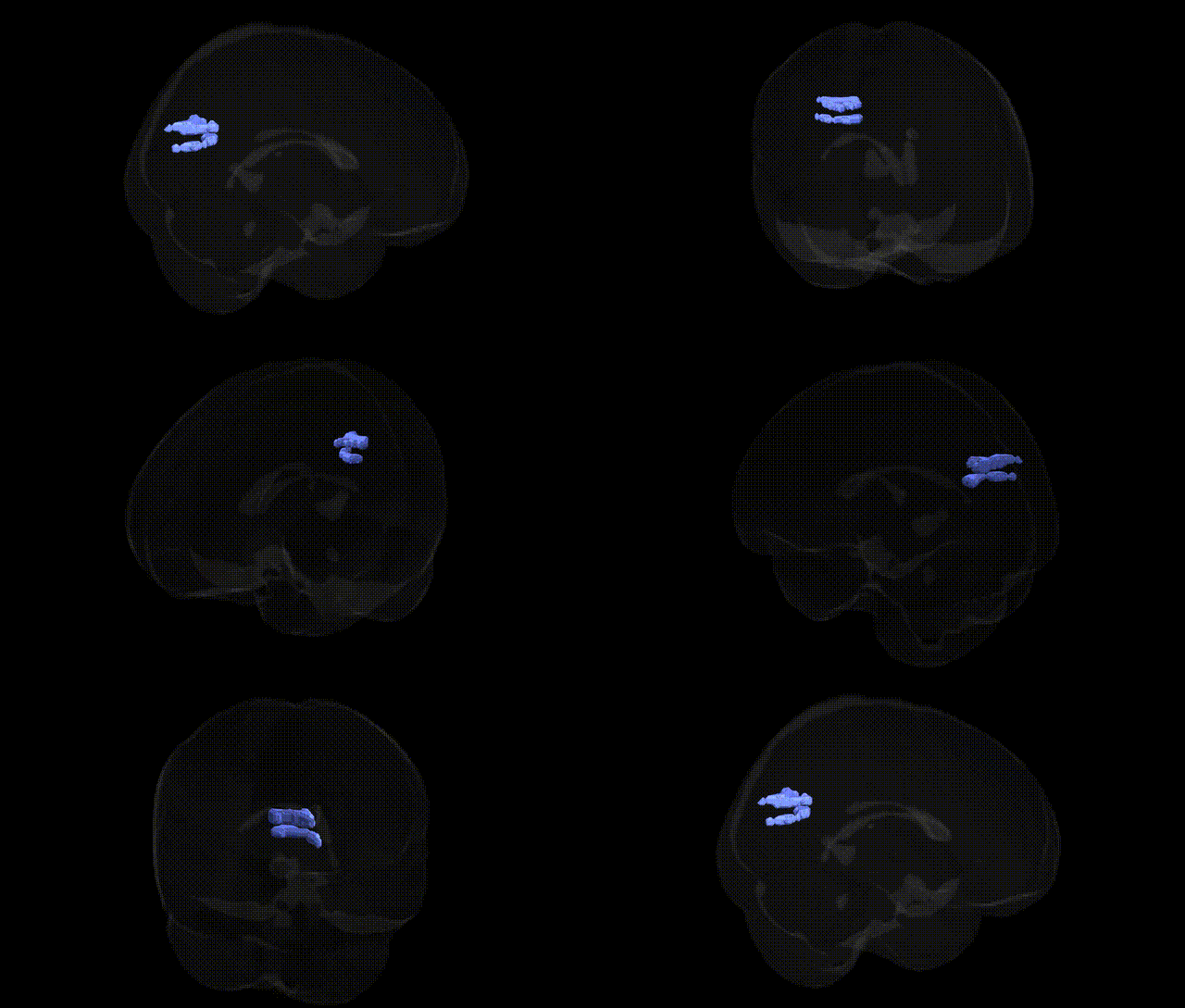
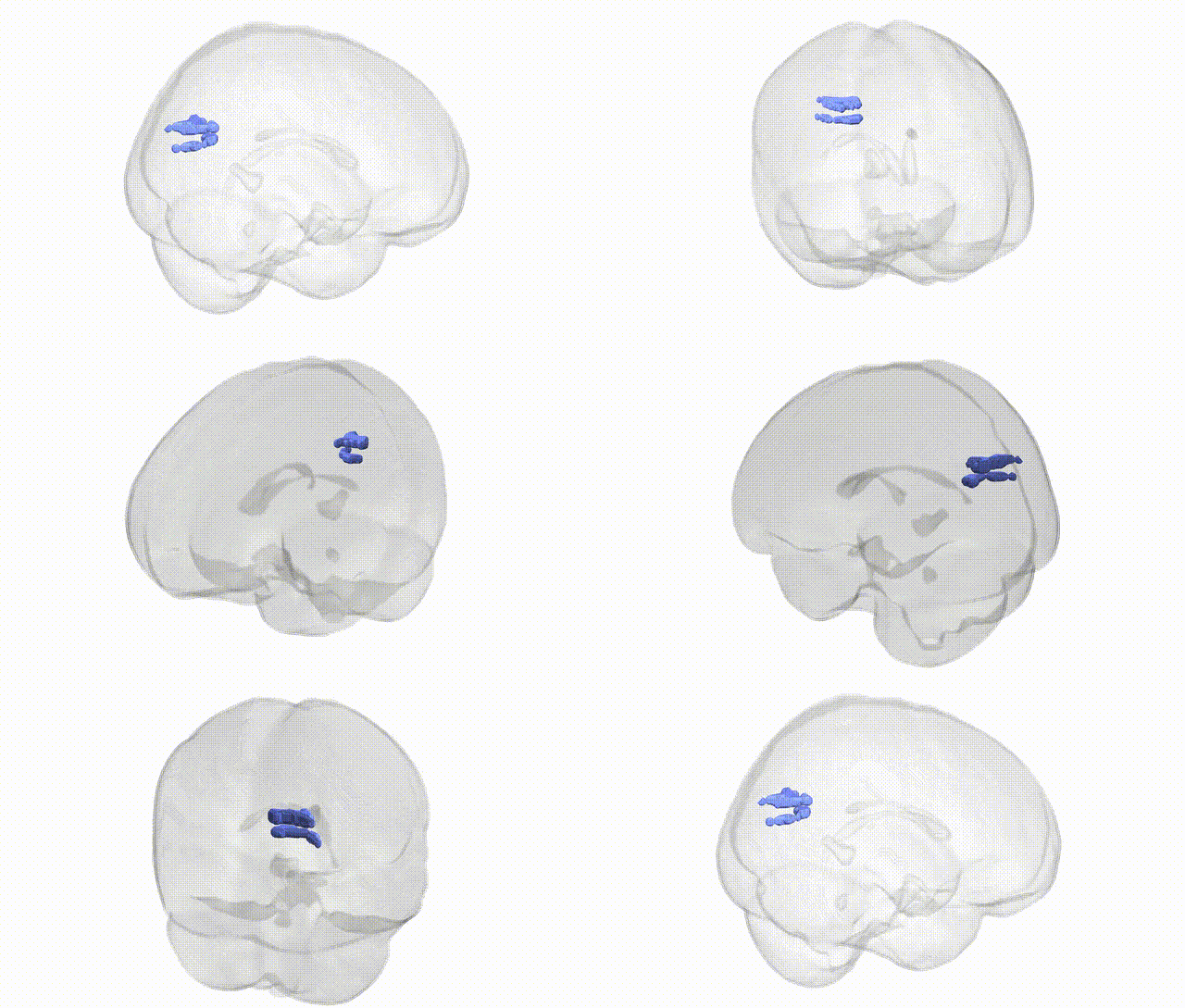
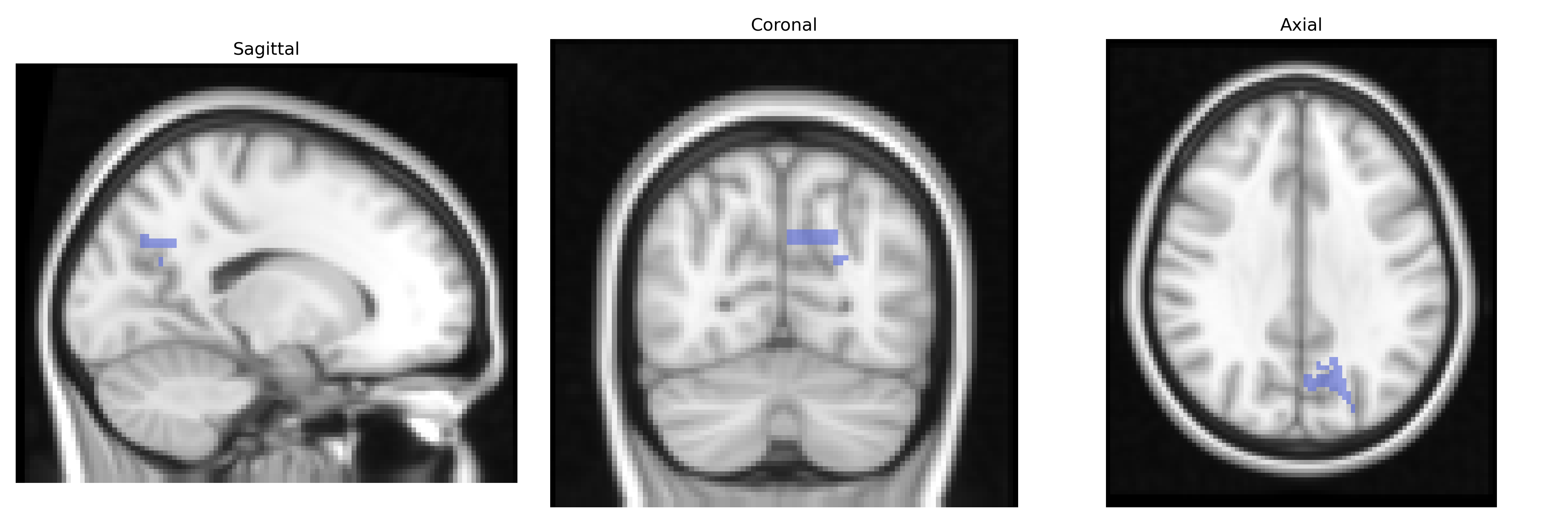
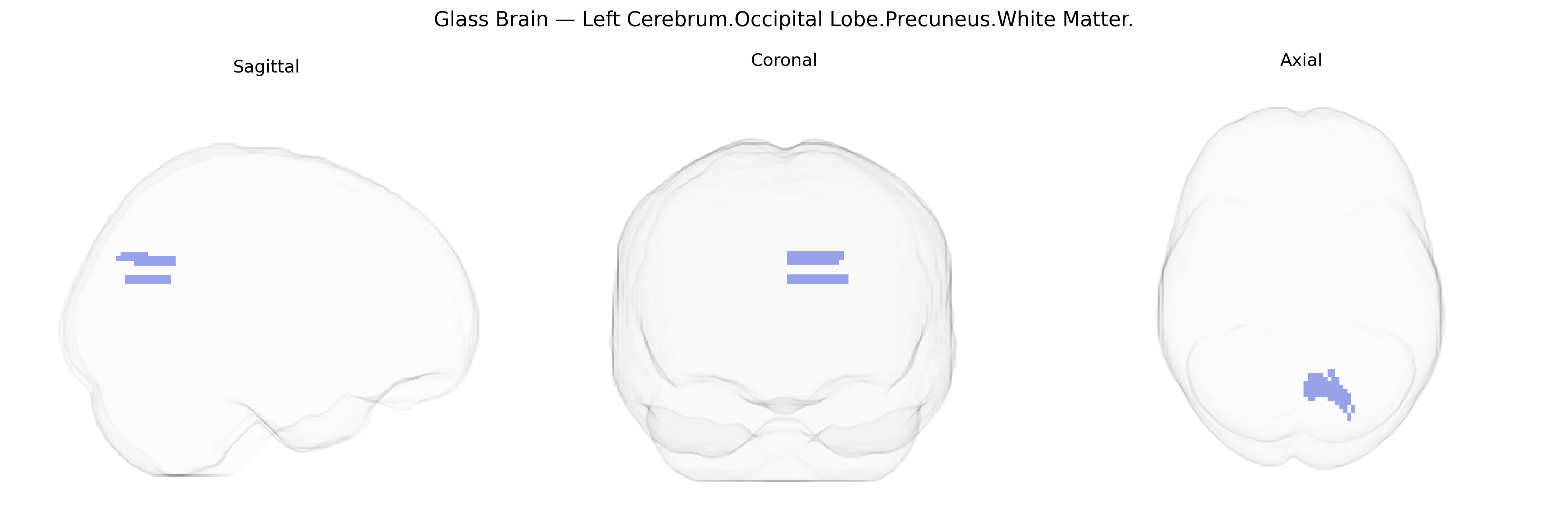
The bilateral Left Cerebrum.Occipital Lobe.Precuneus.White Matter corresponds to deep subcortical fiber tracts lying beneath the cortical precuneus region in the medial parietal–occipital junction. Although labeled within the occipital lobe in the Talairach 2 mm atlas, this white matter primarily supports connectivity of the precuneus with widespread cortical and subcortical territories, including visual associative areas, parietal visuospatial networks, and default mode network hubs. Functionally, these fibers contribute to integration of visuospatial processing, self-related mental representations, and aspects of episodic memory by enabling efficient communication across distributed cortical systems. There is no direct Wikipedia article for this specific white matter label; a closely related cortical structure is the Precuneus.
The bilateral left cerebrum occipital lobe precuneus white matter region, as defined in the Talairach 2 mm atlas, lies within a hub of the default mode and visuospatial networks, and genetic studies typically implicate it through imaging genetics and GWAS of brain structure, connectivity, and cognition rather than through this exact label. Large-scale GWAS of cortical thickness and surface area (e.g., ENIGMA, UK Biobank) have identified multiple loci—commonly near genes including MAPT, KIAA0586, WNT3, MSRB3, and others—that influence occipital and parietal morphometry and white matter microstructure (particularly fractional anisotropy and mean diffusivity in adjacent tracts), with some effects overlapping the precuneus region. Variants in genes affecting myelination, axonal guidance, and synaptic plasticity (such as CNTNAP2, NRG1, and genes within the major histocompatibility complex) have been associated with altered white matter integrity in parietal–occipital networks, which include fibers coursing through or near the precuneus. GWAS of default mode network connectivity and resting-state functional measures have reported associations with loci near APOE, TOMM40, and other Alzheimer’s disease risk genes, consistent with the known vulnerability of the precuneus and surrounding white matter in early Alzheimer’s and related neurodegenerative disorders. In psychiatric genetics, polygenic risk for schizophrenia, major depression, and autism spectrum disorder has been linked to structural and connectivity changes in the precuneus/occipital-parietal white matter pathway, suggesting pleiotropic effects of common variants on this multimodal hub. Additionally, GWAS of cognitive traits (general intelligence, memory, and visuospatial ability) and mind-wandering or self-referential processing have repeatedly implicated the precuneus and adjacent white matter as intermediate phenotypes through which distributed genetic influences on cognition and personality may act, although no single variant or gene is uniquely or specifically tied to the “Left Cerebrum.Occipital Lobe.Precuneus.White Matter” parcel.
Overview generated by GPT-4o (2026).
Region ID: 821
Hemisphere: bilateral
Atlas: Talairach labels 2mm
Full Quality Version: Download MP4
Full Quality Version: Download MP4
Wali Sidiqyar*, Gaurav Rudravaram*, Elyssa M. McMaster, Trent M. Schwartz, Adam M. Saunders, Kurt G. Schilling, Bennett A. Landman "Introducing SPINS: A Shared Public Visualization Library of Neuroanatomical Structures." Medical Imaging with Deep Learning- short paper
This resource is licensed under CC0 1.0 Universal (Public Domain).