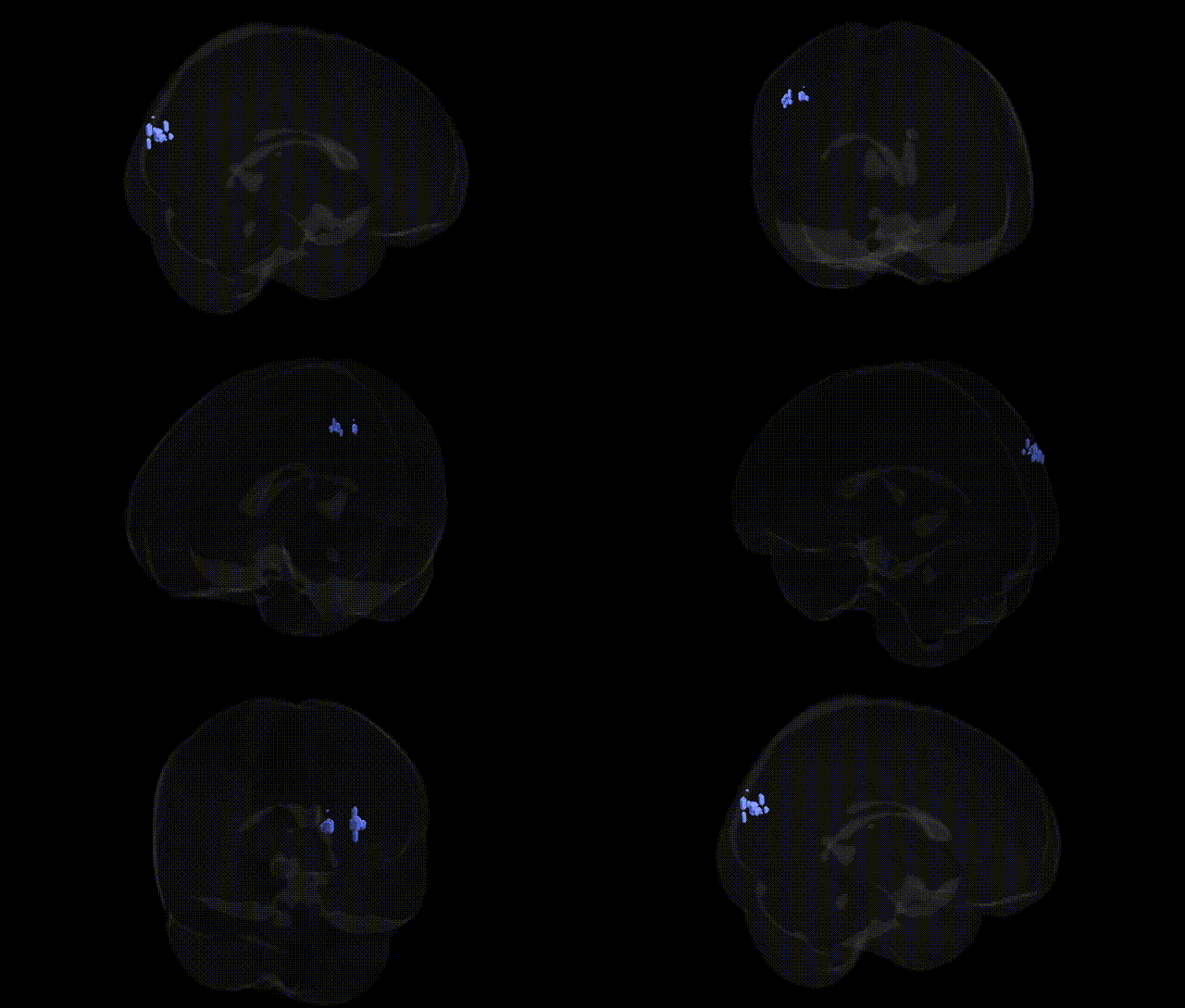
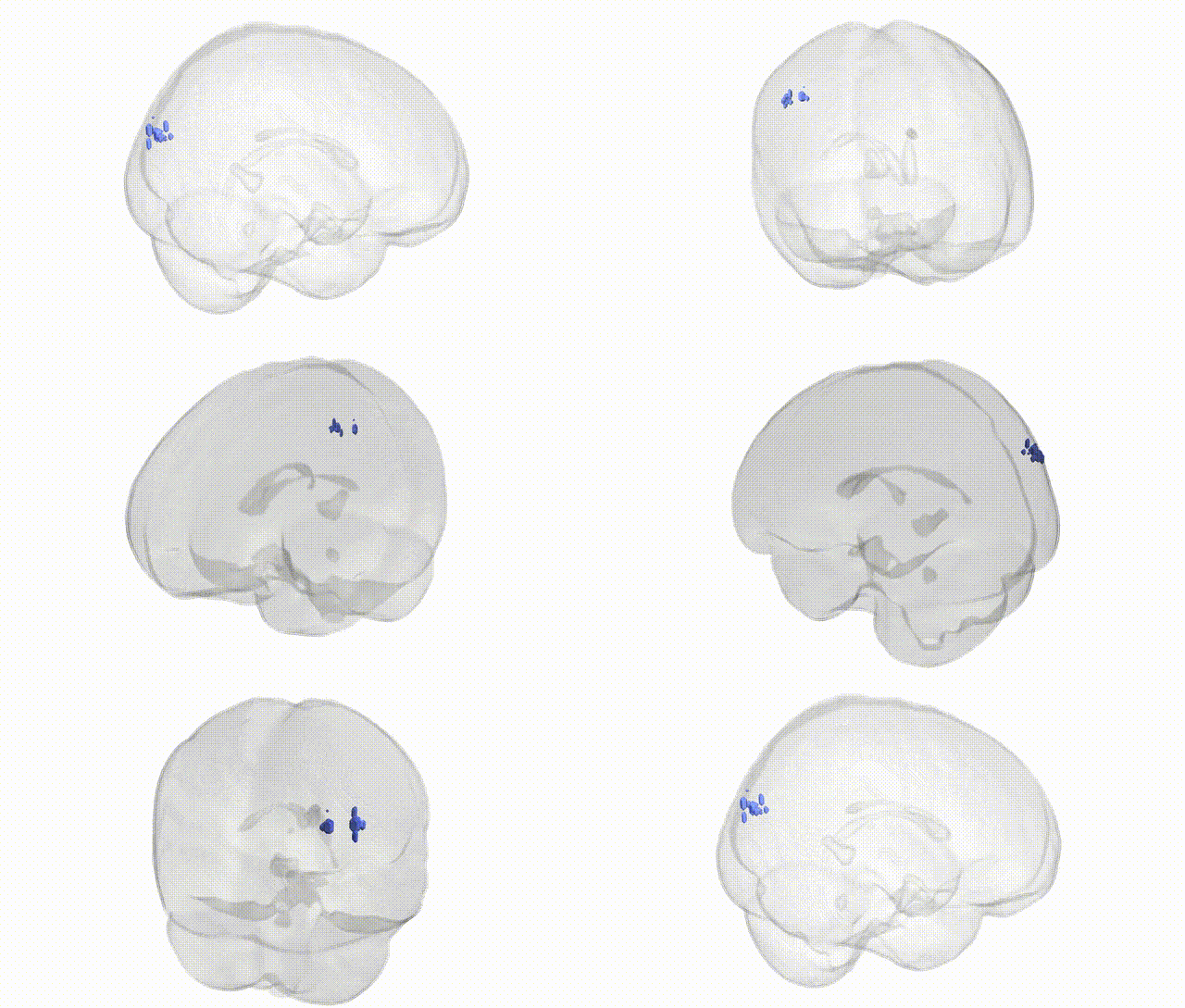
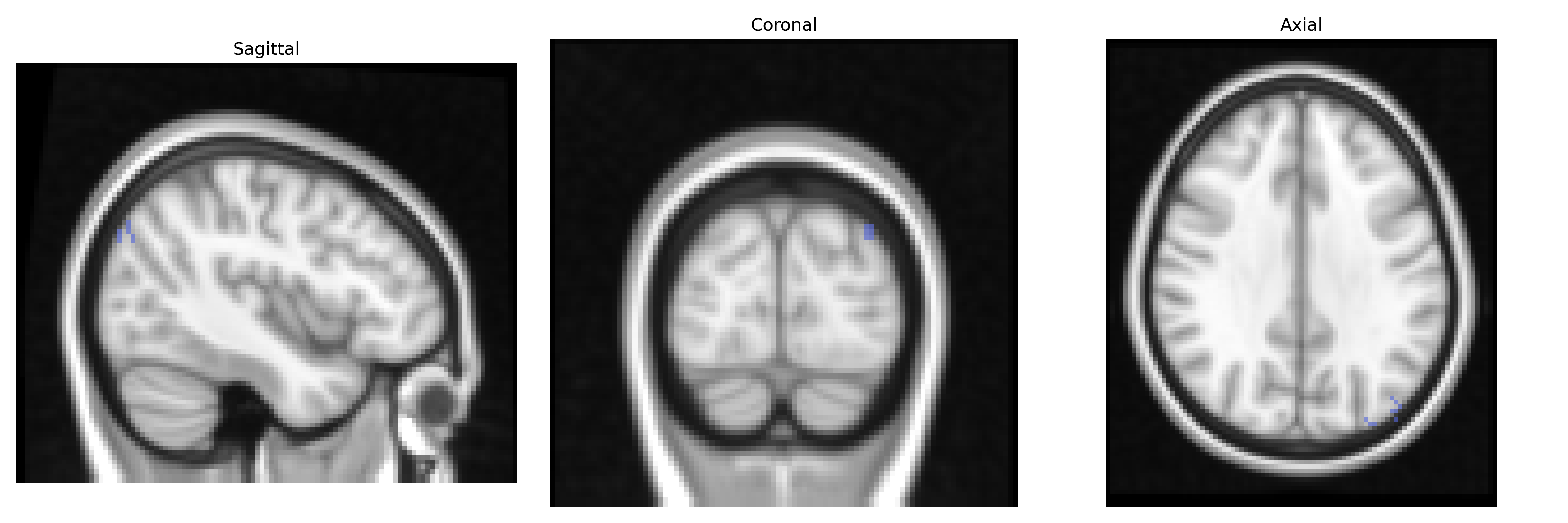
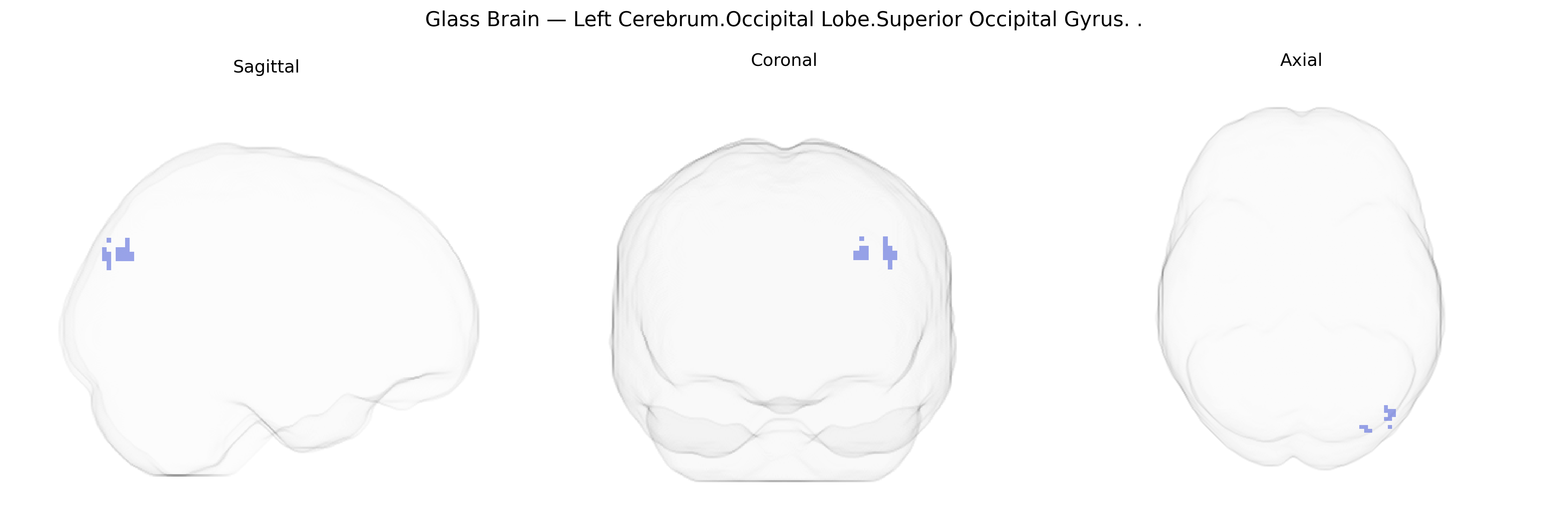
The bilateral Left Cerebrum.Occipital Lobe.Superior Occipital Gyrus, as defined in the Talairach 2 mm atlas, corresponds to cortical tissue along the dorsal aspect of the occipital lobe, bordering the parietal lobe and encompassing portions of Brodmann areas primarily involved in higher-order visual processing. This gyrus participates in the integration of visual information related to spatial orientation, motion, and complex scene analysis, and forms part of the dorsal visual stream that projects toward parietal regions. Functionally, it contributes to visuospatial attention, eye–hand coordination, and the perception of object location rather than detailed form or color. There is no direct Wikipedia article for the superior occipital gyrus; a closely related structure is the Occipital lobe.
The bilateral Left Cerebrum Occipital Lobe Superior Occipital Gyrus, as defined in the Talairach 2 mm atlas, participates in higher-order visual processing, visuospatial integration, and attention, and genetic associations to this region typically arise from imaging genetics and GWAS of cortical structure rather than region-specific candidate gene studies. Large neuroimaging GWAS (e.g., ENIGMA, UK Biobank) have identified multiple loci influencing occipital cortical thickness, surface area, and volume—commonly implicating genes involved in neurodevelopment and synaptic function such as variants near HMGA2, MIR137, and other regulators of neuronal proliferation and connectivity—with occipital metrics often showing heritability in the moderate range. These structural measures in superior and surrounding occipital regions have been linked genetically to cognitive traits (e.g., general intelligence, visual perceptual abilities), psychiatric conditions (major depressive disorder, schizophrenia, bipolar disorder), and neurodevelopmental disorders (autism spectrum disorder, ADHD), where polygenic risk scores for these disorders correlate with occipital morphology or activation patterns. GWAS of visual processing and reading-related traits sometimes report associations in or near occipital cortex, including loci affecting visual word form and motion perception networks that encompass the superior occipital gyrus, although fine-grained parcellation-specific genetic effects for this exact Talairach label are rarely isolated. Overall, genetic influences on this region are best characterized as part of broader occipital and visual network phenotypes, in which common variants affecting neurodevelopment, cortical patterning (e.g., WNT and MAPK pathway genes), and synaptic plasticity contribute to individual differences in structure and function and to risk for neuropsychiatric and cognitive phenotypes that recruit superior occipital cortex.
Overview generated by GPT-4o (2026).
Region ID: 846
Hemisphere: bilateral
Atlas: Talairach labels 2mm
Full Quality Version: Download MP4
Full Quality Version: Download MP4
Wali Sidiqyar*, Gaurav Rudravaram*, Elyssa M. McMaster, Trent M. Schwartz, Adam M. Saunders, Kurt G. Schilling, Bennett A. Landman "Introducing SPINS: A Shared Public Visualization Library of Neuroanatomical Structures." Medical Imaging with Deep Learning- short paper
This resource is licensed under CC0 1.0 Universal (Public Domain).