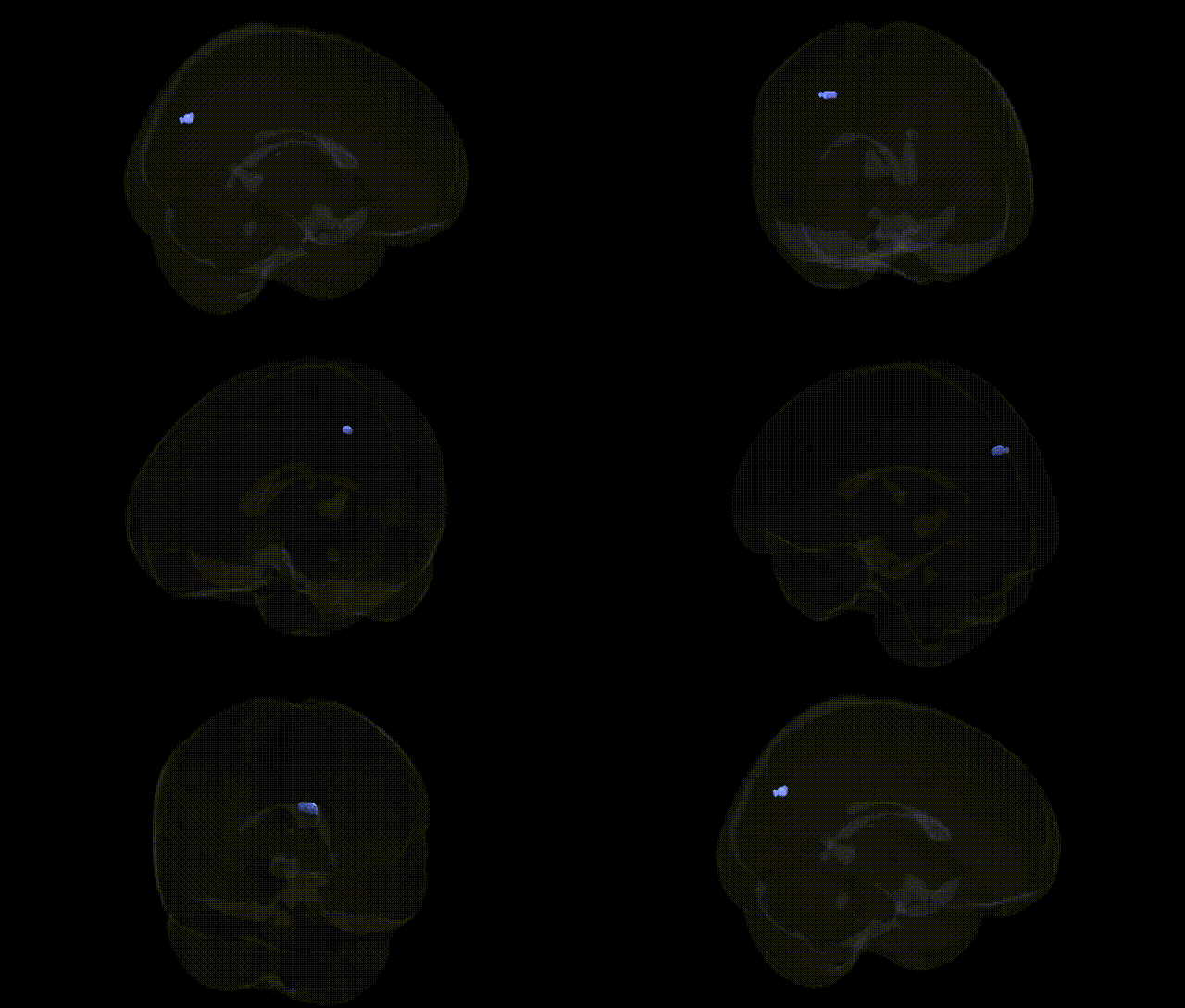
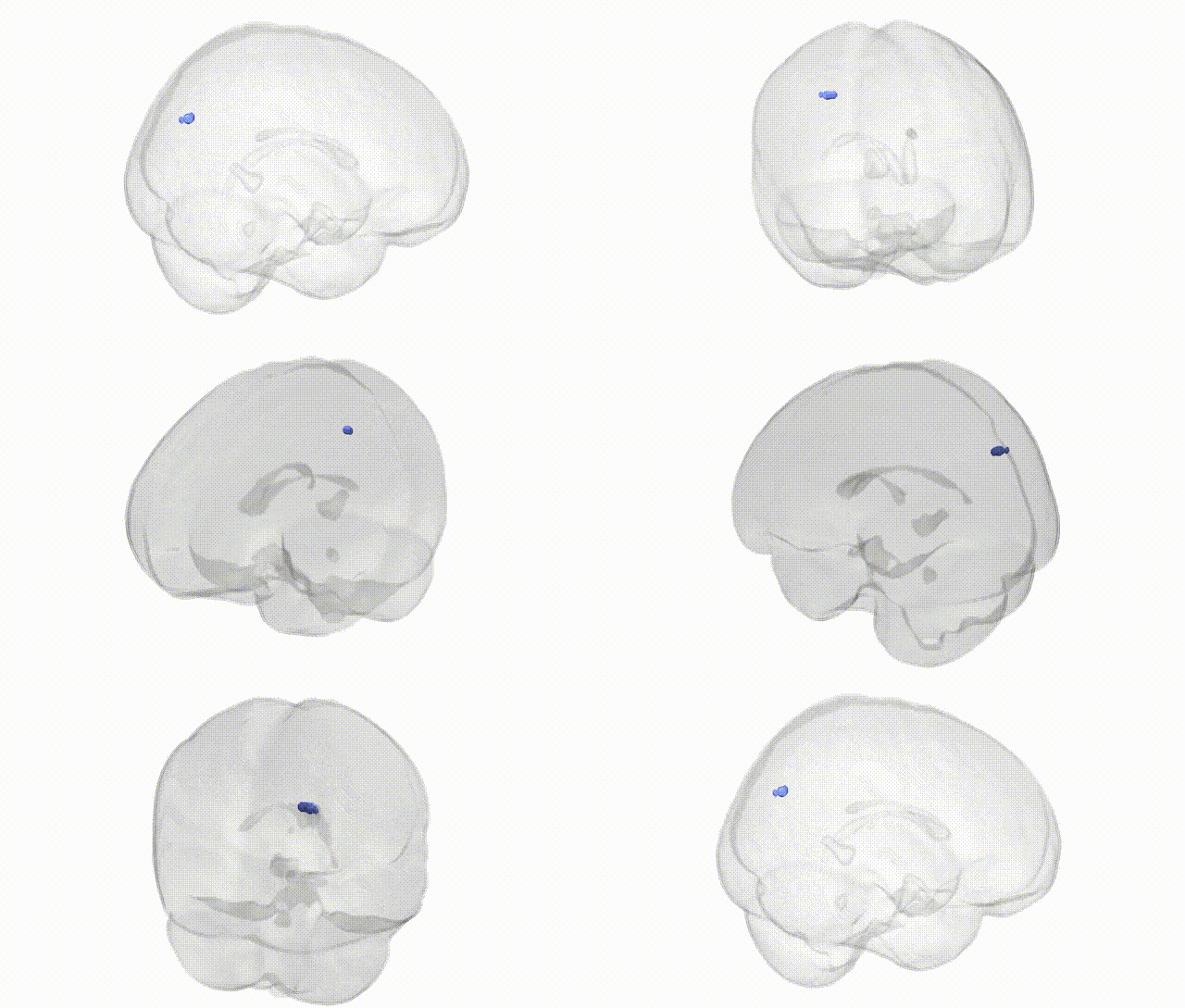
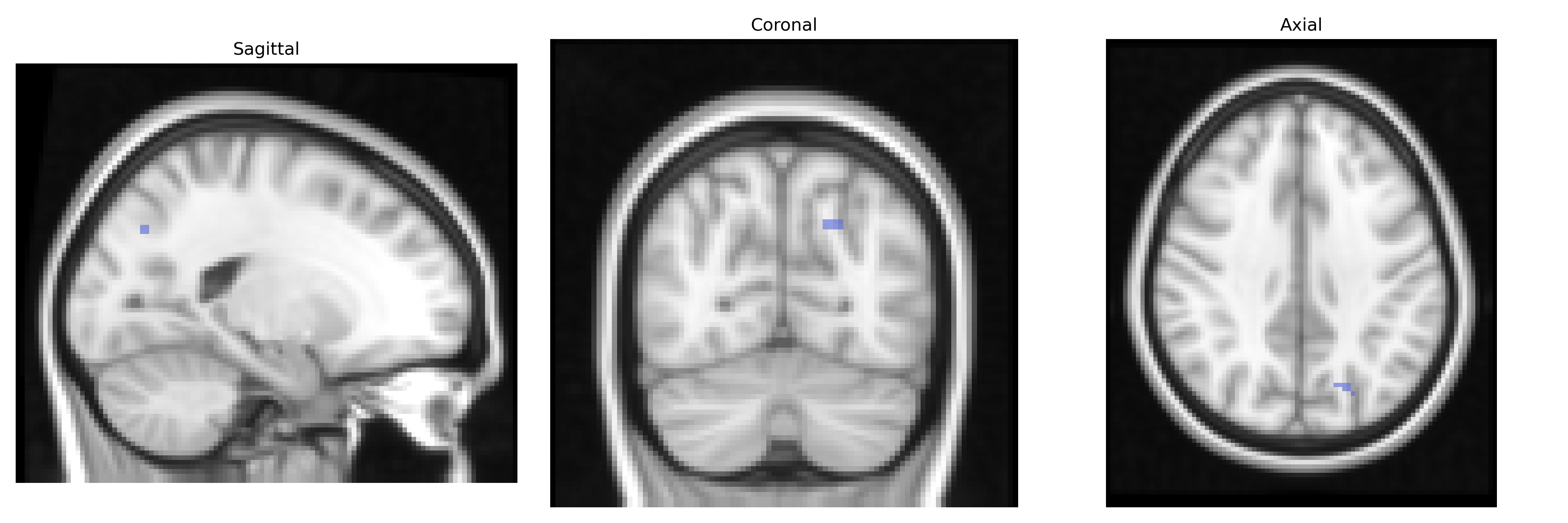
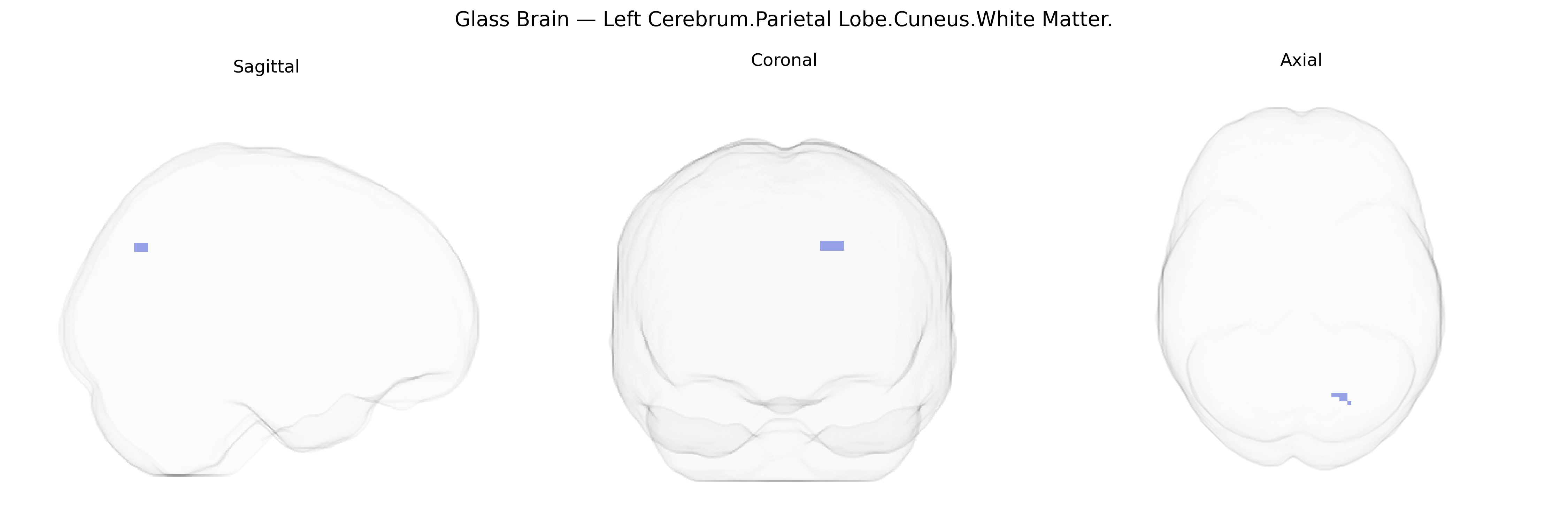
The bilateral Left Cerebrum.Parietal Lobe.Cuneus.White Matter corresponds to the subcortical fiber pathways underlying the cuneus region, a wedge-shaped portion of the medial occipital cortex traditionally associated with basic visual processing. Although labeled here within the parietal lobe in the Talairach 2 mm Atlas, the cuneus is generally considered part of the occipital lobe and contributes to early stages of visual perception, including integration of inputs from the primary visual cortex and relay to higher-order visual areas. The white matter in this region contains association and projection fibers that connect the cuneus to adjacent occipital, parietal, and temporal cortices, supporting visuospatial analysis, visual attention, and the integration of visual information with other sensory and cognitive processes. There is no direct link for the specific white matter label; a related cortical structure is the Cuneus.
The bilateral Left Cerebrum Parietal Lobe Cuneus White Matter, as defined in the Talairach 2 mm atlas, corresponds largely to occipito-parietal visual association pathways rather than a discrete gray-matter functional node, so genetic associations typically emerge from imaging genetics and GWAS of white-matter microstructure or regional volume rather than region-specific gene studies. Large-scale GWAS of diffusion tensor imaging measures (e.g., FA, MD) and cortical/subcortical volumes have identified multiple loci (including variants near genes such as HMGA2, IGF1, BDNF, and others involved in neurodevelopment, axon guidance, and myelination) that influence white-matter integrity in parieto-occipital tracts overlapping the cuneus region; these structural metrics, in turn, have been implicated as intermediate phenotypes for cognitive performance, educational attainment, and general intelligence. Polygenic risk for neuropsychiatric disorders—including schizophrenia, major depressive disorder, bipolar disorder, and autism spectrum disorder—shows associations with widespread white-matter alterations that frequently involve dorsal visual and parietal pathways, including the cuneus-adjacent regions, with risk variants often enriched in genes affecting synaptic function and oligodendrocyte biology. GWAS of visual processing, reading ability, and attentional traits have also implicated occipito-parietal white matter, suggesting that genetic variation influencing development and maintenance of these tracts contributes to individual differences in visuospatial attention, motion perception, and higher-order visual cognition, though findings are generally distributed and not specific to the cuneus white matter ROI as delineated in the Talairach atlas.
Overview generated by GPT-4o (2026).
Region ID: 963
Hemisphere: bilateral
Atlas: Talairach labels 2mm
Full Quality Version: Download MP4
Full Quality Version: Download MP4
Wali Sidiqyar*, Gaurav Rudravaram*, Elyssa M. McMaster, Trent M. Schwartz, Adam M. Saunders, Kurt G. Schilling, Bennett A. Landman "Introducing SPINS: A Shared Public Visualization Library of Neuroanatomical Structures." Medical Imaging with Deep Learning- short paper
This resource is licensed under CC0 1.0 Universal (Public Domain).