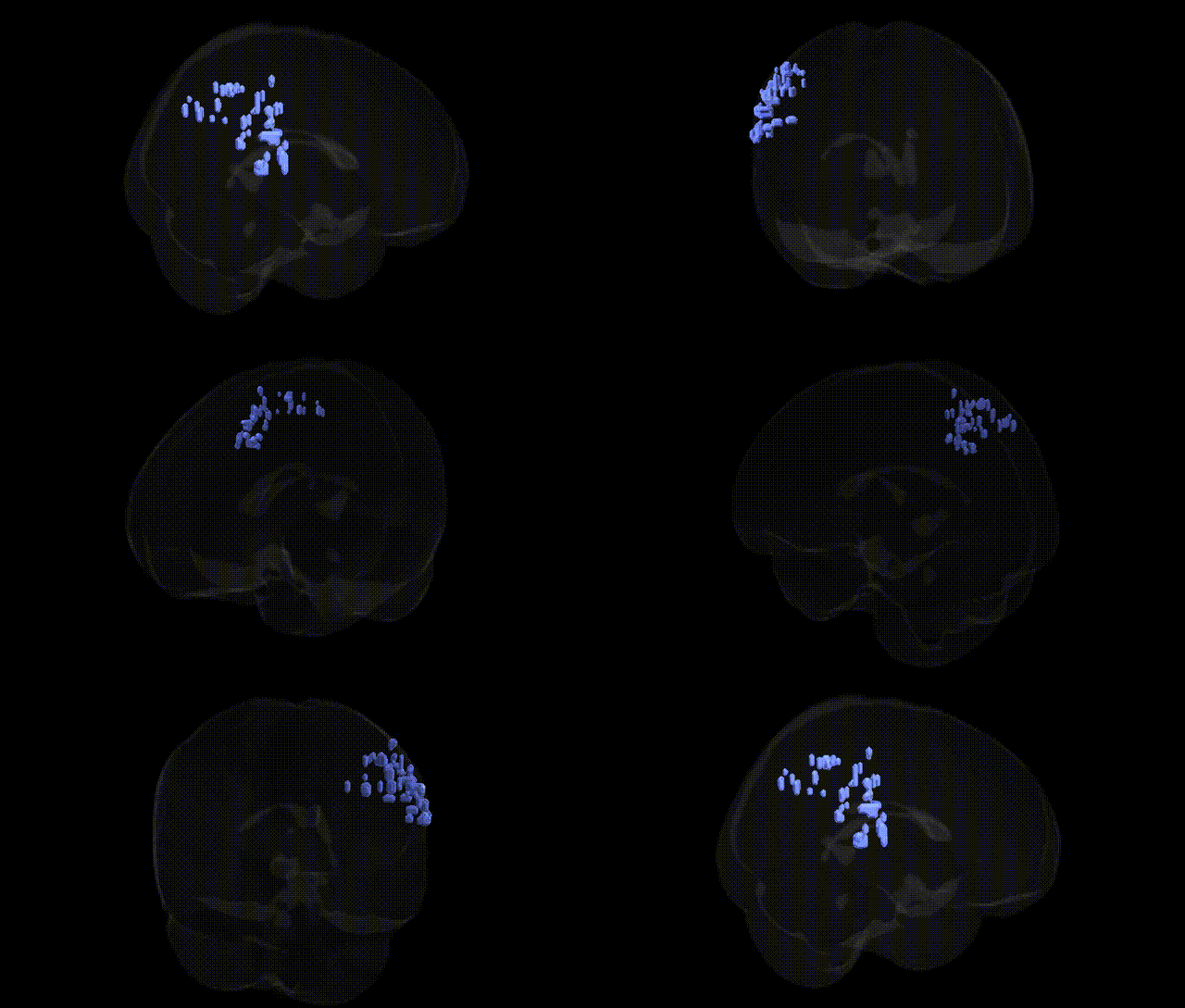
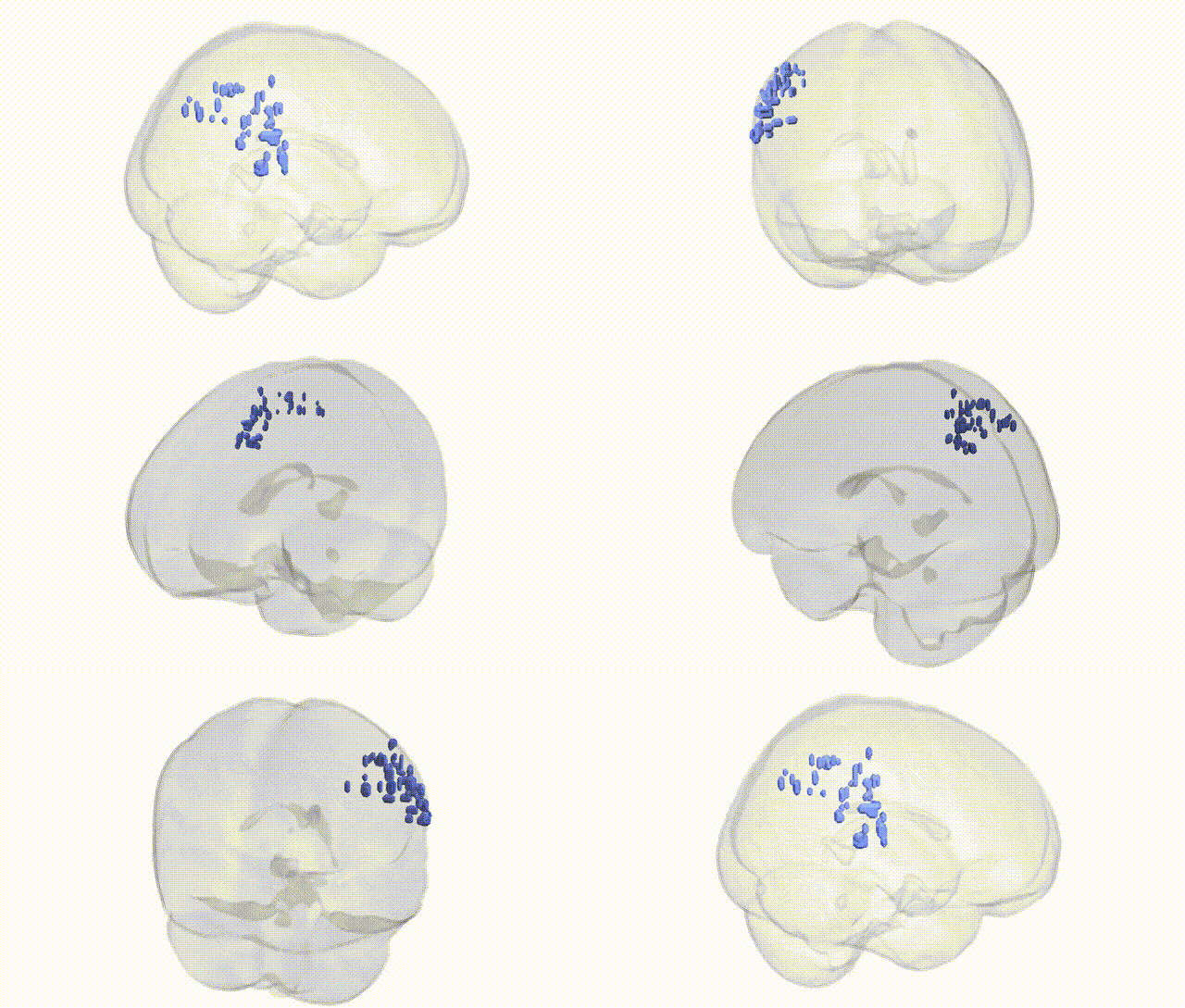
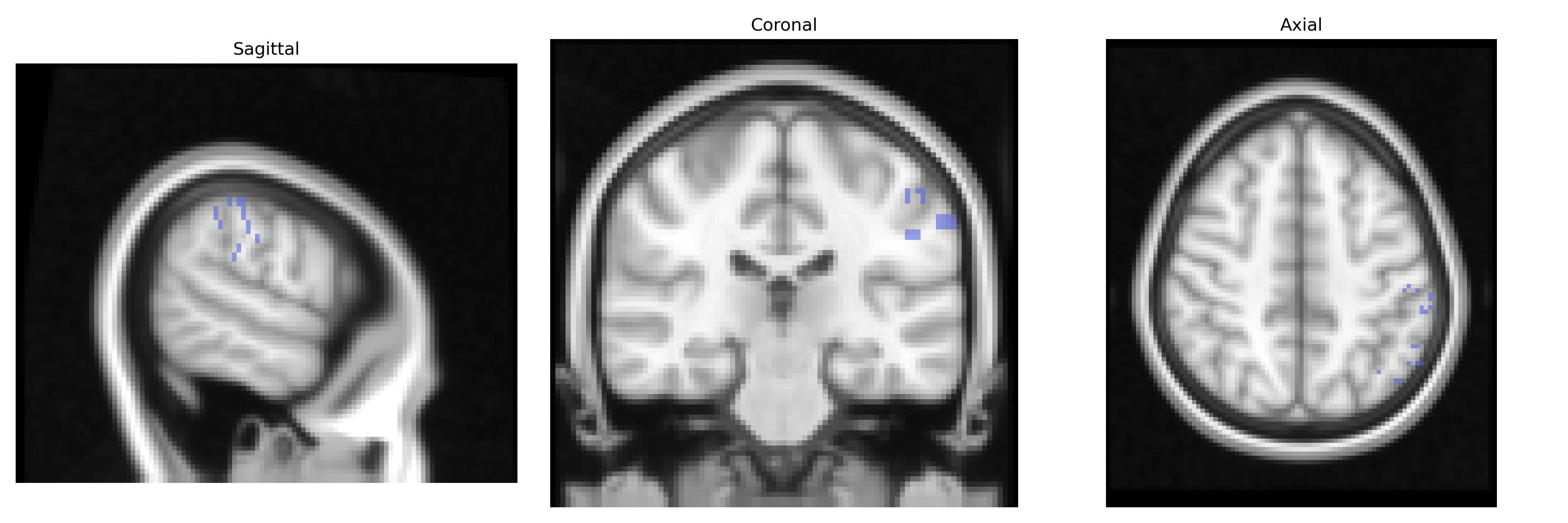
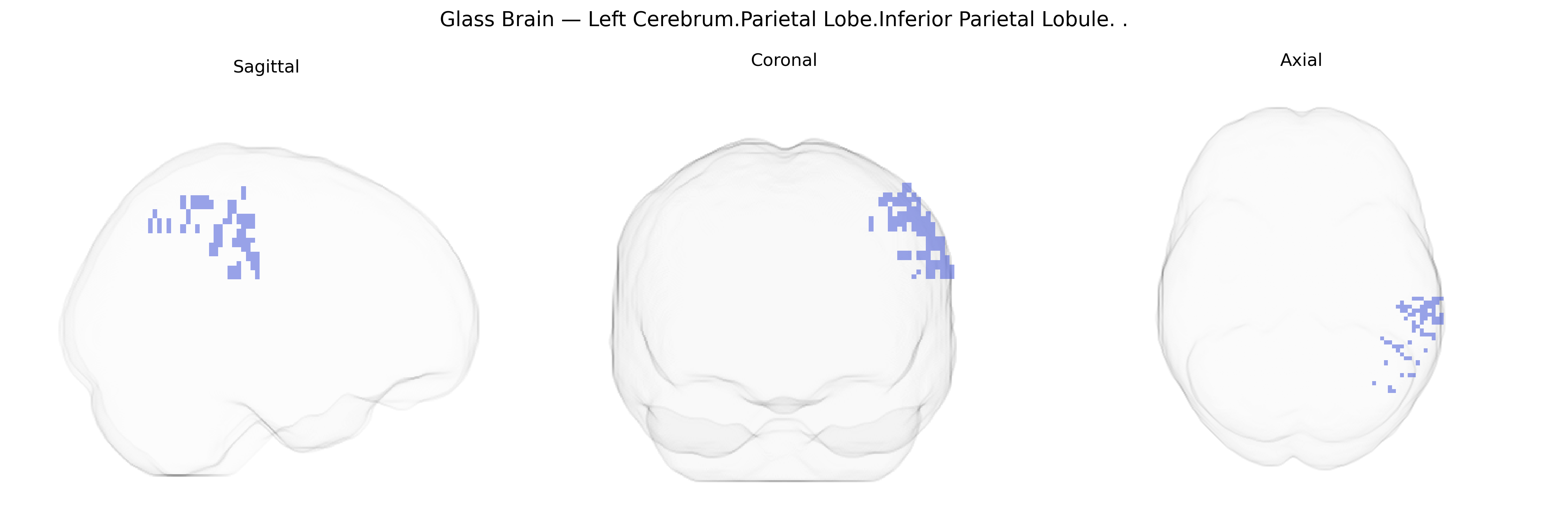
The bilateral Left Cerebrum Parietal Lobe Inferior Parietal Lobule is a heteromodal association cortex region located in the posterior parietal lobe, bordering the supramarginal and angular gyri. It integrates multimodal sensory inputs (visual, auditory, and somatosensory) to support higher-order cognitive functions including spatial attention, body awareness, language comprehension (particularly semantic processing), arithmetic, and aspects of social cognition such as theory of mind. The inferior parietal lobule is strongly involved in the dorsal attention network and frontoparietal control networks, and shows lateralization of function, with the left side more closely associated with language and symbolic processing and the right side more involved in spatial and attentional functions. It maintains extensive reciprocal connections with frontal premotor and prefrontal cortices, temporal association areas, and occipital visual regions, contributing to sensorimotor integration and the coordination of goal-directed behavior.
The bilateral left inferior parietal lobule (IPL) in the Talairach 2 mm atlas is a multimodal association region implicated by genetic studies in language, numerical cognition, attention, social cognition, and higher-order integration, with several GWAS and imaging-genetics findings supporting its involvement across diverse traits and disorders. Common variants near FOXP2, CNTNAP2, DCDC2, KIAA0319, and ROBO1, originally linked to developmental language disorder, dyslexia, and speech/language phenotypes, have been associated with altered structure or activation of left inferior parietal areas during phonological and reading tasks. Large-scale ENIGMA and UK Biobank imaging-GWAS have identified polygenic influences on cortical thickness and surface area in parietal association cortices, including inferior parietal regions, with loci near genes involved in neurodevelopment (e.g., HMGA2, IGF1 and other growth or axon guidance genes) and with genetic correlations to educational attainment, intelligence, and cognitive performance. Schizophrenia and major depression GWAS, as well as polygenic risk score studies, report that higher genetic liability for these disorders is linked to structural and functional alterations in the IPL, consistent with this region’s role in attention, self-other distinction, and default-mode network function. Variants associated with Alzheimer’s disease risk (e.g., in APOE, CLU, CR1, PICALM) and polygenic risk for Alzheimer’s and cognitive decline have been related to atrophy and hypometabolism in parietal association cortex, including inferior parietal lobule, particularly in networks subserving episodic memory and spatial orientation. Additional GWAS of traits such as handedness, mathematical ability, and social cognition show convergent heritable influences on activity and morphology of the left inferior parietal lobule, underscoring its role as a genetically modulated hub for language, symbolic processing, and integrative cognitive function.
Overview generated by GPT-4o (2026).
Region ID: 887
Hemisphere: bilateral
Atlas: Talairach labels 2mm
Full Quality Version: Download MP4
Full Quality Version: Download MP4
Wali Sidiqyar*, Gaurav Rudravaram*, Elyssa M. McMaster, Trent M. Schwartz, Adam M. Saunders, Kurt G. Schilling, Bennett A. Landman "Introducing SPINS: A Shared Public Visualization Library of Neuroanatomical Structures." Medical Imaging with Deep Learning- short paper
This resource is licensed under CC0 1.0 Universal (Public Domain).