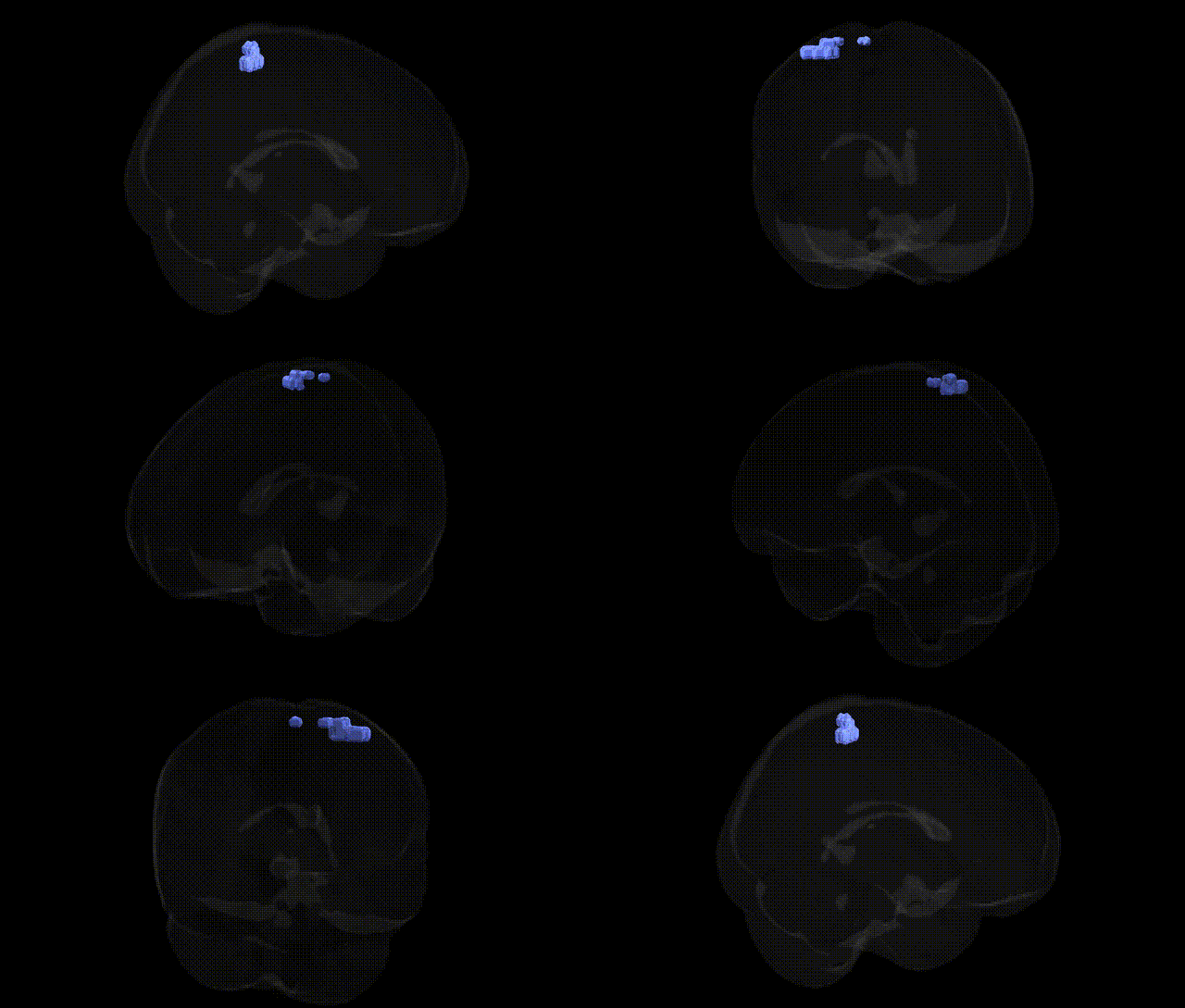
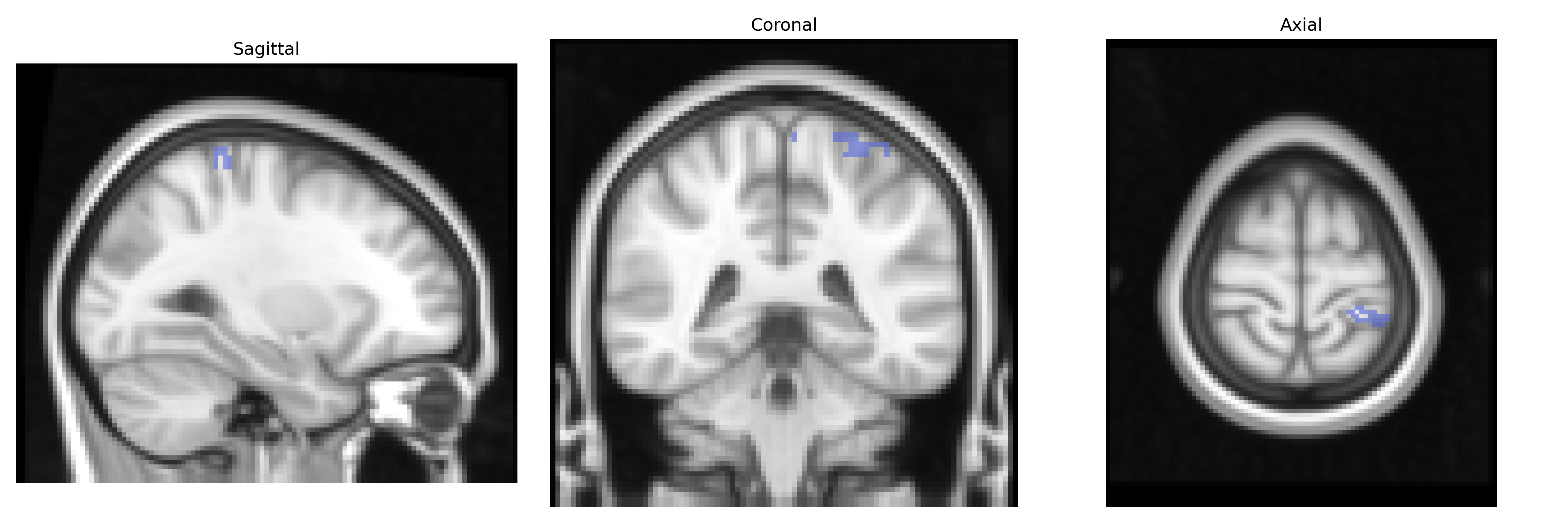
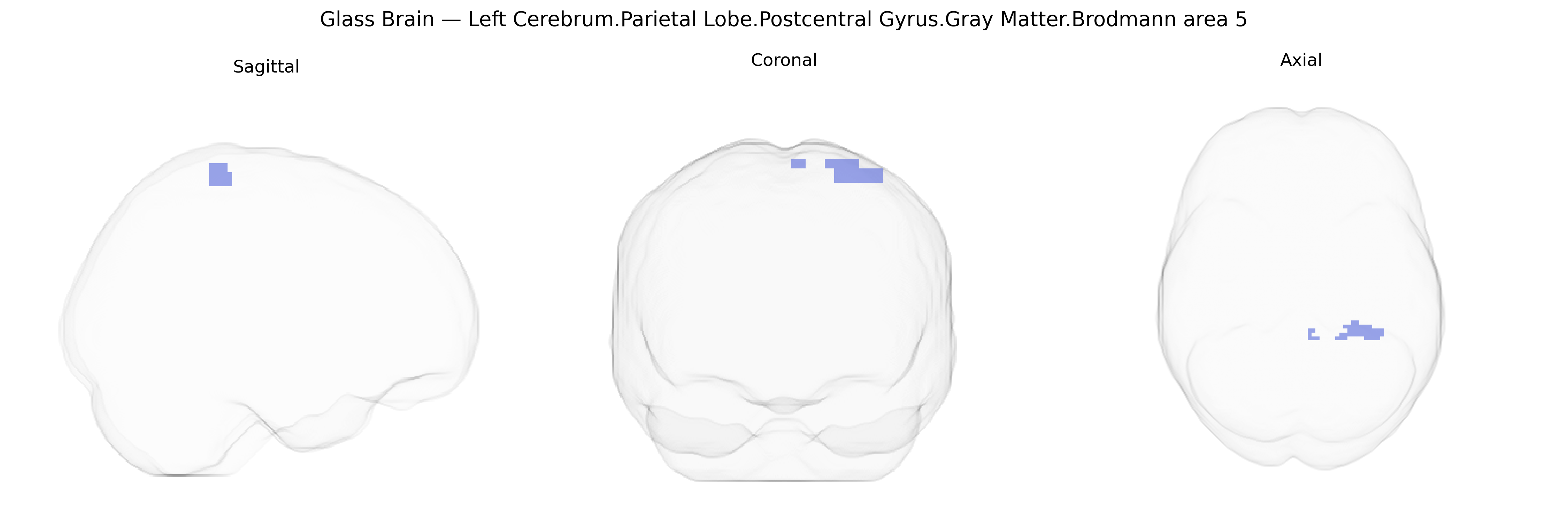
The bilateral Left Cerebrum.Parietal Lobe.Postcentral Gyrus.Gray Matter.Brodmann area 5 corresponds to a portion of the superior parietal cortex located posterior to the primary somatosensory cortex (Brodmann areas 3, 1, and 2) and is involved in higher-order somatosensory processing, including integration of tactile, proprioceptive, and kinesthetic information for spatial orientation and sensorimotor coordination. This region contributes to the construction of internal body representations and the guidance of complex movements based on somatosensory feedback, supporting functions such as object manipulation and limb position estimation in extrapersonal space. There is no direct link for “Brodmann area 5” as a standalone article; a closely related and encompassing structure is the Parietal lobe.
Genetic associations specifically targeting the bilateral Left Cerebrum.Parietal Lobe.Postcentral Gyrus.Gray Matter.Brodmann area 5 (BA5) in the Talairach 2 mm atlas are relatively sparse, but converging evidence from GWAS and imaging genetics studies implicates this somatosensory-parietal region in several traits and disorders. Variants influencing cortical thickness and surface area in superior parietal and postcentral regions have been identified in large neuroimaging GWAS consortia (e.g., ENIGMA, UK Biobank), with loci near genes involved in neurodevelopment and synaptic function such as MAPT, PAX6, and KIAA0586 showing effects on parietal cortical morphology that likely overlap BA5. Somatosensory and parietal areas including BA5 are modulated by genetic risk for neurodevelopmental and psychiatric conditions—polygenic risk scores for schizophrenia, ADHD, and autism spectrum disorder show associations with altered parietal/postcentral structure or function, and risk variants in genes such as CACNA1C, CNTNAP2, and GRIN2A have been linked to changes in sensory integration and parietal connectivity. GWAS of pain sensitivity and chronic pain, motor coordination, and hand skill also report parietal/postcentral structural or functional correlates, suggesting that alleles affecting sensorimotor integration and body representation may act partly through BA5-related networks. Although few studies isolate BA5 as a standalone ROI, genetic influences on superior parietal lobule and postcentral gyrus—regions encompassing BA5—are consistently observed across neuroimaging GWAS of cortical morphology, cognitive function (especially visuospatial and sensorimotor tasks), and multi-trait psychiatric risk, indicating that BA5 participates in genetically mediated variability in somatosensory processing, motor planning, and higher-order body-space representation.
Overview generated by GPT-4o (2026).
Region ID: 1095
Hemisphere: bilateral
Atlas: Talairach labels 2mm
Full Quality Version: Download MP4
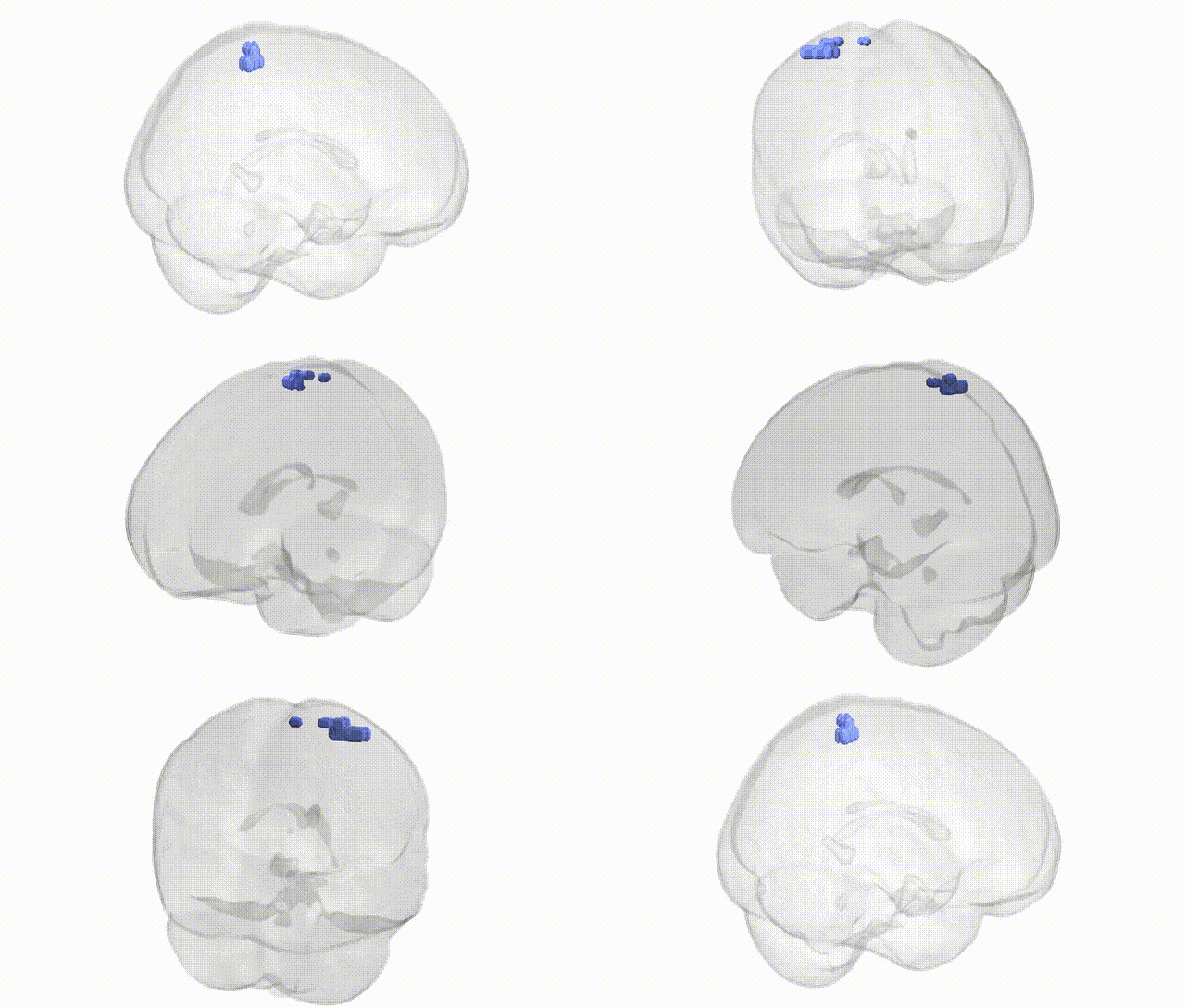
Full Quality Version: Download MP4
Wali Sidiqyar*, Gaurav Rudravaram*, Elyssa M. McMaster, Trent M. Schwartz, Adam M. Saunders, Kurt G. Schilling, Bennett A. Landman "Introducing SPINS: A Shared Public Visualization Library of Neuroanatomical Structures." Medical Imaging with Deep Learning- short paper
This resource is licensed under CC0 1.0 Universal (Public Domain).