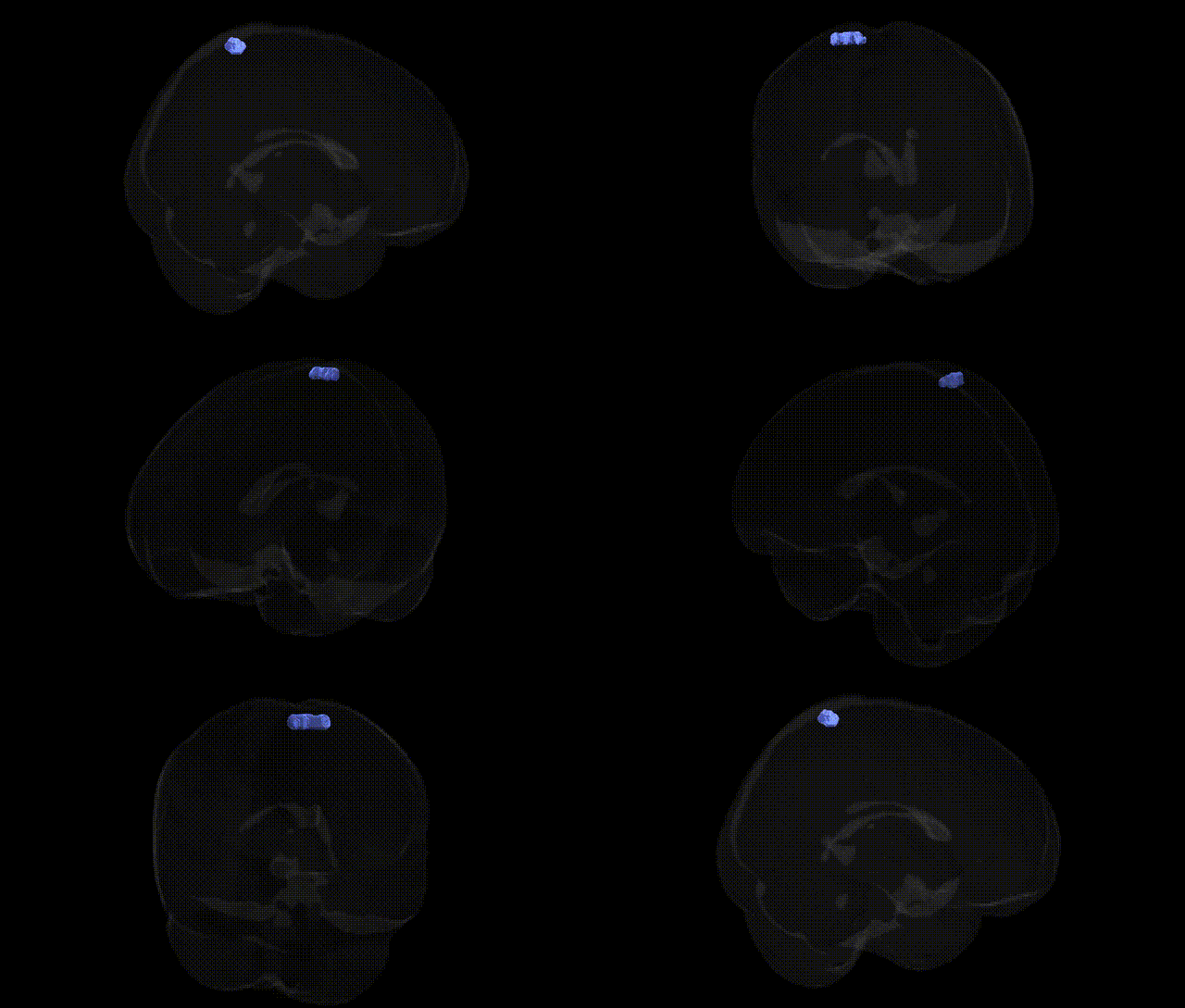
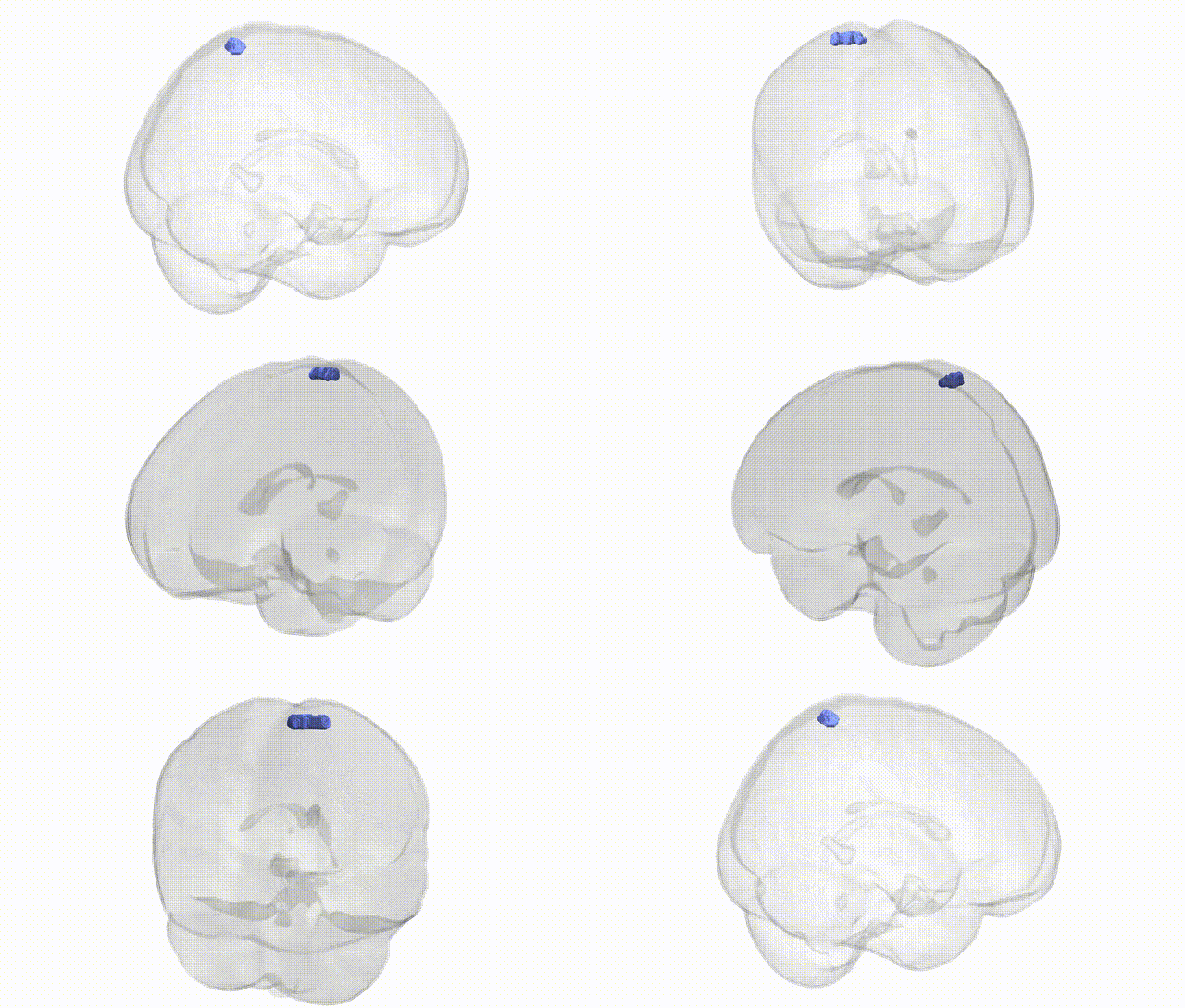
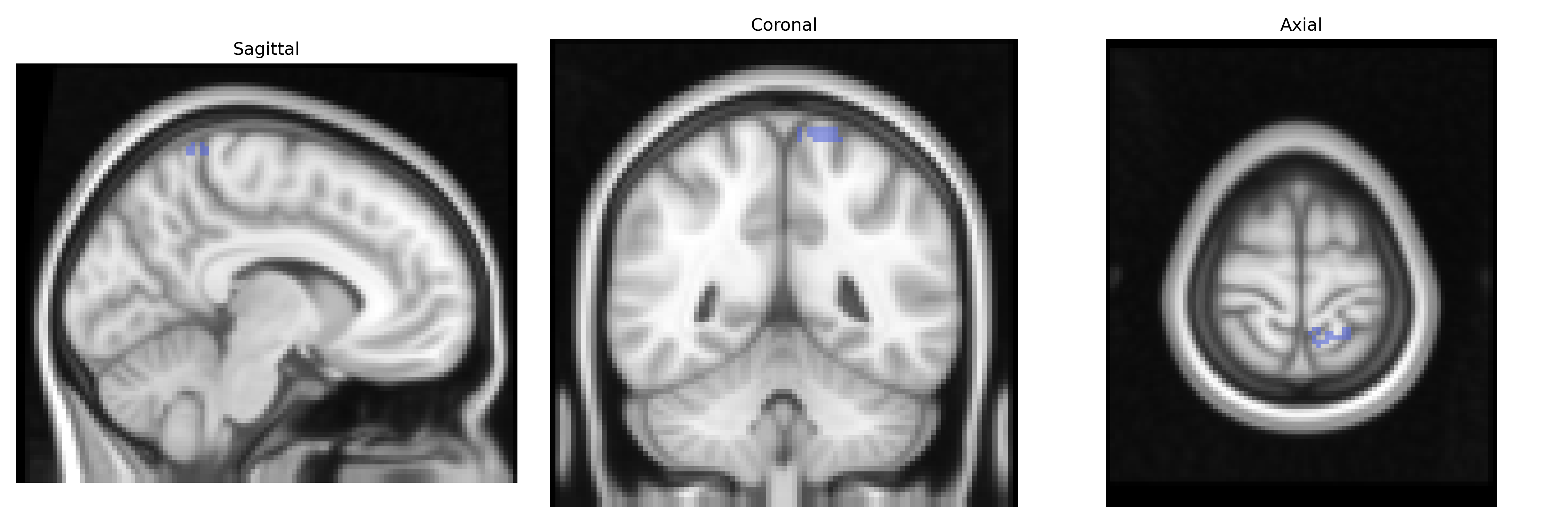
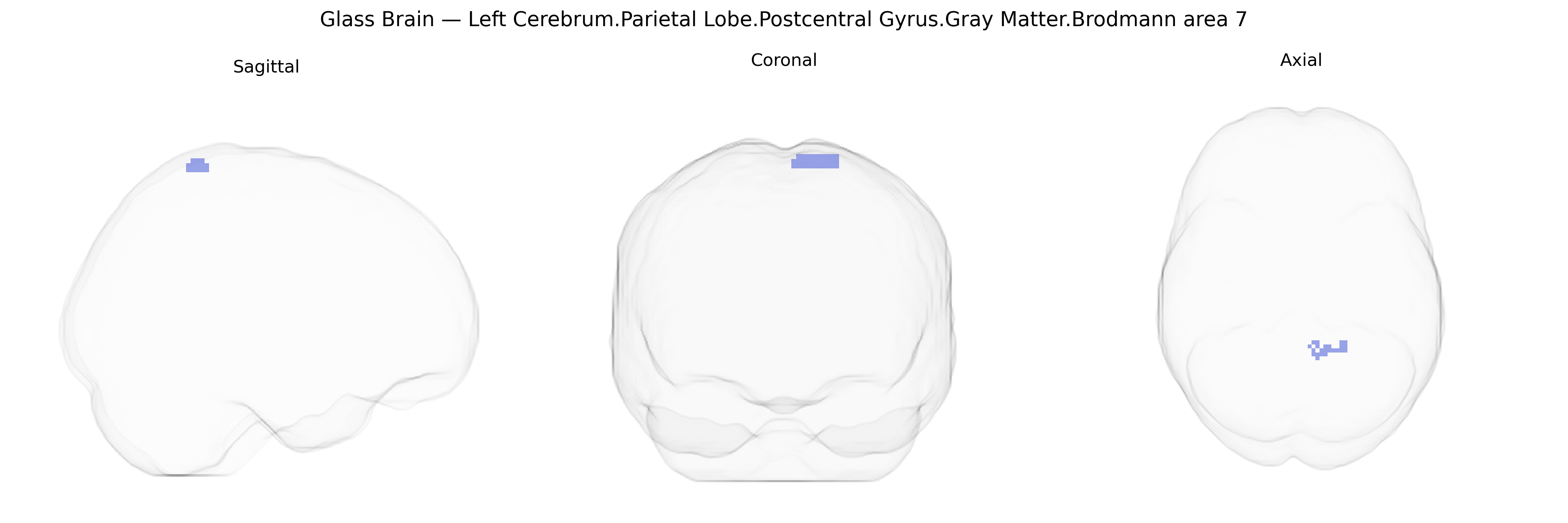
The bilateral Left Cerebrum.Parietal Lobe.Postcentral Gyrus.Gray Matter.Brodmann area 7 corresponds primarily to the superior parietal cortex located posterior to the primary somatosensory cortex, involved in higher-order somatosensory processing and visuomotor integration. Brodmann area 7 participates in spatial orientation, body schema representation, and the coordination of eye–hand movements, integrating visual, proprioceptive, and tactile information to guide complex motor actions and spatial attention. This region contributes to the perception of the spatial relationships of objects and limbs, and lesions here can result in deficits such as optic ataxia, impaired spatial awareness, and difficulties with visually guided movements. There is no direct Wikipedia article for this full Talairach label; a closely related structure is Brodmann area 7.
The bilateral Left Cerebrum Parietal Lobe Postcentral Gyrus Gray Matter Brodmann area 7 (Talairach 2 mm Atlas) lies in superior parietal cortex bordering somatosensory regions and has been implicated in genetic studies of sensorimotor integration, spatial attention, and higher-order visuospatial processing. GWAS and imaging-genetics work using tools such as voxel-based morphometry and atlas-based parcellations have linked structural and functional variation in this region to polygenic influences involving synaptic, neurodevelopmental, and cell-adhesion genes, including variants near or within genes such as BDNF, CNTNAP2, and DISC1 in broader parietal and association cortices, although precise, atlas-specific associations for BA7 are less frequently isolated. Parietal gray matter measures overlapping BA7 have been associated with schizophrenia, autism spectrum disorder, and attention-deficit/hyperactivity disorder, where common risk variants and polygenic risk scores correlate with cortical thickness or surface area differences in superior parietal and postcentral territories. GWAS of general cognitive ability, intelligence, and educational attainment have identified large polygenic effects, and subsequent imaging-genetic studies demonstrate that many of these variants influence parietal association cortex volume and activation, including regions overlapping BA7 during visuospatial and working memory tasks. Additionally, parietal BA7–adjacent areas show heritable patterns of cortical thickness and surface area in twin studies, supporting substantial genetic control, and are implicated in GWAS of chronic pain and somatosensory traits where risk alleles relate to altered somatosensory network structure and function, though these findings typically reference broader parietal or somatosensory networks rather than this Talairach-defined parcel alone. Overall, genetic associations involving this BA7 region are embedded within distributed, polygenic influences on parietal association cortex rather than single-gene effects uniquely mapped to the specific Talairach label.
Overview generated by GPT-4o (2026).
Region ID: 1101
Hemisphere: bilateral
Atlas: Talairach labels 2mm
Full Quality Version: Download MP4
Full Quality Version: Download MP4
Wali Sidiqyar*, Gaurav Rudravaram*, Elyssa M. McMaster, Trent M. Schwartz, Adam M. Saunders, Kurt G. Schilling, Bennett A. Landman "Introducing SPINS: A Shared Public Visualization Library of Neuroanatomical Structures." Medical Imaging with Deep Learning- short paper
This resource is licensed under CC0 1.0 Universal (Public Domain).