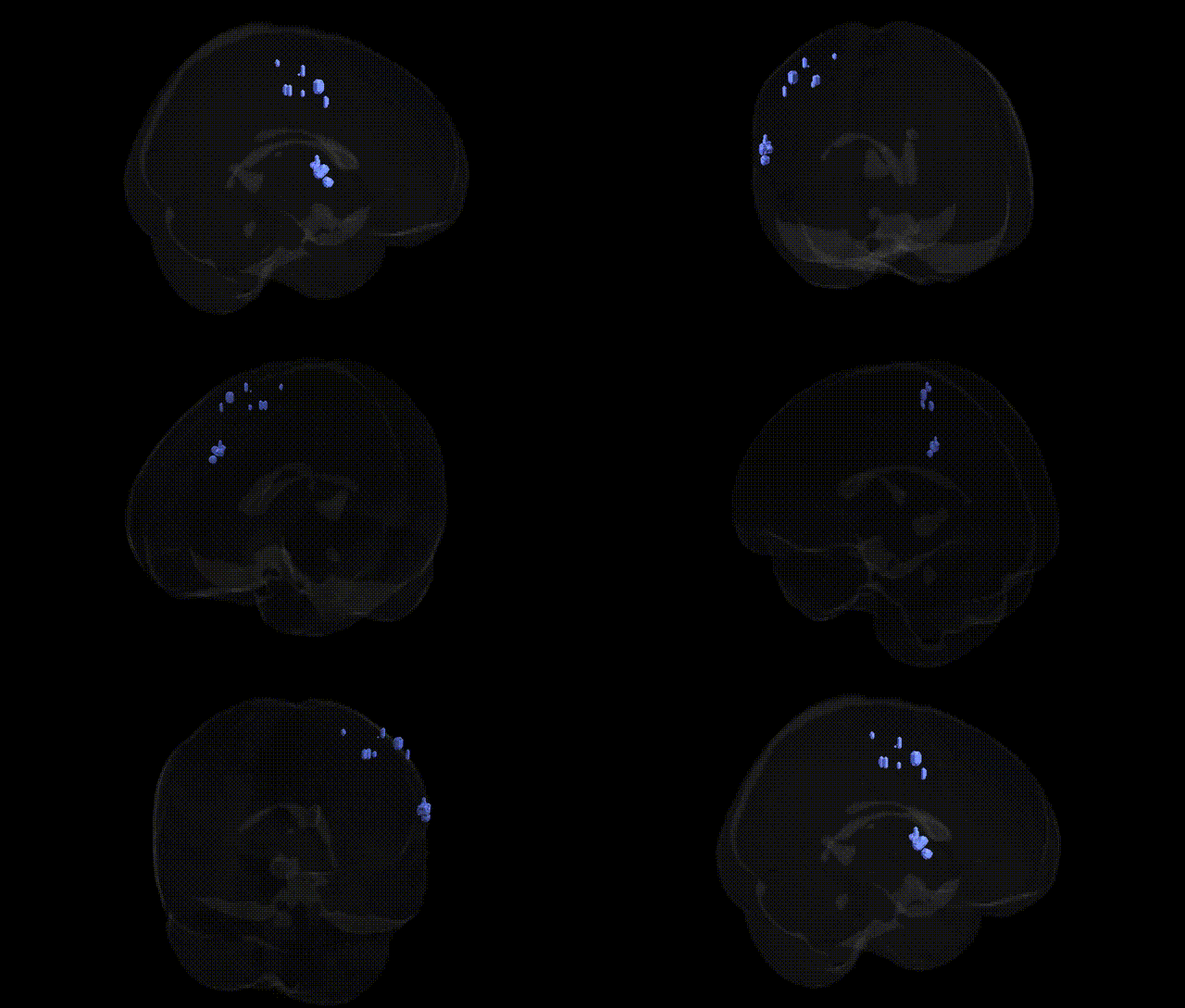
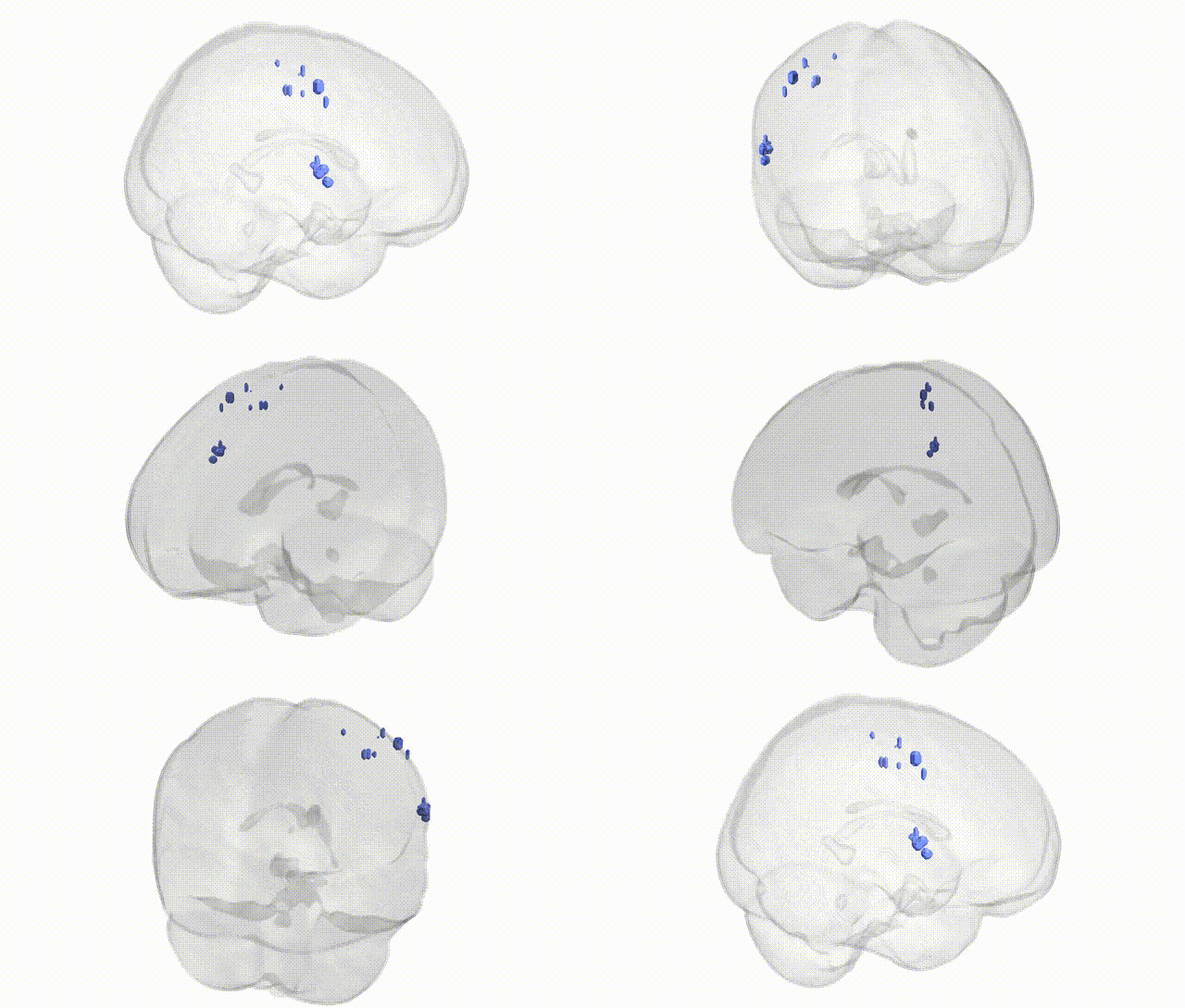
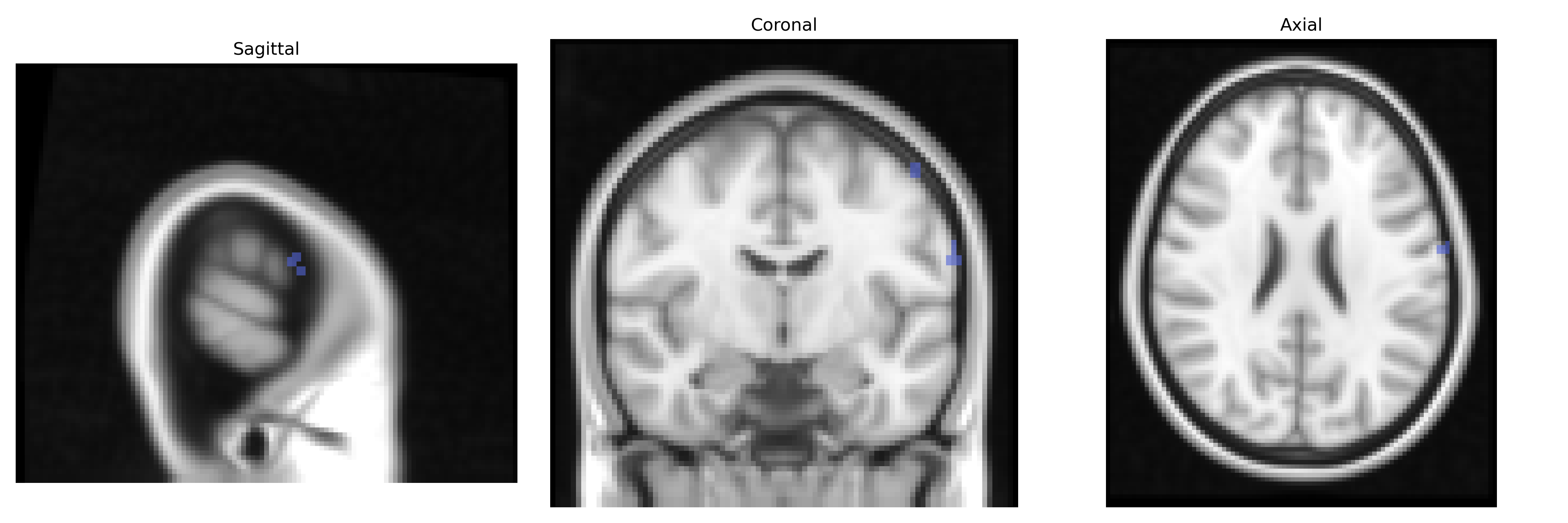
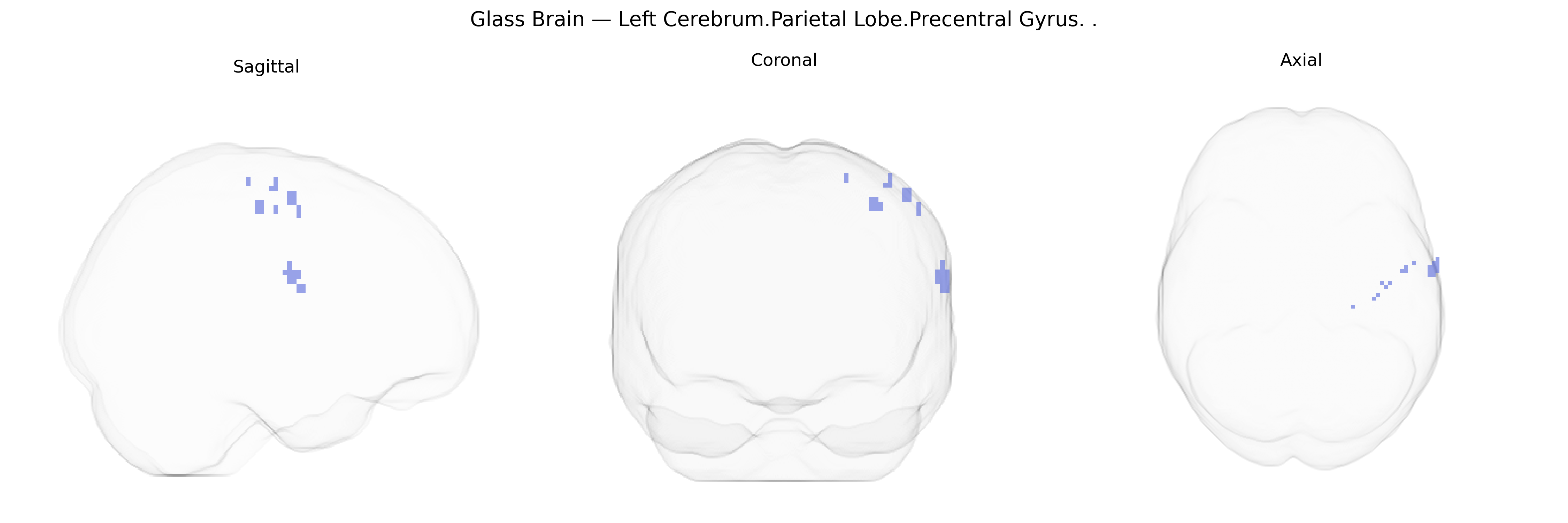
The bilateral Left Cerebrum.Parietal Lobe.Precentral Gyrus, as labeled in the Talairach 2 mm atlas, corresponds largely to the primary motor cortex (Brodmann area 4) situated along the anterior margin of the central sulcus, at the interface of the frontal and parietal lobes. This region contains a somatotopic representation of the contralateral body and is central to the initiation and execution of voluntary movements, integrating descending motor commands with sensory feedback from adjacent somatosensory areas. Neurons in the precentral gyrus give rise to major corticospinal and corticobulbar projections, influencing spinal motor circuits and brainstem nuclei, and are essential for fine motor control, particularly of the distal limbs and orofacial musculature. Although the Talairach label refers to the parietal lobe, the precentral gyrus is classically considered part of the frontal lobe. Precentral gyrus
The bilateral left precentral gyrus (Talairach “Left Cerebrum.Parietal Lobe.Precentral Gyrus,” though classically frontal) is a primary motor cortex region frequently implicated in imaging genetics and GWAS of brain structure and function. Large neuroimaging GWAS consortia (e.g., ENIGMA, UK Biobank–based studies) have identified common variants affecting cortical thickness and surface area in or near the precentral gyrus, with robust heritability estimates for its morphology and activation during motor tasks. Variants in genes involved in neurodevelopment and synaptic function (such as those near MAPT, CNTNAP2, and various cell-adhesion and axon-guidance loci) have been associated with motor cortex structure or connectivity, although specific locus-to-region mappings are often coarse and not restricted to precentral gyrus alone. Genetically influenced alterations of this region’s anatomy or activation have been reported in disorders with motor or sensorimotor components, including amyotrophic lateral sclerosis, cerebral palsy, and movement disorders, and in neurodevelopmental conditions such as autism spectrum disorder and ADHD, where GWAS-implicated risk variants relate to atypical motor circuitry and cortical organization. Polygenic risk for traits such as general cognitive ability, educational attainment, and physical activity has shown associations with precentral gyrus volume or activation patterns, suggesting pleiotropic genetic influences on both motor and higher-order functions; however, most findings reflect distributed cortical effects rather than highly specific, uniquely precentral-gyrus genetic associations.
Overview generated by GPT-4o (2026).
Region ID: 803
Hemisphere: bilateral
Atlas: Talairach labels 2mm
Full Quality Version: Download MP4
Full Quality Version: Download MP4
Wali Sidiqyar*, Gaurav Rudravaram*, Elyssa M. McMaster, Trent M. Schwartz, Adam M. Saunders, Kurt G. Schilling, Bennett A. Landman "Introducing SPINS: A Shared Public Visualization Library of Neuroanatomical Structures." Medical Imaging with Deep Learning- short paper
This resource is licensed under CC0 1.0 Universal (Public Domain).