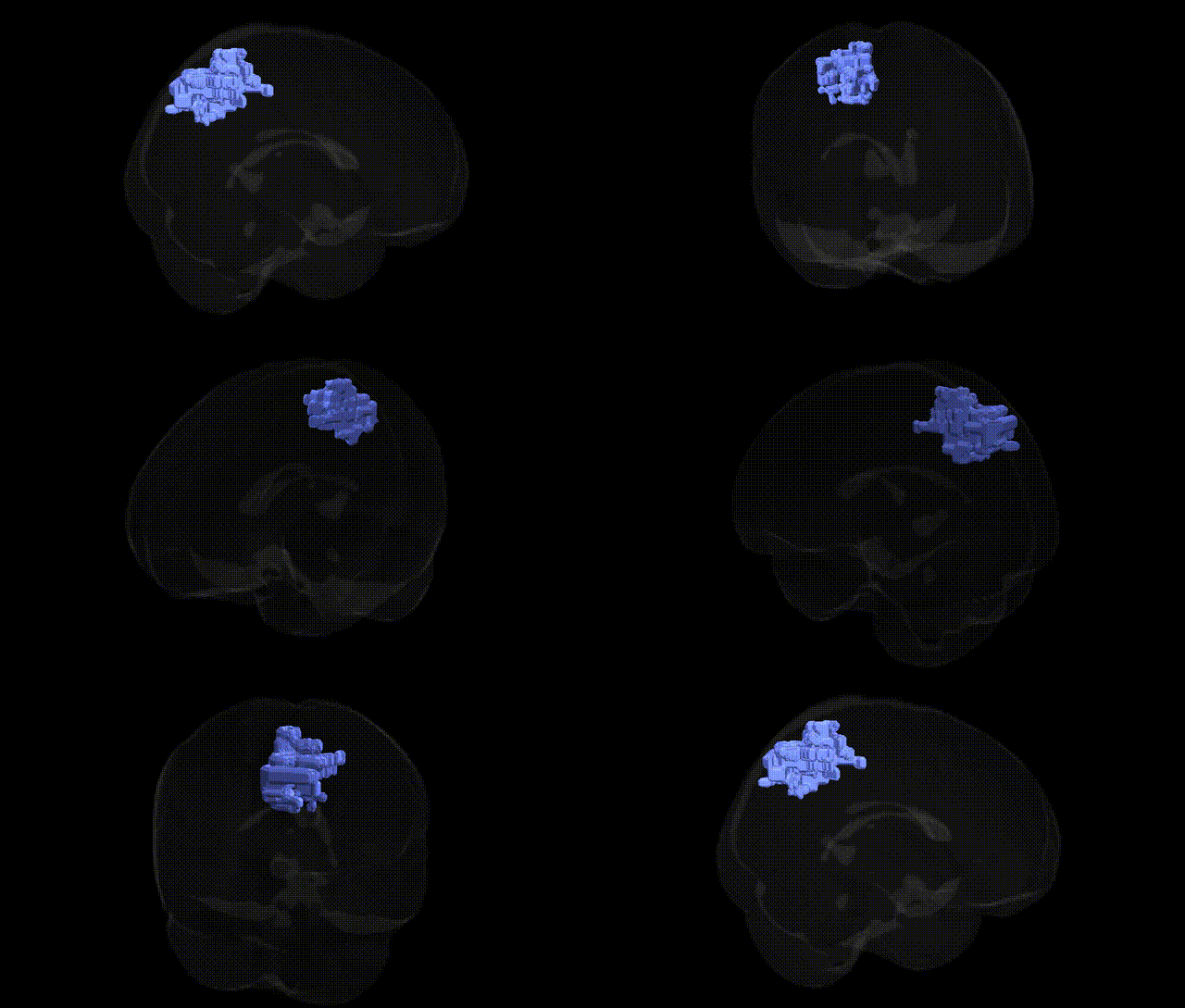
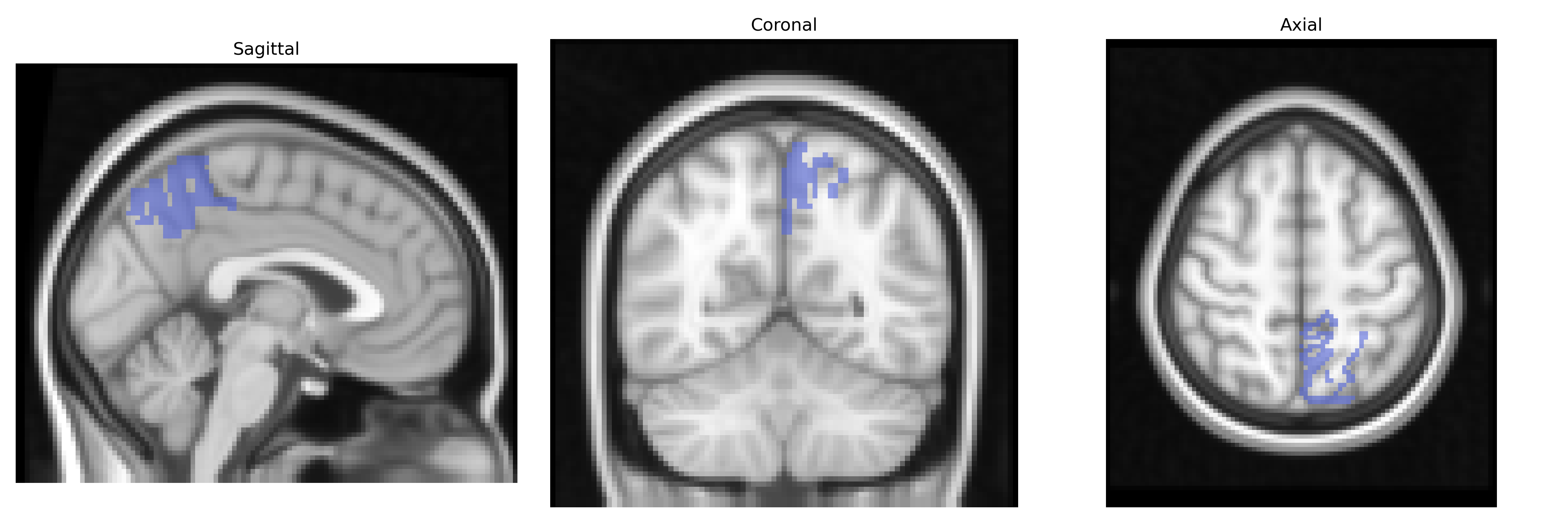
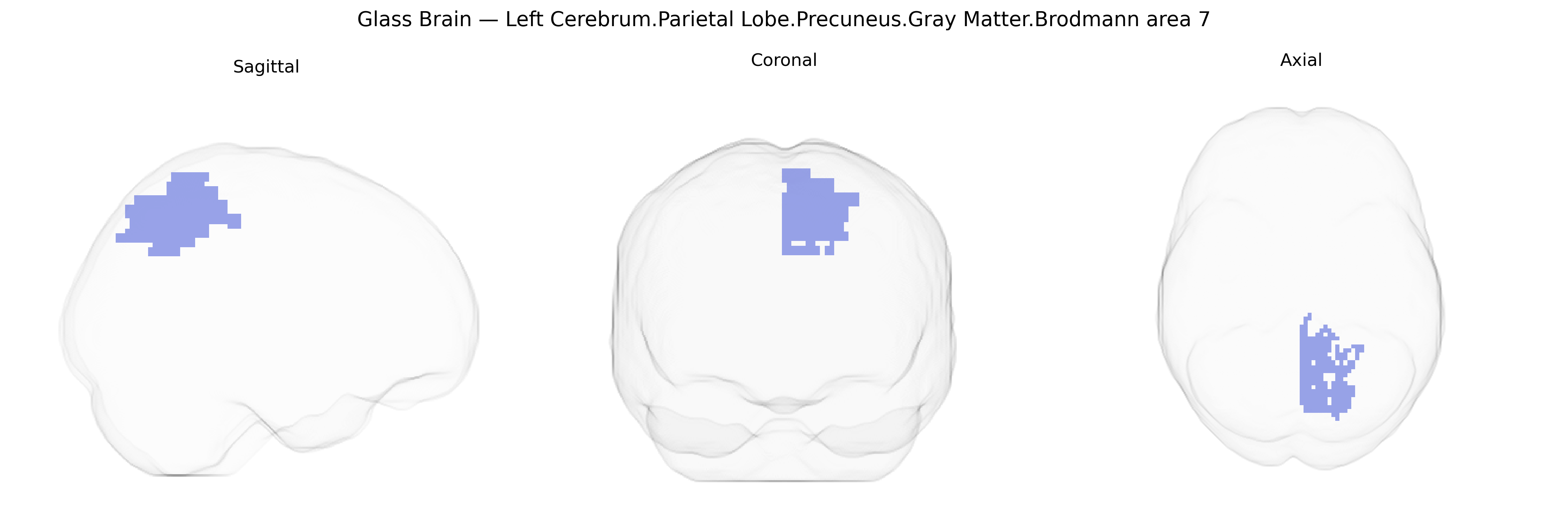
Bilateral Left Cerebrum.Parietal Lobe.Precuneus.Gray Matter.Brodmann area 7 corresponds to a dorsomedial parietal cortical territory within the precuneus, part of the superior parietal lobule, predominantly involved in visuo-spatial integration, sensorimotor coordination, and higher-order associative processing. Brodmann area 7 receives multimodal inputs from visual, somatosensory, and premotor regions, supporting spatial attention, mental imagery of body and environmental space, and the transformation of sensory information into coordinated actions. Functionally, this region contributes to navigation, visually guided movement, and aspects of episodic memory and self-related processing, reflecting its integration within parietal and default-mode networks. There is no direct Wikipedia article for this exact Talairach-defined region; a closely related structure encompassing this area is the Precuneus.
The bilateral left precuneus (parietal lobe, Brodmann area 7) has been repeatedly implicated in imaging genetics and GWAS of brain structure and function, although most studies examine the precuneus or parietal cortex more broadly rather than Talairach 2 mm–specific labels. Large-scale GWAS of cortical thickness and surface area (e.g., ENIGMA and UK Biobank) have identified multiple variants near genes involved in neurodevelopment and synaptic function (such as CENPW, TCF4, DACT1, and MECP2-related networks) that influence parietal and precuneus morphology, including gray matter measures overlapping BA7. Functional imaging genetics studies link common polymorphisms in genes related to glutamatergic and dopaminergic signaling (e.g., COMT, DRD2, and NRG1) with altered precuneus activation during attention, visuospatial processing, self-referential cognition, and default mode network activity. GWAS of psychiatric and neurological disorders—particularly schizophrenia, major depressive disorder, Alzheimer’s disease, and autism spectrum disorder—have shown that risk variants in loci such as APOE, CLU, BIN1, and multiple immune-related and synaptic genes are associated with structural and connectivity changes in the precuneus and adjoining parietal regions, where atrophy or functional dysconnectivity is common. Additionally, genetic studies of cognitive traits (general intelligence, working memory, and episodic memory) and personality dimensions (e.g., openness and neuroticism) frequently report associations with precuneus structure or activity, indicating that polygenic influences on higher-order cognition, self-processing, and default mode network organization are partly mediated through this parietal hub region.
Overview generated by GPT-4o (2026).
Region ID: 968
Hemisphere: bilateral
Atlas: Talairach labels 2mm
Full Quality Version: Download MP4
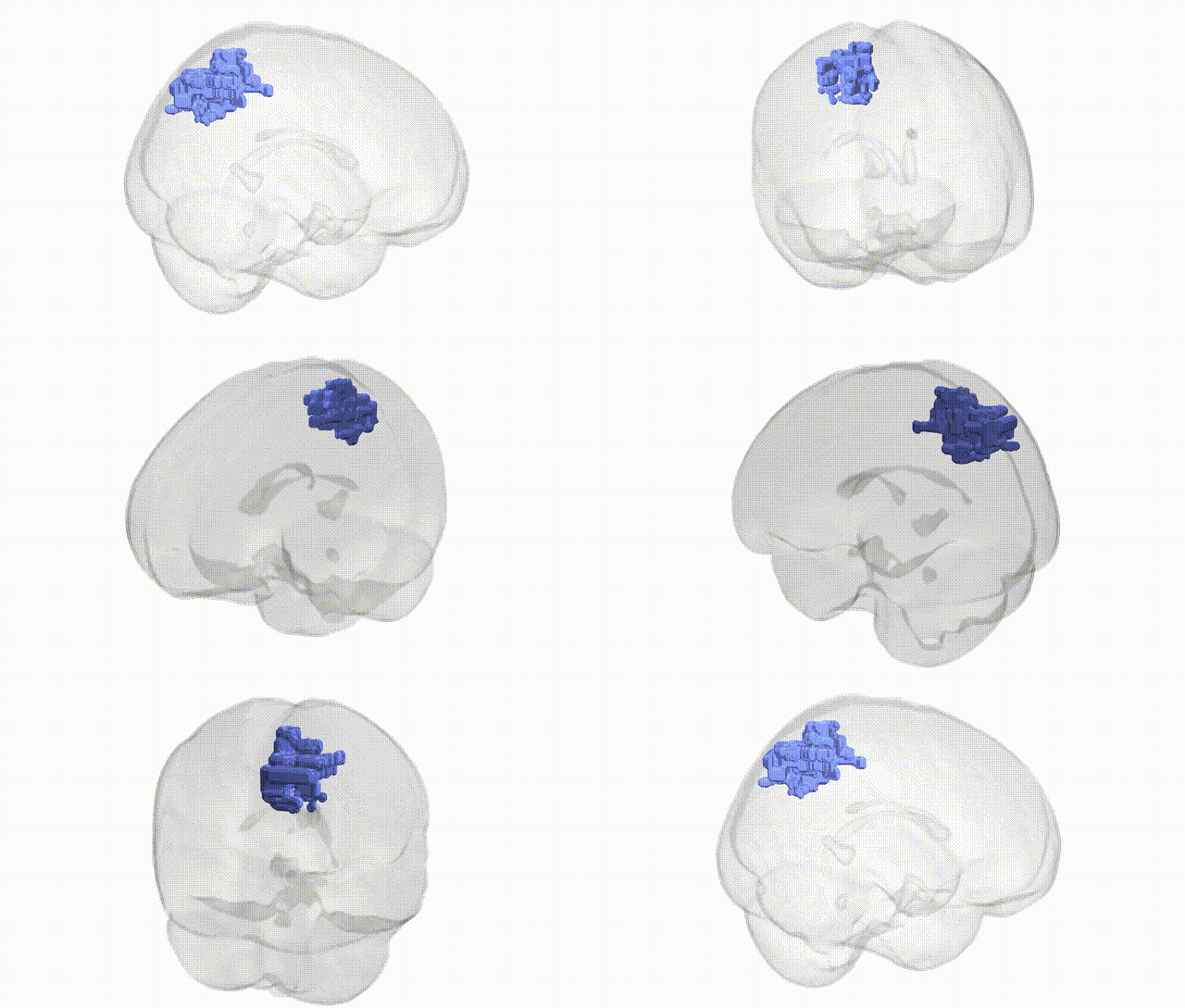
Full Quality Version: Download MP4
Wali Sidiqyar*, Gaurav Rudravaram*, Elyssa M. McMaster, Trent M. Schwartz, Adam M. Saunders, Kurt G. Schilling, Bennett A. Landman "Introducing SPINS: A Shared Public Visualization Library of Neuroanatomical Structures." Medical Imaging with Deep Learning- short paper
This resource is licensed under CC0 1.0 Universal (Public Domain).