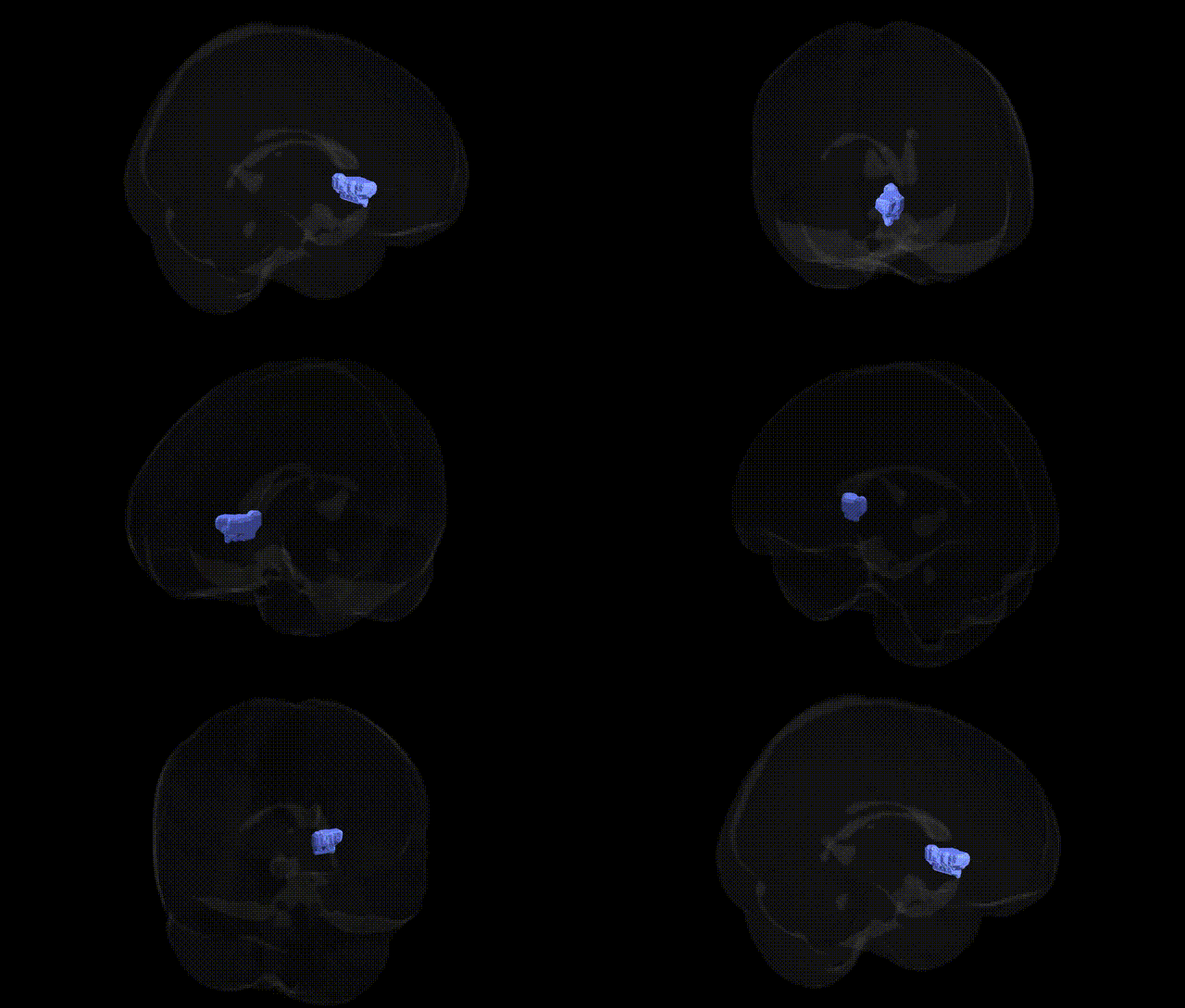
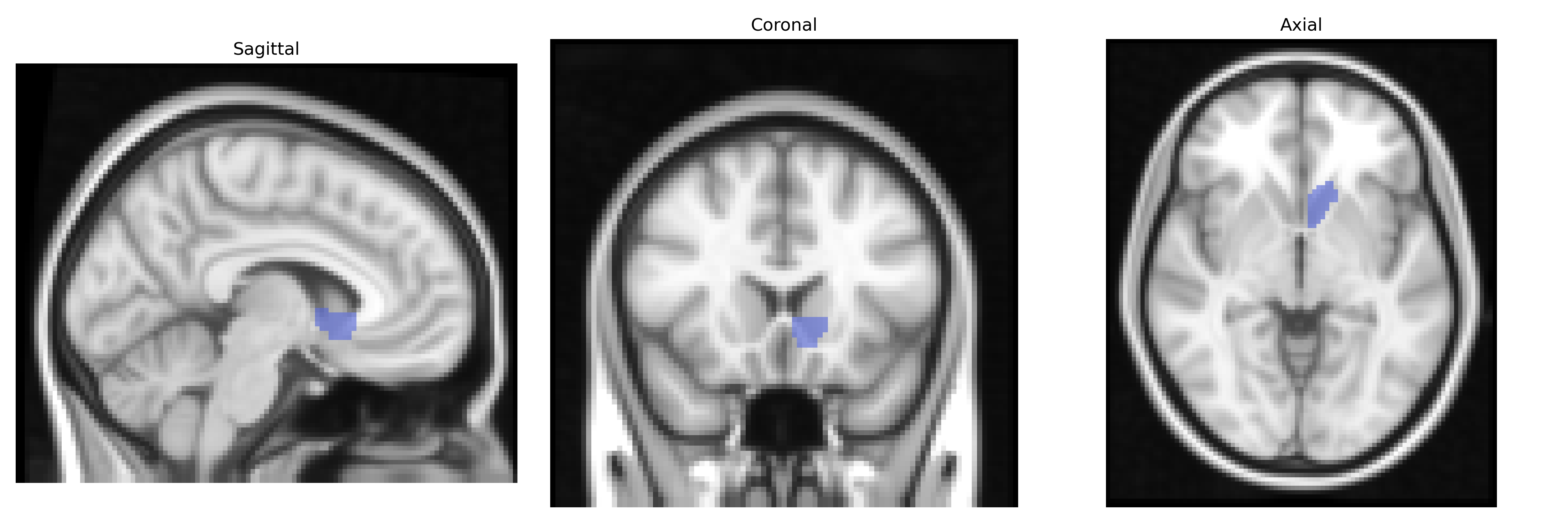
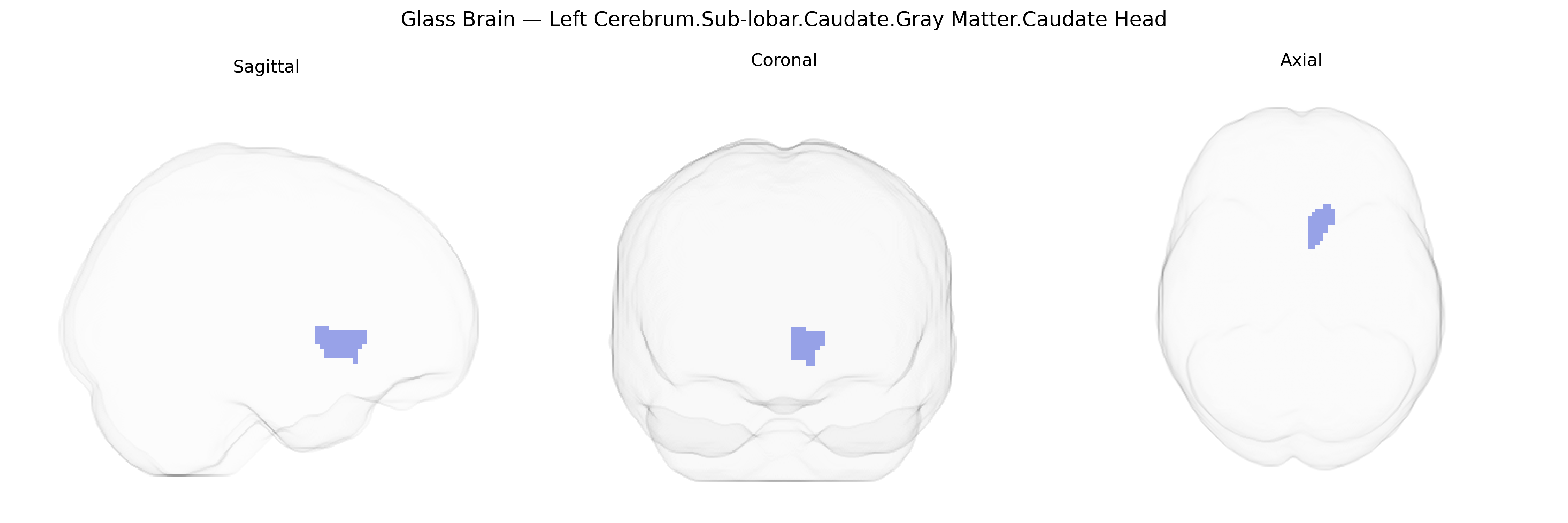
The bilateral Left Cerebrum.Sub-lobar.Caudate.Gray Matter.Caudate Head region corresponds to the head of the caudate nucleus, a major gray matter component of the dorsal striatum situated subcortically within the basal ganglia of the left cerebral hemisphere. The caudate head lies anteriorly and medially, adjacent to the lateral ventricle, and is heavily interconnected with frontal cortical areas, especially the dorsolateral prefrontal cortex. Functionally, it participates in motor control, goal-directed action selection, procedural and associative learning, and aspects of executive function, as well as cognitive and affective processes such as reward evaluation and decision-making. It receives dense dopaminergic input from the midbrain and contributes to basal ganglia-thalamo-cortical loops, with dysfunction implicated in movement disorders (e.g., Parkinson’s disease, Huntington’s disease), obsessive–compulsive disorder, and other neuropsychiatric conditions. There is no direct Wikipedia article for the caudate head; a related structure description is found at Caudate nucleus.
The caudate head, a sub-lobar gray matter structure in the left cerebrum, shows robust genetic influence on its volume and morphology, with twin and family studies indicating high heritability and GWAS identifying multiple associated loci across the genome. Large imaging-genetics consortia (e.g., ENIGMA, UK Biobank) have reported variants near and within genes such as HMGA2, FAT3, DLG2, DRD2, and others that affect striatal and specifically caudate volumes, implicating pathways related to neurodevelopment, synaptic function, and dopaminergic signaling. Genetic variation in this region’s structure and connectivity has been associated with a range of psychiatric and neurodevelopmental conditions, including schizophrenia, bipolar disorder, major depressive disorder, obsessive-compulsive disorder, attention-deficit/hyperactivity disorder, and autism spectrum disorder, many of which show caudate volume or functional alterations that co-localize with disorder risk loci. GWAS of cognitive traits (general intelligence, educational attainment, executive function) and motor or reward-related behaviors have also linked caudate-related genetic architecture to performance variation, consistent with the caudate head’s role in fronto-striatal circuits underlying learning, habit formation, motivation, and cognitive control. In neurodegenerative conditions such as Huntington’s disease, the caudate is a primary site of genetically driven pathology (HTT expansions), and polygenic risk scores for other disorders, including Parkinson’s disease and Alzheimer’s disease, have shown associations with striatal and caudate measures, underscoring the caudate head as a convergent anatomical substrate for diverse genetic influences on brain and behavior.
Overview generated by GPT-4o (2026).
Region ID: 464
Hemisphere: bilateral
Atlas: Talairach labels 2mm
Full Quality Version: Download MP4
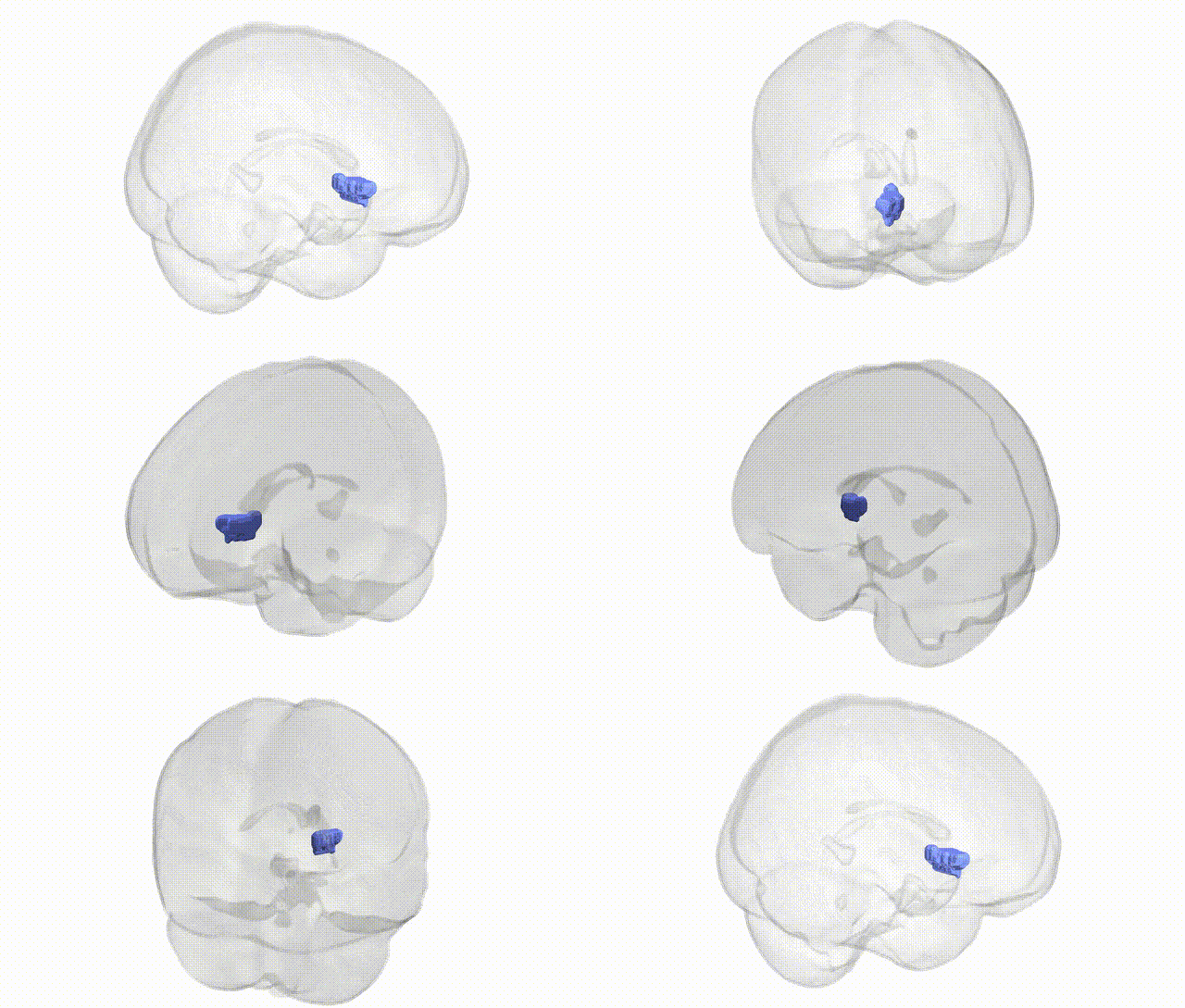
Full Quality Version: Download MP4
Wali Sidiqyar*, Gaurav Rudravaram*, Elyssa M. McMaster, Trent M. Schwartz, Adam M. Saunders, Kurt G. Schilling, Bennett A. Landman "Introducing SPINS: A Shared Public Visualization Library of Neuroanatomical Structures." Medical Imaging with Deep Learning- short paper
This resource is licensed under CC0 1.0 Universal (Public Domain).