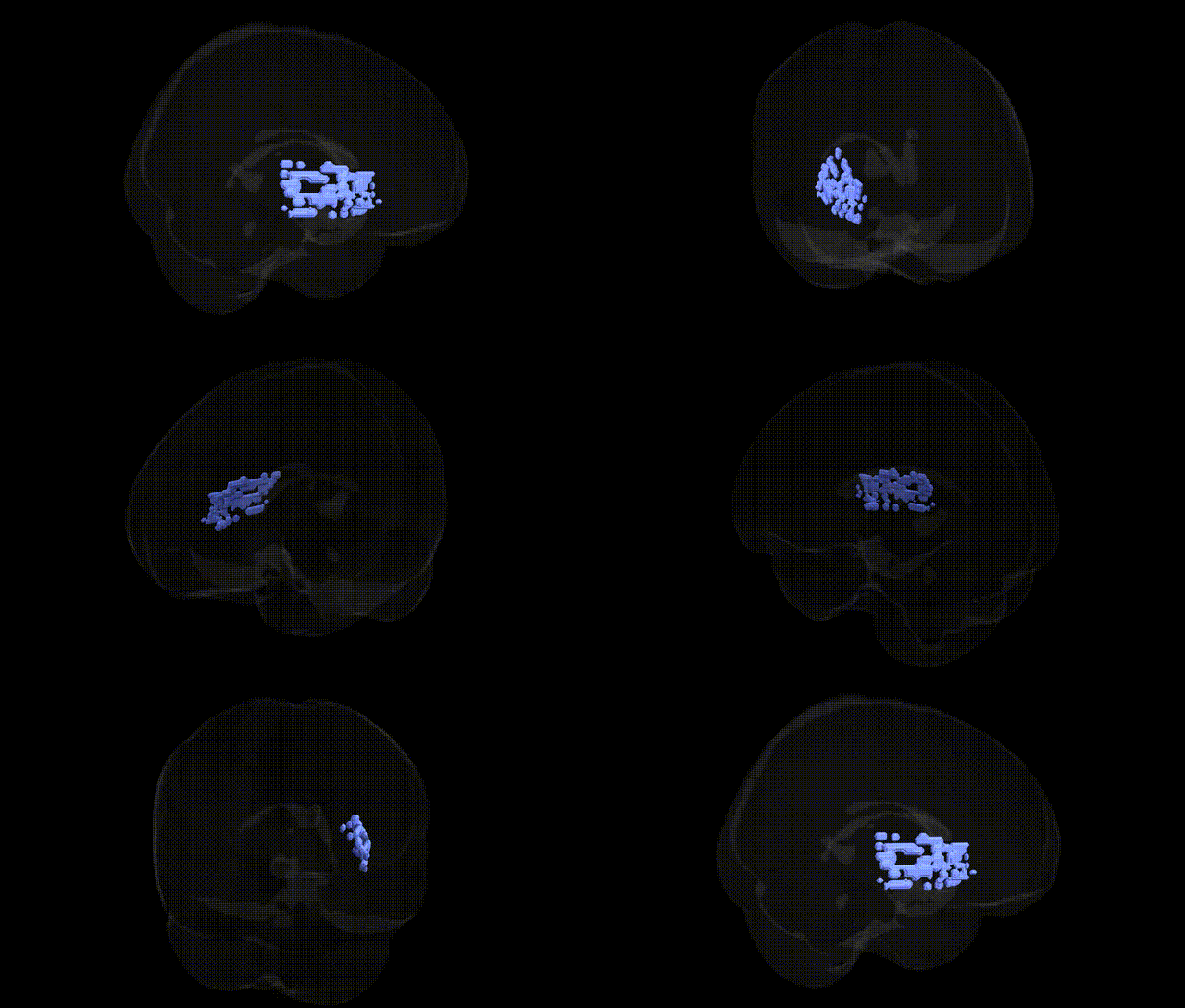
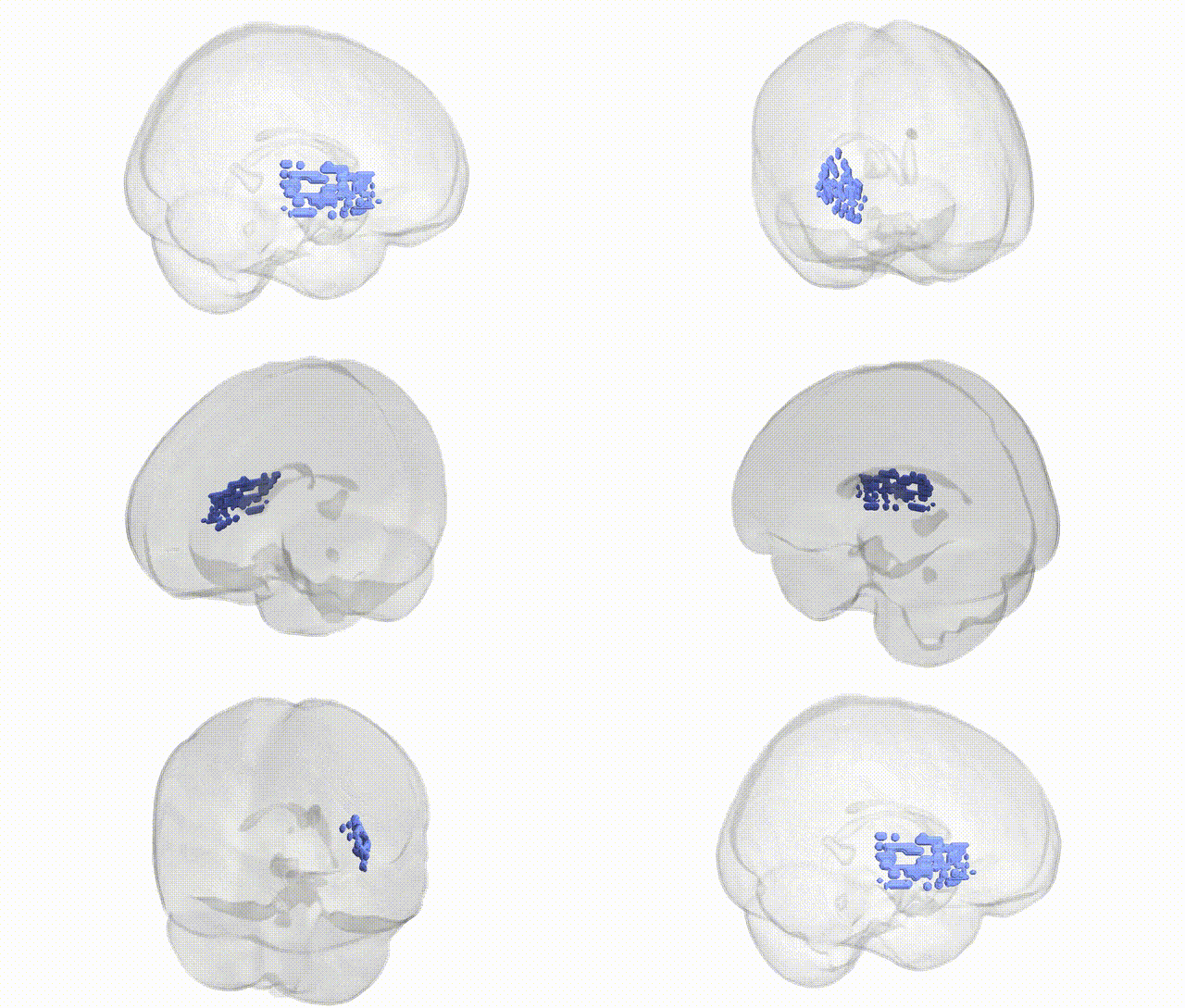
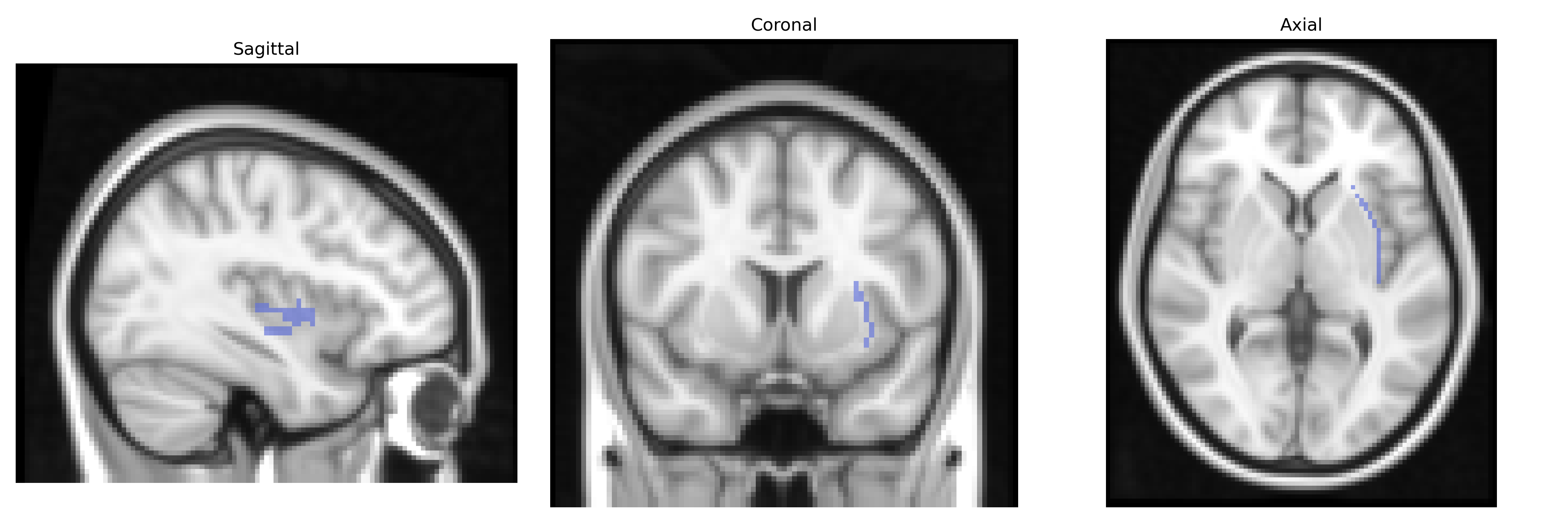
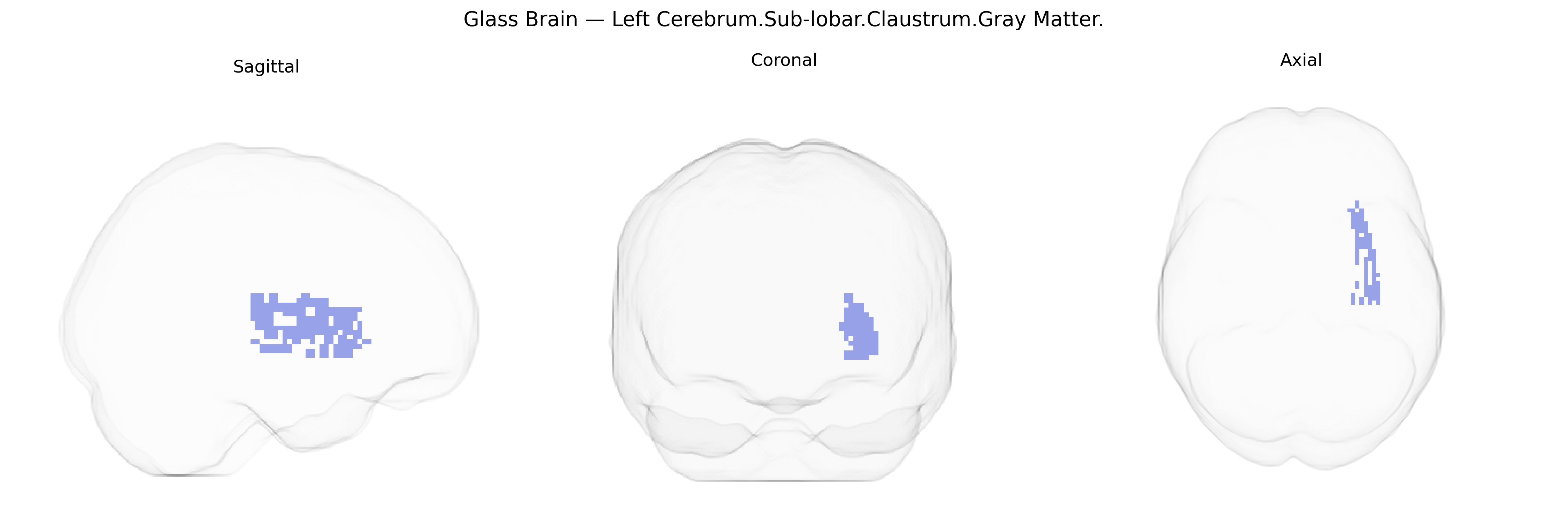
The bilateral Left Cerebrum.Sub-lobar.Claustrum.Gray Matter refers to gray matter within the claustrum, a thin, irregular sheet of neurons located sub-lobarly between the insular cortex and putamen in the left cerebral hemisphere. The claustrum is highly interconnected with widespread cortical regions, receiving and sending projections to sensory, motor, and association areas, and has been hypothesized to play roles in multimodal integration, attention, and aspects of conscious experience, although its precise functions remain incompletely understood. Structurally, it is part of the basal telencephalon and lies within the white matter of the extreme capsule, distinguished from surrounding structures by its dense packing of neurons and distinctive connectivity patterns. There is no direct link for this specific Talairach label; a related structure is the Claustrum.
The claustrum, a thin subcortical gray-matter structure within the sub-lobar region of the left cerebrum, has limited direct genetic association data in the Talairach 2 mm atlas framework, but convergent evidence from neuroimaging genetics and GWAS implicates nearby and functionally related networks. Large-scale imaging genetics studies such as UK Biobank and ENIGMA, which examine subcortical and cortical thickness/volume heritability, suggest that claustrum morphology is highly heritable, although specific locus-level GWAS hits for claustrum volume or thickness have not yet been robustly characterized in the public literature. Functionally, the claustrum is heavily interconnected with cortical association areas and limbic structures, and genes linked to synaptic connectivity, glutamatergic signaling, and neurodevelopment (e.g., variants in CACNA1C, GRIN2B, and other neurodevelopmental and synaptic genes) have been associated with traits and disorders whose imaging endophenotypes often show altered activity or connectivity involving claustral networks, including schizophrenia, major depressive disorder, autism spectrum disorder, and epilepsy. Some GWAS of general brain connectivity and multimodal MRI measures (e.g., functional connectivity, global efficiency, and network-level traits) have identified loci related to axon guidance, synaptic plasticity, and myelination, and these pathways plausibly affect claustral integration with frontal, temporal, and parietal cortices. However, no well-established, claustrum-specific GWAS signals or single-gene Mendelian disorders are currently recognized; most genetic insights involving this region derive indirectly from studies of distributed cortical-subcortical networks rather than from region-specific association tests, and a precise mapping from Talairach “Left Cerebrum.Sub-lobar.Claustrum.Gray Matter” to distinct genetic risk loci remains an open research area.
Overview generated by GPT-4o (2026).
Region ID: 449
Hemisphere: bilateral
Atlas: Talairach labels 2mm
Full Quality Version: Download MP4
Full Quality Version: Download MP4
Wali Sidiqyar*, Gaurav Rudravaram*, Elyssa M. McMaster, Trent M. Schwartz, Adam M. Saunders, Kurt G. Schilling, Bennett A. Landman "Introducing SPINS: A Shared Public Visualization Library of Neuroanatomical Structures." Medical Imaging with Deep Learning- short paper
This resource is licensed under CC0 1.0 Universal (Public Domain).