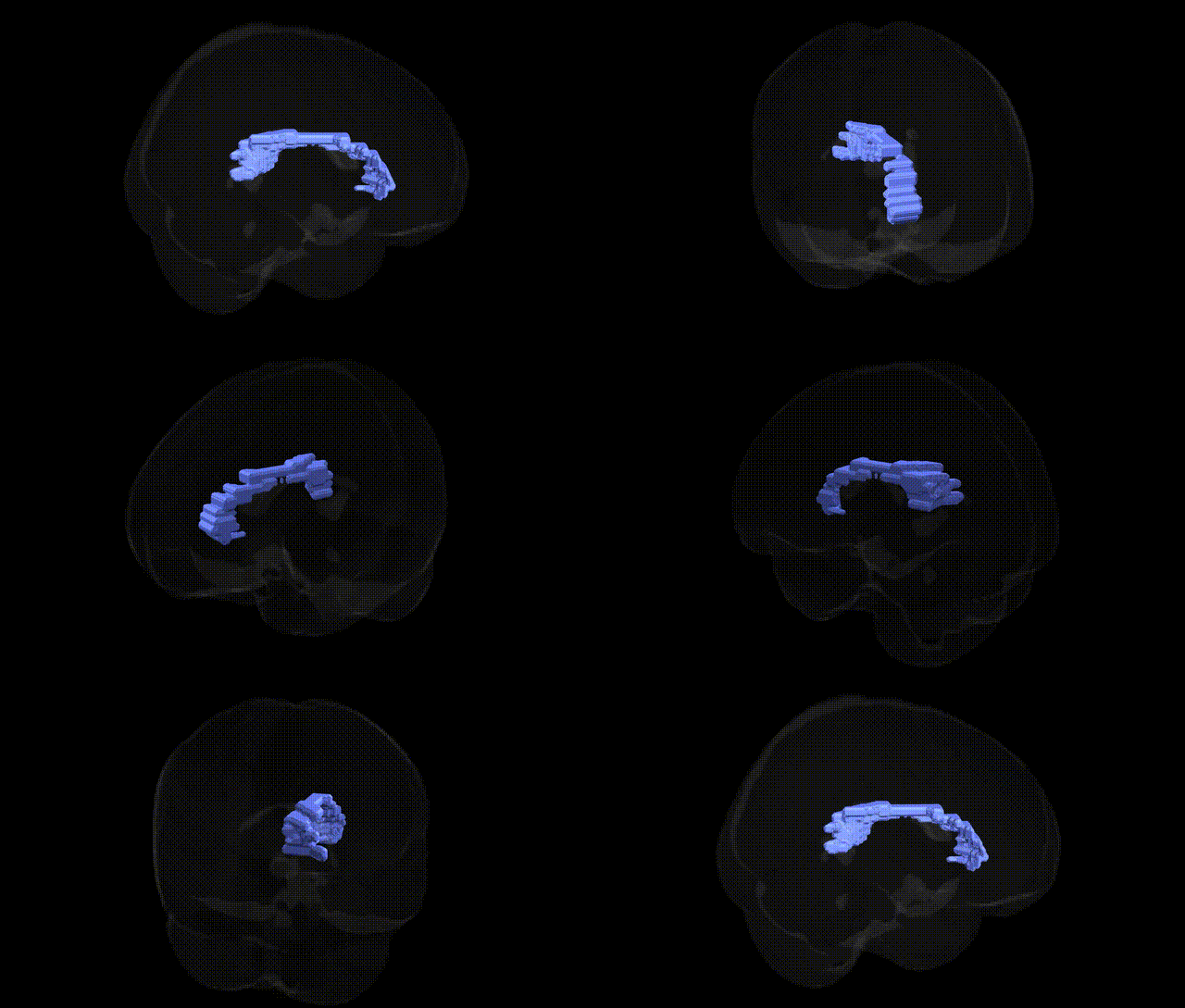
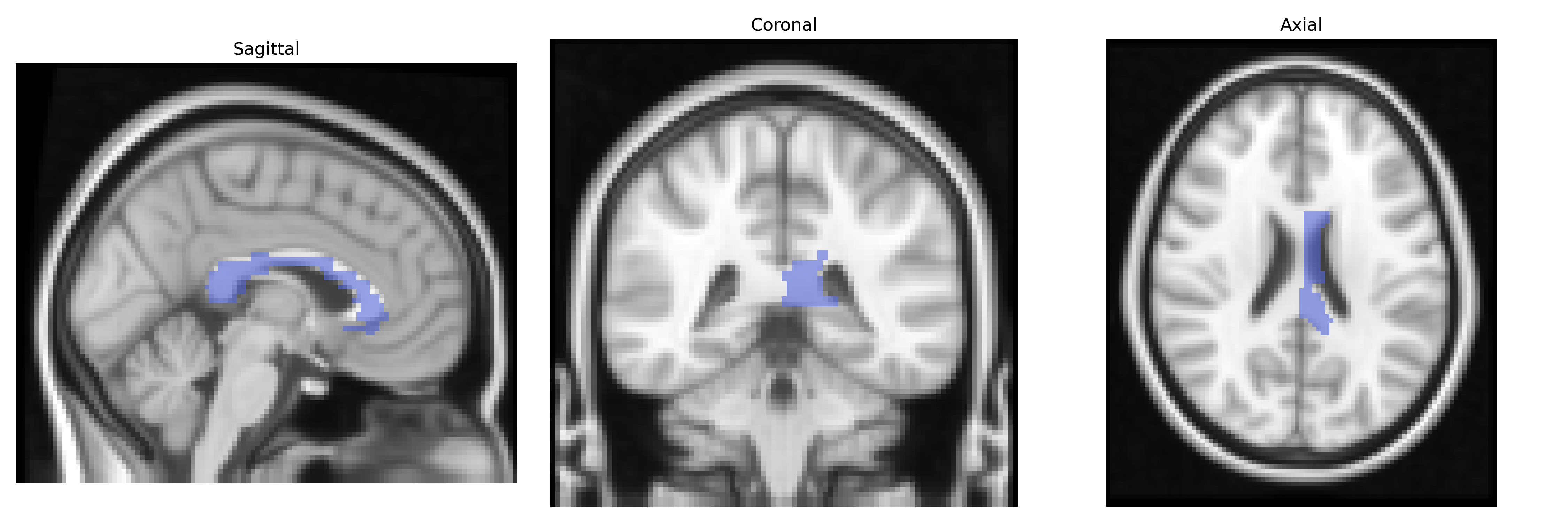
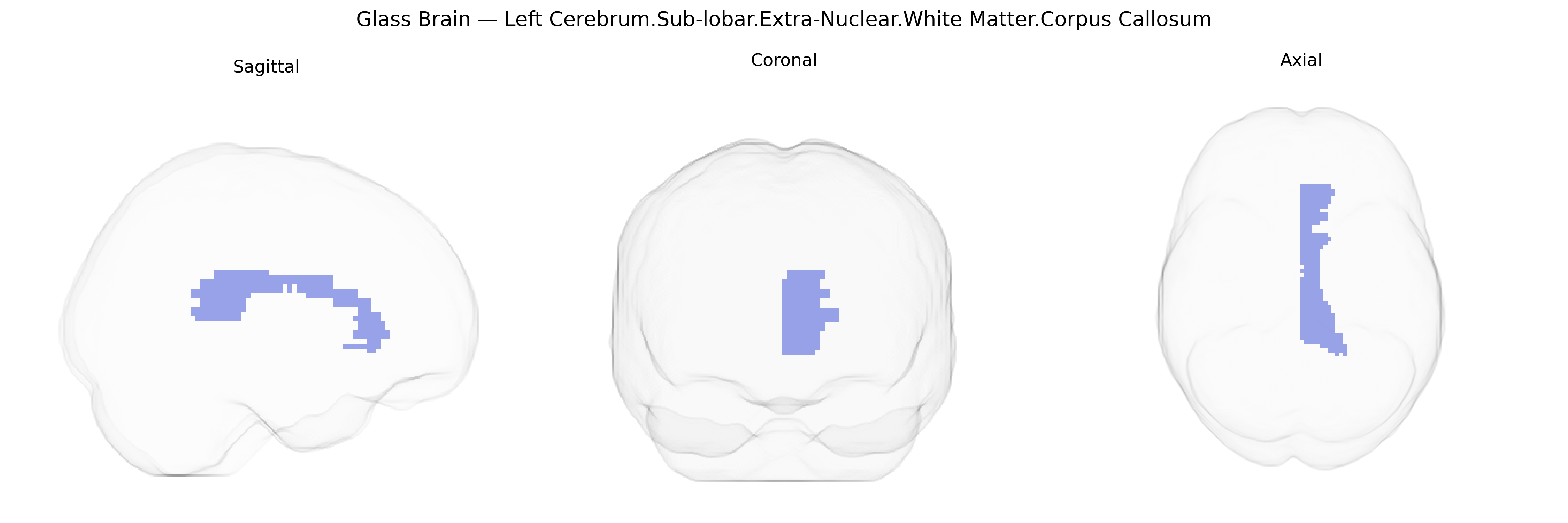
The bilateral Left Cerebrum.Sub-lobar.Extra-Nuclear.White Matter.Corpus Callosum region corresponds to the major interhemispheric commissural fiber bundle that connects homologous cortical areas of the left and right cerebral hemispheres. Composed primarily of densely packed myelinated axons, the corpus callosum is topographically organized along its anterior–posterior axis (rostrum, genu, body, isthmus, and splenium), with different segments linking frontal, parietal, temporal, and occipital cortices. Functionally, this structure enables the integration and coordination of sensory, motor, and higher-order cognitive information across hemispheres, supporting unified perception, bimanual coordination, language lateralization interactions, and complex associative processing. As “extra-nuclear” white matter, these callosal fibers lie outside the basal ganglia nuclei and deep cortical gray matter, forming a central white matter bridge within the cerebrum. Corpus callosum
The corpus callosum, the major interhemispheric white matter tract within the sub-lobar extra-nuclear region of the left cerebrum, shows robust heritability and has been implicated in numerous genetic association studies. GWAS of callosal volume and microstructure (e.g., fractional anisotropy) have identified variants in genes involved in axon guidance, myelination, and neurodevelopment, including loci near or within genes such as NRG1, CNTNAP2, ROBO1, and contactin family members, although specific signals vary across cohorts and imaging measures. Callosal morphology and integrity have been repeatedly linked to genetic risk for neurodevelopmental and psychiatric conditions: schizophrenia and bipolar disorder show altered corpus callosum structure associated with polygenic risk scores; autism spectrum disorder and attention-deficit/hyperactivity disorder demonstrate callosal size and connectivity differences that co-occur with variants in synaptic and axonal development genes; and rare mutations affecting axon guidance pathways can cause agenesis or hypoplasia of the corpus callosum. GWAS of cognitive traits and general intelligence, as well as educational attainment, have reported associations between polygenic scores and callosal microstructure, suggesting that genetically influenced white matter organization contributes to interhemispheric integration underlying higher cognition. Additionally, mood and anxiety-related traits, callosal involvement in multiple sclerosis and other demyelinating disorders, and structural changes in callosal subregions in Alzheimer’s disease and frontotemporal dementia have been tied to risk loci regulating immune function and oligodendrocyte biology, underscoring the corpus callosum’s role as a convergent target of diverse neurogenetic influences.
Overview generated by GPT-4o (2026).
Region ID: 508
Hemisphere: bilateral
Atlas: Talairach labels 2mm
Full Quality Version: Download MP4
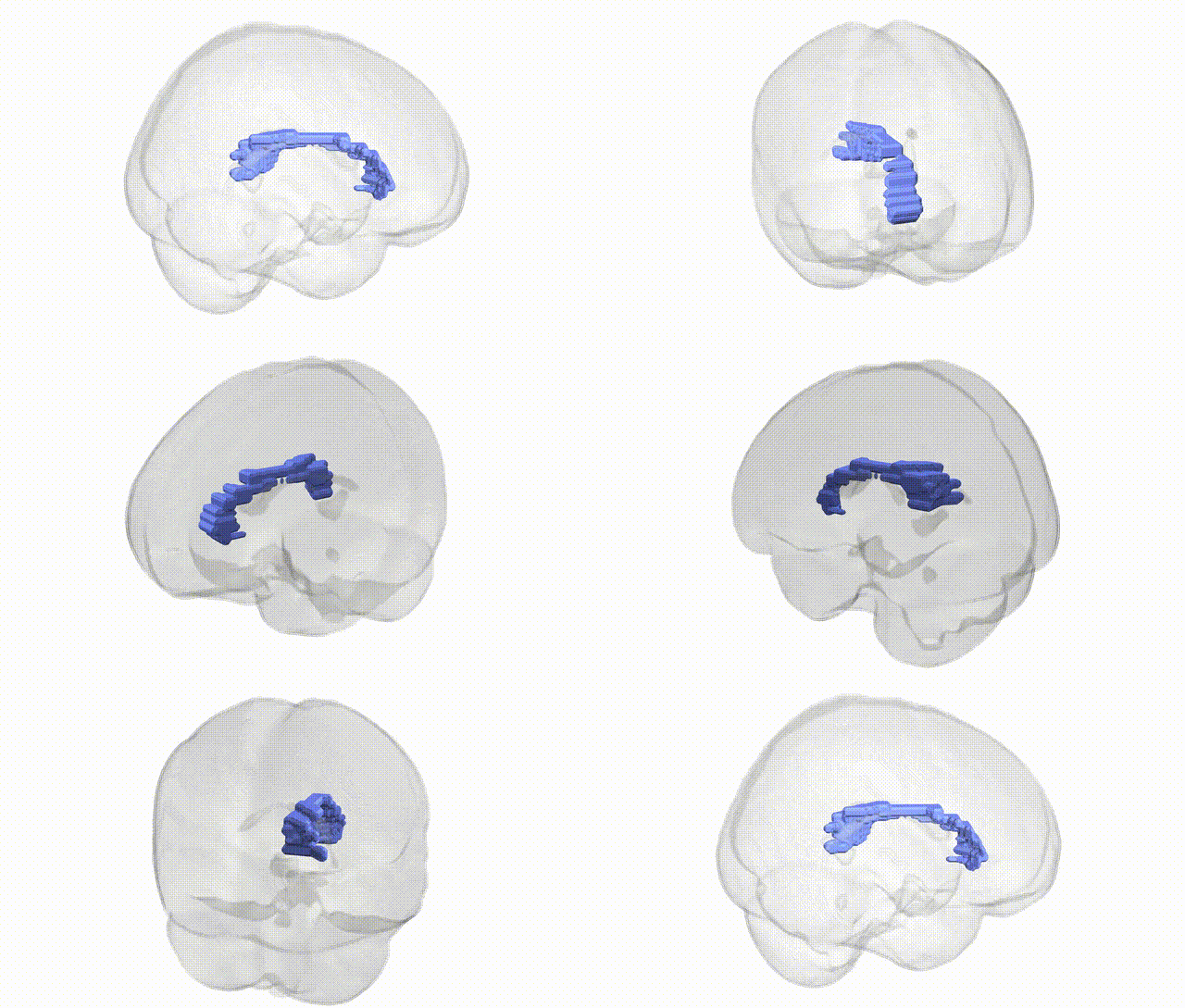
Full Quality Version: Download MP4
Wali Sidiqyar*, Gaurav Rudravaram*, Elyssa M. McMaster, Trent M. Schwartz, Adam M. Saunders, Kurt G. Schilling, Bennett A. Landman "Introducing SPINS: A Shared Public Visualization Library of Neuroanatomical Structures." Medical Imaging with Deep Learning- short paper
This resource is licensed under CC0 1.0 Universal (Public Domain).