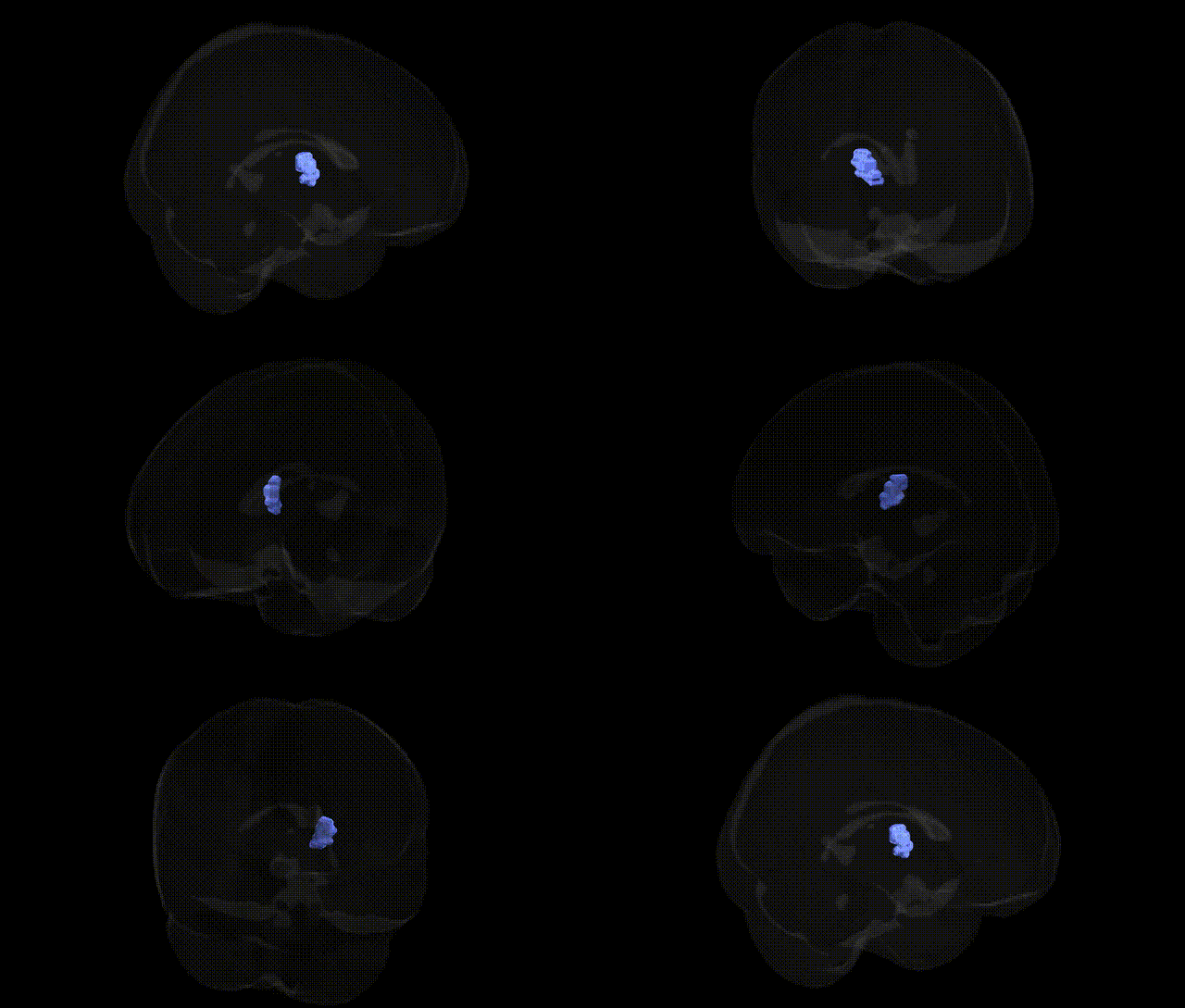
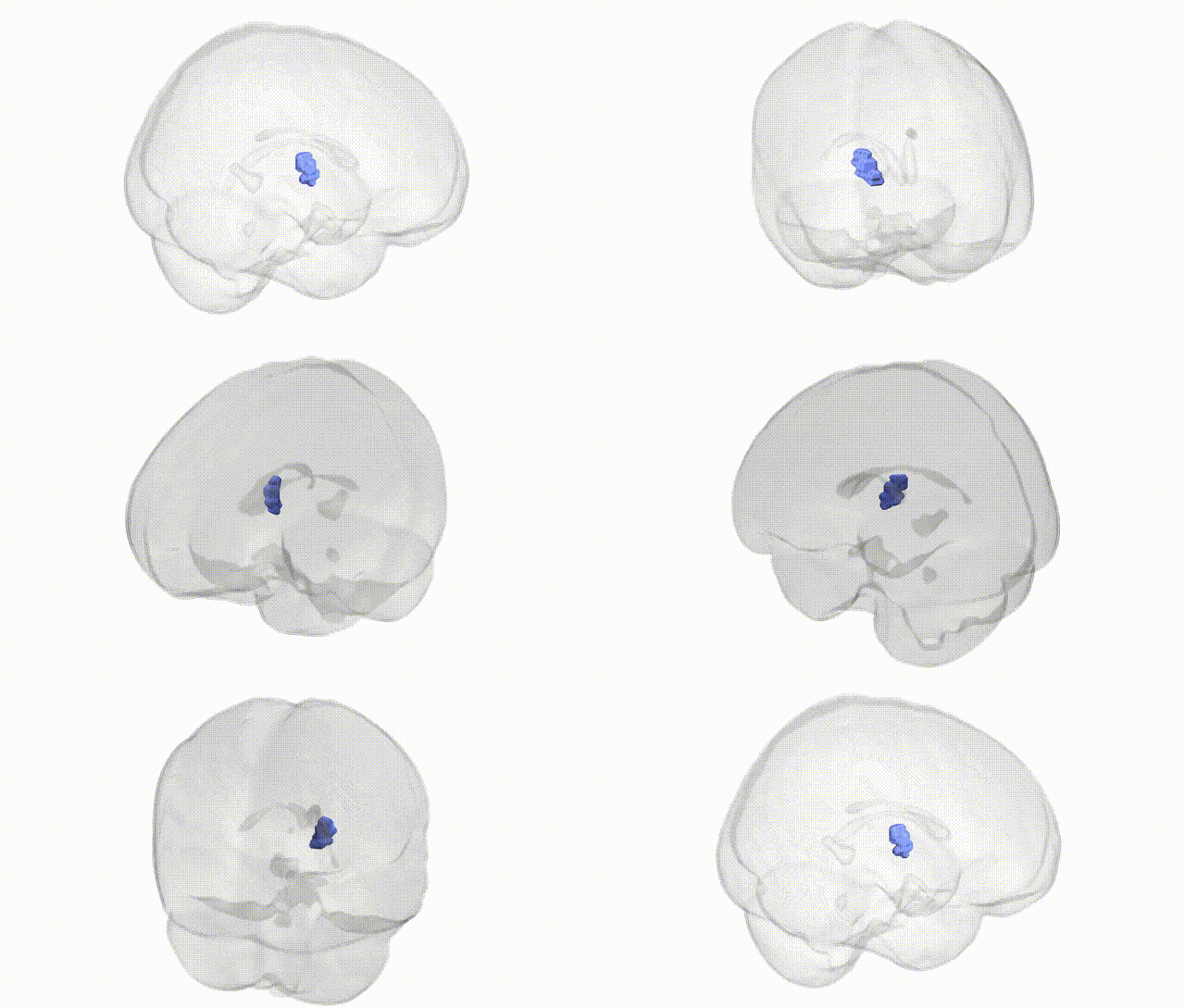
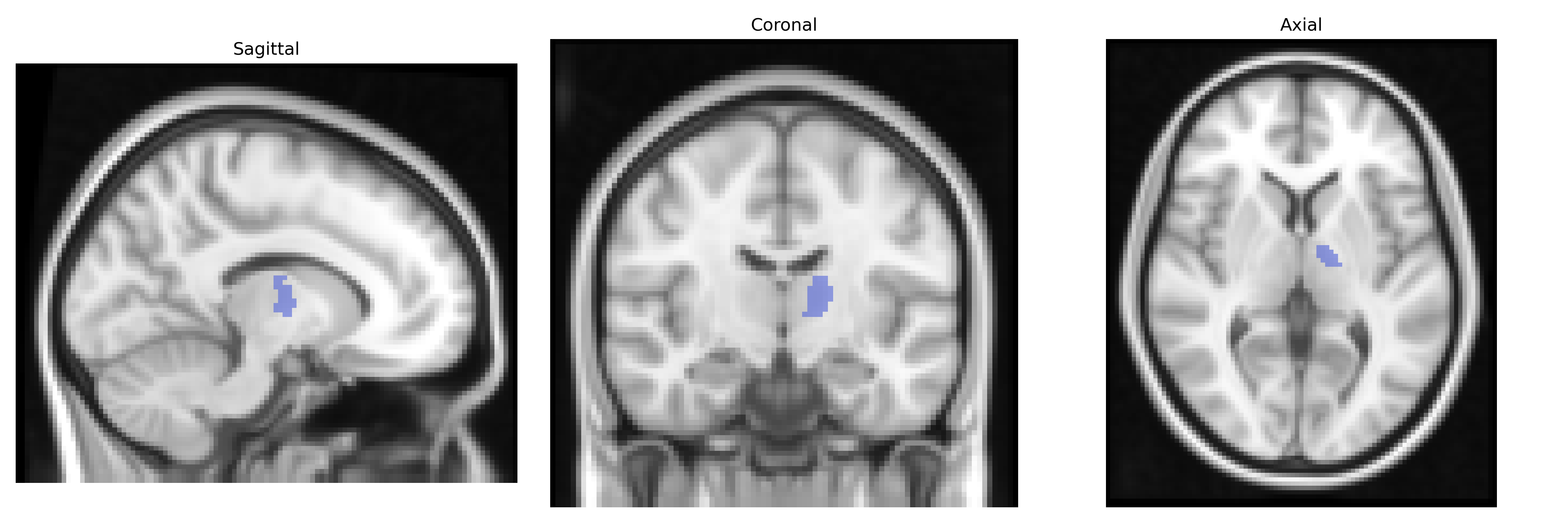
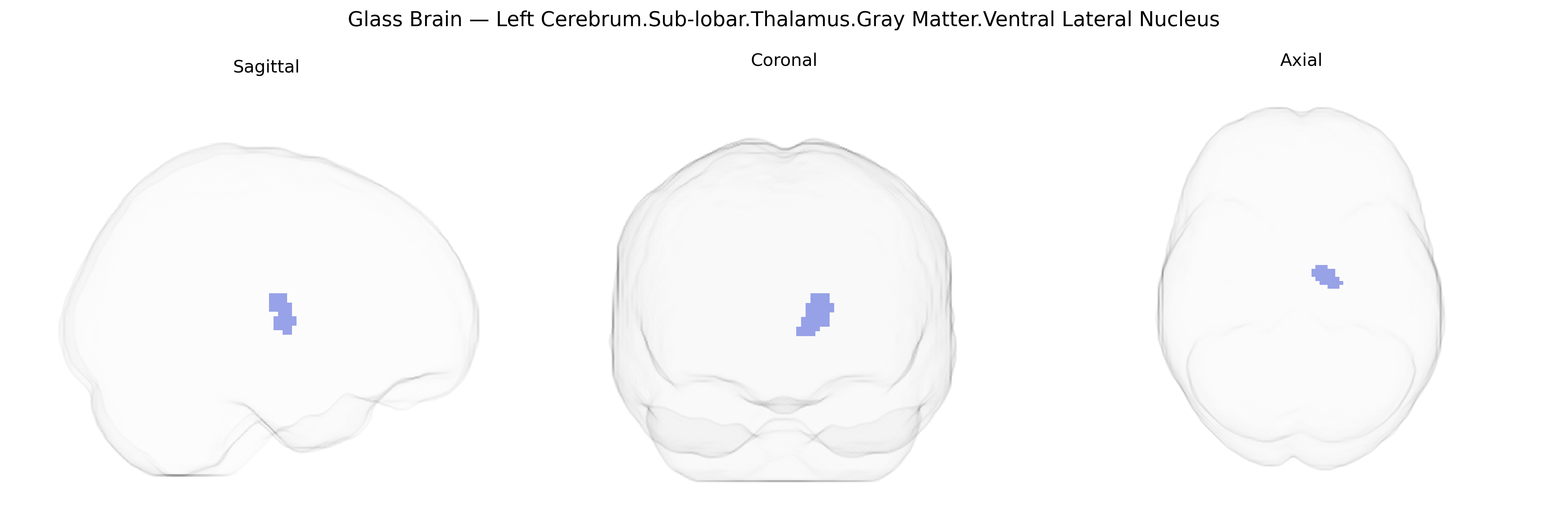
The bilateral Left Cerebrum.Sub-lobar.Thalamus.Gray Matter.Ventral Lateral Nucleus corresponds to the ventral lateral nucleus of the thalamus, a key motor relay structure situated within the subcortical gray matter of the diencephalon. This nucleus receives major afferent input from the cerebellum and basal ganglia and projects primarily to motor and premotor areas of the cerebral cortex, thereby participating critically in the modulation, coordination, and planning of voluntary movement. Functionally, the ventral lateral nucleus integrates cerebellar signals related to timing and precision of movement with basal ganglia signals related to movement initiation and suppression, contributing to smooth execution of motor programs and posture control. Lesions or dysfunction in this region can be associated with movement disorders such as tremor, ataxia, or dystonia, and it is sometimes targeted in neurosurgical interventions (e.g., deep brain stimulation) for certain motor symptoms. There is no direct link for the ventral lateral nucleus itself; a related structure is the Thalamus.
The ventrolateral (VL) thalamic nucleus, a motor-related relay within the sub-lobar gray matter of the left cerebrum, has been implicated in several genetic and neuropsychiatric associations, though most evidence comes from broader thalamic or motor-circuit GWAS rather than nucleus-specific studies. Polygenic risk for schizophrenia, bipolar disorder, and major depressive disorder has been linked to structural and functional alterations in thalamic nuclei, including VL, through imaging-genetics work showing that common variants in glutamatergic (e.g., GRM3), GABAergic, and synaptic plasticity genes modulate thalamic volume, connectivity, and activity within cortico-striato-thalamo-cortical loops. GWAS of essential tremor, dystonia, and Parkinson’s disease have highlighted genes influencing basal ganglia–thalamus–cortical circuitry (e.g., LINGO1, TMEM175, SNCA), with downstream effects on VL thalamic involvement in motor control and tremor generation, consistent with VL being a common deep-brain stimulation target. Large-scale brain imaging GWAS (such as ENIGMA and UK Biobank studies) have identified common variants near genes involved in neurodevelopment, axon guidance, and myelination (e.g., MAPT region, CELF4, TBR1-related networks) that associate with total thalamic volume and microstructure, plausibly encompassing the VL nucleus, and these genetic influences overlap with risk architectures for attention-deficit/hyperactivity disorder, Tourette’s syndrome, and obsessive–compulsive disorder, where altered thalamic gating and motor/behavioral control are prominent. Overall, genetic studies support the VL thalamus as a convergence point for polygenic influences on motor function, cognitive control, and psychiatric vulnerability rather than a locus of single-gene effects, with most associations inferred from thalamus-wide or circuit-level analyses rather than precise Talairach 2 mm atlas labels.
Overview generated by GPT-4o (2026).
Region ID: 643
Hemisphere: bilateral
Atlas: Talairach labels 2mm
Full Quality Version: Download MP4
Full Quality Version: Download MP4
Wali Sidiqyar*, Gaurav Rudravaram*, Elyssa M. McMaster, Trent M. Schwartz, Adam M. Saunders, Kurt G. Schilling, Bennett A. Landman "Introducing SPINS: A Shared Public Visualization Library of Neuroanatomical Structures." Medical Imaging with Deep Learning- short paper
This resource is licensed under CC0 1.0 Universal (Public Domain).