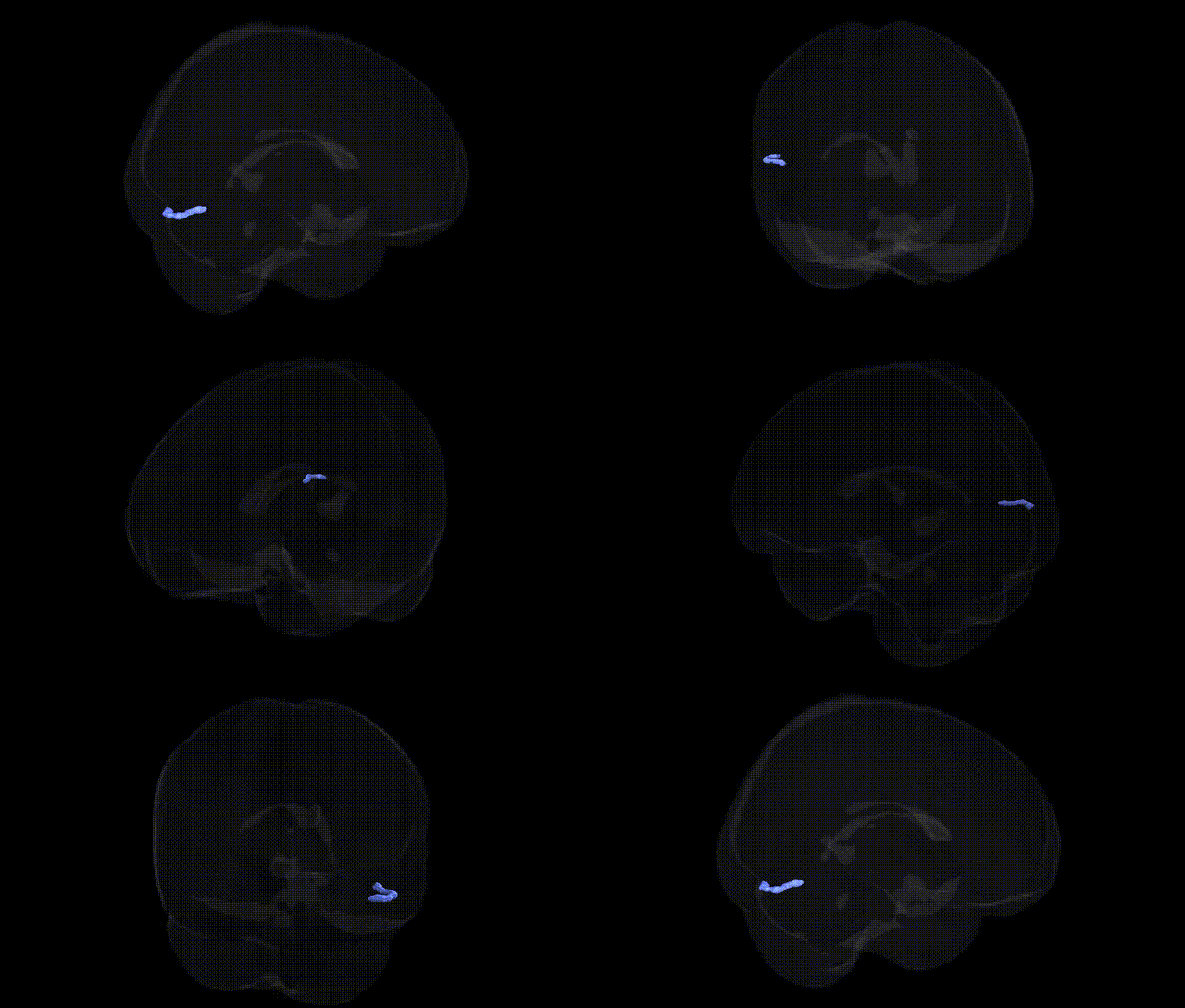
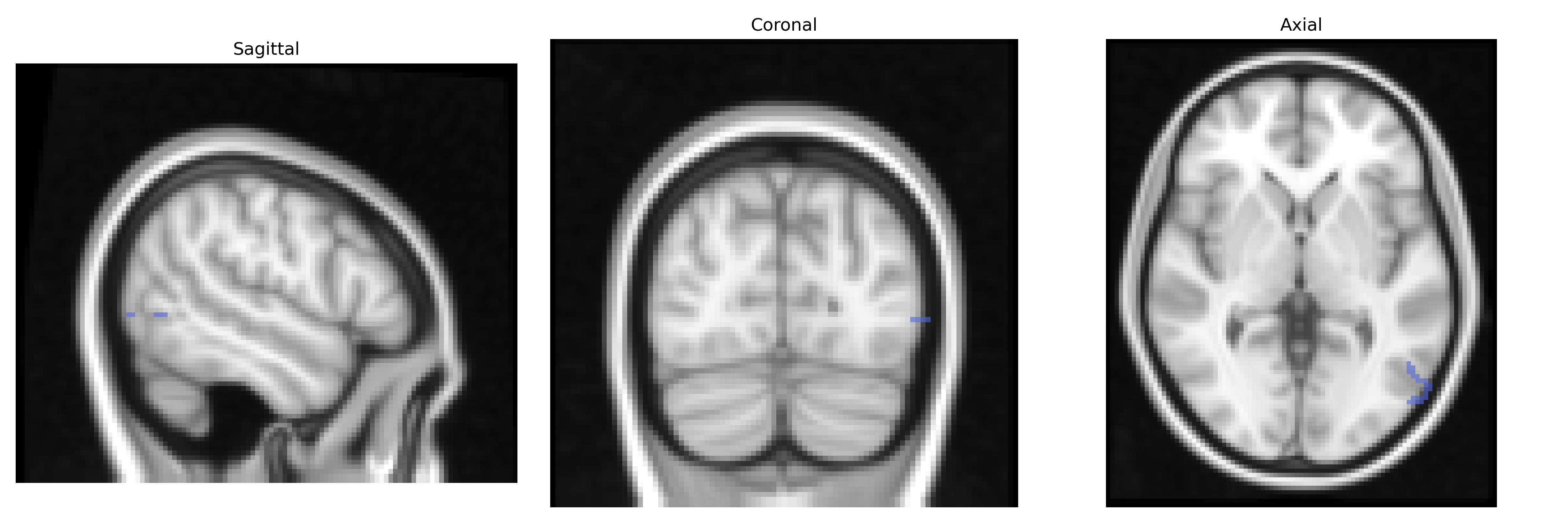
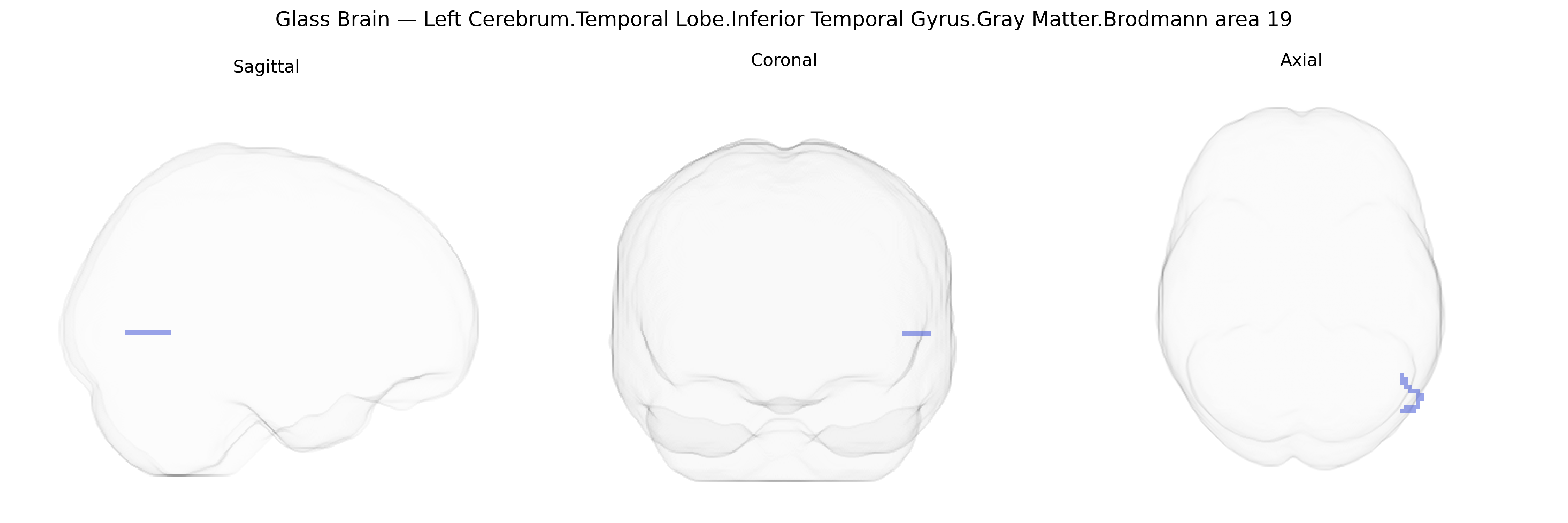
The bilateral Left Cerebrum.Temporal Lobe.Inferior Temporal Gyrus.Gray Matter.Brodmann area 19 corresponds to ventral portions of the extrastriate visual cortex extending into the inferior temporal gyrus, involved in higher-order visual processing and integration of complex object features. Although classically associated with the occipital lobe, BA19 functionally continues along the ventral visual stream into temporal regions, supporting transformation of visual input into more abstract representations necessary for object recognition, pattern analysis, and visuospatial integration. Neuronal populations in this area receive convergent input from primary and secondary visual cortices (BA17 and BA18) and project to downstream temporal and parietal association areas, contributing to multimodal integration and visual memory. Cytoarchitectonically, BA19 is characterized by a well-developed granular layer IV and expanded supragranular layers II–III, reflecting its role as a higher-order associative visual region related to the ventral “what” pathway. There is no direct Wikipedia article for this exact Talairach label; a closely related structure is Brodmann area 19.
The inferior temporal gyrus gray matter within Brodmann area 19 (BA19), part of the ventral visual association cortex, is genetically implicated in higher-order visual processing, object recognition, and aspects of reading and face perception, with several GWAS and imaging–genetics studies highlighting relevant loci and pathways. Variants near or within genes involved in synaptic development and neuroplasticity (e.g., BDNF, NRGN, and other neurodevelopmental candidates) have been associated with individual differences in occipito-temporal cortical thickness and surface area, including regions overlapping BA19 and adjacent fusiform and inferior temporal cortices. Large-scale neuroimaging GWAS (such as ENIGMA and UK Biobank–based studies) have identified heritable variation in temporal and occipital association cortices, with significant SNP-based heritability and polygenic influences on gray matter volume, though specific loci are often shared across broader visual association networks rather than uniquely confined to BA19. Genetic risk for neurodevelopmental and neuropsychiatric disorders—including dyslexia, autism spectrum disorder, and schizophrenia—has been linked to structural and functional alterations in inferior temporal and occipito-temporal regions implicated in word and face processing, with disease-associated variants (e.g., in CNTNAP2, DCDC2, FOXP2 and other language/reading-related genes) correlating with atypical activation or morphology in overlapping territories. Moreover, polygenic risk scores for cognitive traits and educational attainment show associations with cortical measures in temporal and occipital association areas, suggesting that distributed genetic influences on cognition and visual–language integration partially converge on BA19-related networks, although current evidence is largely regionally approximate rather than Talairach-2mm–specific and emphasizes shared genetic architecture across the extended ventral visual stream.
Overview generated by GPT-4o (2026).
Region ID: 479
Hemisphere: bilateral
Atlas: Talairach labels 2mm
Full Quality Version: Download MP4
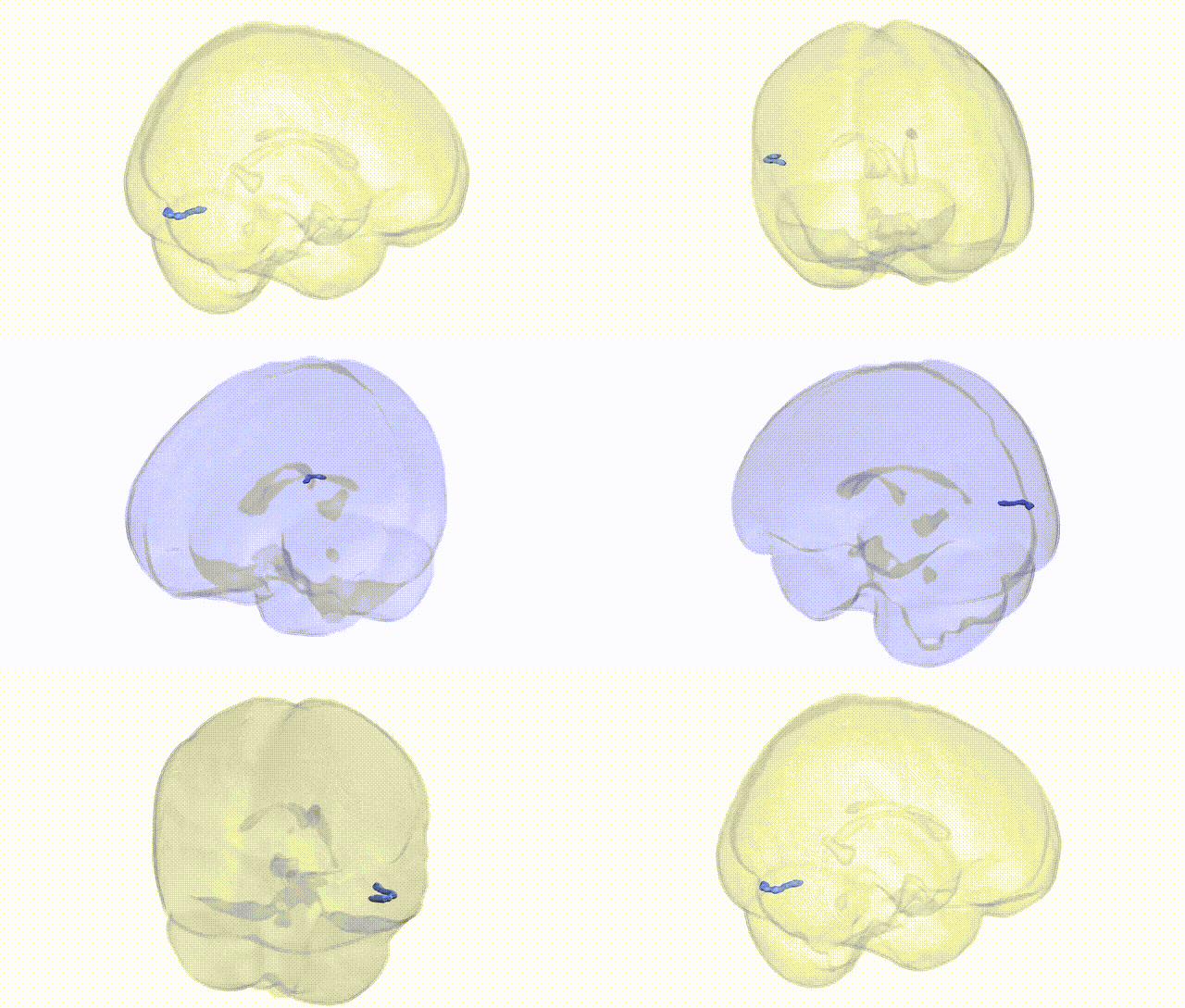
Full Quality Version: Download MP4
Wali Sidiqyar*, Gaurav Rudravaram*, Elyssa M. McMaster, Trent M. Schwartz, Adam M. Saunders, Kurt G. Schilling, Bennett A. Landman "Introducing SPINS: A Shared Public Visualization Library of Neuroanatomical Structures." Medical Imaging with Deep Learning- short paper
This resource is licensed under CC0 1.0 Universal (Public Domain).