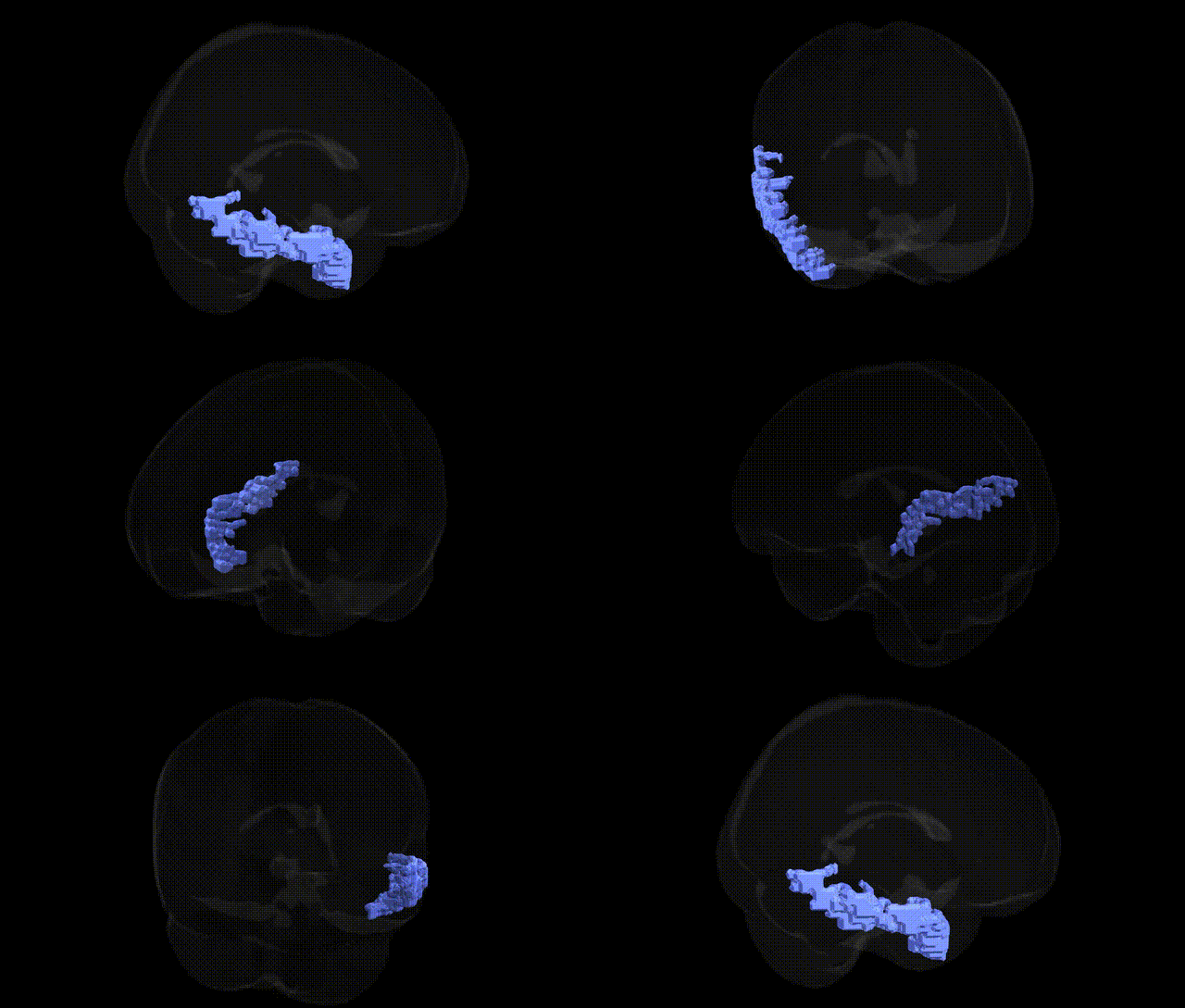
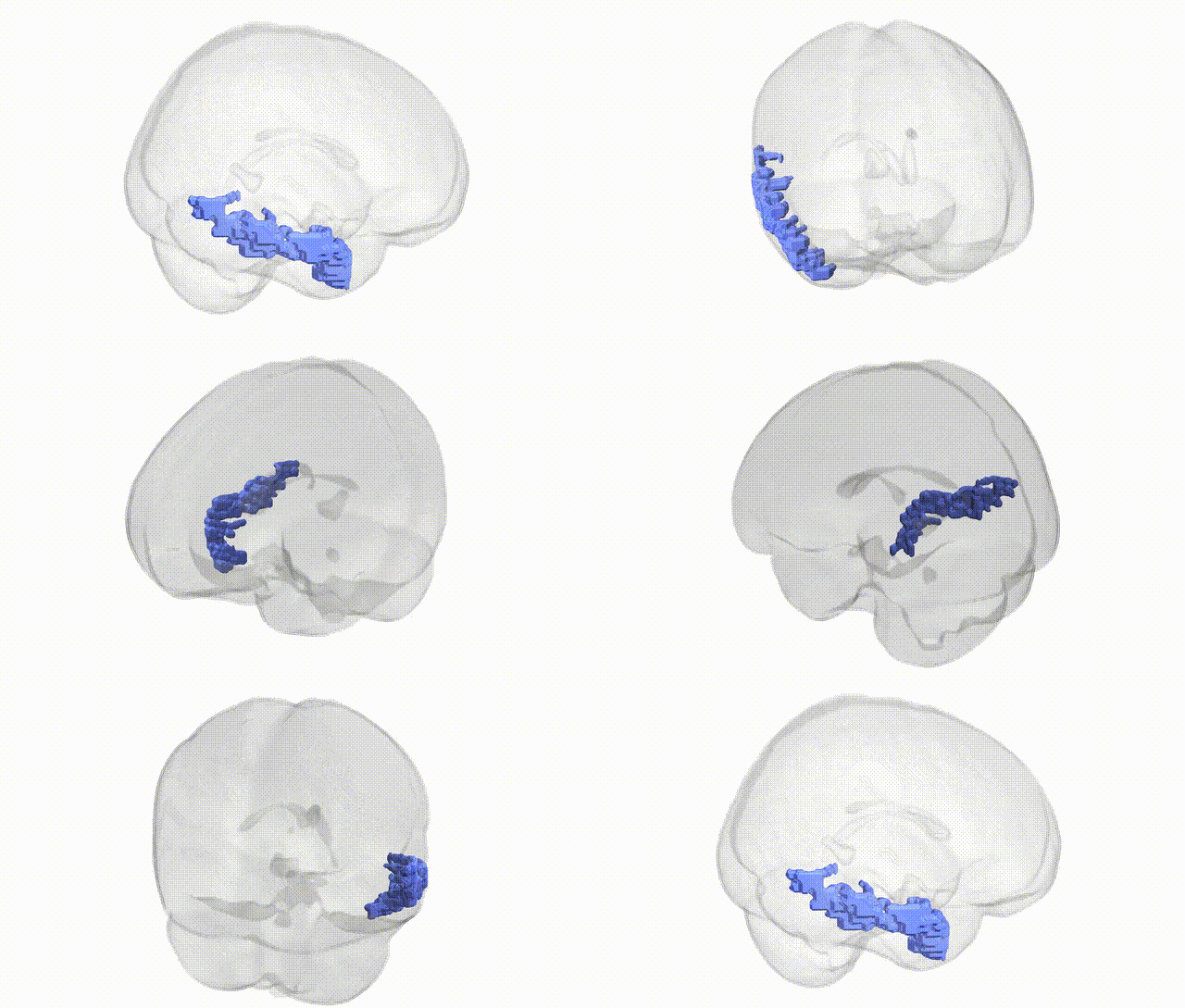
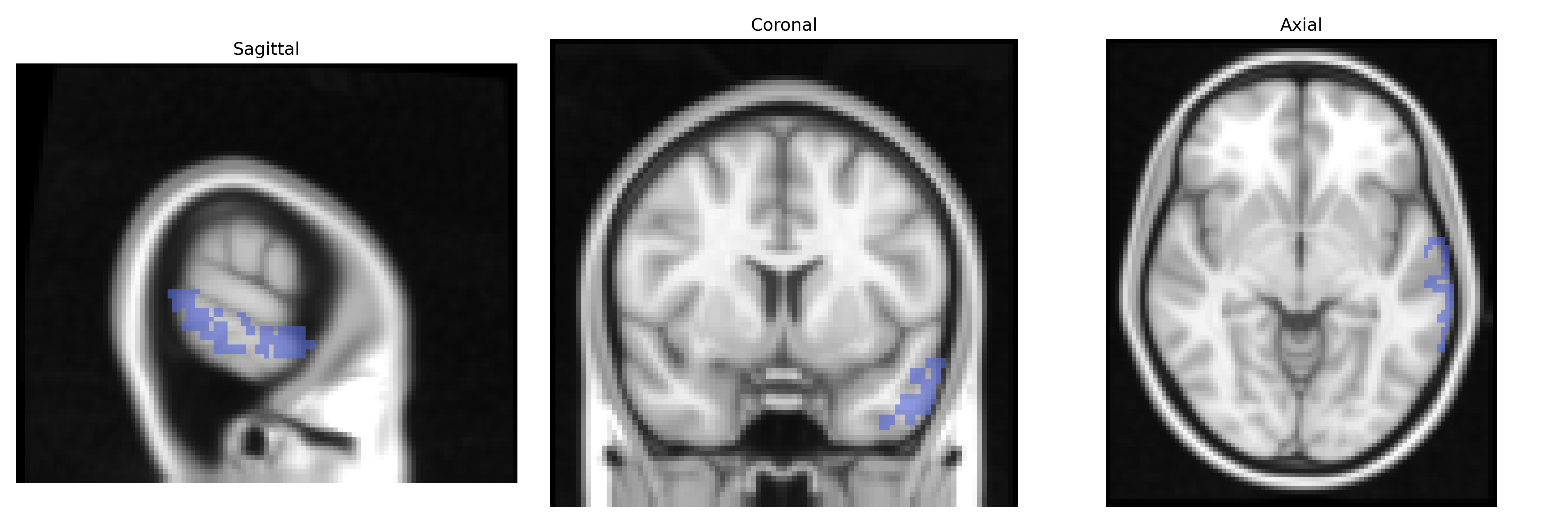
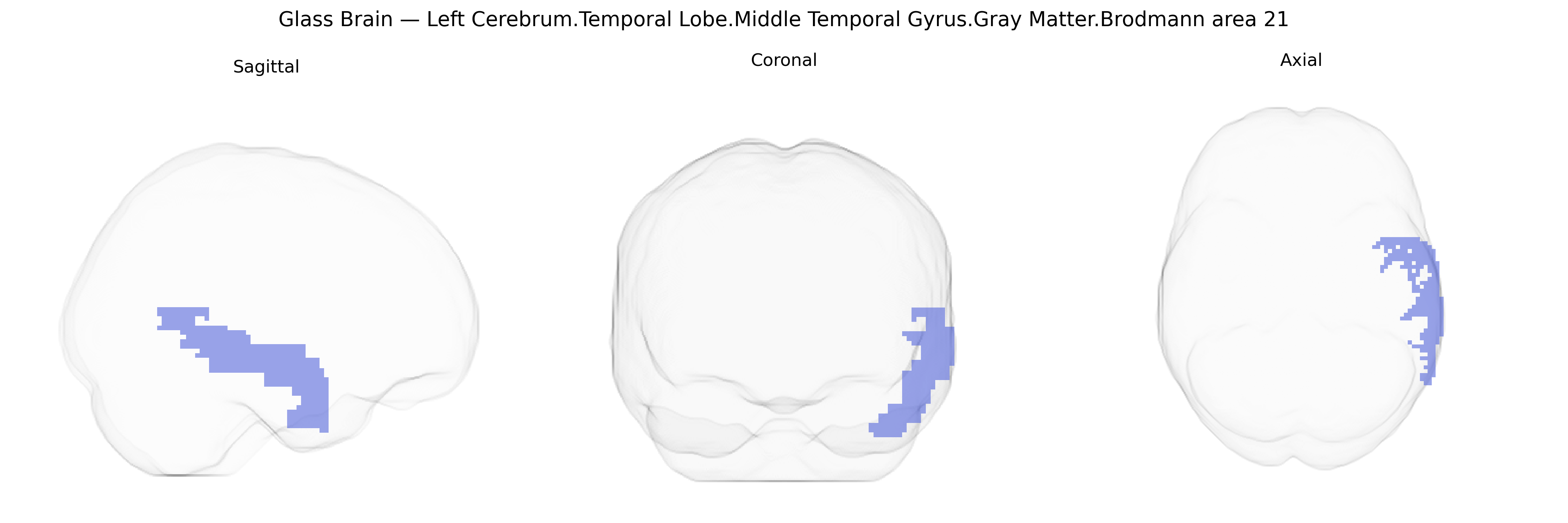
The bilateral Left Cerebrum.Temporal Lobe.Middle Temporal Gyrus.Gray Matter.Brodmann area 21 corresponds to cortex located in the middle portion of the temporal lobe, primarily involved in higher-order auditory processing, semantic language functions, and aspects of visual object recognition. Cytoarchitectonically defined by Korbinian Brodmann, area 21 is characterized by a granular structure typical of association cortex and lies lateral to primary auditory areas, integrating multisensory information to support comprehension of speech, narrative processing, and semantic memory. Functionally, this region contributes to the analysis of complex sounds and linguistic input, interfaces with adjacent temporal and frontal association areas for language and memory networks, and is implicated in disorders affecting language and semantic knowledge such as temporal lobe epilepsy and semantic dementia. There is no direct Wikipedia article for this exact Talairach-labeled region; a closely related structure is Brodmann area 21.
The bilateral left middle temporal gyrus (MTG; Brodmann area 21) has been implicated in multiple genetic and imaging-genetic studies, particularly in relation to language, social cognition, and neuropsychiatric risk. GWAS and candidate gene analyses of cortical thickness and surface area have associated common variants near genes involved in neurodevelopment and synaptic plasticity (e.g., MAPT, FOXP2, GRIN2B, and other glutamatergic and axon-guidance genes) with structural variation in temporal lobe gray matter, including BA21. Imaging genetics in schizophrenia, bipolar disorder, and major depressive disorder has linked risk loci (such as those in CACNA1C, ZNF804A, and complement pathway genes like C4A) to altered MTG volume and functional connectivity, consistent with the region’s role in auditory–verbal processing and social perception. In autism spectrum conditions, GWAS and rare variant studies implicating genes like CNTNAP2, SHANK3, and other synaptic scaffolding and cell-adhesion genes have been associated with atypical activation and morphology in BA21 during language and social communication tasks. Large-scale ENIGMA and UK Biobank studies have further shown that polygenic scores for educational attainment, intelligence, and cognitive performance correlate with MTG structural metrics, while Alzheimer’s disease and frontotemporal dementia risk alleles (including APOE and MAPT-related haplotypes) are linked to temporal lobe atrophy patterns that encompass BA21. Overall, genetic influences on synaptic transmission, cortical development, and neurodegeneration appear to converge on this temporal association cortex, shaping both normal variability and disease vulnerability.
Overview generated by GPT-4o (2026).
Region ID: 78
Hemisphere: bilateral
Atlas: Talairach labels 2mm
Full Quality Version: Download MP4
Full Quality Version: Download MP4
Wali Sidiqyar*, Gaurav Rudravaram*, Elyssa M. McMaster, Trent M. Schwartz, Adam M. Saunders, Kurt G. Schilling, Bennett A. Landman "Introducing SPINS: A Shared Public Visualization Library of Neuroanatomical Structures." Medical Imaging with Deep Learning- short paper
This resource is licensed under CC0 1.0 Universal (Public Domain).